09 May 2019

A cultural shift

That's what the old prayer books and hymnals of our church reveal we have had. Now, thanks to the work of Matthew Carver, we have what Walther and crew thought of as "THE Prayer Book," Lutheran Prayer Companion. The intro rightly points out it was designed for home (personal) use and is rightly considered an addenda to Walther's Hymnal (which we also have in English now thanks to Matthew Carver).

Just a few things to note in this older level of Missouri's piety that would make those accustomed to the shape of her piety in the mid 20th century squirm a bit. There is a prayer on p. 257 for a committal service. Towards the end of the prayer we find these words: "To the deceased, therefore, grant a gentle rest in the bosom of the earth and a joyous resurrection with all the elect on the day of Your beloved Son's appearing." Prayer 257, p. 140  

Of a piece with this prayer 481, a prayer to be used immediately following a death. It includes these words "To Jesus Christ, the Lord of glory and Prince of Life, be praise and thanksgiving, for so graciously delivering this blessed man today and receiving his soul into His holy hands. May He reunite his soul and body in heavenly glory on the Last Day, and grant us together with him a blessed voyage at the time appointed to God..." (pp. 342,3)

Note how this accords also with the prayer from the time of Lutheran Orthodoxy from Starck upon the same occasion: "Refresh the soul that has now departed with heavenly consolation and joy, and fulfill for it all the gracious promises which in Your holy Word You have made to those who believe in You. Grant to the body a soft and quiet rest in the earth till the Last Day, when You will reunite body and soul and lead them into glory, so that the entire person who served You here may be filled with heavenly joy there." (P. 345, Starck's Revised). 

But it is not only in prayers such as these that the different spirit stands out. Consider also the way the Apocryphal books are used throughout the volume. In the section "Comforting verses to read to the sick and the dying" we find as the last of the Old Testament passages Wisdom 3:1 "The souls of the righteous are in the hand of God, and no torment touches them." (See p. 299) Similarly, at the very start of the prayer book Luther's instructions for proper prayer are given there we find as his fifth and final point the principle that one must not assign God a goal, prescribe a time or place, or specify the manner or means of the prayer being answered. He adds "The holy woman, Judith, did the same thing. When she heard that the citizens of Bethuliah would hand over the city in five days unless God delivered them during that time, she rebuked them and said, 'Who are you, that you put God to the test? These are not the means to obtain grace but to stir up more disfavor. Would you prescribe for God a time to have mercy on you, and specify a day according to your whim?'" Judith 8:11ff. Throughout the book, the prayers are replete with the language of Scripture and whoever is familiar with the apocryphal writings will note some turns of phrase lifted directly from there.

And the Eucharistic piety the book evidences is also a thing of beauty to behold! In the Saturday prayer that expands upon "but deliver us from evil" in the Our Father, the prayer asks the Holy Spirit that our last food may be the Holy Supper; the last image in our mind Christ crucified; the last words on our lips "Father, into Your hands I commit my spirit." There are a plethora of prayers of preparation for the Eucharist and nearly as many to offer in thanksgiving after receiving the holy gifts. In all of them the joy of the sacrament is fully expressed and yet the gravity of an unworthy use of the Sacrament is not short-changed at all. 

In sum, the book inculcates a piety that has all the breadth of the Book of Concord's theology. Once again, I highly recommend the volume. It's become well, this Lutheran's daily "Prayer Companion."

07 May 2019

Prayer

People loved by God, please pray for my friend Herb tomorrow. He'll be undergoing surgery to remove a mass on his brain. Please join us in putting him into the loving arms of our Great Physician and begging His mercy, His healing, His protection.


05 May 2019

Our Lord Speaks and We Listen

For Eastertide, Pastor sings the Our Father and we join in at the Doxology, and then he chants the Words of Our Lord's Testament: "Our Lord Jesus Christ..." When he concludes the words over the bread, he elevates the host as the chime rings out three slow steady strokes. I confess that I usually sing the words along with him in my head, and then as he holds aloft the Lord's body, there is time to offer prayer as he and the assistants genuflect before our Lord's body. My usual prayer is:

Thine of Thine own, which Thou didst offer on behalf of all and for all. Glory to Thee, Lord Jesus Christ, my Lord and my God. Glory to Thee forever!

And thus the evocation of Thomas' confession from last week's Gospel which further pulls toward the beatitude that Christ pronounced in response to Thomas's confession: "You believe because you have seen; blessed are those who have not seen and yet have believed."

We look upon the consecrated bread, but we do not see what it is. We believe what it is. Christ word tells us what it is. "My body, given for you." And that is why Pastor drops to his knees before the altar and the servers with him. And this kneeling before the Lord, this is itself a confession of and anticipation of Christ's return in glory, when "every knee shall bow and every tongue confess that Jesus Christ is Lord to the glory of God the Father."

Similarly, with the consecration of the cup. Pastor resumes his chant and I (and I expect most of us) sing the words in our hearts right along with him. He holds the chalice aloft at the conclusion as the chime sounds those three solemn strokes again. And again, my usual prayer during this solemn moment before the blood which has redeemed the world is to pray:

Thine of Thine own, which Thou didst offer on behalf of all and for all. Glory to Thee, Lord Jesus Christ, my Lord and my God. Glory to Thee forever! 

The chalice we see. If we could peek in it, the wine we would see. But the blood is not seen. Yet our Lord has promised us: "This cup is the new testament in My blood, which is shed for you." What He promises is so, and blessed are we who believe. 

Today's Gospel reading from John 10 spoke of the voice of Christ as the very principle of the Church's unity: "And I have other sheep that are not of this fold (i.e., not of the Jews, but the Gentiles, us). I must bring them also, and *they will listen to my voice.* So there will be one flock, one shepherd." The listening to the voice of Christ is precisely that which constitutes the unity of the Church: He speaks, we listen, and His Word bestows what it says (Norman Nagel). And this IS the primary pulse of the Divine Service. One of the great beauties of the Church's Divine Service as celebrated at St. Paul's is the way the listening to the words of Christ (both in the Gospel reading, usually read in the midst) and the Words of the Lord's Testament are given special treatment, where the chanting and the ceremonies invite us, summon us, remind us: "Listen, Little Lambs! Listen now to my voice! I am speaking who gave My life into death that you might never die."

Agnus dei, qui tollis peccata mundi, miscerere nobis... dona nobis pacem.

04 May 2019

Prayer for Confirmation

Tomorrow is Confirmation at St. Paul's. Here is a lovely prayer for Confirmands from Lutheran Prayer Companion. I am persuaded every Lutheran would be hugely blessed by this wonderful volume!

An Intercession for Confirmands:

O almighty, true, living God, eternal and merciful Father of our Savior Jesus Christ, who in loving kindness revealed Yourself to us: You say of Your dear Son, Jesus Christ, "This is My beloved Son, to whom you shall listen"; and this Your beloved Son Himself said, "Let the children come to Me, and do not forbid them, for of such is the kingdom of God." Therefore since these children present have been brought to Your dear Son, Jesus Christ, in Holy Baptism and are baptized into His death, washed with His blood, and buried with Christ by Holy Baptism, we beseech You, merciful God and Father, of Your lavish goodness, to renew in these Your children once more the Holy Spirit, whom You poured out on them richly in Holy Baptism, that their hearts may be lightened with the radiance of the Holy Gospel. Increase in them, O gracious God, both the pure knowledge of Your beloved Son, Jesus Christ, and the true faith, that they may believe firmly in You, the true God, and in Jesus Christ, Your Son, whom You have sent, and with firm confidence abide steadfast in You. Deliver them from the power of darkness and set them in the kingdom of Your beloved Son, in which we have redemption and forgiveness of sins. Put in their minds the peace of Christ and the joy of the Holy Spirit, and the love of God and neighbor. Fill them with the gifts of the Holy Spirit, that He may instruct and guide them into all truth, and make them fit to serve in Your holy congregation, to put to death the deeds of the flesh, to overcome the devil in all his guile and temptation, and to serve You in holiness and the righteousness pleasing to You, that together with all the faithful they may look for and await the coming of Your beloved Son with a cheerful heart and active prayer in soberness, righteousness, and godliness, to Your glory and the edification of Your poor Church; for You live and reign with Jesus Christ, Your only-begotten Son, in the power and unity of the Holy Spirit forever and ever. Amen.

You can buy it right here.


03 May 2019

And that’s a wrap

Today was my final day hosting Thy Strong Word. It’s been such a joy since August of 2014, but this frees me up to attend to other matters and I’m so happy with our new host, Pr. A.J. Espinosa. Here’s the final show, with our “hand off” at the end. Loved doing the show today with Pr. Joel Shaltanis. You can listen right here: 2 Peter 3. Be sure to keep on listening!

28 April 2019

Other Easter Pics

Bekah and Andy; and David, Meaghan, Lydia, Henry and Oliver:

It’s STILL Easter

Of course! A sick little one kept my eldest and her children from attending their congregation's Easter service last week, but they dressed up in their Easter finery and attended today. Dean's holding Evangeline with Flynn in front of him; Lauren's holding Felicity with Sawyer (oldest grandson) and Annabelle (oldest granddaughter) in front of her. Love these guys so much!

Pastor Gleason’s Sermon

From this morning:

Sermon for Easter 2, Quasimodo Geniti, 2019
John 20:19-31 • Rev. William Gleason

"Like newborn infants long for the pure spiritual milk of the word." 

I cannot help but find some irony in Peter's appeal to imitate infants in a day when university students, triggered by scary thoughts, run to "safe spaces" to find comfort with teddy bears and coloring books; or grown men who cuddle together to ease their anxiety; or adults who are wrapped up in swaddling clothes to relieve their stress. Those are actual "therapies" that people today use to cope with their fears and uncertainties. 

Whatever one might think of those therapies, what is, perhaps, more surprising are the trivial anxieties that prompt their employ. College students say they feel threatened by hats that say, "Make America Great Again." Grown adults claim undue stress over normal eight-hour work days. People lie awake at night anxious over their lack of Facebook friends. These are the 21st century worries that must be soothed by hugging stuffed toys or cuddling with friends.

My parents' generation somehow made it through the hardships of the Great Depression and the horrors of World War II without needing a single snuggle bear or a cuddling friend. Oh, they may have embraced one another with tears over crops destroyed by draught or loved ones killed in battle; but once their weeping was done, they rolled up their sleeves, picked up the pieces, and carried on. 

And here is a bit more irony: the reason they could do that was because, for the most of them, "Like newborn infants, [they] craved the pure spiritual milk of the word." It was their faith in God's word and promises that consoled, sustained, and strengthened them for the uncertainties of life. Their trust in the crucified and risen Jesus Christ as their God and Lord soothed their fears and bolstered their courage to face life's trials. God's word still has the power to console and strengthen people today to face the challenges of our world.

That same word of God brought courage and hope to the Israelites who were captive in Babylon. Conquered and dragged into exile far from their promised land, they had fallen into a deep despair. Like the dry bones of men long dead, their spiritual vitality had withered away. Their hope of returning to their homeland was dried up. But God commanded Ezekiel to prophesy to them a new hope; to preach His word of renewal and restoration. The Lord would raise them up and give them new life. Like corpses resurrected from their graves, God would revitalize their hopes and their lives by returning them to the land of Israel. By His word, He would breathe into them His Spirit, the Lord and Giver of life. And when He brought them back to the land of milk and honey, they would know and believe that He is the Lord.

That's the same faith and life that St. John wrote about in his epistles. He appealed to his readers, whom he called "my little children," to hold fast to the faith that was preached to them. John came to them proclaiming the "word of life" that is manifested in Jesus Christ, the incarnate, crucified, and resurrected Lord. Because Jesus had overcome the world by His death and resurrection, they would overcome the world by their baptismal union in Him. This "victory," as he called it, is a victory over sin and the grave. They shared in that victory by believing in the testimony that God has borne concerning His Son. That testimony is "the word of life" that he preached to them.

The Christians to whom John wrote were also facing spiritual dangers. They were threats to their life in Christ and the true hope they possessed by faith in Him. John warned them about "antichrists" that had come teaching false doctrines. These false teachers came with a special "knowledge" (or Greek "gnosis" from which we get the name of their heresy: Gnosticism). With this "knowledge" they tried to deceive the Christians. And what was the deception? That Jesus of Nazareth, born of Mary, was not the real Christ. That only through their special "knowledge" could one find the true, spiritual Christ. They also taught that the spiritual world was one of both light and darkness and that one needed their "knowledge" to understand it. This knowledge came by special works and righteousness, and a proper understanding and love of the world. John told them plainly that these were lies from the "wicked one," the devil.

Against these lies John preached the truth. Of the heavenly realms being both light and darkness, he wrote: "This is the message we have heard from him and proclaim to you, that God is light, and in him is no darkness at all." Of attachment to the world, "Do not love the world or the things in the world. If anyone loves the world, the love of the Father is not in him." Of the incarnation of Jesus Christ, "Beloved, do not believe every spirit, but test the spirits to see whether they are from God, … every spirit that confesses that Jesus Christ has come in the flesh is from God, and every spirit that does not confess Jesus is not from God." And finally of the truth and life in Christ, "We know that the Son of God has come and has given us understanding, so that we may know him who is true; and we are in him who is true, in his Son Jesus Christ. He is the true God and eternal life." 

That was the "word of life" John preached to guard their hearts and minds and to keep them in the one, true faith. In the face of their fears of sin and death and hell's darkness, John proclaimed: "If we confess our sins, he is faithful and just to forgive us our sins, and to cleanse us from all unrighteousness." "Herein is love, not that we loved God, but that he loved us, and sent his Son to be the propitiation for our sins." "I write these things to you who believe in the name of the Son of God that you may know that you have eternal life." That was the eternal Gospel he proclaimed and by which they found victory over the world.

And that was the victorious word that Christ spoke to His disciples when He appeared to them after His resurrection. In the face of their fears, doubts, and confusion, Jesus came to them preaching "peace." Peace to their anxious hearts; peace to their doubting minds; and peace to their troubled souls. It was a peace that came by His holy wounds—wounds that testified of sins forgiven. 

After that, He breathed on them His Holy Spirit so that they may go out and proclaim that same peace to a trouble world. Now every penitent sinner burdened by his guilt may find peace and forgiveness through the absolving word of Christ's ministers, for their forgiveness is Christ's forgiveness. 

Thomas doubted that word when he heard it, but Jesus removed His unbelief when He showed the disciple His pierced hands and side. Then Thomas, too, found peace and forgiveness in the wounds of Christ. But Jesus told him that truly blessed are those who believe in those healing wounds without seeing or touching them. They are blessed because they have found peace and forgiveness of sins by faith in the "word of life" that is proclaimed in the Name of Christ. They are blessed because they have been filled with the breath of life that flows from the Spirit of God. They are blessed because by believing they have eternal life in Jesus Christ, God's Son.

Beloved children of God do not fear the world with its threats of harm, its boasts of knowledge and its promises of wealth. Empty are its promises and powerless are its threats because Christ has overcome the world and its prince. He is risen! And He gives to you the "pure spiritual milk of the word that by it you may grow up into salvation." Ever hunger and thirst for that spiritual milk, the source of life and peace. The Lord who delivered you when you called out in distress has heard your cries for help. He who brought you out of your bondage to sin and death by the forgiveness of your sins will continue to satisfy you with His gifts. And blessed are you who have not seen and yet believe. Amen.


25 April 2019

Homily upon St. Mark’s Day

Today's homily

In the name...

"Get Mark and bring him with you, for he is very useful to me for ministry."  That bare mention at the tail end of 2 Timothy, which was at the tail end of Paul's life, tells us that their story had a happy ending.

You remember the last mention Paul made of Mark, don't you? Barnabas had wanted to bring Mark along with them on their revisiting of the Churches and Paul put his foot down flat.  No way was he having John Mark accompany them again – cousin of Barnabas or not.  You remember why?  John Mark had gotten homesick during the first missionary journey and had left Paul and Barnabas.  To Paul, and his complete consecration to the mission of spreading the Gospel of Jesus Christ, this was a matter of gravity.  Perhaps he recalled the Lord's words about the those who look back after putting their hand to the plough.

Barnabas, whose name is apt and means "son of encouragement", was all for the second chance, but Paul was having none of it.  And you remember their argument grew so hot, that these two great apostles went separate ways.  Barnabas and Mark sail off to Cyprus and leaving Paul to do his own thing his own way. He chose Silas to accompany him and headed off on land through Syria and Celicia.

And yet, in today's epistle, an older and gentler Paul instructs Timothy to bring to him Mark, Mark who is "useful to me for ministry."

What happened?  We can only guess at the details, but we know with certainty why it transpired.  You cannot live in the love of Jesus Christ and harbor resentment.  You cannot live in the forgiveness of Christ and steadfastly refuse to forgive.  It's impossible. 

No question that John Mark was wrong to turn back.  And I do not doubt that he confessed as much to Paul face to face.  But if Paul was going to go on living and serving this Lord of His who had knocked him off his horse on the Damascus road and turned him into the apostle of grace, then grace would have to have the final say in all his relationships too.  Forgiveness won over Paul's heart.  How could it be any other way? He would after all write in his imprisonment: "Be kind to one another, tender hearted, forgiving one another, as God in Christ forgave you." Eph. 4:32. Maybe he was preaching a bit to himself there.

And forgiveness is a powerful force.  Mark may have turned back once upon a time and abandoned the mission, but in the forgiving love of His Savior he grew and he grew ever more bold.  It took courage to hang out with Peter those last months. Peter would write from Rome: "She who is in Babylon, who is likewise chosen, sends you greetings as does Mark, my son." 1 Pet 5. He spent the last days with Peter and through him God gave to the Church the gift of Peter's Gospel.  What we call today the Gospel of Mark – as Peter was condemned and sentenced to death, Mark was scribbling down the memories of the Prince of the Apostles.  And it was with both courage and joy that Mark later journeyed to Alexandria, and became the bishop of that city, only to be martyred for proclaiming to any and all the good news:  "Whoever believes and is baptized will be saved; but whoever does not believe will be condemned."  (Today's Gospel) 

Far from fleeing the mission, Mark ended his life a mighty witness to the Savior came not to be served, but to serve, and to give His life a ransom for many; a witness to Christ whose resurrection astounded the Marys and Salome and the unbelieving disciples.  The Church rejoices in St. Mark's Gospel, in how St. Mark was used by the Holy Spirit to preserve for us St. Peter's witness to Christ.  And she rejoices that in Christ, those set at odds with each other - and maybe even especially those set at odds with each other about how to do the work of the Lord! - can lay aside their accusations and self-righteousness and rejoice together that we are all, after all, only fellow recipients of the mercy of the Crucified, Risen and Reigning Lord, who sends His Gospel promise out to preached to the whole creation, and to whom with the Father and the Holy Spirit be all glory and dominion, forever and ever!  Amen.

Hymn: 481 Scatter the Darkness, Break the Gloom


Prayers: 
Health Difficulties and those in need:  Paula, Gene, Paula, Roger, Allan and Jan, Ken
Roosevelt and all who mourn for Leon Gray; comfort for his family and all who mourn the passing of Pastor Herman Otten
Missionaries: Rev. Joel and Clarion Fritsche, DR

21 April 2019

Huge thank you

To Kantor Muth and her numerous musicians who made this holy week and Easter redound to the glory of God! I have no idea how on earth she could possibly pull it all off. To top it off, when Distribution ran long at the Easter Divine Service, she ran over to the corner, pulled out her handy Orgelbüchlein and gave us Bach's "Christ Lag in Todesbanden" BWV 625 off the cuff. Amazing. We had cello, viola and violin, timpani and trumpet, bells and organ, and of course much choral music. "Instruments, waken!" indeed.

More...

Χριστὸς ἀνέστη! Ἀληθῶς ἀνέστη!

20 April 2019

Great Vigil

Oh, and speaking of Lutheran Prayer Companion

Could we find better words to pray as the sun begins to westering and we know the joy about to break forth?

Prayer of Preparation for Easter

Lord God, we praise You; Lord God, we thank You that You have granted us to see the holy day of Easter in peace and good health. Most especially we glorify You for giving us the victory over all our enemies by the resurrection of Jesus Christ, Your beloved Son.

O Lord Jesus, we thank You for Your triumphant resurrection from death by which You opened heaven to us, destroyed death, and obtained for us the comfort that You are the resurrection and the life.

O God the Holy Spirit, we thank You for Your paschal message, and we pray that You would plant the paschal joy in our hearts and increase and sustain it in us. And as by Your power the troubled hearts of the disciples were made glad at Easter, so comfort us with Christ's resurrection and that we have a gracious God, we shall live forever, hell and Satan have no power over us, and the world cannot hurt us.

O Holy Trinity, God the Father, God the Son, and Holy Spirit, sustain Your Church against all her enemies, spiritual and physical. Grant that after this life we may all keep the joyful feast of Easter in Your life of gladness, and with all the angels praise, extol, and glorify You, most blessed forever. Amen.

P. 46, 47

Twas a Joy

This holy Lententide to spend some extra time in the Word and prayer. Lent calls for us to do this, for we have no strength in ourselves to live as God's children in a way that pleases Him. Our strength always comes from the Word and from invoking God. And when we do, our own frailty and struggle become no cause for despair, but rather in our weakness we learn to stand in awe at the strength God supplies that we know is not our own.

Cindi and I always start the day with Treasury of Daily Prayer, so again this Lent we've read through large swaths of Genesis and are now in Exodus; we've also read St. Mark and are in the midst of Hebrews. I added in for myself the Lamentations during Holy Week (optional reading in Treasury). During my commute, I finished up listening through the Scriptures on Audible right after Ash Wednesday (started a few weeks before PreLent). That is an experience by itself: listening to the Bible (rather than reading). 

This Lent I've tried to be faithful in praying the Psalms according to the monthly pattern laid out in the Book of Common Prayer (and provided also in our Concordia Psalter and Treasury). I've written that division into my Bible and I just turn there and pray them, morning and evening. Then during the days of Lent, I've also added after the morning psalms a reading from whatever chapter in Proverbs corresponds to the number of the day of the month we're on. And it has been odd how that chapter turns almost instinctively from instruction to supplication!

And then there is the marvel of Lutheran Prayer Companion! I've found myself relying on it every day for the Morning and Evening Benedictions and for the wonderful daily prayers on the petitions of the Our Father by Habermann (usually pray those in the morning). I love, for instance, how we pray for our pastor on Sunday in the "Hallowed be Thy name" petition: "O God, on this Sunday make my dear pastor as well as other faithful teachers and preachers, vessels of Your mercy and instruments of Your grace, and let their ministry attain to the praise of Your glory and to the welfare and blessedness of every soul entrusted to their care." I love the way we beg God the Holy Spirit to grant us grace that our last meal in this life may be the Holy Supper, the last image in our mind Christ crucified, and the last words on our lips "Father, into Your hands I commit my spirit." Preparation for Communion now invariably includes prayers from this wonderful volume. And I've tried to form a habit (only partially successful this Lent) Schmemann once recommended: offering the prayers for thanksgiving and for the fruit of the Sacrament for the three after I receive; and then prayers of preparation to receive on the three or four days before I receive again. Then there is the confession of sins in this the Lutheran Prayer Companion. It beggars belief in its brutal honesty, covering every base, the law having done its deep cutting work, no excuses, so extenuations, just naked owning up to the mess.  And that's just a teasing taste! So many times throughout the day, I find myself taking this volume in hand to pray for various needs that arise. It's so helpful that I have my physical copy at home but also carry it in my iPhone and iPad. It's been quite transformative and I cannot recommend this prayer book highly enough (just one of the many gems of Lutheran spirituality Matthew Carver has given in English). 

The extra time in the Word and prayer has stirred a greater hunger for more of both than I think I've remembered in my life since the days when I was a teen and it was all so new to me. I really hesitated to post this; I know it can sound pitifully prideful. But I risk offering it in the hopes that it will not be received that way, but will rather reflect on what an absolute joy this Lentide has been for this poor, miserable sinner through these two gifts of God's grace: His Word and prayer. 


Tomorrow’s Feast,

for any who are curious, will feature:

Appetizers: Sausage Stuffed Mushrooms topped with 5 year aged Cheddar; Deviled Eggs; Bay Scallops wrapped in Bacon; Mimosas

Main: Saganaki; Lamb-Beef-Feta balls; Felafel; Couscous; Greek Salad; Goat Cheese; Home-made Pita; Greek Shrimp; Tzatziki Sauce; Humus; Red Grapes; choice of Cab or Sauvignon Blanc

Dessert: Homemade Vanilla Ice-cream (made with homemade vanilla too!); Baklava; assorted Dark Chocolate; Limoncello and pour-over Coffee.

We did a similar meal last Easter and it proved so popular with the family, we decided to stick with it. Only thing missing this year was the spanakopita, but we subbed in Greek Shrimp instead.

And tomorrow, we'll be doing double duty: a delayed birthday celebration for Cindi (who doesn't even have to give a thought to clean up) and of course the great celebration of our Lord's Pascha (which commences tonight with the Great Vigil at 8; continues tomorrow with Easter Matins at 6:30; and reaches its culmination at 9 with the Divine Service for Easter Day).

19 April 2019

At the Tilting of Triduum

Just got back a few moments ago from our parish's Tenebrae Vespers. A solemn praying of four Psalms (spoken) 22, 2, 27, 51. Then the singing of "O Sacred Head" (Bach setting; but four stanzas) leading into the Passion of Our Lord Jesus Christ, According to the Holy Evangelist St. John (Schalk). David, as usual, did his bang up job on the Evangelista and the choir did a lovely job on the the cries of the crowd. Kudos to Kantor Muth for pulling it off! Responsory and then "A Lamb Goes Uncomplaining Forth." Pastor preached a comforting homily "It Is Finished!" And then we concluded briefly with Kyrie, Our Father, and three collects. The sounding of the strepitus and then we left in silence, but not quite dark. Easter is so late this year there was even a touch of light in the sky.

Earlier, Cindi and I had taken Lydia, Henry and Oliver to the Chief Service, where they were good as gold for us. The Chief Service is longer and filled with some moments of silence, but they made hardly a peep. That liturgy begins unusually (though the way the ancient liturgy DID begin) with simply a collect and then the reading commences. Also unusual that a collect follows the first reading (Isaiah 53) and the second (2 Corinthians 5). Then we sang the first stanza of "Jesus, I Will Ponder" and proceeded to do just that: ponder His Passion as the St. John passion was read, interspersed with the singing of seven stanzas of the rhythmical version of "O Sacred Head." Sermon, then Fortunatus' "Sing My Tongue." The bidding prayer followed and I was delighted to hear grandson Henry chiming in on the Our Father at the end. Then the adoration of the cross with the reproaches (the school children sang the response to the pastor and we joined in the "Lamb of God" after each). They sang the last canticle: "We adore You, O Christ, and we bless You, for by the wood of Your Cross You have brought joy into all the world" as the altar was readied for the Sacrament. Unlike our Roman brothers and sisters, our rite calls not for administration of the pre-sanctified carried from the altar of repose, but for an abbreviated communion rite. So we proceeded from Preface to Our Father to Verba and then Distribution. After the school children communed they sang a lovely Hildebrand setting of "God So Loved the World." Otherwise the Distribution was in silence. A collect after the Distribution and then "The Royal Banners" was sung and we left.

Only one more service to go for this year's joyous Triduum, the Great Vigil of Easter tomorrow. It will not start until 8 p.m. Our pastor (as I have noted before) is no trimmer. The whole provision for the rite will be done, and the service will stretch into the evening with its 12 Old Testament Readings; an epistle reading connected with the Baptismal Remembrance; the Easter Litany, and then the Easter Gospel and the Easter Homily of St. John Chrysostom and then the Sacrament celebrated. Just thinking about it, brings such joy!

The tilt happens tonight. From here on out we're pressing toward the Descent into Hell, the Resurrection, and the Joy that cannot never be taken from us.

14 April 2019

A bit of a soggy Palm Sunday

But the joy was there, despite the dampness. The bells began with a joyful Dobrinski prelude. Then after the ringing of the bell, the liturgy began from the chancel as Pastor gave the apostolic greeting, prayed the collect, and read the Palm Sunday Gospel. Bells and trumpet and organ led off with the beautiful processional hymn of Theodulph of Orleans, sung throughout the world on this day, "All Glory, Laud, and Honor." The children of the school, who formed our choir today, followed the cross, torches, and Gospel book as they waved their palm branches and the hymn came to life before our eyes and ears: "To whom the lips of children made sweet hosannas ring!"

The joyful procession leads to the solemn veiling of the crosses and then the long liturgy begins. Our pastor is not trimmer. He gives us the lot. So the service of readings (Zechariah's prophesy / gradual / Philippians 2 / tract) commenced, culminating in the Passion of St. Matthew, the 26th and 27th chapters of His Gospel, read with reverence. Onto the Nicene Creed and Hymn of the Day: "A Lamb Goes Uncomplaining Forth" in which the children sang the second stanza. 

After a homily that summoned us to awe at the love that our Lord Jesus is revealing to us by His passion, the offertory and offering and intercessions, and then the Service of the Eucharist commenced. Pastor (wisely!) uses the crisp old Preface for Lent (the traditional preface for the feasts of the Holy Cross) from The Lutheran Hymnal and not the wordy version that appears in our current book (which by seeking to be clear ends up being merely pedantic). As always the Sanctus on this Sunday with its Benedictus qui venit rang with particular joy. Again, by the gift of the liturgy the events of the day are brought to us for us to participate in and receive with joy. 

Distribution rang long enough that we ended up singing all the Distribution hymns ("Hosanna, Loud Hosanna," "O Bride of Christ, Rejoice," "No Tramp of Soldier's Marching Feet") and so the children sang for us their memory verse for this year from Psalm 46: "Be still and know that I am God." They sang it first in Latin and then in English and in harmony. So beautiful. 

After the Nunc Dimittis, collect of thanksgiving and closing salutation, benedicamus and benediction, the liturgy closed with a hymn that I always find the most moving of all for Palm Sunday: "Ride On, Ride On in Majesty." "The Father on His sapphire throne Awaits His own Anointed Son." And, of course, trumpet with the organ to send us off. It was a feast of the Word, a feast of prayers and music, and above all, a feast of that sacrifice from the Cross which sustains our life in Christ across all these centuries and will ever till He returns in glory. The liturgy lasted an hour and twenty minutes. 

Hosanna to the Son of David! Blessed is He who comes in the name of the Lord! Hosanna in the highest!

12 April 2019

Last Sermon on the Passion

You can listen here, or read below: Concluding Homily on Luke’s Passion

Homily

In the name of the Father and of the + Son and of the Holy Spirit. Amen.

Who is this that hangs upon the Tree? St. Luke is at pains to make us understand that this is the King. Before His passion began, He had told His disciples at the meal "I assign to you as my Father assigned to me, a kingdom, that you may eat and drink at my table in my kingdom."

Pilate asked: "Are you the King of the Jews?"

The inscription posted above His head as He hung upon His cross announced to any who looked: "This is the King of the Jews." 

And in the face of this Crucified King, you can go one of two ways when your final hour comes. You can either rail at him as the thief on one side did: "Are you not the Christ? Save yourself and us!" For what good, such a man thinks, is such a King, a Christ who lets you die? Useless! Who needs a King like that! Or, in contrast, with the eyes of faith, you can stand with the other thief. Had he read the inscription above our Lord's head? Beholding the Crucified in awe, he rebukes his fellow thief with the words: "Do you not fear God, since you are under the same sentence of condemnation?" A deliciously ambiguous statement, by the way. Since you are under the same sentence of condemnation as....this man or as God? YES! "And we indeed justly, for we are receiving the due reward of our deeds; but this man has done nothing wrong." 

There's the crux. We have no right to complain of death (and it arrives to us in countless little foretastes before it finally squeezes out our last breath). Our deeds demand it all. "The wage sin pays," says St. Paul, "is death." Serve sin and that's the result. And you have, haven't you? I have. But this man, this man hanging here between the two, between the one who rails at death and the one who admits it is the just due for our sin, this King of the Jews, well, "this man has done nothing wrong."

Which means He doesn't belong here. Suffering and dying. Three times Pilate told the truth: I did not find this man guilty. I have found in him no guilt deserving death. That was profoundly true beyond anything Pilate ever imagined. And yet he consigns Him to the will of the people and so hands over the Innocent One to suffer right along with the guilty. And this was God's plan and purpose all along. "It was the will of the Lord to crush Him" as Isaiah said. Behold, the King of the Jews. Again Isaiah: He pours out His soul to death and is numbered with the transgressors. Thief, King, Thief.

And yet this other thief, knowing that King Jesus is innocent, knowing that he himself is only getting the punishment that he has deserved, dares to turn his eyes and prayer to the King on his wooden throne and beg: "Jesus, remember me when you come into your kingdom." And He answers: "Today, you will be with me in paradise." 

Paradise. Before the Innocent Sufferer, the flaming sword withdraws and the gate swings open wide. Paradise. One only enters it with Him, "with Me" as He said. This beautiful word from His cross was not just for that thief, but for you too. It was for all who turn to their eyes to the King who is establishing His kingdom by His suffering and death, to all who gaze upon the Innocent Suffer in awe at His love in choosing to be there for us. It is for all who in their final hours pray to this King who dares to join us in our misery: "Jesus, remember me, when you come into your kingdom." His answer to such a prayer stands forever: "Today you shall be with me in paradise." A King giving out a lordly gift indeed. "You will eat and drink with me in my Kingdom."

A promise to cling to as the darkness grew, as the temple veil tore, as he places His spirit into His Father's hands and breathes his last, as the verdict is heard once more, and again from a Roman, this time the centurion proclaiming: "Certainly this man was innocent." And it is as the innocent sufferer that His Father vindicates Him, and and in Him, you. His innocence is what He dies to give to you; it's how He gives the kingdom. "Not by gold or silver, but by His holy precious blood and innocent suffering and death, that I may be His own, and live under Him in His kingdom, and serve Him in everlasting righteousness, innocence and blessedness." 

And as a Joseph welcomed Him into his arms at the beginning of the Gospel and carried Him from the womb when He could not carry Himself, so a Joseph welcomes him into his arms at the end of the Gospel and carries Him to a tomb. Joseph of Arimathea, about whom we are told: "and he was looking for the kingdom fo God." So He takes the body of his King into his arms and carries him to the new tomb. And then together he and the women cease their work as sun sets, as Sabbath arrives.

Where Jesus, there the Kingdom. Where Jesus, there your King. In your suffering, in your dying, He will not be far away. He, the Innocent One, has been there for you that He may always be there for you. Never cease turning to your King and praying: "Jesus, remember me." Hear and hold His promise: "Today. With me. Paradise. You." Then you too will be able to die with Your king in peace, whispering: "Father, into your hands I commend my spirit." And you will enjoy your own little Sabbath rest until the day of Resurrection, the Final Easter dawns, the Easter day that will have no end.  

In the name of the Father and of the + Son and of the Holy Spirit. Amen.

10 April 2019

Ah, the Perfect Way to Close the Lenten Midweeks

I worked from home today, and that afforded me the opportunity to attend our parish's Wednesday morning Eucharist with the school children (including my granddaughter). The adults show up a few moments before the school children, and sit and pray in silence. But then the school children enter, and the silence becomes even more profound. No one chattering or talking or whispering. Heads bowed here and there. Habakkuk's words ring: "The Lord is in His holy temple, let all the earth keep silence before Him."

With the ringing of the bell, the pastors began the liturgy, a complete Divine Service, largely sung, though only singing one hymn: the Hymn of the Day. Pastor Ball preached to the children about death; about how we can face death like the thief on the cross, asking Jesus to remember us when He comes in His kingdom. About how Jesus has made death something we no longer have to fear; not if we face it with Jesus. And of course, how He remembers us and gives us paradise even already in the very gift of His Body and Blood. 

After the benediction, Pastor quizzes the children on the Catechism and they recited today the first section of the sixth chief part. Already they had learned it by heart: What is the Sacrament of the Altar? Where is this written? The adults join them in the recitation, and then in silence, the children file out and then the adults. 

Tonight we gathered in the Church yet again to pray Vespers and to finish our meditation on St. Luke's Passion. Many who had attended this morning were present for the Church's lovely evening prayer also. We chanted Psalm 40, sang the last stanzas of "O Dearest Jesus, What Law Hast Thou Broken," heard the Passion, sang the responsory for Lent, heard a fine homily on a similar theme from the morning, but not geared toward children per se this time, sang with the holy Virgin her  Magnificat, and concluded with the Litany with its all-encompassing intentions. 

As Cindi and I drove home, I thought to myself: how blessed beyond words we are to be part of such a parish community! The Word preached so richly, the liturgy celebrated so reverently and joyfully, the children instructed so diligently, and the people who shine the love of Christ by their kindness and love. Yes, we are blessed indeed.

04 April 2019

Homily on Luke’s Passion, Part V

Homily

In the name of the Father and of the Son and of the Holy Spirit. Amen.


O dearest Jesus, what must you have experienced when your own people demanded: "Away with this man, and release for us Barabbas"? When to Pilate's desire to release You, they began a raucous chorus of: "Crucify, crucify him!" And when the longer Pilate persisted in trying to free You, the louder grew their demands for Your death? Truly did Your Apostle write: "He came to His own and His own received Him not." As Pilate caved to their demand, he delivered You over to their will. And that will was to destroy You, You who had done so many acts of kindness and love toward our fallen race even before the days of Your flesh, but how much more afterwards.

And Barabbas? Oh, Jesus, we may not pass him by. They demand the son of a father, for so his name runs, be released and You, THE Son of THE heavenly Father, to be slain. Oh, Jesus. A rebel and a murderer was he. A true son of Adam, then. We cannot avoid seeing it: we are Barabbas, are we not? Sons of the man of dust and destined to the dust, rebels in our fightings against Your Father and His will, and murderers not just of one another, but, yes, of You. And You willing tender Your life for our own. You WANT Barabbas to be free. Love divine, all loves excelling.

And Simon unexpectedly getting to carry Your cross. Were you too weak then? Had the beatings of the night before by the soldiers taken their toll? 

The women with their mourning and lamenting. We want to join them. We want to cry out over this terrible thing unfolding before our eyes, but You forbid it. You don't want us to weep for you. You want us to weep for ourselves and our children. You, who set Your face like flint to go to Jerusalem knew exactly what it meant; You, who accepted in the Garden the cup that Your Father poured for You; You want no pity whatsoever for the doing of Your Father's good and gracious will. You want us to weep instead for the judgments that await those who refuse that will, who will be dry wood kindled by the fire. And even as You head into Your passion, Your mind is so filled with the words of the Prophets that Hosea comes tumbling from your lips. How those who shun Your sacrifice will on that Day of Yahweh's glory find no refuge in the earth, no place to hide, no cave deep enough, not though they were buried beneath the mountains. Weep, You tell the daughters of Jerusalem, for that, but not for You. You are moments away from Your glory, from providing the only refuge that will find hide from the true wrath of God. Your most holy cross.

And so the three condemned men arrive at the Skull, the Cranium, for You had comes to deal with death once and for all, had You not? Long before Your prophet Isaiah had foretold how You would be numbered with the transgressors, and so here You are crucified. Nailed to the dry wood and hoisted with them on either side. And as the nails are driven and You are lifted high, You again fulfill holy Isaiah. "He bore the sins of many, and makes intercession for the transgressors." Oh, Jesus, how sweet is that present tense at the end: not just that You did it then, but that Your sacrifice, Your oblation does this for us forever—a never ending plea for mercy before the Throne of Your Father: "Father, forgive them, for they know not what they do."

As the soldiers gamble for your garments, Psalm 22 opens before our eyes: They have pierced my hands and feet, I can count all my bones, they stare and gloat over me; they divide my garments among them and for my clothing they cast lots.

And how oblivious those for whom You sacrifice Yourself in such love. "He saved others; let him save himself if he is the Christ of God, His Chosen One." So the rulers, and the soldiers join their mockery with the sour wine: "If You are the King of the Jews, save yourself!" 

Oh, dearest Jesus, how blind we are by nature! How we miss what is right before our eyes! It was to save others that You would not come down from the Tree; it was to save them, and us. You showed Yourself the Christ of God and His chosen One and Israel's king precisely by refusing to save Yourself, so intent were You on saving us and all for whom You prayed. This is love to the end.

When You stood before Pilate and he asked: "Are You the king of the Jews?" You had only answered: "You say so." And indeed he did say so by the inscription he posted above Your sacred head, now wounded: "this is the King of the Jews." 

Oh, dearest Jesus, our Jesus, thank You for letting us dwell here at Your cross this hour. Thank You for opening our eyes in awe by Your Spirit to see Your determination that we be saved and set free, we poor children of Adam, we Barabbases. Thank You for teaching us to sorrow over our sins, but to glory in Your suffering and Your cross as the most joyous and wondrous gift we could ever receive. Thank You for Your sacrifice pleading to the ages for our forgiveness, our salvation. Thank You for being such a King and welcoming us into such a kingdom. 

We adore You, O Christ, and we bless You for by Your holy cross You have redeemed the world. 

In the name of the Father and of the Son and of the Holy Spirit. Amen.

30 March 2019

Reflections on a Visit to a Graveyard

It was last June. My niece Jessica was getting married to her beloved Curtis. While we waited after the rehearsal for the meal to arrive (long story...), my brother Maupin and I visited the graveyard across the road from Richardsville United Methodist Church (I remember when it was still Richardsville Methodist Episcopal Church South!). We visited our brother's grave. Joe died 34 years ago tomorrow (it was Palm Sunday that year). We visited our parents' grave. And our grandparents'. Both maternal and paternal grandparents are in this graveyard. My father's mother's grandmother is buried behind the Church, the only grave in that location. All the rest are together in the cemetery. So many we had known and loved: Aunt Hattie, Aunt Connie, Aunt Emma, Aunt Fanny, Aunt Kitty, Aunt Ada, Uncle Archie, Uncle Leon, Uncle Jim, Aunt Gee and Uncle Cleve, plus those we never met, but learned to love through our parents' stories: Uncle Seldon, Aunt Annie. But above all Joe, mom and dad, and our grandparents. That's where we lingered.

They've constructed a memorial garden just beyond the Weedon section with a bench. Maup said: "So's you can just sit and remember." He sat for a spell (he was a bit winded that day). I stood beside him and we did remember.

I surely never guessed that the following day would be the last time I'd ever see him in this age. I said our good-byes after the wedding, we headed up to Maryland for a visit with Cindi's family and then home to Illinois. Only to hear in a couple weeks that Maupin had suffered a heart-attack and died. Reflecting on it, I wasn't surprised. He was weak at the wedding; I could see it. Much weaker than I remember him ever being.

We gathered in Richardsville UMC for the funeral and it was such a blessing to see the extended family. But it hit me then as it still does to this day: Maupin was cremated and Nancy, his wife, chose to keep the remains. That means there will be no grave to go visit when we return to Richardsville for him. I grieve for that. I don't know what it is, but there is something about returning to the graves, and remembering, and knowing that here lie the mortal remains of those from whom you came, or to whom you were connected by blood. I can't visit Richardsville without visiting the graveyard. I wish I could get there more often. My sister is so faithful in keeping flowers on the graves of our loved ones. I know some regard that as mere sentimentality. But I think it's more than that. It's a recognition that "what God joined together" death ought not separate. On many of the tombstones there are scripture verses proclaiming this in various ways: "Here we have no continuing city." "If this earthly tabernacle is destroyed..." "Precious in the sight of the Lord is the death of His saints."

I'll still remember Maupin. As long as I live I will never be able to forget this brother who was closer to me in age than any of my other siblings (I'm the caboose). But I grieve that there is no place for me to stand by his mortal remains and remember and pray. But I’m grateful I can still stand by Joe’s grave.

Addendum: Cindi asked me years ago where I wanted to be buried. I’d love to say: Richardsville, but here WATER is thicker than BLOOD. I’ll happily be buried in St. Paul’s cemetery in Hamel, which has become our home. And I’ll be near Cindi’s mom. She’s buried here too.

24 March 2019

Homily on the Passion, Part III

Homily on Luke 22:46-62

In the name of the Father and of the + Son and of the Holy Spirit. Amen.

As we noted last week, people loved by God, we don't get very far by studying the behavior of the disciples during the events of our Lord's Passion. Judas' sad betrayal, leading the mob to Jesus and identifying him for them with a kiss; the disciples with the unsheathed sword, wacking off the ear of the high priest's servant (John lets us know that was Peter and that the servant's name was Malchus); or Peter's denial that he knew Jesus or was one of his disciples or had the first clue what they were talking about. Selling out the Lord, hurting others in our zeal to defend the Lord, and then wimping out when we could open our mouths and confess...I dare say we know something of all of these and the shame that attends them. 

But what is captivating is Jesus' reaction to betrayal and violence and denial. To Judas, one last word of grace: "Judas, would you betray the Son of Man with a kiss?" How often had Jesus embraced him, welcomed and loved him? And even at the Supper had fed him with his own holy body and blood and told him it was for him and for the forgiveness of sin, his sin too. But he turned away in heart from it all and then feared it was lost forever. Yet even as he went to embrace the Lord and kiss him to hand him over to the mob, Jesus is still reaching for him. 

And when Peter's sword swings and severs the ear of the high priest, Jesus intervenes: "No more of this!" He not only stops the violence that would seek to defend Him, to prevent Him drinking the cup that His Father had given Him to drink, but He even here does good to one of those who came to arrest him. He heals the servant's ear. Does His love know any bounds? He continues doing good to those who came out to do Him nothing but evil. And even his challenge to the officers and elders: "Have you come out as against a robber, with swords and clubs?" What was He doing but inviting them to consider the madness of what they were doing in their hour and in the power of darkness? 

And after they have seized him and taken him into the high priest's house, Peter sneaking in and being caught, being afraid, and denying three times before the rooster crows, just as Jesus had told him it would be. But when it happens, only Luke records this, Jesus turns and looks at Peter. In our sinfulness, I fear we write on our Lord's face the wrong look. This was no: "See, I told you so." Jesus never had to play that game. He never got a high from showing others just how right he was the way we do. No, people loved by God, this was a look of love. It was a look that conveyed to Peter: "Man, you may deny that you know me, but I still love you and I do this for you, and remember that I have promised that I have prayed for you and that when you turn again, strengthen your brothers. You will turn again, Peter." 

It's that look of tender love that smashes the Rock-Man to bits and and leaves him running away and crying his heart out for his own shame in the face of such enduring love.

Such is the gaze, people loved by God, that your Jesus would turn on you this day too. He knows full well, better than you ever will, the countless betrayals and denials and all the harm you have wrought on others when you sought to defend Him. He knows it. For it all, He is going to the Tree for love of His Father and, yes, for love of you. He looks upon you in your nakedness, in your shame, in the mess of your life and when you see His gaze, it is not reproach. It is not "I told you you were a bunch of sinners and that you didn't know the half of your own evil" but it is His "how how much I love you and I will never let anything in heaven or on earth separate you from my love. You are mine."

During Lent and always when we remember our shame, it is good for Jesus to gaze upon us, that we might weep our bitter tears with Peter and all penitents. Repentance that is of such a depth is wholly the gift of His love, of knowing that we have betrayed and denied the One who loved us so deeply and still does. God grant us all such tears, but above all, God grant us all to see the face of Christ gazing upon us not in anger, disgust, rejection, or hatred, but from an abyss of love so fathomless that it swallows up all sin and shame. 

In the name of the Father and of the + Son and of the Holy Spirit. Amen


Quite the Feast

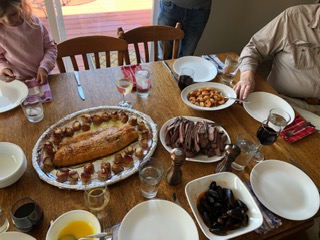
Today ten of us gathered to celebrate Rebekah Lee Ibisch's 28th birthday (which fell on March 21); she wanted surf and turf. So... We served up a huge baked filet of salmon, surrounded by bacon-wrapped bay scallops, muscles in tomato sauce, sautéed shrimp (with lots of old bay!), london broil, salad (for any who wanted the rabbit food), and her brother made her a fabulous pecan maple cheesecake. It was quite the feast!

Outstanding Homily for Oculi

People loved by God, this is the wonderful homily that we heard this morning at St. Paul's, delivered by Pr. Wm. Gleason. Enjoy!

Sermon for Oculi - Lent 3, 2019
Exodus 8:16-24; Luke 11:14-28 • Rev. William Gleason

Every time I hear about the plague of flies that God sent upon the Egyptians, it reminds me of a story told to me by a former parishioner in Missouri. He was a professor of history and archeology, and often traveled to the holy land for study.

He told me that in the holy land, flies are everywhere. They're so persistent and swarming that people don't even bother to swat them away. They just let them crawl over everything, including themselves.

The middle east being an arid land, the flies are drawn to a person's lips seeking the moisture there. Again, people would just put up with it…until they became too numerous or the person wanted to speak or eat. Then he would take his index finger and wipe it over his lips to remove the pests.

I don't tell this story to make your skin crawl. But it occurred to me, especially in the context of today's Bible readings, how well this illustrates the way God delivers us from the demonic attacks we suffer in this dark world ruled by the prince of demons, Beelzebul.

Beelzebul means "lord of the flies," and is one of the names for Satan. He was also one of the many idols of the Egyptians. When the Lord God sent the plague of flies swarming into Egypt and into the homes of the Egyptians, He was not only trying to soften Pharaoh's heart, He was also calling the Egyptians to repent of their idolatry. He was showing them who is the Creator of the flies and of all creatures; indeed, the Creator of heaven and earth. In this and in all of the plagues, He was calling them to turn away from their unbelief and false worship, and to turn to the true and living God.

Well, Beelzebul, the devil, still plagues the world with his hordes of demons seeking the attention and worship of men and women. He is particularly intent on tormenting Christians since we worship the true God who has delivered us from sin, death and hell through the blood of His Son. Like the ancient Israelites who were set apart and protected in the land of Goshen, so believers are set apart and protected in the holy, Christian Church. But, as we are still in this world, we must labor and struggle among and against the forces of darkness, as well as the "sons of disobedience," as Paul described those who reject the Gospel.

We are sojourners in this foreign land, and the devil is busy trying to tempt us and otherwise make our lives miserable. How does he do this? Well, there are countless ways, really, but in today's Epistle St. Paul gives us a good primer on the devil's devices. He lists three of the worst human vices: sexual immorality, impurity, and covetousness. These are the go-to sins where Satan knows he can reap the most fruit of his evil enticements.

The first is sexual immorality. The KJV better translates it as fornication. The Greek word is porneia and means exactly what it sounds like. This sin has become so commonplace and so glamorized in our society, and in all of western societies, that it has turned into a perverted, twisted kind of morality. If you're not into it, then you're just not cool. It saturates our entertainment and our news; it is the most graphic and freely available on the internet; it is taught in our schools, from elementary to university (it has nearly become criminal to speak against it). And, saddest of all, it is glorified and promoted within churches, always falsely justified for the "sake of the Gospel." Satan has the world so enslaved to this depravity that he barely has to work at all tempting people to indulge in it.

The second vice is impurity. It's closely related to the first but includes any kind of impure incentive to sin. Impurity is the conceited and corrupt attitude that says it's okay to lie and steal, defame and kill as long as it is for a "good" purpose. But, for the sinner, that simply means any justification to satisfy his desires and lusts.

The last vice is what might be called the bedrock of the others: covetousness. That's the greedy lust of the sinful heart that moves a sinner to engage in every kind of sin. From enmity toward God and His Word to animosity toward our neighbor, covetousness turns the self, that carnal trinity of me, myself and I, into the greatest of all false gods. That's why Paul calls it idolatry. Satan can always appeal to the covetous heart to tempt a man to commit any kind of sin he wants.

This is the environment in which we Christians live. And there the devil attacks us and our faith. He tries to deceive us into false belief and disobedience to God. He tempts us to give up on our faith and our Lord. Like swarms of flies that relentlessly pester us, he, his demons, and the "sons of disobedience" in his service, try to drive us into a weary, spiritual complacency. They want the Christian to tire of fighting the good fight, to give in and just put up with the evils of the world. To go along with and even condone them. Or, worse, like the demon-possessed man in the Gospel lesson, Satan tries to mute our prayers and our praise to God by causing us to despair and lose hope. And, as Luther wrote in his famous hymn, "With might of ours can naught be done, soon were our loss effected."

Of course, he continues, "But for us fights the Valiant One, whom God Himself elected." Christ Jesus, our Sabaoth Lord and our only God, has come to deliver us from every attack of Satan. By the "finger of God," His Holy Spirit, He casts out every unclean spirit that seek to devour us. By His forgiving Word, He wipes away every sin and removes all guilt with which Satan would accuse us. Jesus is the stronger man who overcomes the evil one who, by "deep guile and great might," had taken us captive; who once imprisoned us in his hellish stronghold. Christ has overcome him and taken away the "armor" in which the devil trusted, "the power of death." Jesus disarmed the devil when He conquered death on the cross. He showed that He truly is the stronger man when He rose from the grave. His resurrection proves that death has no power over those who call upon Christ by faith.

The plagues that God brought down on Pharaoh and the Egyptians culminated in the tenth and last plague: the death of the first-born. Just before that, God instituted the Passover to protect His people from that hideous death. The blood of a lamb without blemish was painted on the doorposts of their homes. As they ate the flesh of that fragrant offering to God, and covered by its sacrificial blood, the angel of death passed over them. God delivered them from their bondage to Beelzebul, the prince of demons.

Jesus, our loving Savior, "gave Himself up for us, a fragrant offering and sacrifice to God." He is our paschal Lamb whose blood covers us, saving us from eternal death. His flesh is our food that strengthens us for the fight. By His death and resurrection, to which you were joined the waters of Holy Baptism, He has delivered you from the realm of darkness and brought you into His light. And in the light of His truth, we may walk as His Children. By His Spirit, we may resist the devil and flee from every temptation. By His holy Word, He has shown you all that is good and right and true. And you are truly blessed as you hear His word and keep it. Amen.


14 March 2019

The Flood Prayer in the Lutheran Baptismal Liturgy

>
> Compare the Great Flood Prayer to this passage from 3 Maccabees:
>
> 3 Maccabees 2:4ff
>
> You destroyed those in who in the past committed injustice, among whom were even giants, who trusted in their strength and boldness, whom you destroyed by bringing upon them a boundless flood....
>
> Flood Prayer: According to Your strict judgment, You condemned the unbelieving world through the flood, yet according to Your mercy You preserved believing Noah and his family, eight souls in all...
>
> 3 Maccabees 2:6ff
> You made known your mighty power by inflicting many and varied punishments on the audacious pharaoh who had enslaved your holy people Israel. And when *he* pursued them with chariots and a mass of troops, you overwhelmed him in the depths of the sea, but carried through safely those who *had put their confidence in you, the Ruler over the whole creation.
>
> Flood Prayer: You drowned hard-hearted Pharaoh and all his in the Red Sea, yet led Your people Israel through the water on dry ground.
>
>

06 March 2019

A Study

Check out this:


A course on my book, hosted by yours truly!

Thanks, CPH!