30 June 2021
Patristic Quote of the Day
If we take a closer look at the origin of sin, I think that it is nothing else than the inordinate love by a rational creature of things set in order by God.—Fulgentius, To Montimus 1.20.2


June’s Summary Workouts
June was full on workouts after the surgery in May. So the month (with a few days off for family issues) totaled: 4,000 pushups; 400 pullups; 400 45 lb kettlebell swings. Felt good to get the kettlebell back. Also had a HIIT workout or two in there. Usual routine is to start listening to Bible (KJV), head downstairs and do 10 pullups and 10 kettlebell swings. Walk around the upstairs twice. Do 25 pushups in my study. Walk around upstairs twice, etc. Repeating till the pushups total 200 for the day, then back to the basement for another 10 pullups and 10 kettlebell swings. This is my Monday through Friday routine. And when I’m being motivated HIIT with Apple’s exercise app on Saturday mornings. All in all, it takes a smidge over 30 minutes to do the M-F and 10 minutes on Saturdays.
Gerhard and Walther
All the saints, even if they were exalted and decorated by God, busied themselves with humility.—Johann Gerhard, Schola Pietatis III:222.
When Christ tells us not to judge and condemn, it does not mean no one is permitted to judge and condemn false doctrine or openly proclaim God’s judgment of unbelieving and wicked people…. This applies not only to preachers but also to the laity. They, too, should confidently reject and condemn false doctrine and a godless life.—C. F. W. Walther, God Grant It!, p. 542, 543.
Catechesis: Clerical Celibacy
For no one will ever be able to change or arrange these matters better or more wisely than God Himself, who instituted marriage to help human frailty and to prevent sexual immorality… How can the marriage of priests and clergy, especially of pastors and others who are to serve the church, be disadvantageous to the Christian Church as a whole? There may well be a shortage of priests and pastors in the future if this harsh prohibition of marriage should last much longer.—AC XXIII:14, 15, 17
29 June 2021
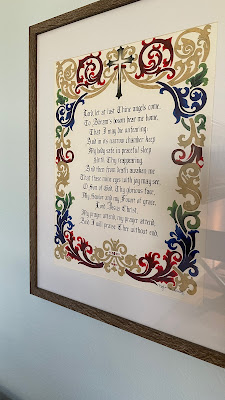
Scriptorium done…
…(Scriptorium sounds better than study; it’s the room the monks used to write in, copying out Scripture and commentaries and such!). We’ve been slowly but surely setting up this room. This past weekend, the final thing we planned for happened (thanks to a dear friend who generously gave of his time and skill): recessed lighting in the book nook. I love coming here to write in the mornings with a cup of java at hand. Cindi did an outstanding job with the blues on the walls, and the total effect is utterly calming.





Gerhard and Walther
Is it not a wrong action for you to think that you, with your haughty pride, hope to be allowed entrance into heaven even though the haughtily proud Lucifer was tossed out of heaven on account of pride? Christ Jesus, the door to the heavenly sheep stall, is low. If you wish to enter into it, you must bow yourself down and humble yourself, otherwise you will strike yourself on your head and never get in there, as Augustine says in Tract. 45 on John.—Johann Gerhard, Schola Pietatis III:218.
They [Christians] are righteous before God only because they believe in Christ. Without faith, their sins would damn them just as readily as the sins of others condemn them. A Christian may progress only so far in sanctification during this life; he must still appear daily as a poor beggar before God.—C. F. W. Walther, God Grant It!, p. 540.
Patristic Quote of the Day
When he [the outsider] sees that God is being praised and that Christ is being adored and that nothing is disguised or being done in secret, as happens among pagans, he will understand clearly that this is true religion.—Ambrosiaster, Commentary on First Corinthians 14:25.
Catechesis: Both Kinds in the Sacrament
There is a clear order and command of Christ in Matthew 26: “Drink from it, all of you.” Concerning the cup Christ here commands with clear words that they all should drink from it.—AC XXII:1,2.
28 June 2021
Gerhard and Walther
Humility is the true, solid foundation of every Christian virtue. Just as one is unable to construct a building without a foundation, where there is humility, everything is in vain if one thinks he can carry out the construction of godliness. For with humility a person turns away from himself, so that he does not highly regard himself or secretly make himself a god.—Johann Gerhard, Schola Pietatis III:213.
God had to send us His love before we could know what it is to love our neighbor. Thus, if we are still unmerciful, it is a sign that we do not stand in faith.—C. F. W. Walther, God Grant It!, p. 537.
Patristic Quote of the Day
Nothing builds up as much as good order, peace, and love, just as nothing is more destructive than their opposites. It is not only in spiritual affairs but in everything that one may observe this.—St. John Chrysostom, Homily 37 on First Corinthians.
Catechesis: The Saints
Concerning the cult of the saints our people teach that the saints are to be remembered so that we may strengthen our faith when we see how they experienced grace and how they were helped by faith. Moreover, it is taught that each person, according to his or her calling, should take the saints’ good works as an example.—AC XXI:1
Also worthy of note: the cult of the saints was included among the articles in which there was presumed doctrinal agreement. The AC starts with the Holy Trinity and ends those presumed undisputed articles with the Saints. There’s a beauty there—I had never noticed it till Pr. Heath Curtis once pointed this out.
25 June 2021
Gerhard and Walther
Apart from cross, faith usually is simply only an ordinary academic thing that flows from the tongue. But, with a cross, adds to the scenario of faith a true exercise and testing by which faith is stamped and notarized like a seal into the heart. Untested people are inexperienced, plain, useless spectators—what do they know? As a marginal note on Is. 28:19, the Gospel is called the Word of the cross, not only because it proclaimed Christ crucified, but also because His power is rightly felt and understood with tribulations.—Johann Gerhard, Schola Pietatis, III:189.
If we compare the condition of the poor and the rich according to the Holy Scripture, we find that the poor are preferred.—C. F. W. Walther, God Grant It!, p. 530.
Patristic Quote of the Day
Second, even if the daughters of Philip did prophesy, they did not do so inside the church. Likewise in the Old Testament, although Deborah was reputed to be a prophetess, there is no indication that she ever corporately addressed the people in the way that Isaiah or Jeremiah did. The same is true of Huldah.—Origen, Commentary on I Cor. 14:34.
Catechesis: Limits of Free Will
However, without the grace, help, and operation of the Holy Spirit a human being cannot become pleasing to God, fear or believe in God with the whole heart, or expel innate evil lusts from the heart. Instead, this happens through the Holy Spirit, who is given through the Word of God.—AC XXVIII:2,3.
24 June 2021
The Nativity of St. John the Baptist

The rabbi was preparing to give the little one the name of his father when Elizabeth interrupted. “No, he shall be called John.” John, which means Yahweh is gracious. The people in the room look at the women in amazement and the rabbi frowns: “None of your relatives is called by that name!” he exclaims. All eyes fix on the old man, Zechariah, still silent, nary a word escaping his lips since his vision in the temple. They make signs to him to ask what he should be named (signs? He’s dumb, not deaf!). He motions for a writing tablet and writes upon it: his name is John.
And then it stopped, as suddenly as it had started. His mouth was opened, his tongue loosed, and he spoke. What did he speak? St. Luke strongly hints at it by saying that he was “blessing God.” That is, the words that we know as the Benedictus. He opens his lips in a canticle of praise to the God of Israel, who has visited and redeemed His people. What is amazing about the canticle is that most of it isn’t about John at all; there’s a bigger miracle in the room!
Zechariah shouts to one and to all that the time of the great fulfillment foretold by the prophets was at hand. The God of Israel had visited His people to rescue them. He was showing mercy, remembering the covenant and oath He swore to Abraham. Now all God’s people would be set free to serve God without fear in holiness and righteousness all the days of their life. And if God was now in the flesh, his beloved little John would be the prophet of the Most High, going before the Lord to prepare His way, the way of Him who came to bring light to those sitting in the shadow of death, guiding feet into the very way of peace. The people marveled and wondered at the astonishing words that they heard.
You may wonder too. For this is what you have been created for: to serve, to worship, to praise God, and to do so without fear because God has come in the flesh to clothe you in a holiness and righteousness that can stand in the presence of the All Holy without trembling, fear or shame. A holiness and righteousness that force death and Satan to back away from you. For your holiness and your righteousness IS the Child who was in Mary’s womb and on Calvary’s tree and is risen from the dead. He has answered for all your sin. He has died the death for you and lives to give salvation too you. Marvel and wonder indeed, people loved by God. He has visited you and shows you great mercy. Open your mouth with Zechariah, and with Mary, and bless His holy name! Amen.
Gerhard and Walther
The strength of the soul that consists of patience is far nobler and better than the strength of the body.—Johann Gerhard, Schola Pietatis III:184.
Let us not think that Jesus prefers the virtuous to those who recognize how far they have fallen. He lets go the virtuous who do not desire to be with Him, and He seeks those who are overwhelmed by the guilt of their sins. He makes sinners of saints and saints of sinners. He lets the self-righteous perish and saves those who are honest enough to recognize that they are lost.—C. F. W. Walther, God Grant It!, p. 529.
Patristic Quote of the Day
We cannot even sing and hymn the Father in Christ with proper rhythm, melody, measure and harmony, unless the Spirit who searches everything, even the depths of God, first praises and hymns him whose depths he has searched out and has understood.—Origen, On Prayer 4.
Catechesis: Church Rites
Concerning church rites, they teach that those rites should be observed that can be observed without sin and that contribute to peace and good order in the church, for example, certain holy days, festivals, and the like.—AC XV:1 (Latin; emphasis added)
23 June 2021
Gerhard and Walther
What one learns from cross has solidity, and thereby a man becomes wise before God. That which is heard from God’s Word apart from the cross generally sweeps only over the tongue.—Johann Gerhard, Schola Pietatis, III:183.
We are sick in our souls, fatally and eternally sick; and Christ came as a physician to restore us to health.—C. F. W. Walther, God Grant It!, p. 525.
Patristic Quote of the Day
But, as this faith, which works by love, begins to penetrate the soul, it tends, through the vital power of goodness, to change into sight, so that the holy and perfect in heart catch glimpses of that ineffable beauty whose full vision is our highest happiness…We begin in faith, we are perfected in sight.—St. Augustine, Enchiridion 1.5.
Subscribe to:
Posts (Atom)