[The following thoughts were shared with a friend a few months ago; I post them in full here as a fuller explanation of my thoughts on the subject as it was introduced by my friend David Juhl on his blog Uneasy Priest. They might provide some further good discussion.]
Such a short little article to cause so much trouble over the years! And at the heart of the controversy is the even littler Latin phrase: rite vocatus. “Our Churches teach that no one is to preach, teach or administer the Sacraments *nisi rite vocatus*” - without being called by rite, or regularly called, or orderly called.
The Augsburg Confession is very bold in its insistence: “As can be seen, there is nothing that varies from the Scriptures, or from the Church universal, or from the Church of Rome, as known from its writers.” (Conclusion of first half of the AC) “In doctrine and ceremonies we have received nothing contrary to Scriptures or the Church universal.” (Conclusion of the second half of the Augsburg Confession).
I would contend, however, that precisely at the point of AC XIV Melanchthon KNEW that something needed to be introduced that was new in both doctrine and in ceremony. But he was betting the farm that his opponent, Johann Eck, would NOT notice what he had done. And so what Melanchthon did was to scrounge up a term from canon law that might be a tad ambiguous – rite voctaus – and hope that Eck wouldn’t notice that the term was being used in a novel manner.
Fat chance. Eck was a careful student of the Lutheran movement and watched it with growing alarm. He did not let AC XIV slip by without telling commentary:
“When in the fourteenth article, they confess that no one ought to administer in the Church the Word of God and the sacraments unless he be rightly called, it ought to be understood that he is rightly called who is called in accordance with the form of law and the ecclesiastical ordinances and decrees hitherto observed everywhere in the Christian world, and not according to a Jerobitic (cf. 1 Kings 12:20) call, or a tumult or any other irregular intrusion of the people. Aaron was not thus called. Therefore, in this sense the Confession is received; nevertheless, they should be admonished to persevere therein, and to admit in their realms no one either as a pastor or as a preacher unless he be rightly called.” (Reu’s *A Collection of Sources for the Augsburg Confession*, p. 357)
Eck seems to have had in mind some of Luther's writings and deeds on the subject. See especially Babylonian Captivity (AE 36:116) and the fact that in 1525 Luther himself ordained Georg Rörer. [Notes: While it is certainly true (as Piepkorn has amply demonstrated) that there were exceptions to the rule of bishops only ordaining here and there in the medieval West, it appears that this practice was limited to the conditions obtaining in the mission field or to the privelege granted by certain popes for abbots in presbyteral orders to ordain to diaconate or presbyterate within their monasteries; but that a university professor should undertake this task was in all points a novelty that would have troubled Eck and other traditionalists among the "old believers".]
This means quite simply that Melanchthon’s bluff did not work. He was called to explain what he had apparently hoped to avoid: detailing what he meant by “rite vocatus.” If the meaning was not the old canonical meaning – priestly ordination in apostolic succession – then what DID it mean?
The Apology is not terribly helpful in answering that. It more or less admits the bluff, with a “well we WANTED to, but you guys were too mean to allow it!” But nowhere in this article does Melanchthon actually provide a positive definition of the term. I suspect he hadn’t worked one out yet. What could “rite vocatus” mean if not employed of “canonical ordination” (Ap XIV:24)?
After searching in vain through the Apology for an answer, a number of years later a possible answer emerged in the much-neglected Tractatus. The answer Melanchthon had been searching for was implied in his reading of St. Jerome, who pointed out that priests and bishops in Scripture hold the same rank (Tractatus 61-64) – an argument that Jerome no doubt relished, being himself a presbyter and never elevated to the Episcopal throne unlike the other three “doctors” of the Western Church. Melanchthon then made the argument that the distinction between bishop and presbyter was a matter of discipline rather than doctrine, and therefore not strictly speaking
something that could be considered divinely mandated. Thus, “it is clear that ordination administered by a pastor in his own church is valid by divine law. Therefore, when the regular bishops become enemies of the Church or are unwilling to administer ordination, the churches retain their own right to ordain their own ministers.” (Tractatus 65, 66) And in summary: “From this it is clear that the Church retains the right to elect and ordain ministers. Therefore, when the bishops are heretics or refuse to administer ordination, the churches are by divine right compelled to ordain pastors and ministers for themselves by having their pastors do it (Latin: adhibitis sui pastoribus).” (Tractatus 72)
The Churches are authorized here to do what the bishops are unwilling to do, and the Churches do so by using their own priests to get the job done. Thus, in this first “positive” definition of rite vocatus, we may define this as a case of presbyteral succession in case of necessity.
But the phrase rendered “by having their pastors do it” is soon lost from the Tractatus and does not even make it into the 1580 or 1584 Book of Concord (this is why it is absent in the Triglotta). The loss of this phrase meant that the Symbols, while mandating the rule “nisi rite vocatus” (without a call according to rite) never then
define what this phrase means. Each successive generation of Lutherans have squabbled over it – and it has been defined in accordance with the whims of each. All Lutherans agree that no one should preach, teach or administer the Word and Sacraments “nisi rite vocatus” but no group of Lutherans can come to agreement on what that
“rite vocatus” consists of!
To some it is a term for ordination (albeit, a non-canonical presbyteral ordination). To some it means that the congregation asks an elder to administer the Sacrament on a Sunday when the pastor is on vacation.
Each side may legitimately argue from Lutheran tradition – for it has come to mean all that and more! Just listen to the current Synodical president talk about it. He admitted in the 2006 convention of the Southern Illinois Convention that the seminary faculties can’t agree on its meaning! And of course they cannot. It HAS no definitive
meaning in the BOC of 1580 except this: it doesn’t mean what it always HAD meant, canonical ordination.
Thus the AC XIV is somewhat of a question mark behind the claim that the Lutherans did not introduce anything "new" in doctrine or in ceremonies. Here is something NEW – and it is new both in doctrine and in ceremony. The sad story of the Lutheran inability to speak with clarity about the Office of the Ministry is the result.
[Addendum: An area that I find fascinating and would like to explore further is the comment by Piepkorn that where the Symbols do not allege any support from the Word of God, it is questionable whether one is bound by what they teach. He uses as prime example the affirmation of the perpetual Virginity of the Holy Theotokos. But also note that the Symbols nowhere allege any Scriptural support for what is found in AC XIV! Does this explain the reason, perhaps, that growing sectors of Missouri feel free to dispense with it entirely?]
24 April 2006


Patristic Quote for the Day
But it is not only the martyrs who share in his passion by their glorious courage!
The same is true, by faith, of all who are born again in Baptism.
That is why are are to celebrate the Lord's paschal sacrifice with the unleavened bread of sincerity and truth.
The leaven of our former malice is thrown out, and a new creature is filled and inebriated with the Lord himself.
For the effect of our sharing in the body and blood of Christ is to change us into what we received.
As we have died with him, and have been buried and raised to life with him, so we bear him within us, both in body and in spirit, in everything we do.
--Pope St. Leo the Great, Paschal Homily
The same is true, by faith, of all who are born again in Baptism.
That is why are are to celebrate the Lord's paschal sacrifice with the unleavened bread of sincerity and truth.
The leaven of our former malice is thrown out, and a new creature is filled and inebriated with the Lord himself.
For the effect of our sharing in the body and blood of Christ is to change us into what we received.
As we have died with him, and have been buried and raised to life with him, so we bear him within us, both in body and in spirit, in everything we do.
--Pope St. Leo the Great, Paschal Homily
Patristic Quote for the Day
All the achievements of the saints were clearly gifts of grace from God. None of the saints had the least thing other than the goodness granted to him by the Lord God according to the measure of his gratitude and love. And what he acquired he acquired only so far as he surrendered himself to the Lord who bestowed it. - St. Maximos the Confessor, Third Century of Various Texts, par. 29
23 April 2006
Father Arseny, A Cloud of Witnesses
"Sometimes this was a positive influence, but it also happened that being too intellectual got in the way of knowing God, of believing in him, of loving others; it got in the way of a spiritual understanding of the world and of the human soul. You could see this during the talks led by Father Arseny, you could see it in the questions that were asked and even in the heated debates. Some people lived their faith not with their soul and heart, but by rationally weighing it against the bulk of knoweldge that they had acquired. Questions and arguments continued after the talks had come to a close while people were leaving to go home. But the longer the community continued, the fewer the arguments we had. They were replaced by mutual understanding and love for each other." (p.203)
Patristic Quote for the Day
In that dreadful place of night where He had tarried for three long days, He retained inviolate the splendor of His majesty and shone with the glory of His eternal nature. Light was not overcome by darkness, but darkness was overcome by Light. Let us therefore rejoice, dearly beloved, and be glad in the Lord; for today the Light of salvation is given to us by the Lord according to which the psalmist has written: the Lord is God, and has illumined us. - St. John Chrysostom, A Paschal Homily [Note: the Paschal Gospel in the Eastern rite is John 1:1-18]
22 April 2006
A fine homily
Here's a link to a fine homily by Father James Shadid from St. George's Cathedral in Wichita, KS. I found it quite comforting. You might too (sermon starts in about 1/2 way - first there is chanting of epistle, alleluia, prokeimenon and Gospel).
http://www.stgeorgecathedral.net/audio/04-09-06-F.wma
http://www.stgeorgecathedral.net/audio/04-09-06-F.wma
A Homily for Quasimodogeniti (preached in 2005)
Did you catch the pattern? Sunday. Disciples gathered. Doors shut. Jesus. The sight of His wounds in a living body. Overflowing joy. A commission to carry forgiveness out into the world.
But Thomas missed the gathering. Maybe he was golfing. Maybe he was finshing. Maybe he was moping. Maybe his siesta lasted a bit longer than usual. We’re not told why he wasn’t there, and there’s a reason for that.
Because it doesn’t matter WHY he wasn’t there. The only thing that matters is that he missed out. And look at what happened because he missed out on that special gathering: Thomas refuses to believe.
Thomas in his unbelief lays down his conditions. He’s got to see with his own eyes those wounds and touch them. Then he’ll see about believing.
And the Lord could have appeared to Thomas by himself on Monday or Tuesday or Wednesday or Thursday or Friday or Saturday. Any of them would have done. But the Lord didn’t. He let Thomas stew in his unbelief for a solid week. And then look at what happened. Deja vu!
Sunday. Disciples gathered. Doors shut. Jesus. The sight of His wounds. Overflowing joy. This time the truant was present and the presence of Jesus in the midst of the gathered disciples brings Thomas from unbelief to full-blast confession: “My Lord and my God!”
Jesus responds to that. Thomas had been brought to faith by seeing. By seeing the wounds in hands and side, he came to confess that his Lord and his God had been raised from the dead just as He had promised He would be. But Jesus is setting a pattern now and he is thinking of more than Thomas on that night. He is thinking of you. And so he says to Thomas: “You believe because you have seen. Blessed are those who have not seen and yet have believed.”
But if it isn’t the seeing that brings to faith, then what? The Gospel holds the answer. It’s all about what happens on the First Day of the week, which is also the 8th day, the day beyond all our sevens - one of which will carry us to death. On the First and 8th Day, a miracle. The disciples of Jesus gather. And into their midst comes the Risen One. He comes with His wounds, His Spirit, His breath, AND His Words. “These have been written that you may believe that Jesus is the Christ, the Son of God, and that by believing you may have life in His name.”
As His people gather, the miracle happens again and again. Even though there is more Jesus than can ever be fit into a book, nevertheless He has given His people a book around which to gather. A book where the breath of Jesus that IS the Spirit of God still blows and calls from unbelief to faith. A book that is opened and read.
Words. Concrete words. Words about Jesus. Jesus’ own words. The Spirit breathed them all. They all come from and are all about Jesus. We read them, and when we do, it is not just a matter of remembering our Lord. No. We confess that Jesus is with us in His Words. He still speaks to us! That’s why we stand. That’s why we sing out: “Alleluia!” in greeting to the One who comes to us in His words. The One who has promised: “If anyone loves Me, he will keep My words and My Father will love Him and We will come to Him and make Our home with him.” (Jn 14:23)
But the One who comes to us in His words is the One who comes to show the wounds and speak peace and bring joy. And so when the words of Jesus are spoken over bread and wine, then we have what those words promise: This is my body, given for you. This is my blood, shed for you. For the forgiveness of sin. Thomas was invited to touch and believe. You are invited to taste and believe. Oh, taste and see that the Lord is good!
Body and blood correspond to the wounds, for you only get body and blood separated from one another when there is a wound. So it is His death that is proclaimed every time we gather at this holy Table and the Resurrected One feeds us with His body and His blood. You can’t see it from where you sit, but a reminder of it is upon the altar cloth. Five little crosses. Two on each end and one in the middle. What are they there for? To be pretty? Hardly! They are there by way of confession that what is placed upon this altar cloth is that which resulted from five piercings: two in the hands, two in the feet, and one in the side. They are there to confess that on this altar is the very body and blood which hung upon the cross for you. That that is what is given you to eat and to drink. And with the sight and taste of the wounds comes the word of peace (“the peace of the Lord be with you always”) and then the joy.
When? On the Lord’s Day. When Jesus comes into the midst of His gathered disciples and speaks His peace and brings the joy of sins forgiveness and calls from unbelief to faith. But the joy isn’t to end here.
The disciples go out and announce - as they did to Thomas - “We have seen the Lord!” So we are sent out from this gathering where Jesus has come to be with us, where we have known Him in His Words and in His Wounds, His body and blood. We are sent forth to tell people like Thomas who are left in the sadness of thinking that death is the end of the road, that there is One who went farther. We are sent to tell people like Thomas who think that their sins still hang around their own neck, that there is one who lifted that burden and carried it Himself long ago to give them peace and joy. We are sent to tell one and all. And not just that there is such a One and such a forgiveness and such an eternal life. But sent to tell WHERE He can be found and where faith is given and forgiveness and joy and peace. To tell them about the secret of the 8th and first day, the Lord's Day when our Savior Jesus still comes to be with us as we gather together in His name, around His words, and His wounds. Amen.
But Thomas missed the gathering. Maybe he was golfing. Maybe he was finshing. Maybe he was moping. Maybe his siesta lasted a bit longer than usual. We’re not told why he wasn’t there, and there’s a reason for that.
Because it doesn’t matter WHY he wasn’t there. The only thing that matters is that he missed out. And look at what happened because he missed out on that special gathering: Thomas refuses to believe.
Thomas in his unbelief lays down his conditions. He’s got to see with his own eyes those wounds and touch them. Then he’ll see about believing.
And the Lord could have appeared to Thomas by himself on Monday or Tuesday or Wednesday or Thursday or Friday or Saturday. Any of them would have done. But the Lord didn’t. He let Thomas stew in his unbelief for a solid week. And then look at what happened. Deja vu!
Sunday. Disciples gathered. Doors shut. Jesus. The sight of His wounds. Overflowing joy. This time the truant was present and the presence of Jesus in the midst of the gathered disciples brings Thomas from unbelief to full-blast confession: “My Lord and my God!”
Jesus responds to that. Thomas had been brought to faith by seeing. By seeing the wounds in hands and side, he came to confess that his Lord and his God had been raised from the dead just as He had promised He would be. But Jesus is setting a pattern now and he is thinking of more than Thomas on that night. He is thinking of you. And so he says to Thomas: “You believe because you have seen. Blessed are those who have not seen and yet have believed.”
But if it isn’t the seeing that brings to faith, then what? The Gospel holds the answer. It’s all about what happens on the First Day of the week, which is also the 8th day, the day beyond all our sevens - one of which will carry us to death. On the First and 8th Day, a miracle. The disciples of Jesus gather. And into their midst comes the Risen One. He comes with His wounds, His Spirit, His breath, AND His Words. “These have been written that you may believe that Jesus is the Christ, the Son of God, and that by believing you may have life in His name.”
As His people gather, the miracle happens again and again. Even though there is more Jesus than can ever be fit into a book, nevertheless He has given His people a book around which to gather. A book where the breath of Jesus that IS the Spirit of God still blows and calls from unbelief to faith. A book that is opened and read.
Words. Concrete words. Words about Jesus. Jesus’ own words. The Spirit breathed them all. They all come from and are all about Jesus. We read them, and when we do, it is not just a matter of remembering our Lord. No. We confess that Jesus is with us in His Words. He still speaks to us! That’s why we stand. That’s why we sing out: “Alleluia!” in greeting to the One who comes to us in His words. The One who has promised: “If anyone loves Me, he will keep My words and My Father will love Him and We will come to Him and make Our home with him.” (Jn 14:23)
But the One who comes to us in His words is the One who comes to show the wounds and speak peace and bring joy. And so when the words of Jesus are spoken over bread and wine, then we have what those words promise: This is my body, given for you. This is my blood, shed for you. For the forgiveness of sin. Thomas was invited to touch and believe. You are invited to taste and believe. Oh, taste and see that the Lord is good!
Body and blood correspond to the wounds, for you only get body and blood separated from one another when there is a wound. So it is His death that is proclaimed every time we gather at this holy Table and the Resurrected One feeds us with His body and His blood. You can’t see it from where you sit, but a reminder of it is upon the altar cloth. Five little crosses. Two on each end and one in the middle. What are they there for? To be pretty? Hardly! They are there by way of confession that what is placed upon this altar cloth is that which resulted from five piercings: two in the hands, two in the feet, and one in the side. They are there to confess that on this altar is the very body and blood which hung upon the cross for you. That that is what is given you to eat and to drink. And with the sight and taste of the wounds comes the word of peace (“the peace of the Lord be with you always”) and then the joy.
When? On the Lord’s Day. When Jesus comes into the midst of His gathered disciples and speaks His peace and brings the joy of sins forgiveness and calls from unbelief to faith. But the joy isn’t to end here.
The disciples go out and announce - as they did to Thomas - “We have seen the Lord!” So we are sent out from this gathering where Jesus has come to be with us, where we have known Him in His Words and in His Wounds, His body and blood. We are sent forth to tell people like Thomas who are left in the sadness of thinking that death is the end of the road, that there is One who went farther. We are sent to tell people like Thomas who think that their sins still hang around their own neck, that there is one who lifted that burden and carried it Himself long ago to give them peace and joy. We are sent to tell one and all. And not just that there is such a One and such a forgiveness and such an eternal life. But sent to tell WHERE He can be found and where faith is given and forgiveness and joy and peace. To tell them about the secret of the 8th and first day, the Lord's Day when our Savior Jesus still comes to be with us as we gather together in His name, around His words, and His wounds. Amen.
Patristic Quote for the Day
The purifying Spirit came upon a virgin
within whom the Word was formed into a man,
the total price of redemption for the total mortal man.
And, seeing as God has no admixture of flesh,
while soul and mind stand, as it were, in middle ground,
the flesh, then, is both God's housemate and his icon:
God's nature mingles with what is akin to it,
and from there has communion also with the flesh.
Thus, both what deifies and what is deified are the one same God.
- St. Gregory of Nazianzus, Against Apollinarius
within whom the Word was formed into a man,
the total price of redemption for the total mortal man.
And, seeing as God has no admixture of flesh,
while soul and mind stand, as it were, in middle ground,
the flesh, then, is both God's housemate and his icon:
God's nature mingles with what is akin to it,
and from there has communion also with the flesh.
Thus, both what deifies and what is deified are the one same God.
- St. Gregory of Nazianzus, Against Apollinarius
21 April 2006
Patristic Quote for the Day
From dirt to mud, then back to dust again.
For earth is reunited again with earth,
and in earthly swaddling clothes is swaddled,
and dirt once more flies forward like the dust
which the violent twisting of the wind
lifts up on high, then throws back down.
And so it is with our much-swirling life
which the heady winds of wickedness
raise up on high, to spurious acclaim.
But again the dirt drops down, and stays below,
until the Creator's Word accords
the things conjoining their necessary parting.
But now there peers out, as if from some depth,
the dirt, made spiritual by the divine image,
and cries aloud in earthly tragedies,
and weeps for this life, which seems to be a joke.
--St. Gregory Nazianzus, Concerning Human Life
For earth is reunited again with earth,
and in earthly swaddling clothes is swaddled,
and dirt once more flies forward like the dust
which the violent twisting of the wind
lifts up on high, then throws back down.
And so it is with our much-swirling life
which the heady winds of wickedness
raise up on high, to spurious acclaim.
But again the dirt drops down, and stays below,
until the Creator's Word accords
the things conjoining their necessary parting.
But now there peers out, as if from some depth,
the dirt, made spiritual by the divine image,
and cries aloud in earthly tragedies,
and weeps for this life, which seems to be a joke.
--St. Gregory Nazianzus, Concerning Human Life
19 April 2006
Patristic Quote for the Day
Paul cried with all exactness of truth, "For if we have been planted together in the likeness of his death, we shall also be in the likeness of his resurrection." Well has he said, "planted together." For since the true vine was planted in this place, we also by partaking in the baptism of death, have been planted together with him. - St. Cyril of Jerusalem, Catechesis.
18 April 2006
Patristic Quote for the Day
My point is that such has been God's custom right from the start, to turn whatever plots the Devil contrives against us back onto that demon's head and to set things in place for our salvation. Consider! The Devil expelled humankind from Paradise, and God opened up heaven to them. He drove them from governing on earth, and God gave them the Kingdom of heaven, and set our nature firmly on the royal throne. In this way He always gives more abundant blessings than the Devil attempts to strip away. - St. John Chrysostom, Homily on St. Romanus, par. 9
16 April 2006


More Easter Joys...
Matins is just ahead - we will gather to pray this joyful liturgy at 6:30. Following that we recess for breakfast (yes, before Mass - see we are NOT legalists!). Then the Easter Eucharist itself. This is the high point of the Church's worship. It is the fountain of joy from which each Sunday of the year is filled. The Preface today expresses the joy perfectly:
It is truly good, right, and salutary
that we should at all times and in all places
give thanks to You,
holy Lord, almighty Father, everlasting God.
And most especially are we bound to praise You on this day
for the glorious resurrection of Your Son, Jesus Christ,
the very Paschal Lamb,
who was sacrificed for us and bore the sins of the world.
By His dying, He has destroyed death,
and by His rising He has restored to us everlasting life.
Therefore, with Mary Magdalene, Peter and John,
and all the witnesses of the resurrection,
with angels and archangels and with all the company of heaven,
we laud and magnify Your glorious name,
evermore praising You and saying:
HOLY! HOLY! HOLY!
It is truly good, right, and salutary
that we should at all times and in all places
give thanks to You,
holy Lord, almighty Father, everlasting God.
And most especially are we bound to praise You on this day
for the glorious resurrection of Your Son, Jesus Christ,
the very Paschal Lamb,
who was sacrificed for us and bore the sins of the world.
By His dying, He has destroyed death,
and by His rising He has restored to us everlasting life.
Therefore, with Mary Magdalene, Peter and John,
and all the witnesses of the resurrection,
with angels and archangels and with all the company of heaven,
we laud and magnify Your glorious name,
evermore praising You and saying:
HOLY! HOLY! HOLY!
15 April 2006
EASTER GREETING
Christos anesti!
Alithos anesti! Alleluia!
A most blessed and joyous Pascha to you all!!!
At Vigil we were blessed to baptize an adult and to confirm three others. As always the Vigil Service is one of the most joyous of the year. As it moves from darkness to light, as the singing becomes ever louder, as the joy of HEARING of Christ's resurrection moves to the joy of RECEIVING the Risen One who will never die again in His body and blood - the very pledge of forgiveness and resurrection - the joy of the people of God overflows and the Alleluias that begin now will NEVER die away!!!
Alithos anesti! Alleluia!
A most blessed and joyous Pascha to you all!!!
At Vigil we were blessed to baptize an adult and to confirm three others. As always the Vigil Service is one of the most joyous of the year. As it moves from darkness to light, as the singing becomes ever louder, as the joy of HEARING of Christ's resurrection moves to the joy of RECEIVING the Risen One who will never die again in His body and blood - the very pledge of forgiveness and resurrection - the joy of the people of God overflows and the Alleluias that begin now will NEVER die away!!!
Paschal Homily of St. John Chrysostom
PASCHAL HOMILY OF ST. JOHN CHRYSOSTOM
Are there any who are devout lovers of God?
Let them enjoy this beautiful bright festival!
Are there any who are grateful servants?
Let them rejoice and enter into the joy of their Lord!
Are there any weary with fasting?
Let them now receive their wages!
If any have toiled from the first hour,
let them receive their due reward;
If any have come after the third hour,
let him with gratitude join in the Feast!
And he that arrived after the sixth hour,
let him not doubt; for he too shall sustain no loss.
And if any delayed until the ninth hour,
let him not hesitate; but let him come too.
And he who arrived only at the eleventh hour,
let him not be afraid by reason of his delay.
For the Lord is gracious and receives the last even as the first.
He gives rest to him that comes at the eleventh hour,
as well as to him that toiled from the first.
To this one He gives, and upon another He bestows.
He accepts the works as He greets the endeavor.
The deed He honors and the intention He commends.
Let us all enter into the joy of the Lord!
First and last alike receive your reward;
rich and poor, rejoice together!
Sober and slothful, celebrate the day!
You that have kept the fast, and you that have not,
rejoice today for the Table is richly laden!
Feast royally on it, the calf is a fatted one.
Let no one go away hungry. Partake, all, of the cup of faith.
Enjoy all the riches of His goodness!
Let no one grieve at his poverty,
for the universal kingdom has been revealed.
Let no one mourn that he has fallen again and again;
for forgiveness has risen from the grave.
Let no one fear death, for the Death of our Savior has set us free.
He has destroyed it by enduring it.
He destroyed Hell when He descended into it.
He put it into an uproar even as it tasted of His flesh.
Isaiah foretold this when he said,
"You, O Hell, have been troubled by encountering Him below."
Hell was in an uproar because it was done away with.
It was in an uproar because it was mocked.
It was in an uproar, for it was destroyed.
It is in an uproar, for it is annihilated.
It is in an uproar, for it is now made captive.
Hell took a body, and discovered God.
It took earth, and encountered Heaven.
It took what it saw, and was overcome by what it did not see.
O death, where is thy sting?
O Hell, where is thy victory?
Christ is Risen, and you, O death, are annihilated!
Christ is Risen, and the evil ones are cast down!
Christ is Risen, and the angels rejoice!
Christ is Risen, and life is liberated!
Christ is Risen, and the tomb is emptied of its dead;
for Christ having risen from the dead,
is become the first-fruits of those who have fallen asleep.
To Him be Glory and Power forever and ever. Amen!
Are there any who are devout lovers of God?
Let them enjoy this beautiful bright festival!
Are there any who are grateful servants?
Let them rejoice and enter into the joy of their Lord!
Are there any weary with fasting?
Let them now receive their wages!
If any have toiled from the first hour,
let them receive their due reward;
If any have come after the third hour,
let him with gratitude join in the Feast!
And he that arrived after the sixth hour,
let him not doubt; for he too shall sustain no loss.
And if any delayed until the ninth hour,
let him not hesitate; but let him come too.
And he who arrived only at the eleventh hour,
let him not be afraid by reason of his delay.
For the Lord is gracious and receives the last even as the first.
He gives rest to him that comes at the eleventh hour,
as well as to him that toiled from the first.
To this one He gives, and upon another He bestows.
He accepts the works as He greets the endeavor.
The deed He honors and the intention He commends.
Let us all enter into the joy of the Lord!
First and last alike receive your reward;
rich and poor, rejoice together!
Sober and slothful, celebrate the day!
You that have kept the fast, and you that have not,
rejoice today for the Table is richly laden!
Feast royally on it, the calf is a fatted one.
Let no one go away hungry. Partake, all, of the cup of faith.
Enjoy all the riches of His goodness!
Let no one grieve at his poverty,
for the universal kingdom has been revealed.
Let no one mourn that he has fallen again and again;
for forgiveness has risen from the grave.
Let no one fear death, for the Death of our Savior has set us free.
He has destroyed it by enduring it.
He destroyed Hell when He descended into it.
He put it into an uproar even as it tasted of His flesh.
Isaiah foretold this when he said,
"You, O Hell, have been troubled by encountering Him below."
Hell was in an uproar because it was done away with.
It was in an uproar because it was mocked.
It was in an uproar, for it was destroyed.
It is in an uproar, for it is annihilated.
It is in an uproar, for it is now made captive.
Hell took a body, and discovered God.
It took earth, and encountered Heaven.
It took what it saw, and was overcome by what it did not see.
O death, where is thy sting?
O Hell, where is thy victory?
Christ is Risen, and you, O death, are annihilated!
Christ is Risen, and the evil ones are cast down!
Christ is Risen, and the angels rejoice!
Christ is Risen, and life is liberated!
Christ is Risen, and the tomb is emptied of its dead;
for Christ having risen from the dead,
is become the first-fruits of those who have fallen asleep.
To Him be Glory and Power forever and ever. Amen!
An Easter Homily
“And they said nothing to anyone, for they were afraid.”
So ends the Holy Gospel for the high feast of Easter. If ever there were an ending to the story that is all wrong, that is it. Fear shutting up the mouths of those who have the best news that could ever be uttered on the face of the earth. Fear locking fast the lips of those whose words could set free a despairing world to sing for joy.
The more things change, the more they stay the same. Bad news spreads like wildfire, but the good news struggles to overcome the reluctant fear of the messengers. Why? What is that the women were afraid of? Afraid that they were losing their minds. Afraid that they would be laughed at? Afraid that they wouldn’t say it just right? What?
The text doesn’t even give us a hint. There might be a purpose in that. You see, it does not matter one whit what ties the tongue, what matters is simply that the tongue is tied. The message unspoken. The joy unshared.
My friends, we must see this in perspective. We must understand the setting. God made a world filled with life and love and joy. We changed all that. We made of God’s world a place of sadness, a place of death. We turned this home God gave us into a great cosmic cemetery. That is rock bottom reality. Death is. It devours the people of this world one by one and it enjoys the fear that its advent brings. It chews on little children and old men, on young people “in their prime” and on the middle aged. It is a hideous and hateful reality. Death is. And death devours us long before we actually expire. We die a thousand deaths for the loss of those we love, for the loss of our homes, our families, our friends. Death devours. Death is.
BUT! Enter Jesus of Nazareth. Enter the Man who does something about death. Enter the Man who was born of the Virgin Mother and sent into this world by God the Father to actually slay death. To undo its damage. To change it forever. To make it something it was not before. When Jesus is through with Death, you can’t even recognize it as the same thing. Jesus make death a passover, a passage into endless life. It was to overcome death and destroy its power that He came.
And you know how He did it. He did it by offering Himself up to death. Death took Him. On the cross, Death took Him. Devoured Him. Munched on Him till He was just a corpse. Never had Death eaten such a deadly meal. But the Lord Jesus was not just any man. He was at one and the same time true God and true man. Death tried to swallow down Life itself. Death tried to digest in its stinking gullet the very Author of Life. In the picture language of the early Church, Death began to feel quite sick on Holy Saturday and then on Easter morning Death itself keeled over, a gaping hole in its stomach from which the Prince of Life emerged alive again, never to die again, shining with His endless life and calling His people to follow Him into death and then out of it again. You see, He has really made of death a passage. It is not the End. It is not the final word. Life is the final word: “the resurrection of the dead and the life of the world to come.”
All of that the angel communicated to the spice-bearing women inside of the tomb. Mirth bubbled up from within him. He laughed as he spoke. “Don’t be afraid!” he said. “Never be afraid again! You are looking for Jesus. Here in a tomb. Not the place, my friends. Why do you seek the Living among the dead? Why do you seek the Incorrupt among corruption? The Crucified One is not to be found among the dead, for He is risen. Living. He goes before you to Galilee, and you’ll see Him there just as He promised. Now run and tell Peter and the disciples!”
But what happened? “They said nothing to anyone, for they were afraid.” Thanks be to God, we know that that was not quite the end of the story. Mary Magdalene at least overcame her fear and finally went to tell Peter and John and the disciples. Jesus Himself appeared to them and charged them with telling everyone the good news of His resurrection and what it means. And what He told them, He tells us all. He sends us everyone out into a world where sadness reigns, where death terrifies, where despair is endemnic. He says: “Go and tell them that I have risen and that Death has been destroyed! Tell them to trust me and so have eternal life.”
But, “they said nothing to anyone, for they were afraid.” Too often that’s the story today also. Who’s the last person you told about Jesus’ victory over death? When’s the last time the joy that Christ’s resurrection brings to your heart so shown on your face that people said: “What are you so happy about? What’s up with you?” When’s the last time you shared with a relative or a friend what it means that Jesus has risen from the dead and they don’t need to fret over sin or death? When? And why not? “For they were afraid.”
Such a silly thing that fear is. I mean, what’s the worst that could happen if you shared the Good News of Jesus’ resurrection? Well, the early Church soon found out that the worst that could happen to the sharer of the Gospel is that the messenger be killed. And when the early church thought about that, they laughed. Right. No problem. What a glorious way to die. To say to the world: “See, we are not afraid of death. Look! We go into it with confidence. We know that there is a hole in its side and our Lord will bring us through that hole to life everlasting.” Thus even by the way the early martyrs met death they preached powerfully about the resurrection. Their very dying was a proclamation: “Don’t be afraid of this Death anymore! Christ is risen! Believe in Him and be free!”
Now, I think I would be quite safe to say that the probability of any of you being killed for witnessing to Jesus is rather slim, at least as things stand now. So what else are we afraid of? Why don’t we shout our joy? Fear of what others may think of us? Fear of not getting it “just right”? Set aside all such fears today! We have good news that is too great to keep to ourselves.
So today, as the joy of the resurrection of Jesus fills our hearts, today as we know that our Passover has been sacrificed for us and so death must leave us unharmed, today as we sing the glories of His resurrection, as we keep the feast and eat His immortal body and drink His incorruptible blood, let His joyful presence overcome all fear so that we leave this place today so filled with His love and bringing to a sad and despairing world the most joyful news it could ever hear: “Christ is risen from the dead, trampling down death by death, and upon those in the tomb, bestowing life.” Amen.
So ends the Holy Gospel for the high feast of Easter. If ever there were an ending to the story that is all wrong, that is it. Fear shutting up the mouths of those who have the best news that could ever be uttered on the face of the earth. Fear locking fast the lips of those whose words could set free a despairing world to sing for joy.
The more things change, the more they stay the same. Bad news spreads like wildfire, but the good news struggles to overcome the reluctant fear of the messengers. Why? What is that the women were afraid of? Afraid that they were losing their minds. Afraid that they would be laughed at? Afraid that they wouldn’t say it just right? What?
The text doesn’t even give us a hint. There might be a purpose in that. You see, it does not matter one whit what ties the tongue, what matters is simply that the tongue is tied. The message unspoken. The joy unshared.
My friends, we must see this in perspective. We must understand the setting. God made a world filled with life and love and joy. We changed all that. We made of God’s world a place of sadness, a place of death. We turned this home God gave us into a great cosmic cemetery. That is rock bottom reality. Death is. It devours the people of this world one by one and it enjoys the fear that its advent brings. It chews on little children and old men, on young people “in their prime” and on the middle aged. It is a hideous and hateful reality. Death is. And death devours us long before we actually expire. We die a thousand deaths for the loss of those we love, for the loss of our homes, our families, our friends. Death devours. Death is.
BUT! Enter Jesus of Nazareth. Enter the Man who does something about death. Enter the Man who was born of the Virgin Mother and sent into this world by God the Father to actually slay death. To undo its damage. To change it forever. To make it something it was not before. When Jesus is through with Death, you can’t even recognize it as the same thing. Jesus make death a passover, a passage into endless life. It was to overcome death and destroy its power that He came.
And you know how He did it. He did it by offering Himself up to death. Death took Him. On the cross, Death took Him. Devoured Him. Munched on Him till He was just a corpse. Never had Death eaten such a deadly meal. But the Lord Jesus was not just any man. He was at one and the same time true God and true man. Death tried to swallow down Life itself. Death tried to digest in its stinking gullet the very Author of Life. In the picture language of the early Church, Death began to feel quite sick on Holy Saturday and then on Easter morning Death itself keeled over, a gaping hole in its stomach from which the Prince of Life emerged alive again, never to die again, shining with His endless life and calling His people to follow Him into death and then out of it again. You see, He has really made of death a passage. It is not the End. It is not the final word. Life is the final word: “the resurrection of the dead and the life of the world to come.”
All of that the angel communicated to the spice-bearing women inside of the tomb. Mirth bubbled up from within him. He laughed as he spoke. “Don’t be afraid!” he said. “Never be afraid again! You are looking for Jesus. Here in a tomb. Not the place, my friends. Why do you seek the Living among the dead? Why do you seek the Incorrupt among corruption? The Crucified One is not to be found among the dead, for He is risen. Living. He goes before you to Galilee, and you’ll see Him there just as He promised. Now run and tell Peter and the disciples!”
But what happened? “They said nothing to anyone, for they were afraid.” Thanks be to God, we know that that was not quite the end of the story. Mary Magdalene at least overcame her fear and finally went to tell Peter and John and the disciples. Jesus Himself appeared to them and charged them with telling everyone the good news of His resurrection and what it means. And what He told them, He tells us all. He sends us everyone out into a world where sadness reigns, where death terrifies, where despair is endemnic. He says: “Go and tell them that I have risen and that Death has been destroyed! Tell them to trust me and so have eternal life.”
But, “they said nothing to anyone, for they were afraid.” Too often that’s the story today also. Who’s the last person you told about Jesus’ victory over death? When’s the last time the joy that Christ’s resurrection brings to your heart so shown on your face that people said: “What are you so happy about? What’s up with you?” When’s the last time you shared with a relative or a friend what it means that Jesus has risen from the dead and they don’t need to fret over sin or death? When? And why not? “For they were afraid.”
Such a silly thing that fear is. I mean, what’s the worst that could happen if you shared the Good News of Jesus’ resurrection? Well, the early Church soon found out that the worst that could happen to the sharer of the Gospel is that the messenger be killed. And when the early church thought about that, they laughed. Right. No problem. What a glorious way to die. To say to the world: “See, we are not afraid of death. Look! We go into it with confidence. We know that there is a hole in its side and our Lord will bring us through that hole to life everlasting.” Thus even by the way the early martyrs met death they preached powerfully about the resurrection. Their very dying was a proclamation: “Don’t be afraid of this Death anymore! Christ is risen! Believe in Him and be free!”
Now, I think I would be quite safe to say that the probability of any of you being killed for witnessing to Jesus is rather slim, at least as things stand now. So what else are we afraid of? Why don’t we shout our joy? Fear of what others may think of us? Fear of not getting it “just right”? Set aside all such fears today! We have good news that is too great to keep to ourselves.
So today, as the joy of the resurrection of Jesus fills our hearts, today as we know that our Passover has been sacrificed for us and so death must leave us unharmed, today as we sing the glories of His resurrection, as we keep the feast and eat His immortal body and drink His incorruptible blood, let His joyful presence overcome all fear so that we leave this place today so filled with His love and bringing to a sad and despairing world the most joyful news it could ever hear: “Christ is risen from the dead, trampling down death by death, and upon those in the tomb, bestowing life.” Amen.
Patristic Quote for the Day
"The soul, having obtained union with the Word, descended into hell; but using its divine power and efficacy, it said to the ones in bondage, 'Go forth!'" - St. Cyril of Alexandria (De Recta Fide ad Theodosium, MPG, 76:1166a. Note that this passage from Cyril is included in the Catalog of Testimonies, appended to the Book of Concord)
14 April 2006
Patristic Quote for the Day

[Addressing the Cross:]
We do not acknowledge you because of the cruelty that godless and foolish men prepared you to effect upon the most gentle Lord, but because of the wisdom and goodness of Him who of His own free will took you up.
For they could not have done anything unless His wisdom had permitted it, and He could not suffer except that in his mercy He willed it.
They chose you that they might carry out their evil deeds; He chose you that He might fulfill the work of His goodness.
They that by you they might hand over the Righteous to death; He that through you He might save sinners from death.
They that they might kill Life; He that He might destroy death.
They that they might condemn the Savior; He that He might save the condemned.
They that they might bring death to the Living; He to bring life to the dead.
They acted foolishly and cruelly; He wisely and mercifully.
Therefore, O Cross to be wondered at, we do not value you because of the intention of their cruel folly, but according to the working of mercy and wisdom.
- St. Anselm of Canterbury, *Prayer to the Holy Cross*
13 April 2006
Patristic Quote for the Day
On this holy day when the Western Church celebrates the Institution of the Eucharist, some wise words from St. Cyril of Jerusalem:
Therefore with fullest assurance let us partake of the body and blood of Christ: for in the figure of the bread is given thee His body and in the figure of the wine His blood; that thou, by partaking of the body and blood of Christ, mightest be made of the same body and blood with Him. For thus we come to bear Christ in us, because His body and blood are diffused through our members; thus it is that, according to the blessed Peter, we become partakers of the divine nature... Contemplate therefore the bread and wine not as bare elements, for they are, according to the Lord's declaration, the body and blood of Christ; for though sense suggests this to thee, let faith establish thee. Judge not the matter from taste, but from faith be fully assured without misgiving, that thou hast been vouchsafed the body and blood of Christ. - On the Eucharistic Food, par. 3, 6 - St. Cyril of Jerusalem
Therefore with fullest assurance let us partake of the body and blood of Christ: for in the figure of the bread is given thee His body and in the figure of the wine His blood; that thou, by partaking of the body and blood of Christ, mightest be made of the same body and blood with Him. For thus we come to bear Christ in us, because His body and blood are diffused through our members; thus it is that, according to the blessed Peter, we become partakers of the divine nature... Contemplate therefore the bread and wine not as bare elements, for they are, according to the Lord's declaration, the body and blood of Christ; for though sense suggests this to thee, let faith establish thee. Judge not the matter from taste, but from faith be fully assured without misgiving, that thou hast been vouchsafed the body and blood of Christ. - On the Eucharistic Food, par. 3, 6 - St. Cyril of Jerusalem
12 April 2006
Happy Birthday, Dear Cindi!
 On this very day, the lovely Cindi turns 46. Unbelievable. We've been friends for over 34 years, and married for almost 24 years. She remains the light of my life, my joy and dearest friend. And God forgive me for all the trouble I've given her over the years, but her love has remained to me a true ikon of God's unfathomable grace. Cynthia Lauren, I am proud to say in this very public spot, I love you!
Liturgical Quote for the Day
Antiphon 15 of the Holy Thursday Passion Gospels Service:
Today is suspended upon the Tree, He who suspended the land upon waters.
Today is suspended upon the Tree, He who suspended the land upon waters.
Today is suspended upon the Tree, He who suspended the land upon waters.
A crown of thorns crowns Him, who is the King of the angels.
He is wrapped in the purple robe of mockery, who wraps the heavens with clouds.
He received smitings, who freed Adam in the Jordan.
He was tranfixed with nails, Who is the Son of the Virgin.
We worship Thy passion, O Christ.
We worship Thy passion, O Christ.
We worship Thy passion, O Christ.
Show us also Thy glorious resurrection!
Today is suspended upon the Tree, He who suspended the land upon waters.
Today is suspended upon the Tree, He who suspended the land upon waters.
Today is suspended upon the Tree, He who suspended the land upon waters.
A crown of thorns crowns Him, who is the King of the angels.
He is wrapped in the purple robe of mockery, who wraps the heavens with clouds.
He received smitings, who freed Adam in the Jordan.
He was tranfixed with nails, Who is the Son of the Virgin.
We worship Thy passion, O Christ.
We worship Thy passion, O Christ.
We worship Thy passion, O Christ.
Show us also Thy glorious resurrection!
11 April 2006
Patristic Quote for the Day
What earthly joy remains untouched by grief?
What glory stands forever on the earth?
Frail shadows - all, delusive dreams;
Which death will one day sweep away.
But in the light of Your countenance, O Christ,
And in the enjoyment of Your beauty,
Give rest to those whom You have chosen and taken
For You are the Lover of mankind.
--St. John of Damascus, Friday Evening Aposticha Verse
What glory stands forever on the earth?
Frail shadows - all, delusive dreams;
Which death will one day sweep away.
But in the light of Your countenance, O Christ,
And in the enjoyment of Your beauty,
Give rest to those whom You have chosen and taken
For You are the Lover of mankind.
--St. John of Damascus, Friday Evening Aposticha Verse
10 April 2006
Father Arseny, the Second Volume
I've only begun, but what a beautiful thought already in the first chapter. Father Arseny is listening to a discussion on which was more important: faith in God or love for the neighbor. He, of course, proceeds to show their inseparability. He then adds this curious thought:
...if a man does good deeds, loves people, perhaps even gives his life for others but does not love God, does not believe in God, then, in spite of his goodness he is spiritually dead because he does not want to know God. I happen to have met such people. They may be good, warm-hearted, ready to give away their last piece of bread, but they are indifferent to God, not accepting of Him - they may even be God's enemies. And, you know, in spite of all their 'goodness' I could see something missing in their behavior, their character, their outlook on life: *they had made a religion out of their own goodness, and for them that had replaced God.*
...if a man does good deeds, loves people, perhaps even gives his life for others but does not love God, does not believe in God, then, in spite of his goodness he is spiritually dead because he does not want to know God. I happen to have met such people. They may be good, warm-hearted, ready to give away their last piece of bread, but they are indifferent to God, not accepting of Him - they may even be God's enemies. And, you know, in spite of all their 'goodness' I could see something missing in their behavior, their character, their outlook on life: *they had made a religion out of their own goodness, and for them that had replaced God.*
Patristic Quote for the Day
Let us glorify and worship Jesus, the Word of God, Who, according to His love, came to save us by His cross and is coming again to resurrect Adam's children in the great day when His majesty shall shine forth. Grieve not, ye mortals, over your corruption. Christ the King shall shine forth from on high; He who is omnipotent shall beckon and thus raise the dead from their graves, and clothe them with glory in His kingdom. - St. Ephrem the Syrian, *A Spiritual Psalter* #149
08 April 2006
De-Supersizing
 Today was a busy day, and after service tonight, I ended up taking Bekah and David out to McDonald's (Cindi had to bowl). But I told them before we went that we weren't ordering a bunch of food. Each of us got:
A cheeseburger
A small fries
A small shake
That's it. They protested at first, but we ate slowly and talked. And you know what? We walked away satisfied, just not stuffed. And I remembered that this is how much we ALWAYS used to eat at McDonald's back in the old days when I was a youngster. And it was sufficient.
I was reminded of the words of St. John Cassian: "They (the holy fathers) have not given us one single rule for fasting or a single standard and measure for eating, because not everyone has the same strength; age, illness, or delicacy of body create differences. But they have given us all a single goal: avoid over-eating and filling of our bellies." (On the Eight Vices)
I've decided that this is the way to go: forget the supersizing of everything under the sun! I hope I can convince the family that a little treat with thankfulness to God and walking away from the table without the belly-ache is most definitely worth it. : )
More Genus Maiestaticum...
...another important thought on the Genus Maiestaticum is that it is not possible to teach this if there is not an ontological distinction between the attributes (energies) and essence of God. For it is the attributes of the divine nature which are communicated to the human nature, NOT the divinity itself. Thanks to Father Gregory Hogg for pointing this out to me a while ago. To go back to the iron and fire analogy that the Fathers loved so much and which Chemnitz relies upon quite heavily: the heat of the fire is what communicates the properties of the fire to the iron, but the heat that is communicated is an energy of the fire and not the fire itself. All of which leads one to cry out: Glory to Your condescension, O Lover of Man!
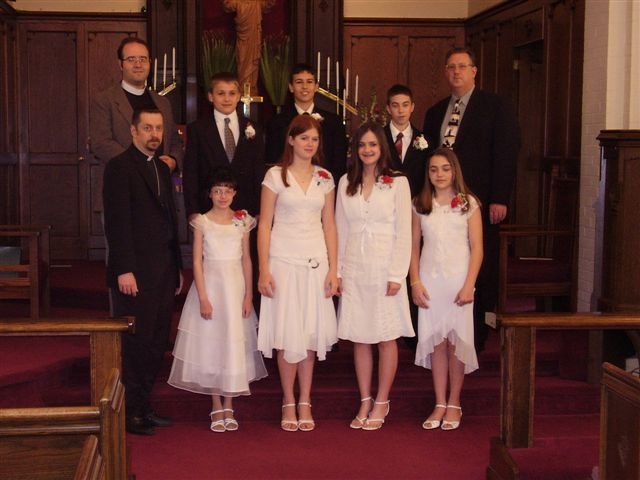
Confirmation at St. Paul's
Tomorrow the following young people will be examined publicly, confess their faith in the Savior who named them His own in Holy Baptism, and receive the Body and Blood of Jesus Christ (truly their baptismal birthright, but that is a matter for another day...):

07 April 2006
Weird Thought for the Day
What is the genus maiestaticum? Theosis in action!
In Christ our Lord, it is the confession that because of the personal union, the divine nature communicated its energies to the human nature, truly divinizing it, without the human nature becoming itself the divine nature. The iron placed in the fire takes on the attributes of fire without ever essentially ceasing to be iron.
So too with the Christian, a similar thing happens, though not through personal union but through mystical union which is accomplished via faith. The God-Man Christ communicates to us His divine energies, thus divinizing us without those properties of His divine nature ever becoming essential characteristics of the human nature.
How far does such divinization reach? Luther in Great Galatians:
"The one who has faith is a completely divine man, a son of God, the inheritor of the universe. He is the victor over the world sin, death, and the devil. Hence he cannot be praised enough... Therefore the Abraham who has faith fills heaven and earth; thus every Christian fills heaven and earth by his faith." (LW 26:247,248)
The implications of the above for the intercession of the saints is significant, it seems to me, for whom it is true that "they know" even as they have been known.
In Christ our Lord, it is the confession that because of the personal union, the divine nature communicated its energies to the human nature, truly divinizing it, without the human nature becoming itself the divine nature. The iron placed in the fire takes on the attributes of fire without ever essentially ceasing to be iron.
So too with the Christian, a similar thing happens, though not through personal union but through mystical union which is accomplished via faith. The God-Man Christ communicates to us His divine energies, thus divinizing us without those properties of His divine nature ever becoming essential characteristics of the human nature.
How far does such divinization reach? Luther in Great Galatians:
"The one who has faith is a completely divine man, a son of God, the inheritor of the universe. He is the victor over the world sin, death, and the devil. Hence he cannot be praised enough... Therefore the Abraham who has faith fills heaven and earth; thus every Christian fills heaven and earth by his faith." (LW 26:247,248)
The implications of the above for the intercession of the saints is significant, it seems to me, for whom it is true that "they know" even as they have been known.
Patristic Quote for the Day
When I say Paul, I don't mean just him, but also Peter and James and John and their whole company. For just as in a single lyre the strings are different, but they make a single harmonious sound, so too in the company of the Apostles the persons were different but the teaching was one and the same, since there was also a single artist, the Holy Spirit, who was setting their souls in motion. - St. John Chrysostom, *Homily on the Holy Martyr Ignatius of Antioch* par. 4.
06 April 2006
Patristic Quote for the Day
"And they learnt from the enthusiasm and experience of that noble man [St. Ignatius of Antioch], that it was not death toward which he ran, but a migration and translation, and ascent to heaven." - St. John Chrysostom, upon the Martyrdom of the Holy Martyr Ignatius (par. 13)
05 April 2006
Patristic Quote for the Day
God, who yearns for the salvation of all men and hungers after their deification, withers their self-conceit like the unfruitful fig tree (Matt 21:19-21). - St. Maximos, *First Century of Various Texts* Par. 74
04 April 2006
Tagged....
My SIL tagged me for these questions:
1. How many Bibles in your home? 30 (not counting the ones I use most often IN my iBook!)
2. What rooms are they in? The study, every bedroom, the family room.
3. What translations do you have? The Septuagint (hey, it's a translation!), NIV, NKJV, ESV, KJV, Philips, Good News, Spanish, German, AAT, New American, NASB, Jerusalem
4. Do you have a preference? My new 1611 KJV with Apocrpypha and funky spelling, saints days calendar, and other goodies.
5. Nominate an interesting verse.
How about 2 verses? Wisdome of Solomon II:23,24
For God created man to bee immortall, and made him to be an image of his owne eternitie. Neueverthelesse through enuie of the deuil came death into the world and they that doe holde of his side doe finde it.
Who to tag?
Petersen http://www.redeemer-fortwayne.org/blog.php
Fenton http://conversiaddominum.blogspot.com/
My buddy Sal (only person I know who gives me a run for my money in the hyper category!) http://lutherlebensstil.blogspot.com/
Chris Orr http://orrologion.blogspot.com
1. How many Bibles in your home? 30 (not counting the ones I use most often IN my iBook!)
2. What rooms are they in? The study, every bedroom, the family room.
3. What translations do you have? The Septuagint (hey, it's a translation!), NIV, NKJV, ESV, KJV, Philips, Good News, Spanish, German, AAT, New American, NASB, Jerusalem
4. Do you have a preference? My new 1611 KJV with Apocrpypha and funky spelling, saints days calendar, and other goodies.
5. Nominate an interesting verse.
How about 2 verses? Wisdome of Solomon II:23,24
For God created man to bee immortall, and made him to be an image of his owne eternitie. Neueverthelesse through enuie of the deuil came death into the world and they that doe holde of his side doe finde it.
Who to tag?
Petersen http://www.redeemer-fortwayne.org/blog.php
Fenton http://conversiaddominum.blogspot.com/
My buddy Sal (only person I know who gives me a run for my money in the hyper category!) http://lutherlebensstil.blogspot.com/
Chris Orr http://orrologion.blogspot.com
Okay, so this was too juicy not to share...
 So I'm reading on in St. Augustine, and he talks about the fall. About how as a consequence of Adam's sin, humanity is handed over to the devil. How does Scripture teach this handing over to the devil? Because God told the serpent: On your belly you shall go and *dust you shall eat.* Then he turns to the man and says: And you, sir, ARE dust! Do you think Adam looked at the serpent a little differently as it licked its chops? Is to that too cool or what?
Oh, and we have to see and rejoice that the Eternal Word of the Father became DUST so that swallowing him down unjustly the serpent might choke and death itself be undone! St. Augustine dwells extensively on the injustice of Satan taking Christ down in death as the cause of death's destruction and the end of Satan's reign over us.
Another Patristic quote for the Day
My friend, Mark Shane, alerted me to this passage in Augustine's *Of the Trinity* Book XIII which I had not seen before (or if I had, it had not registered). He also provided a number of patristic citations that run the reconciliation in the other direction, but those seem to refer to it in passing; this treats the matter in depth:
CHAP. 11.--A DIFFICULTY, HOW WE ARE JUSTITIFIED IN THE BLOOD OF THE SON OF GOD.
15. But what is meant by "justified in His blood?" What power is there in this blood, I beseech you, that they who believe should be justified in it? And what is meant by "being reconciled by the death of His Son?" Was it indeed so, that when God the Father was wroth with us, He saw the death of His Son for us, and was appeased towards us? Was then His Son already so far appeased towards us, that He even deigned to die for us; while the Father was still so far wroth, that except His Son died for us, He would not be appeased? And what, then, is that which the same teacher of the Gentiles himself says in another place: "What shall we then say to these things? If God be for us, who can be against us? He that spared not His own Son, but delivered Him up for us all; how has He not with Him also freely given us all things?" Pray, unless the Father had been already appeased, would He have delivered up His own Son, not sparing Him for us? Does not this opinion seem to be as it were contrary to that? In the one, the Son dies for us, and the Father is reconciled to us by His death; in the other, as though the Father first loved us, He Himself on our account does not spare the Son, He Himself for us delivers Him up to death. But I see that the Father loved us also before, not only before the Son died for us, but before He created the world; the apostle himself being witness, who says, "According as He hath chosen us in Him before the foundation of the world." Nor was the Son delivered up for us as it were unwillingly, the Father Himself not sparing Him; for it is said also concerning Him, "Who loved me, and delivered up Himself for me." Therefore together both the Father and the Son, and the Spirit of both, work all things equally and harmoniously; yet we are justified in the blood of Christ, and we are reconciled to God by the death of His Son.
CHAP. 11.--A DIFFICULTY, HOW WE ARE JUSTITIFIED IN THE BLOOD OF THE SON OF GOD.
15. But what is meant by "justified in His blood?" What power is there in this blood, I beseech you, that they who believe should be justified in it? And what is meant by "being reconciled by the death of His Son?" Was it indeed so, that when God the Father was wroth with us, He saw the death of His Son for us, and was appeased towards us? Was then His Son already so far appeased towards us, that He even deigned to die for us; while the Father was still so far wroth, that except His Son died for us, He would not be appeased? And what, then, is that which the same teacher of the Gentiles himself says in another place: "What shall we then say to these things? If God be for us, who can be against us? He that spared not His own Son, but delivered Him up for us all; how has He not with Him also freely given us all things?" Pray, unless the Father had been already appeased, would He have delivered up His own Son, not sparing Him for us? Does not this opinion seem to be as it were contrary to that? In the one, the Son dies for us, and the Father is reconciled to us by His death; in the other, as though the Father first loved us, He Himself on our account does not spare the Son, He Himself for us delivers Him up to death. But I see that the Father loved us also before, not only before the Son died for us, but before He created the world; the apostle himself being witness, who says, "According as He hath chosen us in Him before the foundation of the world." Nor was the Son delivered up for us as it were unwillingly, the Father Himself not sparing Him; for it is said also concerning Him, "Who loved me, and delivered up Himself for me." Therefore together both the Father and the Son, and the Spirit of both, work all things equally and harmoniously; yet we are justified in the blood of Christ, and we are reconciled to God by the death of His Son.
Patristic Quote for the Day
God made us so that we might become 'partakers of the divine nature' (2 Pet 1:4) and sharers in His eternity, and so that we might come to be like Him (cf. 1 John 3:2) through deification by grace. It is through deification that all things are reconstituted and achieve permanence; and it is for its sake that what is not is brought into being and given existence. - St. Maximos the Confessor, *First Century of Various Texts* par. 42
03 April 2006
Real Leadership
That's a book title by Dean Williams, prof at Harvard. In the book he makes this observation:
As individuals and in groups, people tend to shy away from addressing tough, complex, painful problems that are caused, perpetuated or protected by their own values, habits, and priorities. Rather than look at the reality of the predicament they are in, they often distort what they see, put the problems outside of themselves, scapegoat others, and create distractions - all as a way of distancing themselves from responsibility for the real issue. (pp. 10,11)
Indeed, it's always easier to look out the window than in the mirror...
As individuals and in groups, people tend to shy away from addressing tough, complex, painful problems that are caused, perpetuated or protected by their own values, habits, and priorities. Rather than look at the reality of the predicament they are in, they often distort what they see, put the problems outside of themselves, scapegoat others, and create distractions - all as a way of distancing themselves from responsibility for the real issue. (pp. 10,11)
Indeed, it's always easier to look out the window than in the mirror...
Patristic Quote for the Day
In His love for man, God became man that He might unite human nature to Himself and stop it from acting evilly towards itself, or rather from being at strife and divided against itself, and having no rest because of the instability of its will and purpose. – St. Maximos the Great, *First Century of Various Texts* par. 47
02 April 2006
Surprise Gifts!
So, Cindi and I were over at Matt and Sandy's playing pinochle (and they agree that PASSING makes for a much more exciting game - something that Randy and Rachel understand but that Cindi, Crys, Scott, Dave, Sharon, Richard, Peggy, Stu and Jenn have not figured out yet!!), when there was a ring on the doorbell and who should come walzing in? Lauren Elizabeth! She and Dean snuck home again from Seward. So we got to spend the weekend with her. What a joy! We miss her a great deal. It's just hard to get used to her not basically living with us anymore. So when I looked out at the first row today at early service and saw Anna, Lauren, Cindi, David, Bekah and Shawn, well, it MADE my weekend. And the icing on the cake was Bo at the late service! : ) Cindi drove Lauren back to Collinsville just a little bit ago so she and Dean could begin the journey back to Seward.
01 April 2006
Patristic Quote for the Day
 Do you see God's wisdom, how the greatest of evils, the ultimate disaster for us, which the Devil introduced (I mean death), how this changed into our honor and glory, because it led the athletes towards the prizes of martyrdom? So what? Should we give thanks to the Devil for death? Heaven forbid! For this isn't the outcome of his intent, but the gift of God's wisdom. He (the devil) introduced it so that it would destroy, and so that, when he brought it down to earth, he might cut off all hope of salvation; but Christ took it and converted it and, through it, led us back up to heaven. - St. John Chrysostom, *Homily on the Holy Martyrs* par. 2
31 March 2006
Patristic Quote for the Day
And why do I speak about martyrs? For if their Master is not ashamed to be our Head, by far more are they unashamed to be our limbs. For they possess a love that is firmly rooted, and it is the way of love to join and bind together what is divided, and it doesn't scrutinize the value. So then, just as they join in grieving for our sin, so we join in rejoicing over their good works. This is in fact what Paul ordered us to do, when he said to "rejoice with those who rejoice," and to "weep with those who weep." (Rom 12:15) - St. John Chrysostom, Homily on Saint Romanus, par. 2
30 March 2006
Patristic Quote for the Day
"That I shall be merciful to their wrongdoings and I shall no longer store in my memory their lawless ways." What did he mean? Here he indicates baptism and forgiveness through grace. This happened not under the law, but under the new covenant. For under the law there was punishment and torture and penalty punishing those who transgressed its edicts. Under the new covenant, grace and forgiveness of wrongdoings and absolution. That's why Paul also said: "Because God in Christ was reconciling the world to himself, not counting up their faults against them and placing on us the ministration of that reconciliation" (2 Cor. 5:19). Which is what the prophet says too: "I shall be merciful to their wrongdoings and I shall no longer store in my memory their sins."... when the law was dissolved, no one demanded payment for sins but each received forgiveness for his wrongdoings. - St. John Chrysostom, Homily on Eleazar and the Seven Boys (preaching on Jeremiah 31)
29 March 2006
Patristic Quote for the Day
How, then, isn't it absurd that in all worldly matters we put labors ahead of pleasure, and risks ahead of security, and this when the expected out of those labors is of little value and trivial; yet when it's heaven that lies ahead of us and angelic honors and a life that has no end and spending time with angels and the blessings of which one can neither conceive nor speak, we expect to achieve them through laziness and indolence and a dissolute soul and not to dignify them with the same effort as worldly matters? Don't, please, don't let's plan so badly for ourselves and for our salvation, but look to these saints, these noble and brave athletes, who have been given us in place of torches, and amend our life to their own courage and patience, so that after we depart this life by their prayers we might be able to both see and embrace them and be assigned to their heavenly dwellings. May we attain all these blessings through the grace and lovingkindness of our Lord Jesus Christ, through whom and with whom be glory to the Father and the Holy Spirit, forever and ever. Amen. - St. John Chrysostom, *An Encomium on Egyptian Martyrs*
28 March 2006
Patristic Quote for the Day
Did you hear Abraham saying in the Old Testament: "They will keep you for themselves, but will kill me"? Did you hear Jacob saying: "Snatch me away, Lord, from the hand of Esau, my brother, because I am afraid of him"? Did you see Elijah fleeing a woman's threat because of death? Hear how Paul is disposed regarding this matter - whether he considers it terrifying like they; whether he's distressed when it's approaching, and is afraid. To the contrary, he even thought the thing desirable. For this reason he says: "That I may depart and be with Christ is far better." To them it was terrifying, to him better. To them unpleasant, to him a pleasure. And rightly so! For previously death led us down into Hades. Now death sends us on to meet Christ.
- St. John Chrysostom, Sermon on Saints Bernike, Prosdoke, and Domnina, par. 9
- St. John Chrysostom, Sermon on Saints Bernike, Prosdoke, and Domnina, par. 9
Homily for Judica (Passion Sunday)
"Your father Abraham rejoiced to see my day. He saw it and was glad." So says our Lord in today's Gospel to the Jews. What did he mean? When did Abraham ever see Jesus' day? When did it fill his heart with joy? Well, we heard about it in today's first reading.
Faithful Abraham takes the wood for the offering and lays it on the back of his beloved son. Faithful Abraham takes in hand the fire and the knife. Faithful Abraham tells his servants: “The boy and I will go over there and worship, and then we shall come back to you.” Faithful Abraham and the beloved son move together toward the appointed mountain of sacrifice. And the beloved son, the child whose name meant laughter, the promised one through whose seed God would bring blessing to all the families of the earth, Isaac, notices that something is missing. He asks: “Father, we have the fire and the wood. But where is the lamb for the burnt offering?”
Faithful Abraham, seeing the Day of our Lord, answered his son in a remarkable prophesy: “God will provide himself a Lamb for the offering, my only son.”
What Abraham foresaw was not what took place shortly afterward on Mount Moria. For there, the life of Isaac was spared as the angel of the Lord revealed to Abraham a ram caught in a thicket by its horns.
Abraham did indeed offer up the ram in place of his son. Isaac’s life was spared by the mercy of God. But did you notice what Abraham called the place? “Yahweh Yireh.” The Lord WILL see to it; and to this day it is said, on the mountain of the Lord it WILL Be seen to. Will be, future tense. Not has been, past tense.
Abraham knew well enough that the ram was not the Lamb, but that the ram pointed to the Lamb, even as did his son, Isaac. For the day was coming when God would indeed provide– quite literally – himself as the Lamb for the offering. The day was coming when wood would be laid across the back of another Father’s beloved and only Son. The day was coming when that Father’s Son would climb a mountain with that wood upon his back, and this time, no ram in the thicket. This time, when the Son is bound to the wood for the offering, there is no angel to stay anyone’s hands. This time the hammer blows fall, the nails pierce, and the Lamb is spitted and hoisted high. This time the Son offers Himself to the Father in infinite love for our fallen race, and the Father in infinite love accepts and rejoices in the Son’s self-offering. “It is finished” he cried. The sins of all wiped out and the death of all destroyed.
“Your Father Abraham rejoiced to see my day.” Christ meant the day of His sacrifice's culmination. The day when the High Priest of the good things to come would enter with His own blood into the Most Holy Place in heaven once and for all, having obtained an eternal redemption. The day when the Mediator of the New Testament, by means of His death, would redeem everyone from their transgressions so that they might receive the promised eternal inheritance. (Epistle)
But what makes this sacrifice of the Lord Jesus so powerful that it can wipe out the sins of the world? How can the spilling of one man’s blood – even though He is the perfect man who never sinned – still, how can His blood blot out every accusation of the Law of God against you? Listen! He who is truth and does not lie, tells you: “Before Abraham was, I Am.”
Not by accident did they take up stones to kill him when they heard him say that. He had just made a claim that they could not misunderstand. In those words Jesus told them (and everyone who will ever hear them) that He is Yahweh. That it is He who called Abraham from Ur of the Chaldees and set him apart and promised that through him blessing would come to all families of the earth. He spoke to Moses in the burning bush and revealed His name: “I am who I am.” He led the children of Israel out of their bondage in Egypt. He parted the sea. He led them through on dry ground. He provided them manna from heaven in their forty-year wandering. He brought them into the promised land. He gave them their inheritance there. He sent them prophets to call them to repentance and faith, and now He had come among them in their own flesh and blood, to do for them and for all what He alone could do: yield His sinless life as the offering to take away the sins of the world. Not, however, by stoning, but by being crucified. And since His hour had not yet come, He hid himself and went out from the temple. But His hour would come; the moment when the Lamb foretold by Abraham would be sacrificed so that through Abraham’s Seed blessing – the blessing of eternal life – might indeed come upon all families of the earth.
So, then, when Jesus suffers, it is divine suffering. And when He bleeds, it is divine blood. And when He dies, it is a divine death. Who would dare to put a value on such suffering, blood, and death? The suffering, blood and death of God the Eternal Son is beyond calculation, without price! And that is Who ransomed you. He
thought you were worth that! Me too! Is that awesome or what?
Nor is that the end of the story. Because He knows how hard it is for us to believe that, and to hold on to it, on the mountain of the Lord it will be provided. What God once offered for you on Golgotha, He now offers to you on His altar – built up, you notice, like a little mountain. Here He gives you to eat and to drink as the continual memorial of His sacrifice, His body and His blood and He tells you that it is all for you: given in your place; poured out in your place, to blot out your sins. Here, He, who is before Abraham was, eternally is, comes to you, to be Your Lamb. Amen.
Faithful Abraham takes the wood for the offering and lays it on the back of his beloved son. Faithful Abraham takes in hand the fire and the knife. Faithful Abraham tells his servants: “The boy and I will go over there and worship, and then we shall come back to you.” Faithful Abraham and the beloved son move together toward the appointed mountain of sacrifice. And the beloved son, the child whose name meant laughter, the promised one through whose seed God would bring blessing to all the families of the earth, Isaac, notices that something is missing. He asks: “Father, we have the fire and the wood. But where is the lamb for the burnt offering?”
Faithful Abraham, seeing the Day of our Lord, answered his son in a remarkable prophesy: “God will provide himself a Lamb for the offering, my only son.”
What Abraham foresaw was not what took place shortly afterward on Mount Moria. For there, the life of Isaac was spared as the angel of the Lord revealed to Abraham a ram caught in a thicket by its horns.
Abraham did indeed offer up the ram in place of his son. Isaac’s life was spared by the mercy of God. But did you notice what Abraham called the place? “Yahweh Yireh.” The Lord WILL see to it; and to this day it is said, on the mountain of the Lord it WILL Be seen to. Will be, future tense. Not has been, past tense.
Abraham knew well enough that the ram was not the Lamb, but that the ram pointed to the Lamb, even as did his son, Isaac. For the day was coming when God would indeed provide– quite literally – himself as the Lamb for the offering. The day was coming when wood would be laid across the back of another Father’s beloved and only Son. The day was coming when that Father’s Son would climb a mountain with that wood upon his back, and this time, no ram in the thicket. This time, when the Son is bound to the wood for the offering, there is no angel to stay anyone’s hands. This time the hammer blows fall, the nails pierce, and the Lamb is spitted and hoisted high. This time the Son offers Himself to the Father in infinite love for our fallen race, and the Father in infinite love accepts and rejoices in the Son’s self-offering. “It is finished” he cried. The sins of all wiped out and the death of all destroyed.
“Your Father Abraham rejoiced to see my day.” Christ meant the day of His sacrifice's culmination. The day when the High Priest of the good things to come would enter with His own blood into the Most Holy Place in heaven once and for all, having obtained an eternal redemption. The day when the Mediator of the New Testament, by means of His death, would redeem everyone from their transgressions so that they might receive the promised eternal inheritance. (Epistle)
But what makes this sacrifice of the Lord Jesus so powerful that it can wipe out the sins of the world? How can the spilling of one man’s blood – even though He is the perfect man who never sinned – still, how can His blood blot out every accusation of the Law of God against you? Listen! He who is truth and does not lie, tells you: “Before Abraham was, I Am.”
Not by accident did they take up stones to kill him when they heard him say that. He had just made a claim that they could not misunderstand. In those words Jesus told them (and everyone who will ever hear them) that He is Yahweh. That it is He who called Abraham from Ur of the Chaldees and set him apart and promised that through him blessing would come to all families of the earth. He spoke to Moses in the burning bush and revealed His name: “I am who I am.” He led the children of Israel out of their bondage in Egypt. He parted the sea. He led them through on dry ground. He provided them manna from heaven in their forty-year wandering. He brought them into the promised land. He gave them their inheritance there. He sent them prophets to call them to repentance and faith, and now He had come among them in their own flesh and blood, to do for them and for all what He alone could do: yield His sinless life as the offering to take away the sins of the world. Not, however, by stoning, but by being crucified. And since His hour had not yet come, He hid himself and went out from the temple. But His hour would come; the moment when the Lamb foretold by Abraham would be sacrificed so that through Abraham’s Seed blessing – the blessing of eternal life – might indeed come upon all families of the earth.
So, then, when Jesus suffers, it is divine suffering. And when He bleeds, it is divine blood. And when He dies, it is a divine death. Who would dare to put a value on such suffering, blood, and death? The suffering, blood and death of God the Eternal Son is beyond calculation, without price! And that is Who ransomed you. He
thought you were worth that! Me too! Is that awesome or what?
Nor is that the end of the story. Because He knows how hard it is for us to believe that, and to hold on to it, on the mountain of the Lord it will be provided. What God once offered for you on Golgotha, He now offers to you on His altar – built up, you notice, like a little mountain. Here He gives you to eat and to drink as the continual memorial of His sacrifice, His body and His blood and He tells you that it is all for you: given in your place; poured out in your place, to blot out your sins. Here, He, who is before Abraham was, eternally is, comes to you, to be Your Lamb. Amen.
27 March 2006
Patristic Quote for the Day
Sacred love, permeating all from first to last, from head to foot, joins all to itself, links them up, ties together and unites, renders them strong and unshakable. In experience, it reveals itself to each man as one and the same. It is God with Whom the last may be first and the first last. - St. Simeon the New Theologian, *Practical and Theological Precepts* (#156)
26 March 2006
Patristic Quote for the Day
The Son of God has become the Son of Man in order to make us, men, sons of God, raising our race by grace to what He is Himself by nature, granting us birth from above through the grace of the Holy Spirit and leading us straightway to the kingdom of heaven, or rather, granting us the kingdom of heaven within us, in order that we should not merely be fed by the hope of entering it, but entering into full possession thereof should cry: our 'life is hid with Christ in God.'
Baptism does not destroy our self-will and wilfulness, but it frees us from the tyranny of the devil, who can no longer rule over us against our will. After baptism, it begins to lie within our will either of our own accord to obey the commandments of our Lord Jesus Christ, in Whose name were baptised, or to deviate from the right path, and return again to the devil, our adversary and foe.
- St. Simeon the New Theologian, *Practical and Theological Precepts* par. 120, 121
[I was struck by the similarity in thought in the second paragraph to the Formula's treatment in SD II:67, 68]
Baptism does not destroy our self-will and wilfulness, but it frees us from the tyranny of the devil, who can no longer rule over us against our will. After baptism, it begins to lie within our will either of our own accord to obey the commandments of our Lord Jesus Christ, in Whose name were baptised, or to deviate from the right path, and return again to the devil, our adversary and foe.
- St. Simeon the New Theologian, *Practical and Theological Precepts* par. 120, 121
[I was struck by the similarity in thought in the second paragraph to the Formula's treatment in SD II:67, 68]
25 March 2006
The Annunciation of Our Lord, God, and Savior Jesus Christ
 “And in the sixth month, the angel Gabriel was sent by God to a city of Galilee named Nazareth, to a virgin betrothed to a man whose name was Joseph, of the house of David. The Virgin’s name was Mary. And having come in, the angel...”
I stand amazed before the Maiden, and she looks in amazement at me. But my amazement is greater than hers. She is amazed at my appearing to her but I am amazed at the tidings I bring her. For she shall be a mother, though she knows not a man. She shall conceive in her womb and bring forth a son, though a virgin she shall be and remain. But it is who her son will be that fills me with greatest awe. For this Child that shall be born of her shall truly be hers. A human being exactly as she is a human being. A creature of flesh and blood. A creature that grows from childhood to adulthood. A creature that eats and sleeps and breathes and all that attends being human. Such a creature will her son be.
And that is why I stare at her in awe. For the little child that shall soon be conceived in her womb and that she shall feed at her breast is none other than the Son of the Highest, God the Son, the Eternal Word of the Father through whom I was made, through whom she was made, through whom all things are made. She shall be mother of the Maker. She shall be mother of the Eternal One who was before the stars began their shining or the planets began their great dance. She shall be mother of Him whom it is our delight to serve and worship and praise world without end.
The Child she bears shall reign over David’s house forever. The promise of the Kingdom that has no end is fulfilled in Him. A forever Kingdom! O Lady, do you know what that means? He will reign through endless days and those over whom He reigns will live in endless life. Lady, do you know that you will carry in your womb Him through whom death itself will be destroyed? Lady, do you know that through the deeds of your Son the sin that separates the human race from the all-holy Father will be covered, atoned, pardoned? Lady, do you know how He will do it? No. I can see that you do not know. That is best for now. The day will come when you stand on a darkened hill and see a sight of love so grievous that it will tear your soul in two. But it will be His love for you and for your fallen race that drives Him to it, Lady. So rejoice!
And do not worry yourself over how this promise I bring you will be fulfilled. God knows that you are a virgin. But His Holy Spirit will overshadow you and fill you and change you and inside of you Life Himself will begin to grow and so the Holy One born of you will indeed be my Master, my Lord, my God. It is impossible for any word of God to fail. His promises are more certain than heaven and earth. He said it and so, Lady, rejoice and be glad. It shall be so.
Meekly do I see you bow your head. Meekly do I hear you utter the words: “Behold, the maidservant of the Lord.” Meekly do I hear you say: “Let it be to me as you have said.” And so the moment has come and the great time of God’s keeping all his promises has begun. Begun in you, Lady. Begun in your womb, which He shall make His holy temple and His home for the next nine months during which His tiny infant heart will beat beneath your own, till that moment when the Lord blesses you and keeps you and makes His face shine upon you and gives you peace; that moment when your baby looks at you and nestles at your breast and closes his eyes in the peace and the warmth of your embrace. As you will hold him, so even now, does He hold you and all welcome Him.
Farewell, then, Lady until we meet once more, until together we bow before the Child you will bear and worship at His feet and give Him eternal praise in the Kingdom He comes to prepare, in the presence of all who have trusted in Your Son for forgiveness and salvation, in the life that has no end, where the joys are eternal and where the sorrows are forgotten. Farewell, Vessel of His grace! Farewell, Temple of the Presence! Farewell, Mary, child of David, child of Abraham, Mother of God! Farewell.
“And the angel departed from her.”
23 March 2006
Patristic Quote for the Day
It is the one Savior of his body, our Lord Jesus Christ, who prays for us and in us and is himself the object of our prayers. He prays for us as our priest, he prays in us as our head, he is the object of our prayers as our God. - St. Augustine, Commentary on the Psalms
21 March 2006
Patristic Quote for the Day
The Israelites saw the Lord's mighty power at work when He led them out of Egypt, but you have experienced even greater wonders. Instead of seeing Pharoah and his army drowning in the sea, you witnessed the devil and his forces swallowed up in the waters of baptism. The Israelites passed through the sea; you have passed from death to life. They were rescued from the Egyptians; you have been rescued from evil spirits. They were delivered from slavery in a foreign land; you have have been delivered from something worse - slavery to sin. - St. John Chrysostom
Happy Birthday, Bekah!
 Today the beautiful Rebekah Lee turns 15. And she already got her birthday present - her very own cell-phone. Now she is officially a REAL teenager (this is said to be determined by the possession of the phone, not her actually getting older). I still remember the day this girl was born - a beautiful and warm day in North Carolina, Spring in full swing. Looking outside the window today...well, a little different. Several inches of snow. I love snow, but NOT on my daughter's birthday. Ick! Nevertheless, may God grant her a joyful year of growth in His grace and love. We love, you Bekah Boo!
20 March 2006
Patristic Quote for the Day
[Because the Sundays of Lent are privileged, the Commemoration of St. Joseph is tranferred to today even though it fell yesterday]
If the Patriarch Joseph (sold by his brethren through envy, and forced into servitude in Egypt) was a type of Christ sold by his brethren and handed over to the Gentiles, the other Joseph (forced through the envy of Herod to flee into Egypt) did in actual fact bring Christ amongst the Egyptian Gentiles. The first Joseph (keeping faith with his lord) would not carnally know his lord's lady. The second Joseph (spiritually knowing the Lady who was the Mother of his Lord to be virgin) kept faithfully virgin toward her. To the first Joseph was given to know dark things in the interpretation of dreams. To the second Joseph was given in sleep to know the mysteries of the kingdom of heaven. - St. Bernard
If the Patriarch Joseph (sold by his brethren through envy, and forced into servitude in Egypt) was a type of Christ sold by his brethren and handed over to the Gentiles, the other Joseph (forced through the envy of Herod to flee into Egypt) did in actual fact bring Christ amongst the Egyptian Gentiles. The first Joseph (keeping faith with his lord) would not carnally know his lord's lady. The second Joseph (spiritually knowing the Lady who was the Mother of his Lord to be virgin) kept faithfully virgin toward her. To the first Joseph was given to know dark things in the interpretation of dreams. To the second Joseph was given in sleep to know the mysteries of the kingdom of heaven. - St. Bernard
19 March 2006
Homily for third Lenten Midweek
[Third in our series of midweek homilies focusing on the readings for the Easter Vigil]
Two weeks ago we rejoiced in Baptism as putting us into the eighth day of a new creation through the Resurrection of Christ. Last week we rejoiced in Baptism as the gift of death and new life. Tonight we see that our Baptism into Christ means exodus. It means leaving behind slavery and embracing freedom; it means leaving behind fear and embracing peace; it means leaving behind sorrow and embracing joy.
Before a person is baptized they are asked to do a strange thing. We ask it of children (who speak through their sponsors). We ask it of adults. It is called the renunciation. Do you renounce Satan? And all his works? And all his ways? This before the profession of faith. Years ago, the renunciation was made facing West, the place of the dying light, and the last act was actually spitting at Satan. Then the person was literally lifted up, faced east toward the rising sun and asked to confess faith in God, the Father, Son, and Holy Spirit. What on earth was the point of all that? It was meant to show and confess that in Baptism, Christ sets his people free from their bondage to Satan, to sin, and yes, even to death.
When God brought the children of Israel out of Egypt he prefigured for all time what he planned and intended to do for the whole human race through his Son. The children of Israel lived in Egypt as in exile. They knew it wasn’t home. They were not free. They were forced to work for others. Their lives were tears and hardship and backbreaking labor. But God in his great mercy had not forgotten his people. He sent them his servant Moses. Through the mounting tension of the ten plagues God hammered home to Pharaoh the message: “Let my people go!” Pharaoh’s heart was hard. He did not want to let the children of Israel go free. But finally he could not stand up to the terrible plague brought by the angel of death. He told the children of Israel to go, to get out.
And go they went. Moses led them and he led them in a peculiar way. He led them right up against the shores of the Red Sea. And in the time it had taken Moses to lead them there, Pharaoh had hardened his heart once more and all his armed might was sent to go and bring back the children of Israel, to make them slaves again.
At the shore of the sea, with their enemies closing in behind them, and nothing but water in front of them, God effected a mighty deliverance. His wind, His spirit, blew upon the waters and the waters parted and a way opened up right through the midst of the sea itself. The children of Israel raced into the heart of the sea and walked through towering walls of water on dry ground. When the Egyptians tried to pursue them, the waters collapsed and drowned horse and chariot. When it was all over, God’s children stood on the edge of the sea and looked back in fear and amazement. And then in overwhelming joy. Their slavery was really over! It was ended! God had brought them out with a mighty hand and an oustretched arm. The water had cut them off from the power of their enemies and they were free!
If you want to ever understand the joy of the first Christians over Easter, you must understand it from the perspective of this event. Just listen to one of the hymns we sing: “Come, ye faithful, raise the strain of triumphant gladness; God hath bro’t His Israel into joy from sadness. Loosed from Pharaoh's bitter yoke, Jacob's son and daughters, led them with unmoistened foot through the Red Sea waters.” The whole sad story of Israel in the land of Egypt was like the story of the whole human race. We were living in exile, born in a land that was not our true home, enslaved to sin, living in fear, and headed toward death. But into our darkness and sadness, God sent us a Mighty Deliverer. He broke the fetters that held us captive, he crushed Pharaoh Satan, and he led us straight through the waters to be a new people, a redeemed and rescued people. And the waters covered over and crushed our foes: sin, death, and the devil.
Baptism then marks a “cutting off” from the past. The beautiful prayer used in the Baptismal liturgy expresses this so well: “Almighty and everlasting God, who... didst drown obdurant Pharaoh with all his host in the Red Sea and didst safely lead Thy people Israel through the midst thereof, prefiguring thereby this washing of Thy Holy Baptism... look with favor upon this child and bless him in the Spirit with true faith that... being separated from the number of the unbelieving, he may be kept securely in the holy ark of the Christian Church and ever serve Thy name with fervent spirit and joyful hope.”
Baptism cuts us off from our slavery to Satan and to sin and to the “old ways” of unbelief in this world. It frees us from their tyranny! St. Paul put it like this: “Likewise you also, reckon yourselves to be dead indeed to sin, but alive to God in Christ Jesus our Lord. Therefore do not let sin reign in your mortal body, that you should obey it in its lusts. And do not present your members as instruments of unrighteousness to sin, but present yourselves to God as being alive from the dead, and your members as instruments of righteousness to God.” (Rom 6:11-13) He could speak that way because he had just reminded of them of their Baptism in which they had been buried with Christ and given his new life to live as their very own life.
So in your Baptism, my friends, Christ has severed you from the allegiance to Satan to which were bound by Adam’s fall. Christ has led you through the waters to set you free from that old Pharaoh, free from fear, free from bondage, free from sin, and yes, yes, most glorious of all, free from death.
Death was one of those enemies that drowned in the water. Baptism cuts us off from death. It does that by transforming death itself. We always hear “death” and think right away of biological death. But biological death is only the fruit, the symptom of the real thing: spiritual death. Death is separation from Him who is Life. Death is alienation from God. By his embracing of the way of suffering and death, by His going to His Cross, our Lord Jesus Christ has filled even suffering and death with his life and light and love. He has transformed death itself into a passage to life: “Jesus lives and now is death but the gate to life immortal! This shall calm my trembling breath when I pass death’s gloomy portal. Faith shall cry as fails each sense: Jesus is my confidence!” This is the joy of the Church! This is God’s gift to you in your Baptism! You live now cut off from your enemies and headed under God’s protecting hand to the land of promise. Baptized into Christ, you have nothing to fear! Glory to Jesus Christ! Glory be to Him forever!
Two weeks ago we rejoiced in Baptism as putting us into the eighth day of a new creation through the Resurrection of Christ. Last week we rejoiced in Baptism as the gift of death and new life. Tonight we see that our Baptism into Christ means exodus. It means leaving behind slavery and embracing freedom; it means leaving behind fear and embracing peace; it means leaving behind sorrow and embracing joy.
Before a person is baptized they are asked to do a strange thing. We ask it of children (who speak through their sponsors). We ask it of adults. It is called the renunciation. Do you renounce Satan? And all his works? And all his ways? This before the profession of faith. Years ago, the renunciation was made facing West, the place of the dying light, and the last act was actually spitting at Satan. Then the person was literally lifted up, faced east toward the rising sun and asked to confess faith in God, the Father, Son, and Holy Spirit. What on earth was the point of all that? It was meant to show and confess that in Baptism, Christ sets his people free from their bondage to Satan, to sin, and yes, even to death.
When God brought the children of Israel out of Egypt he prefigured for all time what he planned and intended to do for the whole human race through his Son. The children of Israel lived in Egypt as in exile. They knew it wasn’t home. They were not free. They were forced to work for others. Their lives were tears and hardship and backbreaking labor. But God in his great mercy had not forgotten his people. He sent them his servant Moses. Through the mounting tension of the ten plagues God hammered home to Pharaoh the message: “Let my people go!” Pharaoh’s heart was hard. He did not want to let the children of Israel go free. But finally he could not stand up to the terrible plague brought by the angel of death. He told the children of Israel to go, to get out.
And go they went. Moses led them and he led them in a peculiar way. He led them right up against the shores of the Red Sea. And in the time it had taken Moses to lead them there, Pharaoh had hardened his heart once more and all his armed might was sent to go and bring back the children of Israel, to make them slaves again.
At the shore of the sea, with their enemies closing in behind them, and nothing but water in front of them, God effected a mighty deliverance. His wind, His spirit, blew upon the waters and the waters parted and a way opened up right through the midst of the sea itself. The children of Israel raced into the heart of the sea and walked through towering walls of water on dry ground. When the Egyptians tried to pursue them, the waters collapsed and drowned horse and chariot. When it was all over, God’s children stood on the edge of the sea and looked back in fear and amazement. And then in overwhelming joy. Their slavery was really over! It was ended! God had brought them out with a mighty hand and an oustretched arm. The water had cut them off from the power of their enemies and they were free!
If you want to ever understand the joy of the first Christians over Easter, you must understand it from the perspective of this event. Just listen to one of the hymns we sing: “Come, ye faithful, raise the strain of triumphant gladness; God hath bro’t His Israel into joy from sadness. Loosed from Pharaoh's bitter yoke, Jacob's son and daughters, led them with unmoistened foot through the Red Sea waters.” The whole sad story of Israel in the land of Egypt was like the story of the whole human race. We were living in exile, born in a land that was not our true home, enslaved to sin, living in fear, and headed toward death. But into our darkness and sadness, God sent us a Mighty Deliverer. He broke the fetters that held us captive, he crushed Pharaoh Satan, and he led us straight through the waters to be a new people, a redeemed and rescued people. And the waters covered over and crushed our foes: sin, death, and the devil.
Baptism then marks a “cutting off” from the past. The beautiful prayer used in the Baptismal liturgy expresses this so well: “Almighty and everlasting God, who... didst drown obdurant Pharaoh with all his host in the Red Sea and didst safely lead Thy people Israel through the midst thereof, prefiguring thereby this washing of Thy Holy Baptism... look with favor upon this child and bless him in the Spirit with true faith that... being separated from the number of the unbelieving, he may be kept securely in the holy ark of the Christian Church and ever serve Thy name with fervent spirit and joyful hope.”
Baptism cuts us off from our slavery to Satan and to sin and to the “old ways” of unbelief in this world. It frees us from their tyranny! St. Paul put it like this: “Likewise you also, reckon yourselves to be dead indeed to sin, but alive to God in Christ Jesus our Lord. Therefore do not let sin reign in your mortal body, that you should obey it in its lusts. And do not present your members as instruments of unrighteousness to sin, but present yourselves to God as being alive from the dead, and your members as instruments of righteousness to God.” (Rom 6:11-13) He could speak that way because he had just reminded of them of their Baptism in which they had been buried with Christ and given his new life to live as their very own life.
So in your Baptism, my friends, Christ has severed you from the allegiance to Satan to which were bound by Adam’s fall. Christ has led you through the waters to set you free from that old Pharaoh, free from fear, free from bondage, free from sin, and yes, yes, most glorious of all, free from death.
Death was one of those enemies that drowned in the water. Baptism cuts us off from death. It does that by transforming death itself. We always hear “death” and think right away of biological death. But biological death is only the fruit, the symptom of the real thing: spiritual death. Death is separation from Him who is Life. Death is alienation from God. By his embracing of the way of suffering and death, by His going to His Cross, our Lord Jesus Christ has filled even suffering and death with his life and light and love. He has transformed death itself into a passage to life: “Jesus lives and now is death but the gate to life immortal! This shall calm my trembling breath when I pass death’s gloomy portal. Faith shall cry as fails each sense: Jesus is my confidence!” This is the joy of the Church! This is God’s gift to you in your Baptism! You live now cut off from your enemies and headed under God’s protecting hand to the land of promise. Baptized into Christ, you have nothing to fear! Glory to Jesus Christ! Glory be to Him forever!
18 March 2006
Patristic Quote for the Day
So let us take our part in the Passover prescribed by the law, not in a literal way, but according to the teaching of the Gospel; not in an imperfect way, but perfectly; not only for a time, but eternally. Let us regard as our home the heavenly Jerusalem, not the earthly one; the city glorified by angels, not the one laid waste by armies. We are not required to sacrifice young bulls or rams, beasts with horns and hoofs that are more dead than alive and devoid of feeling; but instead, let us join the choirs of angels in offering God upon his heavenly altar a sacrifice of praise. We must now pass through the first veil and approach the second, turning our eyes toward the Holy of Holies. I will say more: we must sacrifice ourselves to God, each day and in everything we do, accepting all that happens to us for the sake of the Word, imitating his passion by our sufferings, and honoring his blood by shedding our own. We must be ready to be crucified. - St. Gregory of Nazianzus, *Homily for Holy Week*
17 March 2006
In Honor of Saint Patrick
 St. Patrick's Breastplate:
I arise today
Through a mighty strength, the invocation of the Trinity,
Through the belief in the threeness,
Through confession of the oneness
Of the Creator of Creation.
I arise today
Through the strength of Christ's birth with his baptism,
Through the strength of his crucifixion with his burial,
Through the strength of his resurrection with his ascension,
Through the strength of his descent for the judgment of Doom.
I arise today
Through the strength of the love of Cherubim,
In obedience of angels,
In the service of archangels,
In hope of resurrection to meet with reward,
In prayers of patriarchs,
In predictions of prophets,
In preaching of apostles,
In faith of confessors,
In innocence of holy virgins,
In deeds of righteous men.
I arise today
Through the strength of heaven:
Light of sun,
Radiance of moon,
Splendor of fire,
Speed of lightning,
Swiftness of wind,
Depth of sea,
Stability of earth,
Firmness of rock.
I arise today
Through God's strength to pilot me:
God's might to uphold me,
God's wisdom to guide me,
God's eye to look before me,
God's ear to hear me,
God's word to speak for me,
God's hand to guard me,
God's way to lie before me,
God's shield to protect me,
God's host to save me
From snares of devils,
From temptations of vices,
From everyone who shall wish me ill,
Afar and anear,
Alone and in multitude.
I summon today all these powers between me and those evils,
Against every cruel merciless power that may oppose my body and soul,
Against incantations of false prophets,
Against black laws of pagandom
Against false laws of heretics,
Against craft of idolatry,
Against spells of witches and smiths and wizards,
Against every knowledge that corrupts man's body and soul.
Christ to shield me today
Against poison, against burning,
Against drowning, against wounding,
So that there may come to me abundance of reward.
Christ with me, Christ before me, Christ behind me,
Christ in me, Christ beneath me, Christ above me,
Christ on my right, Christ on my left,
Christ when I lie down, Christ when I sit down, Christ when I arise,
Christ in the heart of every man who thinks of me,
Christ in the mouth of everyone who speaks of me,
Christ in every eye that sees me,
Christ in every ear that hears me.
I arise today
Through a mighty strength, the invocation of the Trinity,
Through belief in the threeness,
Through confession of the oneness,
Of the Creator of Creation.
Patristic Quote for the Day
Rise, let us leave this place. The enemy led you out of the earthly paradise. I will not restore you to that paradise, but I will enthrone you in heaven. I forbade you the tree that was only a symbol of life, but see, I who am life itself am not one with you. I appointed cherubim to guard you as slaves are guarded, but now I make them worship you as God. The throne formed by cherubim waits for you, its bearers swift and eager. The bridal chamber is adorned, the banquet is ready, the eternal dwelling places are prepared, the treasure houses of all good things lie open. The kingdom of heaven has been prepared for you from all eternity. - Ancient Homily on Holy Saturday
[In the setting of the homily, Christ is speaking these words to Adam. I've produced it as it appears in the Breviary. I suspect the troublesome words about "now I make them worship you as God" are to be understood from the context of Christ Himself confessing unity with Adam: "For your sake, I, your God, became your son." A bit over the top, but it really drives home the same point that Lewis did in The Lion, the Witch and the Wardrobe. The thrones for which we are destined; the heights to which He has summoned us and prepared the way, and IS that way; and the shocking truth that the angels are made to SERVE us!]
[In the setting of the homily, Christ is speaking these words to Adam. I've produced it as it appears in the Breviary. I suspect the troublesome words about "now I make them worship you as God" are to be understood from the context of Christ Himself confessing unity with Adam: "For your sake, I, your God, became your son." A bit over the top, but it really drives home the same point that Lewis did in The Lion, the Witch and the Wardrobe. The thrones for which we are destined; the heights to which He has summoned us and prepared the way, and IS that way; and the shocking truth that the angels are made to SERVE us!]
16 March 2006
Homily for Oculi
St. John put it very simply: “This was the purpose of the appearing of the Son of God, to undo the work of the devil.” (1 John 3:8b). Jesus was doing just that – His work of setting free a man from a devil who held him speechless – when an argument broke out about him. By what power was he able to do this? Some actually said and thought that he was using Satan's power to drive the devils out.
Jesus is shocked by their illogic. He asks what happens to countries and families where people are fighting against each other? Do they stand strong or do they fall apart? They fall apart! Jesus asks: “Does it look to you like Satan’s kingdom is coming to pieces at the seams?” No way! Satan and all his demons are perfectly united in their opposition to the Kingdom of God and in their hatred and torture of the human race. There is no way that Jesus, breaking their power over human lives, could be doing so with their own power and permission.
Rather, this is how Jesus pictures the struggle: Satan is like a strong man, fully armed, who guards his own home and his goods. His home, unfortunately, is in the hearts and lives of humans. He lives there like a parasite, ultimately destroying the very lives that host him. And he guards his own home, always vigilant for any threat to his power.
But, says Jesus, along comes a stronger man – stronger than the strong man. That's our Lord! And he attacks Satan in the very place where he has set up his kingdom – the hearts of humanity. He attacks and defeats him there. He takes away his weapons on which he relied. His lies, his empty promises and deceits. And then he shows the devil the door; boots him out.
He exposes the lies of Satan above all by His cross - for there every lie that Satan has ever sold us on about our God is shown to be utterly false. The cross reveals the deepest truth about our God: His infinite love for all people that would bring Him to this immense suffering to take away the sin of the world and to destroy by His death the power of death. The cross reveals that God is pre-eminently FOR us. That He is on our side in this battle, that the Stronger One is our hero, come to do what we could never do for ourselves! And as our risen and reigning Lord He continues His great work of liberating folks from Satan's power.
How does he do all this in the lives of humanity? Listen to Dr. Luther on this: “For this task Christ left us designated instruments: holy baptism, the blessed Sacrament, the Word and absolution, and whatever else belongs to the ministry of preaching, in order to enable us to destroy the devil’s kingdom, to take from him his captives and cast him out of people. (HP 1, p. 330)”
Since we are all born under sin, rebels in our hearts, allied with Satan from birth, the first act of the Christian church in driving out the devil from the heart of men, is to baptize. In Baptism, Jesus arrives on the scene and shows Satan the door. It is not by accident that the first words of the Baptismal liturgy are: “Depart unclean spirit and make room for the Holy Spirit!” That’s what Baptism does. It drives out the devil.
But Jesus warned that Satan does not give up easily. Once driven out, he constantly seeks for entrance back in. It’s torture for an unclean spirit not to be resting in a human host. Jesus spoke of them seeking a place of rest. And so Jesus not only left the Church Baptism to drive Satan out, but also Absolution, the Word, and the Eucharist. The faithful use of them KEEPS him out!
Luther again: “When a person whom the devil has greatly overwhelmed and seared with many accusations comes to me with heavy heart and troubled conscience seeking comfort and instruction, I have the mandate, as does every Christian, to comfort my brother and pronounce God’s grace for Christ’s sake upon him. The devil must yield, not to me, a poor and wretched sinner, but to the Word which the Lord Christ left us on earth. When your conscience is weak and terrified, therefore, and you are unable to grasp tightly enough the comfort that God graciously wants you to have, the forgiveness of sins, then know that Christ has given the Lord’s Supper, his true body and blood to eat and to drink, so that you have no reason further to doubt that his body was given for your sins and his blood poured out for your transgressions. Where such faith and trust are present, it is impossible for the devil to dwell and hold sway. This work, therefore, must continue apace in Christendom, in order to drive out the devil by the finger of God.” (HP 1, p. 330, 331)
The Church has no other weapons for her battle with Satan than these means of grace: Baptism, the Gospel of Christ Crucified and Risen, Absolution, and Eucharist. Through these Jesus continues even to this day the work that he began when he walked the earth: his liberation of the hearts of men from the oppression of the devil, and returning them to what they were intended to be, homes for the Triune God.
It is small wonder, then, that Satan works with might and main to divert us from the faithful use of these means of grace – always suggesting that something else might be more important, more pressing, more engaging and entertaining, or attempting to seduce us to make of use of them only in a ritualistic way, without trusting in the promises they make to us. In today’s Epistle Paul warns of being seduced by Satan’s lies into returning to the bondage we were in before Christ liberated us. “Once you were darkness, but now you are light in the Lord. Live as children of the light!” As though he were to say: don’t leave the light of Christ’s Word and Sacraments, through them let Jesus dwell within you to drive all the darkness away!
A woman cried out after hearing Jesus teach: “Blessed the womb that bore you and the breasts that nursed you!” Jesus corrected her: “More blessed still are those who hear the Word of God and keep it.” He wasn’t putting his mother down. He was teaching us that the blessed of Mary – a blessed we can all share in – is that she welcomed and treasured and guarded the Word of God in her heart. She would not let Satan rob her of that treasure and that is why she is blessed among women.
The reason the Son of God appeared was to destroy the works of the devil. To drive him out and to keep him out. “Let us, therefore, thank God for his grace, because he has sent his Son for help against the devil, to drive him out, and has left us his Word through which today he yet performs this work, destroying Satan’s kingdom, building and extending the kingdom of God. God keep us in such grace through his son and the Holy Spirit. Amen. (HP 1, p. 343)” (Luther)
Jesus is shocked by their illogic. He asks what happens to countries and families where people are fighting against each other? Do they stand strong or do they fall apart? They fall apart! Jesus asks: “Does it look to you like Satan’s kingdom is coming to pieces at the seams?” No way! Satan and all his demons are perfectly united in their opposition to the Kingdom of God and in their hatred and torture of the human race. There is no way that Jesus, breaking their power over human lives, could be doing so with their own power and permission.
Rather, this is how Jesus pictures the struggle: Satan is like a strong man, fully armed, who guards his own home and his goods. His home, unfortunately, is in the hearts and lives of humans. He lives there like a parasite, ultimately destroying the very lives that host him. And he guards his own home, always vigilant for any threat to his power.
But, says Jesus, along comes a stronger man – stronger than the strong man. That's our Lord! And he attacks Satan in the very place where he has set up his kingdom – the hearts of humanity. He attacks and defeats him there. He takes away his weapons on which he relied. His lies, his empty promises and deceits. And then he shows the devil the door; boots him out.
He exposes the lies of Satan above all by His cross - for there every lie that Satan has ever sold us on about our God is shown to be utterly false. The cross reveals the deepest truth about our God: His infinite love for all people that would bring Him to this immense suffering to take away the sin of the world and to destroy by His death the power of death. The cross reveals that God is pre-eminently FOR us. That He is on our side in this battle, that the Stronger One is our hero, come to do what we could never do for ourselves! And as our risen and reigning Lord He continues His great work of liberating folks from Satan's power.
How does he do all this in the lives of humanity? Listen to Dr. Luther on this: “For this task Christ left us designated instruments: holy baptism, the blessed Sacrament, the Word and absolution, and whatever else belongs to the ministry of preaching, in order to enable us to destroy the devil’s kingdom, to take from him his captives and cast him out of people. (HP 1, p. 330)”
Since we are all born under sin, rebels in our hearts, allied with Satan from birth, the first act of the Christian church in driving out the devil from the heart of men, is to baptize. In Baptism, Jesus arrives on the scene and shows Satan the door. It is not by accident that the first words of the Baptismal liturgy are: “Depart unclean spirit and make room for the Holy Spirit!” That’s what Baptism does. It drives out the devil.
But Jesus warned that Satan does not give up easily. Once driven out, he constantly seeks for entrance back in. It’s torture for an unclean spirit not to be resting in a human host. Jesus spoke of them seeking a place of rest. And so Jesus not only left the Church Baptism to drive Satan out, but also Absolution, the Word, and the Eucharist. The faithful use of them KEEPS him out!
Luther again: “When a person whom the devil has greatly overwhelmed and seared with many accusations comes to me with heavy heart and troubled conscience seeking comfort and instruction, I have the mandate, as does every Christian, to comfort my brother and pronounce God’s grace for Christ’s sake upon him. The devil must yield, not to me, a poor and wretched sinner, but to the Word which the Lord Christ left us on earth. When your conscience is weak and terrified, therefore, and you are unable to grasp tightly enough the comfort that God graciously wants you to have, the forgiveness of sins, then know that Christ has given the Lord’s Supper, his true body and blood to eat and to drink, so that you have no reason further to doubt that his body was given for your sins and his blood poured out for your transgressions. Where such faith and trust are present, it is impossible for the devil to dwell and hold sway. This work, therefore, must continue apace in Christendom, in order to drive out the devil by the finger of God.” (HP 1, p. 330, 331)
The Church has no other weapons for her battle with Satan than these means of grace: Baptism, the Gospel of Christ Crucified and Risen, Absolution, and Eucharist. Through these Jesus continues even to this day the work that he began when he walked the earth: his liberation of the hearts of men from the oppression of the devil, and returning them to what they were intended to be, homes for the Triune God.
It is small wonder, then, that Satan works with might and main to divert us from the faithful use of these means of grace – always suggesting that something else might be more important, more pressing, more engaging and entertaining, or attempting to seduce us to make of use of them only in a ritualistic way, without trusting in the promises they make to us. In today’s Epistle Paul warns of being seduced by Satan’s lies into returning to the bondage we were in before Christ liberated us. “Once you were darkness, but now you are light in the Lord. Live as children of the light!” As though he were to say: don’t leave the light of Christ’s Word and Sacraments, through them let Jesus dwell within you to drive all the darkness away!
A woman cried out after hearing Jesus teach: “Blessed the womb that bore you and the breasts that nursed you!” Jesus corrected her: “More blessed still are those who hear the Word of God and keep it.” He wasn’t putting his mother down. He was teaching us that the blessed of Mary – a blessed we can all share in – is that she welcomed and treasured and guarded the Word of God in her heart. She would not let Satan rob her of that treasure and that is why she is blessed among women.
The reason the Son of God appeared was to destroy the works of the devil. To drive him out and to keep him out. “Let us, therefore, thank God for his grace, because he has sent his Son for help against the devil, to drive him out, and has left us his Word through which today he yet performs this work, destroying Satan’s kingdom, building and extending the kingdom of God. God keep us in such grace through his son and the Holy Spirit. Amen. (HP 1, p. 343)” (Luther)
Patristic Quote for the Day
For the sake of suffering humanity he came down from heaven to earth, clothed himself in that humanity in the Virgin's womb, and was born a man. Having then a body capable of suffering, he took the pain of fallen man upon himself; he triumphed over the diseases of soul and body that were its cause, and by his Spirit, which was incapable of dying, he dealt man's destroyer, death, a fatal blow. - Paschal Homily of Melito of Sardis
15 March 2006
The Sorrows of Death Compassed Me...
...yesterday we fed him with the bread of life, the very Body of Christ given for the forgiveness of sins, for the life of the world. Today he is with the Lord. "Lord, now lettest thou thy servant depart in peace" we sang in the ICU and He did.
She's facing a move to the nursing home. She hates the thought of it and what it means. Her son is suffering from cancer and in a room in the hospital not far from her own. It doesn't look good. Her daughter-in-law is under double-strain.
"The Lord doesn't give us more than we can bear" another friend said to me this week as she broke down, but she was really wondering if it was true. A parent's love for a child is beyond words.
Imogene called from Texas yesterday morning. She'd moved down there to be near her son. He died yesterday of pancreatic cancer. She's lost son and husband now. He'd come back to the Lord before he died; had received the Holy Eucharist. She had that comfort.
On and on and on. Is it any wonder the Church prays for mercy so often?
Lord, have mercy! Christ, have mercy! Lord, have mercy!
"then called I upon the name of the Lord." His name IS mercy. The Lord, the Lord, gracious and merciful. His gracious mercy shone in the gift of His Son into death for us. His gracious mercy shone in breaking the bonds of death and granting forgiveness to a a world. Help us believe, Lord. Help them all to cling to you!
She's facing a move to the nursing home. She hates the thought of it and what it means. Her son is suffering from cancer and in a room in the hospital not far from her own. It doesn't look good. Her daughter-in-law is under double-strain.
"The Lord doesn't give us more than we can bear" another friend said to me this week as she broke down, but she was really wondering if it was true. A parent's love for a child is beyond words.
Imogene called from Texas yesterday morning. She'd moved down there to be near her son. He died yesterday of pancreatic cancer. She's lost son and husband now. He'd come back to the Lord before he died; had received the Holy Eucharist. She had that comfort.
On and on and on. Is it any wonder the Church prays for mercy so often?
Lord, have mercy! Christ, have mercy! Lord, have mercy!
"then called I upon the name of the Lord." His name IS mercy. The Lord, the Lord, gracious and merciful. His gracious mercy shone in the gift of His Son into death for us. His gracious mercy shone in breaking the bonds of death and granting forgiveness to a a world. Help us believe, Lord. Help them all to cling to you!
Yet more Spring thoughts...
From the Akathist of thanksgiving:
Every flower is fragrant through the power of the Holy Spirit, in a delicate flow of aroma and tenderness of color; the beauty of the Great contained in what is small. Praise and honor to God Who gives life, Who spreads forth the meadows like a flowering carpet, Who crowns the fields with golden ears of wheat and azure basilisks, and the soul with the joy of contemplation. Let us rejoice and sing to Him: Alleluia!
How beautiful You are in the triumphant festival of spring, when all creatures come to life again and in a thousand ways joyfully call out to You; You are the source of life; You are the victor over death.
To the song of the nightingale, the valleys and forests stand in snow white bridal array by the light of the season. All the earth is Your bride, waiting for the immortal bridegroom. If You clothe even the grass is such splendid way, how will You transfigure us in the future age of resurrection, how will our bodies be made light and our souls be made luminous:
Glory to You, who brought out of the earth's darkness diversity of color, taste, and fragrance.
Glory to You, for the warmth and caress of all nature.
Glory to You, for surrounding us with thousands of Your creatures.
Glory to You, for the depth of Your wisdom reflected in the whole world.
Glory to You, I kiss reverently the footprint of Your invisible tread.
Glory to You, Who kindled before us the bright light of eternal life.
Glory to You, for the hope of immortal, ideal, incorruptible beauty.
Glory to You, O God, unto ages of ages!
Every flower is fragrant through the power of the Holy Spirit, in a delicate flow of aroma and tenderness of color; the beauty of the Great contained in what is small. Praise and honor to God Who gives life, Who spreads forth the meadows like a flowering carpet, Who crowns the fields with golden ears of wheat and azure basilisks, and the soul with the joy of contemplation. Let us rejoice and sing to Him: Alleluia!
How beautiful You are in the triumphant festival of spring, when all creatures come to life again and in a thousand ways joyfully call out to You; You are the source of life; You are the victor over death.
To the song of the nightingale, the valleys and forests stand in snow white bridal array by the light of the season. All the earth is Your bride, waiting for the immortal bridegroom. If You clothe even the grass is such splendid way, how will You transfigure us in the future age of resurrection, how will our bodies be made light and our souls be made luminous:
Glory to You, who brought out of the earth's darkness diversity of color, taste, and fragrance.
Glory to You, for the warmth and caress of all nature.
Glory to You, for surrounding us with thousands of Your creatures.
Glory to You, for the depth of Your wisdom reflected in the whole world.
Glory to You, I kiss reverently the footprint of Your invisible tread.
Glory to You, Who kindled before us the bright light of eternal life.
Glory to You, for the hope of immortal, ideal, incorruptible beauty.
Glory to You, O God, unto ages of ages!
Patristic Quote for the Day
It is he who was made man of the Virgin,
he who was hung on the tree;
it is he who was buried in the earth,
raised from the dead,
and taken up to the heights of heaven.
He is the mute lamb,
the slain lamb,
the lamb born of Mary, the fair ewe.
He was seized from the flock,
dragged off to be slaughtered,
sacrificed in the evening,
and buried at night.
On the tree no bone of his was broken;
in the earth his body knew no decay.
He is the one who rose from the dead,
and who raised man from the depth of the tomb.
(Paschal Homily of Melito of Sardis)
he who was hung on the tree;
it is he who was buried in the earth,
raised from the dead,
and taken up to the heights of heaven.
He is the mute lamb,
the slain lamb,
the lamb born of Mary, the fair ewe.
He was seized from the flock,
dragged off to be slaughtered,
sacrificed in the evening,
and buried at night.
On the tree no bone of his was broken;
in the earth his body knew no decay.
He is the one who rose from the dead,
and who raised man from the depth of the tomb.
(Paschal Homily of Melito of Sardis)
Oh, and speaking of Spring...
As vicar and I were driving in St. Louis yesterday we saw the daffodils coming out all along Highway 40, fluttering and dancing in the breeze, and that reminds of ANOTHER poem - Wordsworth, this time:
 I wandered lonely as a cloud
That floats on high o'er vales and hills,
When all at once I saw a crowd,
A host, of golden daffodils;
Beside the lake, beneath the trees,
Fluttering and dancing in the breeze.
Continuous as the stars that shine
And twinkle on the milky way,
They stretched in never-ending line
Along the margin of a bay:
Ten thousand saw I at a glance,
Tossing their heads in sprightly dance.
The waves beside them danced; but they
Out-did the sparkling waves in glee:
A poet could not but be gay,
In such a jocund company:
I gazed--and gazed--but little thought
What wealth the show to me had brought:
For oft, when on my couch I lie
In vacant or in pensive mood,
They flash upon that inward eye
Which is the bliss of solitude;
And then my heart with pleasure fills,
And dances with the daffodils.
 I wandered lonely as a cloud
That floats on high o'er vales and hills,
When all at once I saw a crowd,
A host, of golden daffodils;
Beside the lake, beneath the trees,
Fluttering and dancing in the breeze.
Continuous as the stars that shine
And twinkle on the milky way,
They stretched in never-ending line
Along the margin of a bay:
Ten thousand saw I at a glance,
Tossing their heads in sprightly dance.
The waves beside them danced; but they
Out-did the sparkling waves in glee:
A poet could not but be gay,
In such a jocund company:
I gazed--and gazed--but little thought
What wealth the show to me had brought:
For oft, when on my couch I lie
In vacant or in pensive mood,
They flash upon that inward eye
Which is the bliss of solitude;
And then my heart with pleasure fills,
And dances with the daffodils.
14 March 2006
Spring
As we drove to the Winkel today in Granite City, IL, vicar and I noticed the first greening of spring. And, as my son could tell you, whenever I notice that I HAVE to recite Robert Frost:
 Nature’s first green is gold,
Her hardest hue to hold.
Her early leaf’s a flower;
But only so an hour.
Then leaf subsides to leaf,
So Eden sank to grief,
So dawn goes down to day
Nothing gold can stay.
 Nature’s first green is gold,
Her hardest hue to hold.
Her early leaf’s a flower;
But only so an hour.
Then leaf subsides to leaf,
So Eden sank to grief,
So dawn goes down to day
Nothing gold can stay.
Patristic Quote for the Day
In Christ you were tempted, for Christ received his flesh from your nature, but by his own power gained salvation for you; he suffered death in your nature, but by his own power gained life for you; he suffered insults in your nature, but by his own power gained glory for you; therefore, he suffered in your nature, but by his own power gained victory for you. - St. Augustine, from a Homily for Invocabit
13 March 2006
Patristic Quote for the Day
In his humility, Christ entered the dark regions of our fallen world and he is glad that he became so humbled for our sake, glad that he came and lived among us and shared in our nature in order to raise us up again to himself. And even though we are told that he has now ascended above the highest heavens - the proof, surely, of his power and godhead - his love for man will never rest until he has raised our earthbound nature from glory to glory, and made it one with his own in heaven. - St. Andrew of Crete, Sermon for Palm Sunday
On the Use of My Writings...
...no, I didn't mean it like THAT. I meant when it comes to OTHERS making use of them...
A certain anonymous website has made much of the fact that a writing of mine was posted to a pro-Orthodox website dealing with helping Prots become Orthodox. A few facts:
1) I did not give permission for my writings to be posted on the site indicated.
2) The piece in question was originally posted on my blog in two separate places; my friend, Chris Orr (former WELS, now Orthodox), asked permission to put it on his blog and I gave that, in standing with an open policy on anything I write.
3) The piece in question, consists entirely of citations from the Lutheran Symbols; the unLutheran thing about this is?
I am somewhat at a loss to understand its usefulness to Orthodoxy, but whatever. It was intended to engender discussion about the nature of the "quia" subscription to the Symbols, a purely inter-Lutheran question, and one that was and is being discussed in the District I serve as the pastors of that District engage in a study of the Augsburg Confession.
So now you know...
A certain anonymous website has made much of the fact that a writing of mine was posted to a pro-Orthodox website dealing with helping Prots become Orthodox. A few facts:
1) I did not give permission for my writings to be posted on the site indicated.
2) The piece in question was originally posted on my blog in two separate places; my friend, Chris Orr (former WELS, now Orthodox), asked permission to put it on his blog and I gave that, in standing with an open policy on anything I write.
3) The piece in question, consists entirely of citations from the Lutheran Symbols; the unLutheran thing about this is?
I am somewhat at a loss to understand its usefulness to Orthodoxy, but whatever. It was intended to engender discussion about the nature of the "quia" subscription to the Symbols, a purely inter-Lutheran question, and one that was and is being discussed in the District I serve as the pastors of that District engage in a study of the Augsburg Confession.
So now you know...
12 March 2006
Hear ye! Hear ye!
It's all Vicar's fault. He bought it first, and I thought it looked really neat. Now I have my own copy and I honestly don't think I'll ever use anything else for my Bible: The Holy Bible 1611 Edition King James Version.
This remarkable publication of Hendrickson Publishing contains a photographic reprint of that classic 1611 translation. And it is THE WHOLE Bible - the Apocrpyha is included. There are table of readings (noting the major festivals and saint days of the year - for example, today is St. Gregory's Day) for Matins and Vespers. There are marginal notes when the scholars couldn't quite agree on the best rendering of the original into English. There are the delightfully unpredictable spellings - Psalm 58:4: "Their poison is like the poyson of a serpent; they are like the deafe adder that stoppeth her eare." Two different spelling of poison in the self-same verse!
If you are an English language buff, this version is a must. You can get your copy from Christian Book Distributors. You won't regret it!
[I should add that many Lutherans in America today are utterly unaware that until the adoption of English, no Bible published by CPH lacked the Apocrpha - it was because the Americans had dropped it from the KJV by then that the Lutherans allowed it to disappear, which is a crying shame. I think especially of something like Wisdom 2!]
This remarkable publication of Hendrickson Publishing contains a photographic reprint of that classic 1611 translation. And it is THE WHOLE Bible - the Apocrpyha is included. There are table of readings (noting the major festivals and saint days of the year - for example, today is St. Gregory's Day) for Matins and Vespers. There are marginal notes when the scholars couldn't quite agree on the best rendering of the original into English. There are the delightfully unpredictable spellings - Psalm 58:4: "Their poison is like the poyson of a serpent; they are like the deafe adder that stoppeth her eare." Two different spelling of poison in the self-same verse!
If you are an English language buff, this version is a must. You can get your copy from Christian Book Distributors. You won't regret it!
[I should add that many Lutherans in America today are utterly unaware that until the adoption of English, no Bible published by CPH lacked the Apocrpha - it was because the Americans had dropped it from the KJV by then that the Lutherans allowed it to disappear, which is a crying shame. I think especially of something like Wisdom 2!]
Homily for Reminscere
I didn't preach today, but here is a sermon for this Sunday from last year...
Homily for Reminscere (2005)
If you want to make sense out of the readings for Lent you need to remember that this season was designed as an instruction period for those who were new to Christ. So the first Sunday in Lent introduces the newbees to the devil. Let’s them know that yes, there really is an enemy out there literally hell-bent on destroying them and wiping out their faith in the God who is calling them to life in Jesus Christ. The first Sunday in Lent warns: Expect to be tempted, and prepare for all kinds of seduction because if the tempter can’t get at you one way, he’ll just try another. The Word of God, however, has the power to defeat and drive this enemy away.
The second Sunday introduces new Christians to a phenomenon that old Christians know well, but that will seem quite shocking to those who are just beginning to walk the way. We tell them not only do they have to deal with the devil roaring like a lion, looking for someone to devour, but they will have to content with another quite common and trying spiritual experience: getting the cold shoulder from God. Don’t be deceived we tell them. There are times that you pray and God’s answer to your prayer seems to drop on your plate before you even say “Amen” – but this Sunday warns: don’t get used to it and think that’s what it’s always like; it most certainly is not.
No, instead many times we struggle and wrestle with God in prayer, and like Jacob, we walk away limping. We cry out like the woman in today’s Gospel and we feel ignored, excluded and insulted. And what then? Do we give up and believe what the Enemy is whispering in our ear? When he tells us: See, it was all an illusion; there is no God to hear your prayer; or if there is a God who hears prayers, he sure as shootin’ isn’t listening to the prayers of someone like you. Should we just hang our heads and walk away from the whole Christianity thing and think: It’s no good; it’s not meant for me?
Today the Church urges you: Don’t do it! Don’t give into those despairing thoughts! Look at the little lady from Canaan and follow her example instead. She is a living enactment of our Lord’s words: “Ask and it shall be given to you; seek and you shall find; knock and the door shall be opened to you, for everyone who asks receives and he who seeks finds, and to him who knocks it shall be opened.”
She came to Jesus. Maybe she was trying to disguise the fact that she had no claim on him by using the title “Son of David.” “Son of David, have mercy on me. My daughter is severely demon-possessed.” One of Satan’s crew had a grabbed hold of her daughter like a bull-dog and wasn’t letting go; filling that poor child with the hatred and bitterness, the rage and anger and resentment that is the beating heart of hell. And when she hears that the great Healer has come into her area, it was like a gift from heaven. Never had any been known to cry to Him in vain. And so she runs to him and pleads.
But what is this treatment she receives? “He answered her not a word.” Even the disciples are shocked at how he treats this woman. They intervene on her behalf, but it does no good. He simply tells them: “I was not sent except to the lost sheep of the house of Israel.”
If she thought that she had fooled him by using the Messianic title “Son of David” that he might think her a Jew, she now knows that no one pulls the wool over Jesus’ eyes. He knows that she is not one of the chosen people. Does she slink off then? Does she give up? No! She falls down before him and insists: “Lord, help me!”
Surely now? But what does He say? “It is not good to take the children’s bread and throw it to the little dogs.”
He doesn’t just tell her that she is not one of the chosen people; He tells her she is a dog unworthy of the bread He was sent to give to His people. Now does she slink away? Now does she finally give up? No!
“Yes, Lord, yet even the little dogs eat the crumbs which fall from their masters’ table.” She only was asking for a crumb.
See how she wrestled with our Lord! See how she clung to His words! “I will not let you go until you bless me!” See how she let herself be emptied of every claim and yet still throw herself on His pity, mercy, and kindness! And see how see was not disappointed. “O woman, great is your faith, let it be to you as you desire.” “And her daughter was healed from that very hour.”
Study at this woman, the Church says to the new Christians, on this Sunday in Lent! Learn from her! When you pray, come to Jesus and bring your requests to him. Own up to the fact that you have no claim on Him for you are but a poor, miserable sinner, and yet do not cease to plead for His mercy. But if He seems to turn His back upon you, don’t believe it. Not for a second. You stick to Him like a burr on a dog. You hold Him tight and don’t let Him go.
You see, it’s His way to test those who come to Him. No two ways about it. He teaches them the long and hard way not to rely on themselves and their feelings and how they think things should go in their lives. He teaches them to trust in Him and in His great love and mercy and He does it by giving them the cold shoulder.
Think of it: this woman didn’t even know the whole story. Not like you do, and yet she clung to Him. How much more reason do you have not to give up on Him? After all, you know that where His love landed Him: upon the cross, laden with your sin! You know how He spilled His blood to wipe out your sin and undo your death and deliver to you the gift of eternal life.
St. Paul, in thinking about this, wrote: “He who did not spare His own Son but gave Him up for us all, how shall He not with Him freely give us all things?” Every time we share the Eucharist, eating the crumbs from His Table, our confidence is reinforced that the God who would do THIS for us can be trusted absolutely not to deny us or forsake us in the end – no matter what we may be going through right now.
And that’s what the Church would say to the newbies and, by way of reminder, to the old foggies too on this, the Second Sunday in Lent: Stick to Jesus and keep praying and asking, and no matter what. He uses the cold shoulder to bless you, for "tribulation will produce perseverance and perseverance, character, and character, hope, and that hope will not disappoint!" (Epistle for today) Amen.
Homily for Reminscere (2005)
If you want to make sense out of the readings for Lent you need to remember that this season was designed as an instruction period for those who were new to Christ. So the first Sunday in Lent introduces the newbees to the devil. Let’s them know that yes, there really is an enemy out there literally hell-bent on destroying them and wiping out their faith in the God who is calling them to life in Jesus Christ. The first Sunday in Lent warns: Expect to be tempted, and prepare for all kinds of seduction because if the tempter can’t get at you one way, he’ll just try another. The Word of God, however, has the power to defeat and drive this enemy away.
The second Sunday introduces new Christians to a phenomenon that old Christians know well, but that will seem quite shocking to those who are just beginning to walk the way. We tell them not only do they have to deal with the devil roaring like a lion, looking for someone to devour, but they will have to content with another quite common and trying spiritual experience: getting the cold shoulder from God. Don’t be deceived we tell them. There are times that you pray and God’s answer to your prayer seems to drop on your plate before you even say “Amen” – but this Sunday warns: don’t get used to it and think that’s what it’s always like; it most certainly is not.
No, instead many times we struggle and wrestle with God in prayer, and like Jacob, we walk away limping. We cry out like the woman in today’s Gospel and we feel ignored, excluded and insulted. And what then? Do we give up and believe what the Enemy is whispering in our ear? When he tells us: See, it was all an illusion; there is no God to hear your prayer; or if there is a God who hears prayers, he sure as shootin’ isn’t listening to the prayers of someone like you. Should we just hang our heads and walk away from the whole Christianity thing and think: It’s no good; it’s not meant for me?
Today the Church urges you: Don’t do it! Don’t give into those despairing thoughts! Look at the little lady from Canaan and follow her example instead. She is a living enactment of our Lord’s words: “Ask and it shall be given to you; seek and you shall find; knock and the door shall be opened to you, for everyone who asks receives and he who seeks finds, and to him who knocks it shall be opened.”
She came to Jesus. Maybe she was trying to disguise the fact that she had no claim on him by using the title “Son of David.” “Son of David, have mercy on me. My daughter is severely demon-possessed.” One of Satan’s crew had a grabbed hold of her daughter like a bull-dog and wasn’t letting go; filling that poor child with the hatred and bitterness, the rage and anger and resentment that is the beating heart of hell. And when she hears that the great Healer has come into her area, it was like a gift from heaven. Never had any been known to cry to Him in vain. And so she runs to him and pleads.
But what is this treatment she receives? “He answered her not a word.” Even the disciples are shocked at how he treats this woman. They intervene on her behalf, but it does no good. He simply tells them: “I was not sent except to the lost sheep of the house of Israel.”
If she thought that she had fooled him by using the Messianic title “Son of David” that he might think her a Jew, she now knows that no one pulls the wool over Jesus’ eyes. He knows that she is not one of the chosen people. Does she slink off then? Does she give up? No! She falls down before him and insists: “Lord, help me!”
Surely now? But what does He say? “It is not good to take the children’s bread and throw it to the little dogs.”
He doesn’t just tell her that she is not one of the chosen people; He tells her she is a dog unworthy of the bread He was sent to give to His people. Now does she slink away? Now does she finally give up? No!
“Yes, Lord, yet even the little dogs eat the crumbs which fall from their masters’ table.” She only was asking for a crumb.
See how she wrestled with our Lord! See how she clung to His words! “I will not let you go until you bless me!” See how she let herself be emptied of every claim and yet still throw herself on His pity, mercy, and kindness! And see how see was not disappointed. “O woman, great is your faith, let it be to you as you desire.” “And her daughter was healed from that very hour.”
Study at this woman, the Church says to the new Christians, on this Sunday in Lent! Learn from her! When you pray, come to Jesus and bring your requests to him. Own up to the fact that you have no claim on Him for you are but a poor, miserable sinner, and yet do not cease to plead for His mercy. But if He seems to turn His back upon you, don’t believe it. Not for a second. You stick to Him like a burr on a dog. You hold Him tight and don’t let Him go.
You see, it’s His way to test those who come to Him. No two ways about it. He teaches them the long and hard way not to rely on themselves and their feelings and how they think things should go in their lives. He teaches them to trust in Him and in His great love and mercy and He does it by giving them the cold shoulder.
Think of it: this woman didn’t even know the whole story. Not like you do, and yet she clung to Him. How much more reason do you have not to give up on Him? After all, you know that where His love landed Him: upon the cross, laden with your sin! You know how He spilled His blood to wipe out your sin and undo your death and deliver to you the gift of eternal life.
St. Paul, in thinking about this, wrote: “He who did not spare His own Son but gave Him up for us all, how shall He not with Him freely give us all things?” Every time we share the Eucharist, eating the crumbs from His Table, our confidence is reinforced that the God who would do THIS for us can be trusted absolutely not to deny us or forsake us in the end – no matter what we may be going through right now.
And that’s what the Church would say to the newbies and, by way of reminder, to the old foggies too on this, the Second Sunday in Lent: Stick to Jesus and keep praying and asking, and no matter what. He uses the cold shoulder to bless you, for "tribulation will produce perseverance and perseverance, character, and character, hope, and that hope will not disappoint!" (Epistle for today) Amen.
Subscribe to:
Posts (Atom)