11 October 2007
Patristic Quote for the Day
Rather, since it is through death that God arranged to give us the Kingdom of the Resurrection, and incorruptibility and all of life everlasting, yet we already, without a doubt, become in soul partakers and communicants here below of the future good things, and as it were incorruptible and immortal and sons of God and sons of light and of the day, heirs of the Kingdom of heaven. -- St. Symeon the New Theologian, *On the Mystical Life* p. 164


Old Lutheran Quote of the Day
It is precisely the freedom of faith that liberates the worshipping Christian to practice the humility of submitting to the forms as an expression of servant love to the neighbor. -- Ken Korby, *Lively Function of the Gospel* p. 71
Further Thoughts on Preaching
This past Sunday's sermon was reviewed on KFUO's Issues, Etc. yesterday. You can listen here:
Issues
I found out about it at Bible Class last night! Pastor Wilken commented specifically about the ending - how it didn't put you back under the law - and I certainly hope that it didn't. What I'd suggest was the basic pattern of the sermon was: Law/Gospel/Mysical Union. A rather typical approach for me.
I think the mystical union is simply the key ingredient that is too often missing in homilies. It's how the life described BY the law comes to be LIVED by the Christian - that is, by faith's union with Jesus Christ. "That Christ be formed in you" was the Apostle's way of putting it. I'd argue that it gives you what folks concerned about third use are looking for, but does so without the impression of being left "under law." It also then is something different than the generic: "so come receive the Eucharist." Thoughts?
Issues
I found out about it at Bible Class last night! Pastor Wilken commented specifically about the ending - how it didn't put you back under the law - and I certainly hope that it didn't. What I'd suggest was the basic pattern of the sermon was: Law/Gospel/Mysical Union. A rather typical approach for me.
I think the mystical union is simply the key ingredient that is too often missing in homilies. It's how the life described BY the law comes to be LIVED by the Christian - that is, by faith's union with Jesus Christ. "That Christ be formed in you" was the Apostle's way of putting it. I'd argue that it gives you what folks concerned about third use are looking for, but does so without the impression of being left "under law." It also then is something different than the generic: "so come receive the Eucharist." Thoughts?
10 October 2007
On Jacob's Ladder
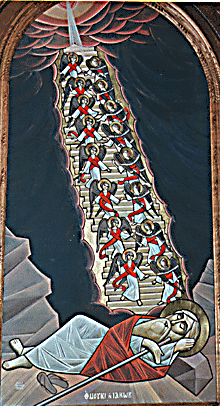 [The Chapel Homily this morning, in brief] I think he misses the whole point. He is lying down and looking up. He thinks the ground is holy there. What's holy is the man lying on the ground. He's one of the rungs in the ladder by which the God of Abraham would step down from heaven to earth in human flesh. Angels go up and down those stairs, accompanying the whole glorious condescension!
Some people think the Church is "holy ground" - "the house of God, the gate of heaven." It is, of course. But it is such because of the Person about whom we gather there. The God of Abraham who took the final step off the last rung, the Blessed Virgin, and stepped out upon the earth, the God who will not leave us or forsake us until He has brought us home again. HE is the promised offspring through whom all the families of the earth will be blessed. He is the union of heaven and earth, for He is both God and Man in His person, and by His holy cross and passion He has flung wide the kingdom of heaven to all believers.
Not the place, Jacob. YOU. Your flesh and blood - one of the precious rungs by which the Eternal Word stepped forth into human flesh. Glory to You, O Christ and to Your condescension!
Wonderful Wednesday
First, it's chilly. Feels GREAT. The sky is deep blue, though we've had lots of fall clouds too. And Cindi made Pumpkin Cheesecake last night.
Second, it was Parent's Day at our school, so when I did chapel this a.m. we had a church full to sing Matins - and sing it they did. But WHERE is Trinity's *Accompaniment to the Liturgy*???
Third, it's the day I get to study the Scriptures with fellow pastors. We meet at St. John's in Maryville at 10 and study for an hour and then go to lunch. The "mutuum fratrem" was the sacrament it always is, and the lunch was a new place for me - a Greek place in Collinsville, 20 minutes from home. How sweet is that? Saganki and Gyro Salad. Scrumptious!
Fourth, I get to preach and celebrate the Eucharist tonight for Pastor Curtis. Forgiveness and life, here I come! I tried to get out of doing it because it butts right up against our Bible Class, but Pastor Curtis doesn't take no for an answer. And I'm kind of glad he doesn't. Bible Class, hang on! I'll be there. Promise.
Fifth, I get to continue teaching Old Testament Catechesis and tonight is the Passover. So after tasting Passover's fulfillment, I get to talk about it. How sweet is that, I ask you?
Sixth, Compline wraps up the day: "Into your hands, O Lord..."
Oh, and seventh, maybe: a fire in my new outdoor fire place thingy. It's definitely cool enough!
Second, it was Parent's Day at our school, so when I did chapel this a.m. we had a church full to sing Matins - and sing it they did. But WHERE is Trinity's *Accompaniment to the Liturgy*???
Third, it's the day I get to study the Scriptures with fellow pastors. We meet at St. John's in Maryville at 10 and study for an hour and then go to lunch. The "mutuum fratrem" was the sacrament it always is, and the lunch was a new place for me - a Greek place in Collinsville, 20 minutes from home. How sweet is that? Saganki and Gyro Salad. Scrumptious!
Fourth, I get to preach and celebrate the Eucharist tonight for Pastor Curtis. Forgiveness and life, here I come! I tried to get out of doing it because it butts right up against our Bible Class, but Pastor Curtis doesn't take no for an answer. And I'm kind of glad he doesn't. Bible Class, hang on! I'll be there. Promise.
Fifth, I get to continue teaching Old Testament Catechesis and tonight is the Passover. So after tasting Passover's fulfillment, I get to talk about it. How sweet is that, I ask you?
Sixth, Compline wraps up the day: "Into your hands, O Lord..."
Oh, and seventh, maybe: a fire in my new outdoor fire place thingy. It's definitely cool enough!
Christ the High Priest
Tonight I'll be subbing for Pastor Curtis at our sister parish's Wednesday Eucharist. We'll be using the Votive of Christ the High Priest. The Gospel for this is a great passage from Luke 22:14-20. Our Lord has a gift for His people. He's been aching to give it to them. Looking forward to it for the longest time - even longer than His incarnation. Throughout the long history of Israel He was forever dropping hints about it: Melchizedek and his bread and wine; the Passover itself; manna in the wilderness; Elijah's miraculous meal that brought him to the mountain of God. Many, many more. Teasing little hints dropped here and there: "Open your mouth wide and *I* will fill it!" Psalm 81. "I will lift up the cup of thanksgiving and call on the name of the Lord." Psalm 116 "I will make my wonders to be remembered." Psalm 111 On and on the hints go and grow: "I will cut a new covenant with the house of Israel and with the house of Jacob...I will forgive their iniquities and their sins I will remember no more." Brighter and brighter it shines.
But at last comes the wondrous moment when the veil is removed and the time for prophetic types and hints is gone: "This is my body given for you; this cup is the new testament in my blood, shed for you, for forgiveness." A gift reached them by hands soon to be pierced by nails.
The Eucharist. The great gift that has been in the heart and mind of God from the start, and which He ached to give us, longed to impart. Now it is here. This is the point of it all. What you were made for: to be a temple of God, a dwelling place for Him through His Spirit and in the Body and Blood of the Eternal Logos made flesh.
Receiving the gift in awe and wonder and love, we can't help but marvel at how great a God we have, who plans and carries out such great things on our behalf. Glory to Him! Glory to Him forever!
But at last comes the wondrous moment when the veil is removed and the time for prophetic types and hints is gone: "This is my body given for you; this cup is the new testament in my blood, shed for you, for forgiveness." A gift reached them by hands soon to be pierced by nails.
The Eucharist. The great gift that has been in the heart and mind of God from the start, and which He ached to give us, longed to impart. Now it is here. This is the point of it all. What you were made for: to be a temple of God, a dwelling place for Him through His Spirit and in the Body and Blood of the Eternal Logos made flesh.
Receiving the gift in awe and wonder and love, we can't help but marvel at how great a God we have, who plans and carries out such great things on our behalf. Glory to Him! Glory to Him forever!
When Our Lord
asks a question, we do well to ponder it. In this coming Sunday's Gospel the question is: "Which is easier, to say, 'Your sins are forgiven,' or to say, 'Rise and walk?'"
As true God and Man our Lord could heal the paralytic. But that healing would not do much good apart from forgiveness. For it would only be temporary and then death and judgment. But with forgiveness, we can lie on our mats and die in peace.
For forgiveness was not easier. It was the harder thing to say. It was spoken as promise that the holy blood of Christ would blot out the sin of the world; it hinged upon the mystery of the Holy Cross.
Whenever He speaks His forgiveness to you, it is not mere words. They are blood-soaked words; gifts of His very life given up for you. And because He has spoken those words to you, you will indeed on the last day rise, take up our mat, and head home. His home. For you will be forgiven AND healed.
Glory to Your cross, O Lord, and to Your condescension!
As true God and Man our Lord could heal the paralytic. But that healing would not do much good apart from forgiveness. For it would only be temporary and then death and judgment. But with forgiveness, we can lie on our mats and die in peace.
For forgiveness was not easier. It was the harder thing to say. It was spoken as promise that the holy blood of Christ would blot out the sin of the world; it hinged upon the mystery of the Holy Cross.
Whenever He speaks His forgiveness to you, it is not mere words. They are blood-soaked words; gifts of His very life given up for you. And because He has spoken those words to you, you will indeed on the last day rise, take up our mat, and head home. His home. For you will be forgiven AND healed.
Glory to Your cross, O Lord, and to Your condescension!
Patristic Quote for the Day
Indeed, with reverence for the price paid on our behalf, and with love for our Master who paid it, and as having accepted His love for us, let us recognize that, if He had not wished to save by means of Himself us who have been purchased, He would not have come down to earth, nor would He have been slain for our sake. But, as it is written, He has done this because He wills that all should be saved. --St. Symeon the New Theologian, *On the Mystical Life* p. 89
Old Lutheran Quote of the Day
Theology is interpretation of God's Word and not the exercise of human wit in the field of the divine mysteries. And the Sacrament of the Altar is not primarily a theoretical, doctrinal problem, as some theologians seem to think. Even our orthodox fathers in the seventeen century never forgot that. All dogmatic work concerning this Sacrament, all endeavours to preserve the pure doctrine of Holy Writ on this "sacrament sacramentorum" must have the purpose to help the Church celebrate this sacrament with the deep reverence and devotion we can learn from Martin Luther and from the early Lutheran Church which speaks to us in the confessions and liturgies of the sixteen century still today. -- Hermann Sasse, *Scripture and the Church* pp. 316, 317
09 October 2007
Odd Things You Learn About Your Neighbors
Tonight Pastor Curtis and I had a school board meeting to attend. While waiting for the meeting to begin, the conversation wandered into the area of food and hunting. Pastor Curtis, you see, is an avid hunter. I am not. If I had to deal with meat in anything but packaged form, I am certain I'd be a vegetarian. In fact, just TALKING to Pastor Curtis is enough to send me running for my copy of Laurel's Kitchen! Tonight Pastor Curtis had some of "Doris." Yes, "Doris." He NAMES the poor beast that he shoots before he stores it away in the freezer as an aid to remembering WHEN the slaughter took place, I believe. So the Curtis family feasted tonight on Doris. I ate hamburger and was rather thankful that I didn't know by name the beast from which it came!
Tis a Hoot!
Okay, I wasn't going to blog on this, but it is too funny. Earlier today a friend sent me this gem:
WELS Q&A
Go visit. Talk about a bunch of bologna!
Now, if someone tells me "You're too catholic" I usually say "Thank you! Let's talk about that!" But when someone accuses me of being a ROMANIST, well, that's just going too far!
Um, as the dear Reverend Dean of the Society of St. Polycarp, Pastor Larry Beane, points out, the Society is committed to a quia subscription to the Book of Concord, and the Book of Concord prohibits invocation of the saints. Next question? I find it VERY humorous.
Except that they should have contacted the Dean and gotten the straight scoop rather than inventing something out of their own imagination. Kyrie eleison!
WELS Q&A
Go visit. Talk about a bunch of bologna!
Now, if someone tells me "You're too catholic" I usually say "Thank you! Let's talk about that!" But when someone accuses me of being a ROMANIST, well, that's just going too far!
Um, as the dear Reverend Dean of the Society of St. Polycarp, Pastor Larry Beane, points out, the Society is committed to a quia subscription to the Book of Concord, and the Book of Concord prohibits invocation of the saints. Next question? I find it VERY humorous.
Except that they should have contacted the Dean and gotten the straight scoop rather than inventing something out of their own imagination. Kyrie eleison!
Entrance Hymn
for this coming Sunday's liturgy (where the OT reading is Genesis 28 - Jacob's vision):
Only-begotten, Word of God eternal,
Lord of creation, merciful and mighty:
Hear us, Your servants, as our tuneful voices
Rise in Your presence.
Holy this temple where our Lord is dwelling;
This is none other than the gate of heaven.
Ever Your children year by year rejoicing,
Chant in Your temple.
Hear us, O Father, as we throng Your temple.
By Your past blessings, by Your present bounty,
Smile on Your children and in grace and mercy
Hear our petition.
God in three persons, Father everlasting,
Son coeternal, ever blessed Spirit:
To You be praises, thanks and adoration,
Glory forever.
Latin: 9th Century
LSB #916
Only-begotten, Word of God eternal,
Lord of creation, merciful and mighty:
Hear us, Your servants, as our tuneful voices
Rise in Your presence.
Holy this temple where our Lord is dwelling;
This is none other than the gate of heaven.
Ever Your children year by year rejoicing,
Chant in Your temple.
Hear us, O Father, as we throng Your temple.
By Your past blessings, by Your present bounty,
Smile on Your children and in grace and mercy
Hear our petition.
God in three persons, Father everlasting,
Son coeternal, ever blessed Spirit:
To You be praises, thanks and adoration,
Glory forever.
Latin: 9th Century
LSB #916
Old Lutheran Quote of the Day
There is no more damning indictment of a theologian than to say that he knows nothing about liturgy. -- Hermann Sasse, *Scripture and the Church: Selected Essays* p. 41
Patristic Quote for the Day
What "throne of grace" is he speaking of? that royal throne concerning which it is said, "The Lord said unto my Lord, Sit on My right hand." ( Ps. cx. 1 .)
What is "let us come boldly"? Because "we have a sinless High Priest" contending with the world. For, says He, "Be of good cheer, I have overcome the world" ( John xvi. 33 ); for, this is to suffer all things, and yet to be pure from sins. Although we (he means) are under sin, yet He is sinless.
How is it that we should "approach boldly"? Because now it is a throne of Grace, not a throne of Judgment. Therefore boldly, "that we may obtain mercy," even such as we are seeking.
--St. John Chrysostom, Homily 7 on Hebrews
What is "let us come boldly"? Because "we have a sinless High Priest" contending with the world. For, says He, "Be of good cheer, I have overcome the world" ( John xvi. 33 ); for, this is to suffer all things, and yet to be pure from sins. Although we (he means) are under sin, yet He is sinless.
How is it that we should "approach boldly"? Because now it is a throne of Grace, not a throne of Judgment. Therefore boldly, "that we may obtain mercy," even such as we are seeking.
--St. John Chrysostom, Homily 7 on Hebrews
You know you've made it in blogdom...
...when folks write and ask you to mention their sites so that others may find them. LOL!
I'm happy to do so, and I am not trying to being a snob about not listing my favorite blog sites on this page. I just don't know how to do it. It wasn't an option in the template I chose to start this blog with and I'm not about to go around scrounging in the depths of Blogger to figure out how to fix it. So I've just made it a habit to mention names of blogs along the way and that will have to do.
Today I got a request from Philip Hoffman from Minnesota. His blog is located here:
http://prairieponderings07.blogspot.com/
Philip's first post there is on not letting come unglued the Gospel believed and lived. Quite an incarnational start to his writings and I look forward to reading some more of his work, and I think you might too. Yet another to add to blogrolls (which is really a great time saver! - thanks to Pastor Charles Lehmann for pointing me to it!).
I'm happy to do so, and I am not trying to being a snob about not listing my favorite blog sites on this page. I just don't know how to do it. It wasn't an option in the template I chose to start this blog with and I'm not about to go around scrounging in the depths of Blogger to figure out how to fix it. So I've just made it a habit to mention names of blogs along the way and that will have to do.
Today I got a request from Philip Hoffman from Minnesota. His blog is located here:
http://prairieponderings07.blogspot.com/
Philip's first post there is on not letting come unglued the Gospel believed and lived. Quite an incarnational start to his writings and I look forward to reading some more of his work, and I think you might too. Yet another to add to blogrolls (which is really a great time saver! - thanks to Pastor Charles Lehmann for pointing me to it!).
You Know You're Getting Old When...
...a book arrives. You look at it and say to yourself: I don't remember ordering it, but I must have, for here it is. And you cheerfully go on with that assumption and yet it never occurs to you that it was a GIFT sent to you by someone else. Thanks, Lauren and Dean! Thanks for the book (really) and thanks for making the old man feel even older (really too). ;)
08 October 2007
The Fifth Setting
Reformation is approaching and this year we'll use the 5th Setting of the Divine Service from LSB for our worship that day.
The Confession and Absolution and Entrance Hymn is the same as DS III, but then you move into a different world. Instead of the traditional Kyrie there is Hymn #942; instead of the traditional Gloria in Excelsis there is Hymn #948 or #947. Salutation and collect follow, and then first reading, Psalm or Gradual, second reading and Hymn of the Day. The Holy Gospel is announced and read and the Creed is sung in metrical paraphrase #954 or #953. The sermon follows. The Prayer of the Church is based on Luther's paraphrase of the Our Father. Then the offering is gathered as the altar is prepared. After the preface (invariable, based on Luther's Deutsche Missa), the Our Father and Verba follow and the great hymn "Isaiah, Mighty Seer" - a peculiar form of the Sanctus. Pax Domini and Agnus lead to distribution. Then a post-communion hymn ("O Lord, We Praise You") and collect, benedicamus and benediction.
This is clearly an adaptation of Luther's Chorale Mass, the German Mass, and the vitality and vibrancy of the Reformation rings through the texts. It is not the Divine Service that we're most accustomed to, but it has its own richness and beauty. I'm glad we'll celebrate it - even if only once a year.
The Confession and Absolution and Entrance Hymn is the same as DS III, but then you move into a different world. Instead of the traditional Kyrie there is Hymn #942; instead of the traditional Gloria in Excelsis there is Hymn #948 or #947. Salutation and collect follow, and then first reading, Psalm or Gradual, second reading and Hymn of the Day. The Holy Gospel is announced and read and the Creed is sung in metrical paraphrase #954 or #953. The sermon follows. The Prayer of the Church is based on Luther's paraphrase of the Our Father. Then the offering is gathered as the altar is prepared. After the preface (invariable, based on Luther's Deutsche Missa), the Our Father and Verba follow and the great hymn "Isaiah, Mighty Seer" - a peculiar form of the Sanctus. Pax Domini and Agnus lead to distribution. Then a post-communion hymn ("O Lord, We Praise You") and collect, benedicamus and benediction.
This is clearly an adaptation of Luther's Chorale Mass, the German Mass, and the vitality and vibrancy of the Reformation rings through the texts. It is not the Divine Service that we're most accustomed to, but it has its own richness and beauty. I'm glad we'll celebrate it - even if only once a year.
So what exactly IS LSB?
Certain ex-Lutherans who happen to be good friends of mine, argue that it is inaccurate to speak of LSB as the Synod's official liturgy. I think they have a vested answer to the question. But let's let the LSB itself answer:
The Preface to LSB notes:
"Officially accepted at the Synod's 2004 convention, Lutheran Service Book is a careful blending of the best of The Lutheran Hymnal and Lutheran Worship. It offers treasured melodies and texts that have nourished God's people for generations.... Lutheran Service Book is offered with the prayer that it may be used in all its fullness to give voice to the prayer, praise, and thanksgiving of God's holy people as they are graciously served by Him through Word and Sacrament."
From the Preface to the Altar Book:
"There are two levels of rubrics that are used in the Altar Book.
* Rubrics - Rubrics are italicized directions in red that are used throughout the service to describe how the rite is to be conducted....
* 'May' rubrics - Rubrics that contain the word 'may' are optional and may or may not be followed accoording to the needs of the particular circumstances or according to pastoral judgment."
And that's precisely how St. Paul's has received LSB - a great resource that guides us into giving fuller voice to the prayer, praise, and thanksgiving of God's holy people as He serves us in Word and Sacrament. It is "ordo" or "use" precisely as Lutherans use such things - freed from the burden of "law" and received and rejoiced in as Gospel-bearing, that is, Christ-bearing. We live within the structure it provides in the freedom afforded with the "may" rubrics.
The Preface to LSB notes:
"Officially accepted at the Synod's 2004 convention, Lutheran Service Book is a careful blending of the best of The Lutheran Hymnal and Lutheran Worship. It offers treasured melodies and texts that have nourished God's people for generations.... Lutheran Service Book is offered with the prayer that it may be used in all its fullness to give voice to the prayer, praise, and thanksgiving of God's holy people as they are graciously served by Him through Word and Sacrament."
From the Preface to the Altar Book:
"There are two levels of rubrics that are used in the Altar Book.
* Rubrics - Rubrics are italicized directions in red that are used throughout the service to describe how the rite is to be conducted....
* 'May' rubrics - Rubrics that contain the word 'may' are optional and may or may not be followed accoording to the needs of the particular circumstances or according to pastoral judgment."
And that's precisely how St. Paul's has received LSB - a great resource that guides us into giving fuller voice to the prayer, praise, and thanksgiving of God's holy people as He serves us in Word and Sacrament. It is "ordo" or "use" precisely as Lutherans use such things - freed from the burden of "law" and received and rejoiced in as Gospel-bearing, that is, Christ-bearing. We live within the structure it provides in the freedom afforded with the "may" rubrics.
Great Thought
"Only respect for the liturgy's fundamental unsponteneity and pre-existing identity can give us what we hope for: the feast in which the great reality comes to us that we ourselves do not manufacture but receive as a gift."
Now, who wrote it and where? And what do you think of it?
Now, who wrote it and where? And what do you think of it?
Patristic Quote for the Day
 What He says, is of this kind: Marvel not that I am to be lifted up that you may be saved, for this seems good to the Father, and He has so loved you as to give His Son for slaves, and ungrateful slaves. Yet a man would not do this even for a friend, nor readily even for a righteous man; as Paul has declared when he said, "Scarcely for a righteous man will one die." ( Rom. v. 7 .) Now he spoke at greater length, as speaking to believers, but here Christ speaks concisely, because His discourse was directed to Nicodemus, but still in a more significant manner, for each word had much significance. For by the expression, "so loved," and that other, "God the world," He shows the great strength of His love. Large and infinite was the interval between the two. He, the immortal, who is without beginning, the Infinite Majesty, they but dust and ashes, full of ten thousand sins, who, ungrateful, have at all times offended Him; and these He "loved." Again, the words which He added after these are alike significant, when He says, that "He gave His Only-begotten Son," not a servant, not an Angel, not an Archangel. And yet no one would show such anxiety for his own child, as God did for His ungrateful servants.
His Passion then He sets before him not very openly, but rather darkly; but the advantage of the Passion He adds in a clearer manner, saying, "That every one that believes in Him. should not perish, but have everlasting life." For when He had said, "must be lifted up," and alluded to death, lest the hearer should be made downcast by these words, forming some mere human opinions concerning Him, and supposing that His death was a ceasing to be, observe how He sets this right, by saying, that He that was given was "The Son of God," and the cause of life, of everlasting life. He who procured life for others by death, would not Himself be continually in death; for if they who believed on the Crucified perish not, much less does He perish who is crucified. He who takes away the destitution of others much more is He free from it; He who gives life to others, much more to Himself does He well forth life. Do you see that everywhere there is need of faith? For He calls the Cross the fountain of life; which reason cannot easily allow, as the heathens now by their mocking testify. But faith which goes beyond the weakness of reasoning, may easily receive and retain it. And whence did God "so love the world"? From no other source but only from his goodness. - St. John Chrysostom, Homily on John 3
Subscribe to:
Posts (Atom)