From my friend, Pr. Gernander. I was so blessed to read this today:
Sermon #1,555: St. Luke 14:15-24 (Historic Gospel)
6-26-22, Trinity 2, Hope-Leander TX
“INVITED BY THE GOSPEL”
Sermon Text, St. Luke 14:15-24 (v. 16-17). 16 [Jesus] said to him, “A man once gave a great banquet and invited many. 17 And at the time for the banquet he sent his servant to say to those who had been invited, ‘Come, for everything is now ready.’ ”
Lord, this is Your Word and these are Your words. Sanctify us by the truth. Your Word is truth. By Your Word of truth, lead us on the way of truth to be eager to sit at Your feast of salvation, Make us eager to invite others, and bring them too. Amen!
Dear people loved by God in Christ: Grace to you and peace from God the Father and our Lord and Savior Jesus Christ. Amen.
This week the big news was that the Supreme Court decision was announced, overturning Roe v. Wade. It cancelled the so-called constitutional legality of abortion. But there was a reaction that was heartbreaking to see: people threatening violence and shouting in favor of keeping the “right” to kill the weakest and littlest. A deafening chorus of angry people, effectively saying to children in the womb: “We don’t want you.”
How opposite of that is what we see from Jesus in this parable. The words Jesus puts in the mouth of the master, who represents God, are about how He wants everyone. Not just the ones who have it all together, but the downtrodden and the ones who are nothing but trouble, “the poor and crippled and blind and lame.” He wants them too. He wants everyone.
That’s what it means to be invited: to be wanted. All through this parable the master is inviting.
Jesus says he “invited many.” The word for invited here is actually “called.” The first thing we learn about the Holy Spirit in the catechism is that “He has called me by the gospel.” When God calls you, He’s just inviting you. It means He wants you. The Gospel is the way you know that He wants you. So He makes sure you hear this loud and clear, that you are wanted,
Invited, By the Gospel
I. His invitation can be rejected. Jesus’ parable starts out as an answer to this man at the table who says, rather smugly: “Blessed is everyone who will eat bread in the kingdom of God!” He seems to be expecting a pat on the back from Jesus. Instead Jesus tells this parable which is a warning. A warning not to reject the invitation and lose the kingdom.
Jesus seems to be implying that this man is in danger of rejecting the invitation. Which seems odd because he’s there at the table with Jesus. But if you think that “accepting” the invitation is something you get credit for, then it isn’t grace, which means it isn’t true saving faith. That would be rejecting God’s gift. Jesus isn’t being hard on the man. He tells this parable because He cares about him. He cares about you too.
So, the invitation. Jesus says: “A man once gave a great banquet and invited many.” Actually He says the man “made” this great supper, prepared it, and tells his servant to tell the “many” who are invited that “everything is now ready.” This is Jesus’ first point, the preparing. It’s about the salvation God’s prepared. The Father so loved the world that He gave His only Son. Christ came down from heaven and did all the work to save us. Then the Holy Spirit does His part: to call (invite) people by the Gospel, by Word and Sacrament. The standard ELS invitation to the Lord’s Supper is for the pastor to say this verse from Jesus’ parable: “Come, for all things are ready.”
So this is all beautiful, the careful preparing of our salvation, but then in Jesus’ story we see a sad result. All we hear are excuses. One doesn’t come for this reason, one doesn’t come for that reason. Now, we get exasperated with these people, but the truth is it’s exactly how we are, how we are by nature.
If you find this hard to believe, if you love to come to church, you love Jesus and His Word, you think it’s just natural. But it isn’t. The fact that you feel this way is a sign that the Holy Spirit is leading and guiding you, that He has success in changing and melting your stubborn heart. But if you get bored with God’s Word, if you find other things to do, if you get embarrassed by the Bible’s teaching, if you lose patience with people, make excuses – that’s how we naturally are!
We cannot by our own reason or strength believe in Jesus or come to Him. All we are able to do is reject the invitation. What we’re good at is excuse-making! Now, this frustrates us about ourselves and it frustrates us when we see it in others.
Because this frustrates us, we’re tempted to use the Law to overcome it. God’s way of invitation seems weak. So for some people even a religion like Islam or Mormonism looks attractive at this point, at least some elements of it. Because these religions use threat and guilt and force to produce godliness. Their results look better. But it’s only outward righteousness. It doesn’t produce confidence before God, or give peace.
But we’re tired of the excuses people make, we’re tired of the excuses we make, we’re tired of shoddy Christianity. So we turn to the Law. We guilt others, we guilt ourselves, into better behavior. We look to what we do. Where we are lacking, we depend on our determination to do better. See how the devil gets you to force your way into God’s kingdom, not to be content with God’s inviting. He makes a new god for you: your own obedience. But in the end, we’re fooling ourselves. Your works of the Law aren’t the way in; they would leave you outside. But now for the truth that does comfort:
II. His invitation is His declaration that He wants you. This is the Gospel. It’s the only way He brings people in, keeps us in.
The part of Jesus’ story where this comes out is when the master sends His servant to “bring in the poor and crippled and blind and lame.” These are people who can’t bring themselves. They’re helpless. That’s how we are, Jesus is saying. It’s consistent with the rest of Scripture that teaches that you are totally unable by your own ability, reason, or strength to come to faith in Jesus or even to keep and hold onto this faith.
Now for the big finish: We hear the master say: “Go out to the highways and hedges and compel people to come in.”
Now this sounds wrong. Dragging them in, it sounds like forcing, exactly what God doesn’t do! But it isn’t an outward forcing, like dragging someone to church. It isn’t the work of the Law that does this. Jesus is here describing the power of the Gospel. That’s what the invitation is: only gospel. The message of the Law, of obedience to the commandments, can never bring someone into the kingdom. It can only prepare you to hear the Gospel. Only the Gospel can convert someone, and it isn’t a message of anger but purely a message of God’s love.
But the Gospel is not just magic, as if you just speak it and all this will happen. The Gospel has power, but it is the power of God to bring salvation. God is involved. The Holy Spirit is a hard worker. So this “compelling” is the hard work of speaking the Word to a heart that doesn’t want to hear it.
It’s the work of “forcing the sins into the conscience” (Luther: Church Postil), so that you’re forced to acknowledge your sins, and your conscience is weighed down and burdened and finding no peace, and all this is so that you are ready to hear that there is a Savior for you, Christ who has done it all, paid it all, to free you from your sin, to lift your load, to forgive it all!
You never would believe it. You never could believe it. But Christ looks at you in your sins and through His called servant He says He wants you. You! He invites you to be with Him. His invitation is something that He brings you to accept. It’s grace!
The Gospel that you hear is Jesus inviting you. All the time. That’s what life in His kingdom is: always being invited. There is no time when He’s not inviting you. In Your baptism He invited you,so each time we begin “In the name of the Father and of the Son and of the Holy Spirit,” the baptism words, it’s a sign that He’s inviting you, He wants you, you’re His child.
When you hear His Word, hear what He your Savior did, He did it for you! He’s inviting you as you read or hear His Word.
In the Lord’s Supper, Jesus’ words “This is My body …” etc., certainly do something to the elements; through the words the bread is now also His body and the wine is His blood. But His words of institution also do something to you, and I love how speaking the words behind this altar, facing the congregation, it’s obvious that as you hear “this is My body given for you … this is My blood shed for you for the remission of sins,” Jesus, who is speaking in the Lord’s Supper, is inviting you.
He’s always inviting you. So this is how to think of yourself: you are “the invited one.” You are one who is wanted, by God! This is really how heaven sees you. This parable is showing us a preview of heaven, which Scripture pictures as a great supper, where we’ll see all the people He’s invited and brought in.
This teaches us to see everyone else as “an invited one.” Not as people who are better or worse than you. Not as people who irritate you or who are irritated by you. That’s all gone, see, if we all are invited, wanted, by Him!
He calls you to see the other person as one invited by Him, one to whom He speaks the Gospel, which removes sin. His invitation is not for you alone, to remove your sin. It also removes everything that stands between you and others. His invitation calls you to not give up on anyone, but emblazoned on them you are to see: “Invited!” Which is emblazoned on you. You are the same. We are united. By His invitation. All, together, wanted by Him. Amen!
26 June 2022


Well…that was fun…
…and exhausting! The 2022 Making the Case Conference is over…and its schedule was smashed to smithereens (without even seeming to bother my boss…even when I helpfully pointed it out to him…again and again and again). Personal highlights this year were hearing my friends, Chris Rosebrough and Bryan Wolfmueller. They’re both so very good as teachers of God’s precious Word. But of course, my absolute favorite is the hymn sing. The conference was in exceptionally fine voice this year as we sang our way through various hymns of cross and comfort, with Professor Jonathan Kohrs on the organ and Pr. Leonard Payton on the piano. To quote one of my favorite Christmas hymns “tiding of comfort and joy” indeed. This year my pastor (Pr. Benjamin Ball) served as the celebrant at the closing Divine Service, at which Pr. Wilken preached a wonderful sermon on the Gospel reading from Matthew 10 (we were celebrating the Anniversary of the Augsburg Confession on Saturday). When the Divine Service was all over, I was shocked that Pr. Ball was planning to go out with friends! Then I remembered something Pr. Bill Cwirla taught me years ago: Extraverts energize through socializing. I knew he was getting up early to get back to St. Paul’s for late service! Yikes!!!! Trust me, by the end of the conference, this introvert was DONE with people. Cindi and I decided to try to find a Brazilian Steakhouse (that was a mistake; memo to self: don’t try to find anything around Chicago at night!!!) so nearly an hour later, we made our way back to our hotel where we finally got to order dinner and a glass of wine sometime after 9:30 p.m. Whew. We were both starved and so we each ate two one-half pound burgers topped with cheese and bacon. We woofed it down (I know, Thomas Aquinas says that’s gluttony). Cindi quipped we were “channeling our inner Krauser” since my friend Jim Krauser (New York!) often eats so very late. When we finished dinner, we headed straight to bed and next thing we knew it was morning. We had a rather uneventful trip home (with some slight backups on 55, but nothing like Friday’s trip TO Chicago). So at long last this hobbit is back home and in bliss again. It was wonderful to meet folks up there and to hear some stories, particularly of those new to our Lutheran Confession (one of whom gave me a chaplet that I’m eager to learn how to pray). Glory be to God!!!
25 June 2022
Ann Sexton’s poem
Somebody who should have been born
is gone.
Just as the earth puckered its mouth,
each bud puffing out from its knot,
I changed my shoes, and then drove south.
Up past the Blue Mountains, where
Pennsylvania humps on endlessly,
wearing, like a crayoned cat, its green hair,
its roads sunken in like a gray washboard;
where, in truth, the ground cracks evilly,
a dark socket from which the coal has poured,
Somebody who should have been born
is gone.
the grass as bristly and stout as chives,
and me wondering when the ground would break,
and me wondering how anything fragile survives;
up in Pennsylvania, I met a little man,
not Rumpelstiltskin, at all, at all…
he took the fullness that love began.
Returning north, even the sky grew thin
like a high window looking nowhere.
The road was as flat as a sheet of tin.
Somebody who should have been born
is gone.
Yes, woman, such logic will lead
to loss without death. Or say what you meant,
you coward…this baby that I bleed.
is gone.
Just as the earth puckered its mouth,
each bud puffing out from its knot,
I changed my shoes, and then drove south.
Up past the Blue Mountains, where
Pennsylvania humps on endlessly,
wearing, like a crayoned cat, its green hair,
its roads sunken in like a gray washboard;
where, in truth, the ground cracks evilly,
a dark socket from which the coal has poured,
Somebody who should have been born
is gone.
the grass as bristly and stout as chives,
and me wondering when the ground would break,
and me wondering how anything fragile survives;
up in Pennsylvania, I met a little man,
not Rumpelstiltskin, at all, at all…
he took the fullness that love began.
Returning north, even the sky grew thin
like a high window looking nowhere.
The road was as flat as a sheet of tin.
Somebody who should have been born
is gone.
Yes, woman, such logic will lead
to loss without death. Or say what you meant,
you coward…this baby that I bleed.
24 June 2022
GLORIA IN EXCELSIS DEO!
I was 12 when it happened. I am so thankful at 61 to see the insanity overturned. Thank you, Lord Jesus! Please help us always to love and treasure the most vulnerable among us!
Patristic Quote of the Day
By the “woman clothed with the sun,” he meant most manifestly the church, endued with the Father’s Word, whose brightness is above the sun.—Hippolytus, On the Antichrist
Catechesis: The Cause of Sin
Our churches teach that although God creates and preserves nature, the cause of sin is located in the will of the wicked, that is, the devil and ungodly people. Without God’s help, this will turns itself away from God, as Christ says, “When he lies, he speaks out of his own character.”—AC XIX
Luther
God is such a Craftsman that He has the skill to make those things that would harm and hinder us help and further us. What would do us to death must serve us unto life; what would bring us into sin and condemnation must serve to make hope and faith firmer within us, to make prayer stronger and more richly answered.—Exposition, Jn xv
23 June 2022
Patristic Quote of the Day
However, since the veil of the ancient temple and the wall of partition have now been torn asunder by the sword of the blood of the Lord, in the church, the temple of the living God, whose citizenship is in heaven, the ark of his incarnation is laid open to all the world.—The Venerable Bede on Rev. 11:19
Luther
He sometimes lets a conscience be afraid and troubled, in order that the soul, even in the happy days, may not forget the fear of God.—Exposition of the Lord’s Prayer
Catechesis: Ceremonies
Our churches teach that ceremonies ought to be observed that may be observed without sin. Also, ceremonies and other practices that are profitable for tranquility and good order in the church (in particular, holy days, festivals, and the like) ought to be observed.—AC XV
21 June 2022
Patristic Quote of the Day
The number of months signifies not only the time of the last persecution, but also the entire time of Christianity.—Primasius on Rev. 11:2
Luther
Thus God acts in all His works. When He wills to bring us to life, He puts us to death; when He wills to make us saintly, He smites our conscience and makes us first sinners; when He wills to raise us up into heaven, He casts us first into hell, as the Scriptures say: ‘The Lord killeth and maketh alive, He bringeth down to hell and bringeth up.’ (1 Sam. ii.6)
Catechesis: Confession
Our churches teach that private Absolution should be retained in the churches, although listing all sins is not necessary for Confession. For, according to the Psalm, it is impossible. “Who can discern his errors?” (Ps. 19:12)—AC XI
Midsummer
Well, it’s not yet 8… But up early to catch the planets in alignment:


And then did my puzzles (did Nerdle last night, but Wordle and Quordle and Knotwords this a.m.), as I started sipping coffee. But Cindi suggested we walk out to see sunrise, so I carried coffee along. We greeted the longest day of the year at the old Uelsmann farm (always makes me think of Dorothy, Eileen, and LaVern; may they rest in peace!):


And then we came back, prayed from Treasury, and I did my usual Matins, Jesus Prayer, reading from Luther, from Book of Concord, and from Lewis. Went to the basement and did ten minutes of high intensity interval training with Jamie Ray on Apple TV. Finally, headed outside again to join Cindi (she’d been walking while I did HIIT) and we strolled about the neighborhood as the day was heating up. Came in a few minutes ago with 10,000 steps already under the belt for day. Now ready for the day’s work to begin, after I get a second pot of coffee on. Cindi will be heading to Highland shortly to pick up our half cow from Steve and Dana, and I’ll be digging into Revelation.
20 June 2022
Patristic Quote of the Day
“And it will be bitter to your stomach, but sweet as honey in your mouth.” This means that when you receive it, you will be delighted by the sweetness of the divine speech and by the hope of the promised salvation and by the sweetness of the divine justice; however, you will then sense bitterness when you begin to preach this to the pious and the impious. For when the preaching of the divine judgment is heard, some are turned by the bitterness of penance and are changed for the better, while others are offended and become yet more hardened and bear a bitter hatred toward the preachers.—Primasius on Rev. 10:10
Luther
And what have all the saints? They have the knowledge that their sins are forgiven. They have comfort and help promised them through Christ in every kind of need against sin, death, and the devil. And I have the same, and you, and all believers have.—Sermons, 1530
Catechesis
Our churches teach that one holy Church is to remain forever. The Church is the congregation of saints [German: the assembly of all believers] in which the Gospel is purely taught and the Sacraments are correctly administered.—AC V:1
19 June 2022



16 June 2022
Patristic Quote of the Day
…for the wicked spirits desire the death of humankind at every hour and moment of time. These will be permitted to rage more freely so that the church might be made stronger, but at the proper time, they themselves shall be destroyed. And what do you think [such spirits] will do when they are released, when they work such devastation even now when they are bound?—The Venerable Bede, on Rev. 9:15
Luther
Where faith in Christ is, on the other hand, there the Holy Ghost pours both comfort and childlike confidence into the heart. And the heart no longer doubts God’s gracious Will and help, because He has promised both grace and help, fulfillment and comfort, not because of our own worthiness, but because of the merit and Name of Christ, His Son.—Exposition of Romans viii.12ff.
Catechesis: Preface to AC
We will at least leave you a clear testimony. We are not holding back anything that could bring about Christian concord, such as could be effected with God and a good conscience.—Preface 13
15 June 2022
Patristic Quote of the Day
I think the image of these locusts depicts rather evil demons who are prepared for war against us and who wear upon their heads crowns as of gold in expectation of victory against us. Whenever we submit to these demons and win an evil victory through pleasure, we believe ourselves also to be crowned with such crowns. That their hair is like that of women reveals their love of luxury and their arousal to fornication. The teeth like those of a lion signifies their murderous and poisonous character.—St. Andrew of Caesarea on Rev. 9:7,8
Luther
And that Christ dwells in our hearts means nothing else than to know who He is and what we may hope of Him, and that is, that He is our Saviour through whom we have been brought into that state where we can call God our Father, and receive through Him the Spirit who gives us courage in the face of all calamities.—Sermons, 1525
Catechesis: Preface to AC
As your edict shows, we are all under one Christ and do battle under Him. We ought to confess the one Christ and do everything according to God’s truth. With the most fervent prayers, this is what we ask of God.—AC Preface 11
14 June 2022
Patristic Quote of the Day
The first trumpet of the [church’s] preaching reveals the universal destruction of the impious by fire and hail… The foretelling of these plagues is rightly compared with a trumpet, which is the signal for battle. For, the Scripture says, ‘Lift up your voice as a trumpet; declare to my people their transgressions.’—The Venerable Bede on Rev. 8:7
Luther
Of a truth, we ought to teach of God’s unsearchable and unfathomable Will, but to take upon ourselves to understand it is a very dangerous thing, through which we may stumble and break our neck. It is my habit to restrain and direct myself by the word which the Lord Christ spoke to Peter—‘What is that to thee? Follow thou me.’…Yet above all these things, practice faith in God’s promises and the works of His commandments—Table-talk
Catechesis: For All in Common
The commandments…are summed up in this word: “You shall love your neighbor as yourself.”
“First of all, then, I urge that supplications, prayers, intercessions, and thanksgivings be made for all people.”
Let each his lesson learn with care, and all the household well shall fare.—Table of Duties, For All
By joining together the commandment to love the neighbor as the self with the commandment that prayers (including thanksgivings) be made for all, we learn that essential part of loving our neighbor as ourselves, is to lift our heart to God on his or her behalf, both in intercession and thanksgiving. You cannot truly love the one whom you do not intercede for; and conversely, by interceding and offering thanks for your neighbor, you come truly to love him or her.
13 June 2022
Patristic Quote of the Day
Nor ought we to pay too much attention to the order of what is said. For the sevenfold Holy Spirit, when he has passed in revue the events to the last time, to the very end, returns again to the same times and supplements what he had said incompletely. Nor ought we inquire too much into the order of Revelation. Rather, we ought inquire after the meaning.—St. Victorinus of Petovium
Luther
Thus we must not search God’s nature and His hidden will. For therein we have nothing to do with Him, nor does He desire to have anything to do with us. God is at work in many ways which He does not reveal to us in His Word. Likewise He has many intentions which He has not revealed to us in His Word. Therefore, we should behold the Word and leave the unfathomable Will alone, for we have received no command about it.—On the Enslaved Will
Catechesis: Introduction to Table of Duties
Certain passages of Scripture for various holy orders and positions, by which these people are to be admonished, as a special lesson, about their office and service.—SC Table of Duties
Note: thus, holy orders in the SC embraces not just the clergy of the church, but the hearers, government and citizens, domestic relations (husband, wife, parents, child), economic relations (employers, employees), and social relation (the young in general, widows, and finally all in common). All are to be thought of as holy order and positions, with Scripture informing them how their special service is to be carried out.
11 June 2022
Today is St. Barnabas’ Day…
…and that means it is also the birthday of this young man: Joshua Flynn Herberts. He’s my second-oldest grandson and today he turns seven. He is fearless (in whatever he’s doing: swimming, running, climbing). He is fascinated by bugs and reptiles. He loves to work with tools (last year, he asked for a real drill for his birthday), and he dearly loves his Opa. We’ll be celebrating his birthday next weekend. Happy birthday, Flynn!!! We love you big time!


10 June 2022
Haiku-ish
I wonder at this stranger,
staring from the glass,
hoarfrost thickening upon his pate,
presaging the advent of winter.
staring from the glass,
hoarfrost thickening upon his pate,
presaging the advent of winter.
Blessed be the name of the Lord…
…Job 1:21 (KJV) The LORD gave, and the LORD hath taken away; blessed be the name of the LORD.
 Our beloved Principal, Joseph Gerth, shared a book with me that I’ve been slowly savoring, Eugene Vodolazkin’s latest: Brisbane. As with Laurus, this one probes the depths as Russian works are wont to do. A world famous musician, at the height of his powers, able to move people to tears with his guitar and voice, comes down with Parkinson’s. Too many echoes there of my friend, Henry Gerike.

In the novel, a mad man (like the medieval fool) speaks truth: “Life is the long habituation to death.” And our lives consist of many “deaths” along the way, that is, gifts that God gives and then takes away. I’ve watched it up close and personal with my wife, who had the voice of an angel of God. Simply stunning in its clarity and simplicity and seeming to have no stopping point at the height. She could soar and it would take my breath away.
But God has taken that gift from her. Oh, she’s still more musical than almost any person you’d meet. But the effortless voice is gone, and she grieves it. I grieve it with her. The Lord gave, and the Lord has taken away. Blessed be the name of the Lord.
Or when God brings people into our lives and gives them to us as companions for a while on the journey. To quote from Vodolzkin, again, “Any gift is undeserved.” I remember when Carlo was playing for us at St. Paul’s and leading choir. I thought I was in heaven. Such joy. But then he moved on. I grieved, I truly did. I knew I had been given a grace undeserved in that experience. But how foolish and stupid would it be for me in that sad moment not to realize that He who took it away had more gifts to give that would also bring joy. So first, Kate, then Kantor. It was all good in the end.
Of course, it is so much harder when it’s not someone moving onto other things, but someone dying. But every little death along the way is given to prepare us for that, for the loss of those whom we can’t imagine being able to live without. Dr. John Kleinig put it like this: Throughout our life He keeps taking away people and things, but He always says, “But you still have Me and I am enough.” Indeed, as Francis Thompson portrays it in his delightful The Hound of Heaven,
All which I took from thee I did but take,
Not for thy harms,
But just that thou might’st seek it in My arms.
All which thy child’s mistake
Fancies as lost, I have stored for thee at home:
Rise, clasp My hand, and come!’
And so it seems to me that the art of living gracefully is to learn gratitude toward God for the gifts given and then taken, for the memories created and cherished, for the moments which in retrospect shine with a heavenly happiness that we may not even have heeded as they transpired. C. S. Lewis in his space trilogy notes how prone we are to destroy a present joy because it is not the joy we had anticipated or expected. “The fruit you are eating is always the best fruit.” Rather than moaning that the apple tastes not like the orange I had anticipated, I must learn to savor the apple for what it is, for it is also a gift, for which I can bless God.
O Lord God, help us to see all as gift. Help us to become habituated to all the deaths of life and to the death when You shall even take away our breath. Fill us all with gratitude for each undeserved joy. Help us to fearlessly clasp your hand, and walk with You the road to home with gratitude for all You give and for all You take away, but above all for all that awaits us; through Jesus Christ, our Lord. Amen.
Patristic Quote of the Day
When Christ offered Himself to the Lord as an agreeable and acceptable sacrifice, he made the sorrows of the hearts of the saints acceptable.—The Venerable Bede, Apocalypse 8:3-4.
Luther
Only the Christians recognize the Word of God and deem it to be the highest treasure on earth; they only perceive the dignity and power of His great divine works, although even they never sufficiently marvel at them and praise them as they should.—Sermon on the Ascension, 1527
Catechesis: A Rejected Teaching
[Of the Schwenkfeldians]: The ministry of the Church—the Word preached and heard—is not a means by which the Holy Spirit teaches people and works in them saving knowledge of Christ, conversion, repentance, faith, and new obedience.—FC XII:30
09 June 2022
Patristic Quote of the Day
With a loud voice [the martyrs] sing of salvation from God, since they recall with great thanksgiving that they have triumphed, not by their own virtues, but with his help, in the struggle with the tribulations assailing them.—The Venerable Bede (on Rev. 7:12)
Luther
For He (our Lord Jesus) gathers His Church through the preaching of the Gospel, and adorneth her with His Holy Spirit.—Sermons, 1537
Catechesis: Guarding the Deposit
We desire, by God’s grace, to persevere constantly in this confession [The Augustana] until our end. And as long as it depends on our ministry, we will not overlook error or be silent, lest anything contrary to the genuine sense of the Augsburg Confession is introduced into our churches and schools, in which the almighty God and Father of our Lord Jesus Christ has appointed us teachers, doctors, and pastors.—FC SD XII:6
08 June 2022
Patristic Quote of the Day
He did not say, ‘After this I saw another people,’ but ‘ I saw a people,’ that is, the same people that had been seen in the mystery of the 144,000, which he now sees without number from every tribe and tongue and nation. For by believing, all nations have been engrafted into the root.—St. Caesarius of Arles
Luther
…the Holy Ghost cannot remain outside. And when He comes He makes the heart joyful, willing, and gay, so that it freely goes and gladly and with good heart does all that is well-pleasing to God, and suffers what has to be suffered, and would gladly die. And the purer and greater the knowledge, the deeper grows the bliss and joy. Thus the Lord’s command is fulfilled and all is done that should be deon; and thus you are made just.—Sermons, 1523.
Catechesis: Conclusion of Controversial Articles
We willingly advance unity where nothing of the divine truth of the Holy Gospel is surrendered, no room is given to the least error, and poor sinners are brought to true, genuine repentance, raised up by faith, confirmed in new obedience, and justified and eternally saved alone through the sole merit of Christ.—SD XI:96
07 June 2022
Patristic Quote of the Day
[On the 144,000 of Rev. 7:4] By this finite number is signified the innumerable multitude of the whole church…—St. Bede the Venerable
Luther
As regards His Godhead, He [the Holy Ghost] is of indivisible divine essence with the Father and the Son; but to us He is called a Comforter, and a comforter is one who makes a sad heart glad and joyful towards God and tells you to be of good cheer for your sins are forgiven, death is slain, heaven is open, and God smiles on you. Whoever could grasp this definition rightly would have already won the victory and would not find or see anything but sheer comfort and joy in heaven and on earth.—Exposition, John xiv
Catechesis: Election
Furthermore, this teaching gives no one a cause either for despair or for a shameless, loose life. By this teaching, people are taught that they must seek eternal election in Christ and His Holy Gospel, as in the Book of Life. This excludes no penitent sinner, but beckons and calls all poor, heavy-laden, and troubled sinners to repentance and the knowledge of their sins. It calls them to faith in Christ and promises the Holy Spirit for purification and renewal.—FC SD XI:89
06 June 2022
Patristic Quote of the Day
The preaching of the Old Testament joined with the New reveals the Christian people singing a new song, that is, the proclaiming of their public confession. It is new that the Son of God became man; it is new that he was given over into death by men; it is new that he rose again the third day; it is new that he ascended in the body into heaven; it is new that he gives the forgiveness of sins to men; it is new that men are sealed with the Holy Spirit; it is new that they receive the priestly service of supplication and await a kingdom of such immense promises.—St. Victorinus of Petovium
Luther
Thus Christendom began with the word of the poor fishermen, and with the despised and disdained work of God, which is called Jesus of Nazareth, nailed to the cross.—Sermon for Whitsunday, 1534
Catechesis: Election
So the holy apostle also introduces the example of Pharaoh for no other reason than to prove God’s justice by it, which He exercises toward the unrepentant despisers of His Word. By no means, however, has the apostle intended or understood this to mean that God begrudged salvation to him or any person. He doesn’t mean that God ordained Pharaoh to eternal damnation in His secret counsel so that Pharaoh should not be able, or that it should not be possible for him, to be saved.—FC SD XI:86
05 June 2022
And a fine dinner out for our anniversary…
…at 1818 Chophouse. Flank steak skewers for appetizers with a bottle of wine. And then blue cheese crusted 18 ounce ribeyes for the meal. And a cup of decaf Goshen coffee and cream for dessert. Ah, wonderful! I’m a poorer man, but my tummy is very happy.


Well, today’s the day: 40 years!
And as I look back over them, I am so thankful for the countless blessings that have attended us along the way, through the joys, through the sorrows, through the tears, through the laughter, and, yes, through losing Liverpool more times than I can even begin to count….


Thank You, Lord, for my beautiful and sweet wife, her smile, her music, her industriousness, her ability to whip up feasts for who knows how many people in a matter of minutes…
Thank You, Lord, for our sweet children, for Lauren and for David and for Rebekah…
Thank You, Lord, for the godly spouses you have granted them: for Dean and for Meaghan and for Andy…
Thank You, Lord for each one of our grandchildren: for Kloe, Sawyer, Annabelle, Lydia, Flynn, Henry, Felicity, Oliver, Evangeline, Griffin, and Chancellor…
Thank You, Lord, for our parents, for Stuart and Mildred, for Dave and Jo, and for the years of their love and nurture, and thank you for allowing us to still be enjoying Dave’s presence, even as we cherish the others’ memories…
Thank You, Lord, for the dear friends you have never failed to provide us both through the years…
Thank You, Lord, for the parishes we’ve been part of and all the wonderful members of God’s family we’ve come to know and treasure…
Thank You, Lord, for the joy of making this pilgrimage in each other’s company, and always looking forward to whatever adventure awaits around the next bend in the road…
Thank You, Lord, above all for giving us Yourself to be our Savior, for being the Forgiveness of all our many sins, and the Destruction of death itself; and for preparing for us a place in the home to which we are journeying, where we shall see Your face with our own eyes, and sing our praises to You unto the ages of ages...
Glory to God! Glory to God for all things!


03 June 2022
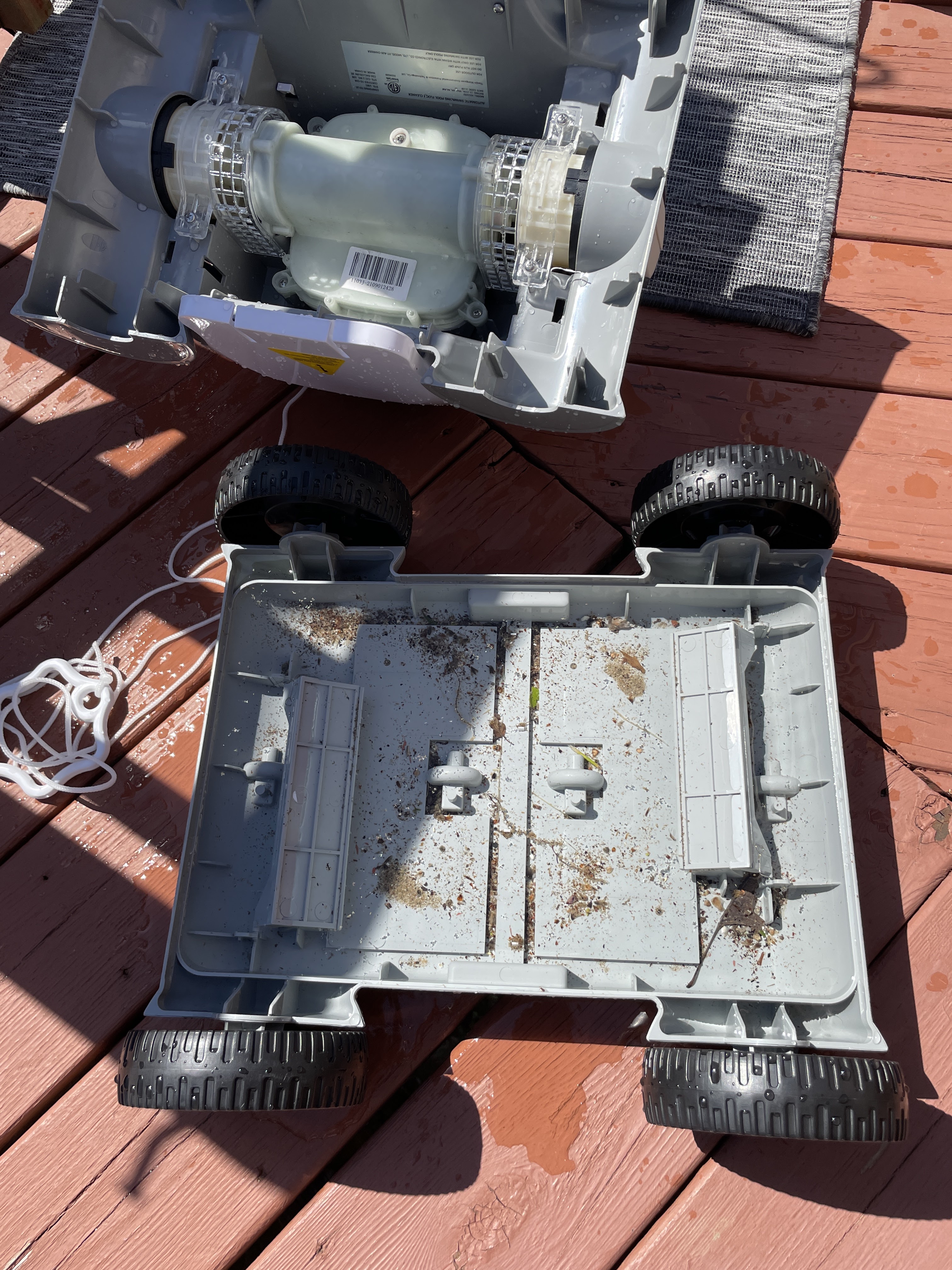
So very worth it…
…this new tool: a little robot that vacuums the pool bottom:


And there’s what it sucked off the floor:
Patristic Quote of the Day
For no law is called a testament, nor is anything called a testament, except that which is made by one who is about to die. And whatever is within the testament is sealed until the day of the death of the testator. And therefore rightly it is unsealed by the Lamb slain, who, as a lion, destroyed death and fulfilled that which had been foretold of him, and had freed man, that is flesh, from death, and received as a possession the property of him who was dying, namely the human race. For as through one body all people had come into the debt of death, so through one body all who believe might rise to eternal life.—St. Victorinus of Petovium
Luther
Certainly, not reason, but the Holy Ghost, must convince people, and He is called the Spirit of truth because He strengthens and upholds the heart against such appearance and feelings. Without Him no man would have believed, or would believe now, that Jesus Christ is true God, sitting eternally at the right hand of the Father, He who was thus shamefully nailed to the cross by His own people, like a thief.—Exposition, John xvi
Catechesis: Election
Also, Paul teaches this in a very consoling way. He explains that God in His purpose has ordained before the time of the world by what crosses and sufferings He would conform every one of His elect to the image of His Son. His cross shall and must work together for good for everyone, because they are called according to God’s purpose.—FC SD XI:49
02 June 2022
Patristic Quote of the Day
When the animals resound with praise, that is, when the Evangelists preach and celebrate the dispensation of Christ… the twenty-four elders, that is, the whole church, that is, the leaders and the people, immediately fall on their faces and adore him who lives forever and ever… By casting their crowns before the throne, they are ascribing to God whatever they possess of virtue and dignity.—St. Victorinus of Petovium
Luther
For where the Spirit of grace is, He quickens our hearts, so that we can, and may, and must begin to pray.—Exposition of John xiv
Catechesis: Election
Few receive the Word and follow it. Most despise the Word and will not come to the wedding. The cause for this contempt for the Word is not God’s foreknowledge, but the perverse human will. The human will rejects or perverts the means and instrument of the Holy Spirit, which God offers it through the call. It resists the Holy Spirit who wants to be effective, and who works through the Word, as Christ says, “How often would I have gathered your children together as a hen gathers her brood under wings, but you would not!”—FC SD XI:41
31 May 2022
Patristic Quote of the Day
“There was,” he says, “an open door in heaven.” John sees the preaching of the New Testament, and it is said to to him, “Come up here.” When it is shown that the door was opened, it is clear that previously it had been closed to humankind. However, it was sufficiently and perfectly opened when Christ ascended in the body to the Father in heaven….And now he recalls that which had been fore-told in the law by means of similitudes, and through this Scripture he joins together all the previous prophets and opens the Scripture.—St. Victorious of Petovium.
Luther
This is the first main point and most important article, that Christ is in the Father, that no one doubts, that what this Man says and does is and must be said and done in heaven before all the angels, in the world before all the tyrants, in hell before all the devils, and in the heart before all bad consciences and self-willed thoughts. For I am certain that what He says, thinks and wills, the Father also wills, I can brave all that is angry and evil.—Exposition of John xiv
Catechesis: Election
Holy Scripture also testifies that God, who has called us, is faithful. So when He has begun the good work in us, He will also preserve it to the end and perfect it, if we ourselves do not turn from Him, but firmly hold on to the work begun to the end. He has promised His grace for this very purpose. (See 1 Corinthians 1:9; Philippians 1:6; 1 Peter 5:10; 2 Peter 3:9; Hebrews 3:2).—FC SD XI:32
26 May 2022
Ascension Day 2022…
During the prelude, I believe I counted no less than 26 young people in attendance at the Divine Service. In fact, it was mostly oldsters and youngsters with a smattering of in between.


25 May 2022
Not exactly the week I had in mind…
… Our office was closed this week (and Jeff and Craig both headed to Florida). I figured it would be a good week to get a colonoscopy done (which I put off for some seven years). Only during procedure I apparently aspirated some stomach acid. So after getting home and developing fever, back to ER. After chest X-ray and blood tests, I was put on some antibiotics. The doc had removed a couple benign polyps, so had bleeding and that led to things not being “regular” through till Monday. Had to do a video promo with Pete on Friday for Revelation (see below). Saturday was Hamel Yard-sales and so Cindi had transformed our garage, and then Saturday evening and Sunday I had the services at St. Paul’s, though thankfully Vicar preached. Our out-of-town guests (the Herls, also see below) arrived just as Saturday Church was letting out, so we went back to the house. I’m so thankful (and it was an answer to prayer) that I made it through services without, well, “having an incident.” The David Weedon family joined the Herls and Cindi and me for a brunch after Church. Monday had to take car in for service (my muffler was broken; it sounded like a hot rod). Cindi was watching grandkids that day, so we picked them up after dropping car off, and when they called that car was ready, we packed them up and headed back down to O’Fallon (30+ minutes away). I get on the highway to come home and car is shaking like crazy. Le sigh. And so arrange to bring it back to them the following morning, after a follow-up doctor’s appointment. By Tuesday I am feeling myself again (thank you, Lord!), but the car unfortunately needs two new tires and somehow that was overlooked the day before. Home to cut grass at our house; then Cindi cut at her dad’s, and we loaded up the car so she could take the remains of yard-sale to Salvation Army store in Litchfield. When she got back, I proposed we just go out for dinner and then on a whim we took in the latest (and I assume, last) Downton movie. Today we actually got to sleep in a bit and do nothing at all but what we chose to do. WHEW. So, out of the eight days of “vacation,” at least the last of them kind of felt that way! I have just about decided that “staycations” are a myth.
24 May 2022
Carnivore Heaven…
… Our local grocery, DK’s, had a butcher’s special on ribeyes only $9.99 per lb. We snagged some and had the butcher slice them thick for us. I am looking forward to the next few days!


22 May 2022
An all too brief visit…
…with Dr. Dr. Joseph Herl (he was just awarded an honorary doctorate from Concordia St. Louis!), Jenny and Mary. They spent the night and joined us for Bible Class, Church, and brunch today. Joseph and I went to Concordia Bronxville together many, many moons ago. 


17 May 2022


14 May 2022
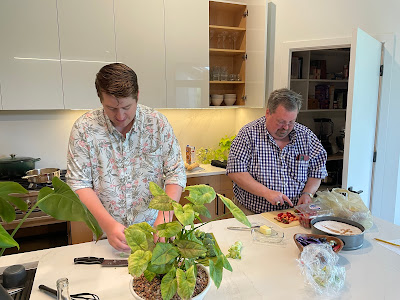
Had a wonderful visit…
…with my friend, Pr. Jim Krauser, and we capped it off last evening with dinner at David and Meaghan’s place:




13 May 2022
Catechesis: Person of Christ
The apostle Peter testifies in clear words that we also, in whom Christ dwells only by grace, on account of that great mystery [of the communion of the two natures], are "partakers of the divine nature" in Christ.—FC SD VIII:34
Luther
The marks, nails, crown of thorns, and scourgings I must bear, and so must all Christians, and not just painted on the wall, but stamped in our flesh and blood.—Sermon, 1535
Patristic Quote of the Day
CANON 5. If anyone says that not only the increase of faith but also its beginning and the very desire for faith, by which we believe in Him who justifies the ungodly and comes to the regeneration of holy baptism -- if anyone says that this belongs to us by nature and not by a gift of grace, that is, by the inspiration of the Holy Spirit amending our will and turning it from unbelief to faith and from godlessness to godliness, it is proof that he is opposed to the teaching of the Apostles, for blessed Paul says, "And I am sure that he who began a good work in you will bring it to completion at the day of Jesus Christ" (Phil. 1:6). And again, "For by grace you have been saved through faith; and this is not your own doing, it is the gift of God" (Eph. 2:8). For those who state that the faith by which we believe in God is natural make all who are separated from the Church of Christ by definition in some measure believers.—Council of Orange, 529, presided over by St. Caesarius
Good time with old friends...
...Michael, Jim and I went to Concordia, Bronxville together; and additionally Michael lived with Cindi and me for a while when we were at seminary (ironically, he slept on our couch again last night!).


12 May 2022
Patristic Quote of the Day
CANON 4. If anyone maintains that God awaits our will to be cleansed from sin, but does not confess that even our will to be cleansed comes to us through the infusion and working of the Holy Spirit, he resists the Holy Spirit himself who says through Solomon, "The will is prepared by the Lord" (Prov. 8:35, LXX), and the salutary word of the Apostle, "For God is at work in you, both to will and to work for his good pleasure" (Phil. 2:13).—Council of Orange, 529, presided over by St. Caesarius of Arles
Luther
By this we should learn that God does not want people to be sad and that He hates sad thoughts and sayings, and doctrines which oppress us. He makes our hearts joyful. For He did not send His son to make us sad, but to make us glad. That is why the prophets and apostles and the Lord Christ Himself admonishes us and even commands us at all times to be joyful and of good cheer.—Commentary on the Prophet Jonah
Catechesis: The Person of Christ
On account of this personal union and communion of the natures, Mary, the most bleed Virgin, did not bear a mere man. But, as the angel Gabriel testifies, she bore a man who is truly the Son of the most high God. He showed His divine majesty even in His mother's womb, because He was born of a virgin, without violating her virginity. Therefore, she is truly the mother of God and yet has remained a virgin.—FC SD VIII:24
11 May 2022
Yesterday...
...was my friend's 62nd birthday. Jim and I have known each other since Concordia, Bronxville (may she rest in peace!) days, and it is always a joy to catch up with him. He's a pastor in the ELCA and David's godfather. We travelled up to Springfield to check out the Lincoln home and tomb yesterday, and then came back to Edwardsville and had an early dinner.




07 May 2022
Our niece, Grace, was married yesterday...
...to John. Cindi made the wedding; I'm still at home. She sent along a few pics:


06 May 2022
Patristic Quote of the Day
CANON 3. If anyone says that the grace of God can be conferred as a result of human prayer, but that it is not grace itself which makes us pray to God, he contradicts the prophet Isaiah, or the Apostle who says the same thing, "I have been found by those who did not seek me; I have shown myself to those who did not ask for me" (Rom 10:20, quoting Isa. 65:1).—Council of Orange 529, Presided over by St. Caesarius of Arles
Luther
And yet He says here: 'My Father knoweth me' (even in such shame, and suffering, and disgrace) as His beloved Son, sent forth by Him to be made the sacrifice and to surrender my soul to save and to redeem My sheep. And in the same way I know the Father and know that He will not forget Me or forsake Me, but that through shame, and cross, and death, He will lead me to life and to eternal glory.—Exposition of Jn 10
Catechesis: Sacrament of the Altar
With heart and mouth we reject and condemn as false, erroneous, and misleading all errors that do not agree with but contradict and oppose the doctrine mentioned above and founded in God's Word, such as these: The papistic transubstantiation. It is taught that the consecrated or blessed bread and wine in the Holy Supper entirely lose their substance and essence. They are changed into the substance of Christ's body and blood in such a way that only the mere form of bread and wine is left, or the accidents without the object.—FC VII:107, 108
Cf. Certainly the sacraments of the body and blood of Christ are a divine thing, through which we are made partakers of the divine nature; and yet the substance or nature of bread and wine does not cease to be. – Pope St. Gelasius, De duabis nature. In Chr. Adv. Eutych. Et Nestor. Patrology IV, 1:422
Cf. Certainly the sacraments of the body and blood of Christ are a divine thing, through which we are made partakers of the divine nature; and yet the substance or nature of bread and wine does not cease to be. – Pope St. Gelasius, De duabis nature. In Chr. Adv. Eutych. Et Nestor. Patrology IV, 1:422
One of the excellent...
...sermons I was blessed to hear at the South Wisconsin Pastors' Conference. Shared with permission of Pr. Chris Raffa:
Spring Pastor’s Conference Meditation: Sola Scriptura
May 2nd, 2022
St. Matthew 4:1-4
In Nomine Jesu
“It is written.” Sola Scriptura. Without fail the church is convulsed with various crisis that shape their whole subsequent existence. I think here of the Ecumenical Councils which hammered out sound credal confession. I think of the Christological controversies that carefully navigated the proper understanding and relationship of the two natures in Christ. I think of Seminex and those who fought tirelessly for the sole authority of the Scriptures over against any human authority. I think of the educational and confessional crises that we face in our higher institutions of learning. And as of late, I think back mostly to the Predestinarian controversy in the 1880’s over the doctrine of election, and I ponder the words that were exchanged between C.F.W Walther and one of his former students.
Walther: “I ask you upon your conscience, in the presence of God, do you not believe that this controversy on Election will shiver our dear Missouri Synod into fragments? Alas! What will become of us? How many will remain? The pastor replied: “Dear Doctor, I do not believe any will leave us, excepting perhaps seven or eight who are not and have not been Missourians at heart, such as heed the Word only, though it be contrary to all reason…But in every controversy only this, what has God said?” Or as Jesus said to the tempter, “It is written.” Or as the Reformers confessed, Sola Scriptura.
Right after His baptism, our Lord endure a most grievous crisis. Sent out into the wilderness by the Holy Spirit to be tempted by the devil for 40 days. Then proceeded all sorts of grandiose plans for a successful career. The decisions He faced were fundamental to His person and work as the Messiah. I suppose, some might flippantly say that it wasn’t that bad for Jesus. Yet at its core, they were as simple as they were crucial: faith or unbelief, obedience or disobedience, cross or no cross, “It is written” or, “Did God really say,” Sola Scriptura or Sola Ratio.
As pastors, you are on the frontlines and in the trenches of a cosmic war. You know intimately that Christ’s Church is assailed by Satan, by those who don’t want to live beneath Word of God but above it, by those whose confessional subscription would reflect more a quatenus (in so far as) than a quia (because), and by those who want to fashion the Church according to the alluring promises of Satan. You are aware of the theological hesitation and indecision over the years in our Missouri Synod that has simply accumulated to a point where we now have produced crises in our life as church that can no longer be evaded or ignored.
To break the hypnotic spell of the ecumenical mushiness and pagan progressive ideals that buffet the Church we must return to the “It is written,” to the Sola Scriptura. We must have a clear grasp of the true Biblical doctrine of what the Church really is, as it is so beautifully confess in AC 7 and 8, in the Smalcald Articles, and in the Large Catechism. A pile of stones is not yet the Church, thus a pile of churches is not the Church. Only that is the Church which is built on the foundation of the prophetic and apostolic Word, Jesus Christ Himself being its cornerstone. “It is written.” Sola Scriptura. In every controversy only this: “What has God said?”
St. Athanasius wrote after outlining the Old and New Testaments, “These are the fountains of salvation, that they who thirst may be satisfied with the living words they contain. In these alone is proclaimed the doctrine of godliness. Let no man add to these, neither let him take ought from these. For concerning these the Lord put to shame the Sadducees, and said, ‘Ye do err, not knowing the Scriptures.’ And He reproved the Jews saying, ‘Search the Scriptures, for these are they that testify of Me” (Festal Letter, 39:6-7). Jesus is clear, anything but Him as the key that unlocks the fountains of truth and grace from the well spring of Scripture is a demonic imitation. Sadly, many pastors and laity are tragically trapped within their own hubris, the false piety of the devil, or their conscience is ever vacillating between “Did God really say,” or the Sola Scriptura of “It is written.”
It is quite evident that the real Church, the mystical body of Christ, is and remains hidden to mortal eyes. It lives under the cross and suffers many weaknesses, sins, and offenses, within and without. We may see the Devil’s enticing promises of grandeur and magnificence, of “all the kingdoms of the world,” but we must believe and confess the Church—she is an article of faith. We find her not by sight but only by faith in her pure marks, in the purely preached Gospel, and the purely administered Sacraments. For as a creature of the Word of God, the Church always remains under the Word. She lives, not by the bread of men, but by the bread of God that comes down from heaven and gives life and salvation to the tempted, the fallen, and the broken. The Sola Scriptura of Christ’s Word comes first, and it alone determines what the Church is and what it is not.
The promise, “It is written,” alone keeps you, even as it keeps the One who spoke it into existence. This is the great confession of Jesus in desert amid the devil’s wiles: “It is God’s promise alone which keeps me. By it I live by faith, and not by gazing at bread. No, I see no bread and am starving; I see no water and I am dying of thirst; I see no men who believe in me, yet I am to bring them the kingdom.” Jesus does not believe in bread but in the promises; He believes in “every word that comes from the mouth of God.” Sola Scriptura. And if the Word now gives Him bread in His great hunger, He will thank God. The connection to sola fide and sola gratia should be obvious to you here. And if that same Word refuses Him the loaf, he will go on hungering and believing in God’s promise that He is destined to a great work and will not die of hunger. The very Word of God is the Lord in this hour, and Jesus lives by it. And so do you as His undershepherds, men who feed and tend the lambs of the Good Shepherd’s flock even as you are tended and fed by same living voice, the same living waters of Baptism, and the same Table prepared in the midst of fierce and demonic enemies.
This is always the real crisis: that we are always in temptation, even as we pray not to be led into it. The tempter is always within our hearts. He comes not as foe, but as friend. He courteously said what we had always thought: “Did God really say this? Did He not mean it this way? Would it not suit Him if you now did this or that, instead of taking His Word, all too literally, of believing Sola Scriptura?
Even as the devil is deep within our hearts. Though our hearts condemn us, Christ Jesus justifies us in His blood-sealed promise, “It is written,” your sins are forgiven. Your death is destroyed. Your life is always with me, for I am in you and you are in Me. I am the Vine, you are the branches.” Abiding in your Savior, you will join your voices to the confession of St. Gregory of Nyssa, “Let the inspired Scriptures then be our umpire and the vote of truth will be given to those whose dogmas are found to agree with the Divine Words” (on the Holy Trinity, NPNF, p. 327). “It is written.” Sola Scriptura.
In the Name of the Father, and of the Son [+] and of the Holy Spirit. Amen.
Helmut Thielicke, Between God & Satan: The Temptation of Jesus (Michigan, Oil Lamp Press, 2010), 65-66.
“The Election-by-Grace Doctrinal Controversy and Doctrine of Justification” in Propter Christum: Christ & the Center: Essays in Honor of Daniel Preus (Luther Academy, 2013), 400-401.
Truth, Salvatory and Churchly. Works of Kurt E. Marquart. Vol III Essays Historical and Historic (Luther Academy, 2018), 17, 22.
05 May 2022
Patristic Quote of the Day
CANON 2. If anyone asserts that Adam's sin affected him alone and not his descendants also, or at least if he declares that it is only the death of the body which is the punishment for sin, and not also that sin, which is the death of the soul, passed through one man to the whole human race, he does injustice to God and contradicts the Apostle, who says, "Therefore as sin came into the world through one man and death through sin, and so death spread to all men because all men sinned" (Rom. 5:12).—Council of Orange, 529, presided over by St. Caesarius of Arles
Luther
Behold, if we could so portray our Lord and imprint His heart [as the Good Shepherd] on our heart, with His overflowing longing, concern, and desire for us, it would be impossible for us to be afraid of Him. Rather we should joyfully run towards Him, and stay with Him and listen to no other word or master.—Sermon, 1532
Catechesis: Sacrament of the Altar
Our faith in this article about the true presence of Christ's body and blood in the Holy Supper is based on the truth and omnipotence of the true, almighty God, our Lord and Savior, Jesus Christ. This foundation is strong and firm enough to strengthen and establish our faith in all temptations about this article. They overthrow and refute all the Sacramentarians' counterarguments and objections, however agreeable and plausible they may be to our reason. A Christian heart can rest securely and rely firmly on these truths.—FC SD VII:106
04 May 2022
Whew!
We had our Weedon grandsons with us on Saturday night and Sunday night (David, Meaghan, and Lydia flew out to California for the Baptism of the youngest Yow), but then bright and early on Monday I drove up to Steven's Point, Wisconsin, for the South Wisconsin District Pastors' Conference. Was an absolute joy to be there with the brothers. Wonderful worship, richly using LSB. Great homilies. I presented on the topic: "The Solas and the Fathers, Etc." My last session finished up on Tuesday, we prayed an early Vespers and I hit the road again. Got home last night about 10:15. The most fascinating thing to be me about the long drive, and particularly the long drive when I was tired and it got dark: I was able to stay alert without coffee. No coffee since Easter. And it was actually EASIER than with the coffee. Not to mention, less stops! I would never have guessed that. Big job for today is cutting grass and maybe writing a podcast. But that's why I've been missing in action on the blog.
Tomorrow Cindi flies out to Maryland for niece Grace's wedding. She'll be gone till the following Wednesday. And in the evening I get to head back to the airport and pick up longtime friend Jim Krauser, who's heading out for a visit. I told his godson, David, that he had to fix Jim a birthday feast to celebrate his 62nd birthday.
29 April 2022
Patristic Quote of the Day
CANON 1. If anyone denies that it is the whole man, that is, both body and soul, that was "changed for the worse" through the offense of Adam's sin, but believes that the freedom of the soul remains unimpaired and that only the body is subject to corruption, he is deceived by the error of Pelagius and contradicts the scripture which says, "The soul that sins shall die" (Ezek. 18:20); and, "Do you not know that if you yield yourselves to anyone as obedient slaves, you are the slaves of the one whom you obey?" (Rom. 6:126); and, "For whatever overcomes a man, to that he is enslaved" (2 Pet. 2:19).—Council of Orange, Presided over by St. Caesarius of Arles
Luther
God's grace is a great, strong, mighty, and active thing. It upholds, leads, drives, draws, and works all things in a man and is really felt and experienced. It remains hidden, but its works are manifest. Works and words point to where it is, just as the fruit and the leaves show the kind and nature of the tree.—Sermons, 1522
Subscribe to:
Posts (Atom)