 Come, then, with precision let us launch the ship that never perishes nor sustains shipwreck. But pay precise attention to what's being said. For today the psalm leads us out into battle array against the heretics, not so that we might fell them as they stand, but so that we might raise them up from their fallen state. I mean, that's how our battle works. It doesn't make corpses of the living, but fashions living people of the dead, brimming as it is with gentleness and considerable kindness. For I don't hound in reality, but pursue verbally, not the heretic, but the heresy. I don't reject the person, but hate the error and want it overturned. My fight is not with substance. For substance is a work of God. Rather, I want to set straight the thinking which the Devil destroyed. - St. John Chrysostom, *On Saint Phocas* par. 4
26 February 2006
Patristic Quote for the Day
Come, then, with precision let us launch the ship that never perishes nor sustains shipwreck. But pay precise attention to what's being said. For today the psalm leads us out into battle array against the heretics, not so that we might fell them as they stand, but so that we might raise them up from their fallen state. I mean, that's how our battle works. It doesn't make corpses of the living, but fashions living people of the dead, brimming as it is with gentleness and considerable kindness. For I don't hound in reality, but pursue verbally, not the heretic, but the heresy. I don't reject the person, but hate the error and want it overturned. My fight is not with substance. For substance is a work of God. Rather, I want to set straight the thinking which the Devil destroyed. - St. John Chrysostom, *On Saint Phocas* par. 4


25 February 2006
Patristic Quote for the Day
It is not just the death that creates the martyr, but also the disposition. For often the martyr's crown is woven not just from the way out, but also from the will. Indeed, it is not I, but Paul who gives this definition of martyrdom when he speaks in this way: "I I die every day." (1 Cor. 15:31) - St. John Chrysostom, *On Saint Eustathius* par. 5
24 February 2006
Patristic Quote for the Day
For saints' memorials are not urns or coffins or columns or inscriptions, but good works and a zeal for faith and a healthy conscience towards God. - St. John Chrysostom, *On Saint Eustathius* par. 3
23 February 2006
Quinquagesima - Luke 18:31-43
“Son of David, have mercy on me!” That is what the blind man cried in today’s Gospel. And in that cry he spoke words of truth that are deep indeed. “Son of David.” There is no title for Jesus that gets more to the heart of what He said He would happen to Him in Jerusalem. “For he will be delivered over to the Gentiles and will be mocked and shamefully treated and spit upon. And after flogging Him, they will kill Him, and on the third day He will rise.”
Son of David. Think of what happened with David and Bathsheba. After the great King had committed adultery with the wife of one of his soldiers, after she turned up pregnant with his son, after his failure to make Uriah think that the child was his, after he arranged the murder of Uriah and tried to make it look like an accident of warfare, after he then took Bathsheba into his house as his wife, after he thought he had gotten away with it all, Nathan shows up on the royal doorstep with a story.
The story of the poor man and his little ewe lamb, which was snatched from him and killed to serve as a rich man’s feast. David, the former shepherd, now King, became very angry. He said: “The man who did this deserves to die.” And Nathan whirled around and confronted him: “You are the man! You did this!”
You can see the color drain from David’s face as Nathan proceeds to expose to him and to all the court the sins which David had thought he had successfully hidden. One after the other, Nathan named the sins of David. And David sunk beneath the weight of the truth. He was crushed and devastated. He did not try to excuse what he had done. He did not order Nathan killed and so silenced. Instead, in utter honesty David confessed: “I have sinned against the Lord.”
To that confession, Nathan spoke a word of absolution. “The Lord has also put away your sin.” Then he added some curious words. I wonder if we hear them correctly: “You shall not die.” The Lord put away David’s sins, and so David did not die. But another would. You shall not die. But the child born to Bathsheba shall die. That is, the little son of David shall die. And die for the sins of another.
“Son of David,” cried the blind man! That is, the One who is truly David’s Son, flesh of his flesh and bone of his bone, and who as David’s Son is on His way up to Jerusalem to be handed over to the Gentiles who will mock him, and treat him shamefully, and spit on him, and flog him, and kill him. And all for David’s sins. And not just for David’s, but for the sins of all people. Yours and mine too. The little son of David had no choice in the matter. He suffered innocently, true enough. But he was, as were the many animals sacrificess, an unwilling victim, and so an altogether inadequate sacrifice. The little son of David was only a type. He pointed ahead to a greater Son of David. One whose death could truly wipe out sins, because it wouldn’t be a forced death, but a voluntary one.
Jesus walks the road to Jerusalem and it is a road that He wills to walk. No one makes Him. He himself said it: “No one takes my life from me; I have the authority to lay it down, and I have the authority to take it up again. This command I have received from my Father.” (John 10) The absolution that Nathan spoke to David is anchored in the voluntary death of David’s Son; as is the absolution spoken to you.
To give the absolution its power, to demonstrate its truth, Jesus heads up to Jerusalem to lay down His life and to take it back up again. “They will kill him, and on the third day he will rise.”
He wanted them to be in no doubt that what was about to transpire in the holy city was no tragedy that befell him, nothing outside of his control. He was giving himself into it, and He gave Himself into it in the confidence that He would rise again on the third day. He would die the death for David’s sin, and the sins of all the people of Israel, and the sins of all the Gentiles. He would die the death for all. But death was not the end for this Son of David, for He was innocent. He would be raised again, but not like those He raised from the dead. He would rise in a body that never subjected to death again. Incorruptible, and so made the source of incorruption for all who believe in Him.
The disciples just didn’t get it. St. Luke makes that clear: “But they understood none of these things. This saying was hidden from them, and they did not grasp what was said.” They were the ones who were truly blind; it was ironically the blind man who really saw. For He called Jesus both “Son of David” – in other words, the one who would suffer and die for the sins of others – and he calls Him, “Lord,” confessing that He has the power to give sight to the blind. “Then shall the eyes of the blind be opened” said Isaiah. Then when? “When your God will come and save you.” (Is 35:4)
And so the blind man who saw, even before his eyes were opened, pleaded with the God, with the Son of David, with the Lord, for mercy, and he received it. Not only seeing eyes, but then the privilege of following Christ up the road to Jerusalem with eyes wide open to the mercies of God.
“We are going up to Jerusalem.” We, too, for Lent is upon us. Let us not follow Christ on the road to the cross with the blindness of the disciples, who feel sorry for what Christ is about to undergo. Rather, let us follow with the sight of the blind man. For our Lord goes forth as the Son of David, to suffer for a world gone wrong. He goes forth as the Lord, who rises from death and leaves it shattered in pieces behind Him, granting freedom from death, resurrection and incorruption to all who believe. Let us follow Him up the road, joining the formerly blind man as he glorifies God the Father, the Son, and the Holy Spirit, the God who loves mankind, whose mercy opens blind eyes and leads His people home, now and ever and unto the ages of ages. Amen.
Beautiful gift
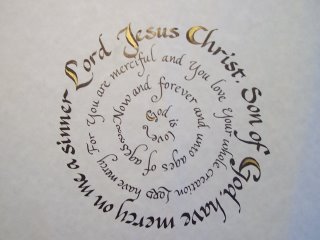
I was given yesterday the most wonderful gift. It was a prayer in calligraphy that simply gets at the very heart of it all:
Lord Jesus Christ, Son of God, have mercy on me a sinner,
For you are merciful and love your whole creation. Lord have mercy!
Now and ever and unto ages of ages.
God is love.
The way it is designed the "God is love" is right at the heart and center of the concentric circles of writing.
It is drop dead beautiful and right at the heart of it all. Thanks, Laura!!!!
Here's the pic:
Lord Jesus Christ, Son of God, have mercy on me a sinner,
For you are merciful and love your whole creation. Lord have mercy!
Now and ever and unto ages of ages.
God is love.
The way it is designed the "God is love" is right at the heart and center of the concentric circles of writing.
It is drop dead beautiful and right at the heart of it all. Thanks, Laura!!!!
Here's the pic:

Patristic Quote for the Day
In addition to all these things, who does not know that by the very fact that He was among men and thus fully united with our flesh, Christ most clearly and evidently showed forth the kindness and love for mankind of Him who sent Him, and thus rendered the glory which was the Father’s due. St. Nicholas Cabasilas, *The Life in Christ*
18 February 2006


A Kretzmann Goodie
My God, My God, why hast Thou forsaken me?
There are few unique events in history... The same patterns occur and recur... Here, however, is a moment in the story of man which is unique... Suddenly on a Friday afternoon a man was forsaken of God, cut off from the living and the dead, utterly and ultimately alone... The sudden emptiness in those shadowed eyes... The sudden flood of every sin of every soul from Eden to Chicago raging in a broken heart... It was then, much more than afterward, that He died...
You see, this is sin... It is not merely a matter of murder and adultery and gossip... Something to do or not to do!... It is always loneliness... It is cutting yourself off from God... It is a deliberate turning away from truth, from goodness, from heaven...
You see, this is redemption... All this He took into Himself, alone there in the dark... He became sin for us... A mystery?... Yes, but only a part of the great mystery which began in a stable and was now ending on a cross... Above His "Eli, Eli" was the sound of tearing veils, of falling walls, of the glad crying of those who now had a home again after the long loneliness of sin... They would continue to wander, groping, stumbling, falling, in all the black ways which men will walk when they turn away from God - to the countinghouse, the Maginot line, and the West Wall... But there was a way back now, beyond Jerusalem and beyond thought and hope to the place where the open arms of the cross had become the gates of heaven.
(O.P. Kretzmann, *The Pilgrim*, p. 47)
Patristic Quote for the Day
It is obvious that in the Savior we have come to know the utmost limit of God’s love for man. By the things which He has done He alone taught men how God loves the world and how great is His concern for mankind. - St. Nicholas Cabasilas, *The Life in Christ* p. 119
17 February 2006
Another Patristic quote for the Day
A most famous quote on the nature of Redemption by St. Gregory the Theologian:
We must now consider a problem and a doctrine often passed over silently, which in my view, nevertheless needs deep study. The blood shed for us, the most precious and glorious blood of God, the blood of the Sacrificer and the Sacrifice – why was it shed and to whom was it offered? We were under the reign of the devil, sold to sin, after we had gained corruption on account of our sinful desire. If the price of our ransom is paid to him who has us in his power, I ask myself: Why is such a price to be paid? If it is given to the devil, it is outrageous! The brigand receives the price of redemption. Not only does he receive it from God, he receives God Himself. For his violence he demands such a disproportionate ransom that it would be more just for him to set us free without ransom. But if the price is paid to the Father, why should that be done? It is not the Father who held us as His captives. Moreover, why should the blood of His only Son be acceptable to the Father, who did not wish to accept Isaac, when Abraham offered Him his son as a burnt-offering, but replaced the human sacrifice with the sacrifice of a ram? Is it not evident that the Father accepts the sacrifice not because He demanded it or had any need for it but by His dispensation? It was necessary that man should be sanctified by the humanity of God; it was necessary that He Himself should free us, triumphing over the tyrant by His own strength, and that He should recall us to Himself by His Son who is the Mediator, who does all for the honor of the Father, to whom He is obedient in all things… Let the rest of the mystery be venerated silently. (Oration 45, 22)
We must now consider a problem and a doctrine often passed over silently, which in my view, nevertheless needs deep study. The blood shed for us, the most precious and glorious blood of God, the blood of the Sacrificer and the Sacrifice – why was it shed and to whom was it offered? We were under the reign of the devil, sold to sin, after we had gained corruption on account of our sinful desire. If the price of our ransom is paid to him who has us in his power, I ask myself: Why is such a price to be paid? If it is given to the devil, it is outrageous! The brigand receives the price of redemption. Not only does he receive it from God, he receives God Himself. For his violence he demands such a disproportionate ransom that it would be more just for him to set us free without ransom. But if the price is paid to the Father, why should that be done? It is not the Father who held us as His captives. Moreover, why should the blood of His only Son be acceptable to the Father, who did not wish to accept Isaac, when Abraham offered Him his son as a burnt-offering, but replaced the human sacrifice with the sacrifice of a ram? Is it not evident that the Father accepts the sacrifice not because He demanded it or had any need for it but by His dispensation? It was necessary that man should be sanctified by the humanity of God; it was necessary that He Himself should free us, triumphing over the tyrant by His own strength, and that He should recall us to Himself by His Son who is the Mediator, who does all for the honor of the Father, to whom He is obedient in all things… Let the rest of the mystery be venerated silently. (Oration 45, 22)
Patristic Quote for the Day
When physicians are treating the body they do not administer the same remedy in all cases. Neither does God, when treating the illnesses of the soul, regard a single kind of therapy as suitable for all conditions; but He allots to each soul what is suitable for it and effects its cure. So let us give thanks while we are being treated, however great our suffering, for the result is blessed. - St. Maximos the Great, *First Century on Various Texts* par. 20
15 February 2006
Patristic Quote for the Day - #2
 As man I deliberately transgressed the divine commandment, when the devil, enticing me with the hope of divinity, dragged me down from my natural stability into the realm of sensual pleasure; and he was proud to have thus brought death into existence, for he delights in the corrruption of human nature. Because of this, God became perfect man, taking on everything that belong to human nature except for sin, and indeed sin is not part of human nature. In this way, by enticing the insatiable serpent with the bait of the flesh, He provoke him to open his mouth and swallow it. This flesh proved poison to him, destroying him utterly by the power of the Divinity within it; but to human nature it proved a remedy restoring it to its original grace by that same power of the Divinity within it. For just as the devil poured out his venom of sin on the tree of knowledge and corrupted human nature once it had tasted it, so when he wished to devour the flesh of the Master he was himself destroyed by the power of the Divinity within it. - St. Maximos the Confessor, *First Century on Various Texts*, #11
Patristic Quote for the Day
 Christ our God is born and becomes man by adding to Himself flesh endowed with an intellective soul. He who from non-being brings all things into being is Himself born supranaturally of a Virgin who does not thereby lose her virginity. For just as He Himself became man without changing His nature or altering His power, so He makes her who bore Him a Mother while keeping her a Virgin. In this way He reveals one miracle through another miracle, at the same time concealing the one with the other. This is because in Himself, according to His essence, God always remains a mystery. He expresses His natural hiddenness in such a way that He makes is the more hidden through the revelation. Similarly, in the case of the Virgin who bore Him, He made her a Maother in such a way that by conceiving Him the bonds of her virginity became even more indissoluble. - St. Maximos the Confessor, First Century of Various Texts, #9
You know, he always DID like to play dress up...
 ...Captain America - the original superhero - David Weedon. Today was "Super heros day" at Metro. He won a prize at school for the costum which he mostly created himself, with a little help from the Mama.
Patristic Quote for the Day
 “Death came to His body, therefore, not from Himself but from enemy action, in order that the Savior might utterly abolish death in whatever form they offered it to Him.” -- St. Athanasius, *On the Incarnation of the Word of God*, Par 24
14 February 2006
In honor of Valentines Day...
...in its secular form, that is, this is where the Weedon Clan happens to stand currently - Lauren and Dean, David and Misha, Bekah and Shawn:


Your Body, So Full of Divine Power...
 Pre-Communion Prayer of the Blessed Johann Gerhard...
Almighty Lord Jesus Christ, source of life and immortality, as I come to Your holy table to refresh my spirit, I pray You to make me, unworthy as I am, worthy through Your grace; impure as I am to make me clean; naked as I am to clothe me, so that Your Body, so full of divine power, and Your most precious blood, may not become for me, Your servant, the occasion for judgment or punishment,but a memorial of the death You underwent for me, a strengthening of my faith, a proof of the taking away of my sin, a bond of closer union with You, an increase of holiness, the basis of a glad resurrection, and a pledge of eternal life. Amen.
Patristic Quote for the Day
 You must understand why it is that the Word of the Father, so great and so high, has been made manifest in bodily form. He has not assumed a body proper to His own nature, far from it, for as the Word He is without body. He has been manfested in a human body for this reason only, out of the love and goodness of His Father, for the salvation of us men. - St. Athanasius, *On the Incarnation of the Word* par. 1
13 February 2006
Thee before Whom as My Judge I Cannot Stand...
 A Pre-Communion Prayer of St. Ambrose of Milan
To the Table of thy most sweet Feast, O loving Lord, Jesus Christ, I, a sinner, presuming nothing on my own merits, but trusting in thy mercy and goodness, approach with fear and trembling.
For my heart and my body are stained with many and grievous sins, my thoughts and my lips have not been carefully kept.
Wherefore, O gracious God, O awful Majesty, I, in my misery, being brought into a great strait, turn to thee, the Fountain of mercy; to thee I hasten to be healed, and flee under thy protection: and thee, before whom as my Judge I cannot stand, I long to have as my Savior.
To thee, O Lord, I show my wounds, to thee I discover my shame.
I know my sins, for which I am afraid, are many and great. My trust is in thy mercies, of which there is no end.
Look therefore upon me with the eyes of thy mercy, O Lord Jesus Christ, eternal God, God and Man, crucified for man.
Hearken unto me whose trust is in thee; have mercy upon me who am full of misery and sin, thou Fountain of mercy that will never cease to flow.
 Hail, Victim of salvation, offered for me and all mankind upon the Altar of the cross!
Hail, noble and precious Blood, flowing from the wounds of my Crucified Lord Jesus Christ, and washing away the sins of the whole world!
Remember, O Lord, thy creature whom thou hast redeemed with thine own Blood. It grieves me that I have sinned, and I desire to amend what I have done.
Take away therefore from me, O most merciful Lord, all my sins and iniquities; that being purified both in soul and body, I may be made meet worthily to taste the Holy of Holies; and grant that this holy foretaste of thy Body and Blood, which I, unworthy, purpose to take, may be for the remission of my sins, the perfect cleansing of my faults; the driving away of shameful thoughts, and the renewal of good desires; the healthful performance of works well-pleasing unto thee; and the most sure protection of soul and body against the wiles of my enemies. Amen.
Patristic Quote for the Day
A soul can never attain the knowledge of God unless God Himself in His condescension takes hold of it and raises it up to Himself. For the human intellect lacks the power to ascend and to participate in divine illumination, unless God Himself draws it up - in so far as this is possible for the human intellect - and illumines it with the rays of divine light. - St. Maximos the Confessor, *First Century on Theology* #31
12 February 2006
Ack! Chris!!!!!
Well, I've been tagged. Drat it all. Christopher, I hate these things. But FOR YOU I will do it:
Four Jobs I've Had:
Gas-station attendent
Salesman at a lighting store
Tile Layer (okay, so it only lasted about two weeks)
Pastor
Four Movies I Watch Over and Over Again:
Steel Magnolias
Lord of the Rings (I, II, III)
My Big Fat Greek Wedding
Anne of Green Gables
Four TV Shows I Watch:
I really don't watch TV anymore. But I used to watch:
Cadfael
Magnum PI
Rockford Files
Barretta
Four Places I've Lived:
Wheaton, MD
Richardsville, VA
Garfield, NJ
Burlington, NC
Four Places I've Vacationed:
St. Thomas, Virgin Islands
Prince Edward Island
Niagara Falls
Bethany Beach, DE
Four Websites I visit daily:
Drudgereport
Mac News Network
http://chaz-lehmann.livejournal.com/
http://www.redeemer-fortwayne.org/blog.php
Four of My Favorite Foods:
Chicken a la Shannon
Pizza (loaded!)
Lobster
My mother's buckwheat pancakes
Four Places I'd like to be right now:
Wherever it is snowing (NY, NJ, Boston, I'm not picky)...
Wherever it is 85+ sunny and there is a beautiful beach...
Wherever the Mass is being celebrated...
Wherever the Rachmaninoff All Night Vigil is being sung (has to be Russian and with real Russian basses)...
Four Bloggers I'm Tagging:
Deb Dillon - http://www.homeschoolblogger.com/debdillon/
Charles Lehmann - http://chaz-lehmann.livejournal.com/
John Fenton - http://conversiaddominum.blogspot.com/
David Juhl - http://fatherdmj.livejournal.com/
Offertory - "We Give Thee But Thine Own"
Have you ever pondered over the fact that our Lord commanded the use of bread and wine, not wheat and grapes? It's a giving contest of sorts:
He gives us wheat and grapes.
We work to transform them into bread and wine.
Then we give them back to Him at His command - and He seems to say: "You think THAT'S something! Well, how about this!"
And He proceeds to transform the bread and wine into something so much more: His body and His blood, given for us and for the forgiveness of our sins.
Which is all to say that anything we offer is only His gift to begin with, and that the ability to labor over those gifts is a gift from Him, and that when at His command we offer His gifts and our labor back to Him, He in turns blesses them to be so much more than anything we could ever dare desire or dream of. You can never outgive Him!
Glory to Your condescenion, O Lover of man!
Prayer of St. Anselm of Canterbury
(Before receiving the Body and Blood of Christ)
Lord, I acknowledge that I am far from worthy
to approach and touch this sacrament;
but I trust in that mercy
which caused You to lay down Your life for sinners
that they might be justified,
and because You gave Yourself
willingly as a holy sacrifice to the Father.
A sinner, I presume to receive these gifts
so that I may be justified by them.
I beg and pray You, therefore, merciful Lover of men,
let not that which You have given for the cleansing of sins
be unto me the increase of sin,
bur rather for forgiveness and protection.
Patristic Quote for the Day
Blessed is he who knows in truth that we are but tools in God's hands; that it is God who effects within us all ascetical practice and contemplation, virtue and spiritual knowledge, victory and wisdom, goodness and truth; and to all this we contribute nothing at all except a disposition that desires what is good. Zerubbabel had this disposition when he said to God: 'Blessed art Thou who hast given me wisdom; I give thanks to Thee, O Lord of our fathers; from Thee comes victory and wisdom; and Thine is the glory and I am Thy servant" (1 Esd. 4::59-60). As a truly grateful servant he ascribed all things to God, who had given him everything. He possessed wisdom as a gift from God and attributed to Him as Lord of his fathers the efficacy of the blessings bestowed on him. These blessings are, as we have said, the union of victory and wisdom, virtue and spiritual knowledge, ascetic practice and contemplation, goodness and truth. For when these are united together they shine with a single divine glory and brightness.
All the achievements of the saints were clearly gifts of grace from God. None of the saints had the least thing other than goodness granted to him by the Lord God according to the measure of his gratitude and love. And what he acquired, he acquired only in so far as he surrended himself to the Lord who bestowed it. - St. Maximos the Confessor, *Third Century on Various Texts* #28, 29
All the achievements of the saints were clearly gifts of grace from God. None of the saints had the least thing other than goodness granted to him by the Lord God according to the measure of his gratitude and love. And what he acquired, he acquired only in so far as he surrended himself to the Lord who bestowed it. - St. Maximos the Confessor, *Third Century on Various Texts* #28, 29
11 February 2006
On Collects and Such...
I couldn't help but notice. At the first Mass for Septuagesima, which we celebrated this evening, the LSB collect struck me as a bit odd. I went and checked it against TLH and other sources. This is what I discovered:
LSB: "O Lord, graciously hear the prayer of Your people, that we, who justly suffer the consequences of our sin, may be mercifully delivered by Your goodness to the glory of Your name; through Jesus..."
TLH: "O Lord, we beseech Thee favorably to hear the prayers of Thy people that we, who are justly punished for our offenses, may be mercifully delivered by Thy goodness, for the glory of Thy name; through Jesus..."
TLH offers a rather precise translation of the Gregorian original, except for the phrase "by Thy goodness" (added by Cramner at the time of the Reformation).
I find the transformation of "justly punished for our offenses" into "justly suffer the consequences of our sin" to be a bit of weaking of the bite of the original. The one confesses that God actively punishes; the other confesses that He permits us to suffer the consequences of our sins. Both could be argued biblically. Still, why the change? Surely there is nothing wrong in saying that we ARE justly punished for our offenses, is there? It is the "darkness" of the original which makes the petition so bold: "that we may mercifully be relieved...to the glory of thy name!"
Patristic Quote for the Day
Let us then, my brethren, love stillness until the world is made to die in our heart. Let us always remember death, and by this meditation let us approach God with our heart, despise the vanity of the world, and hold its pleasure as something contemptible... - St. Isaac the Syrian, The Ascetical Homilies (#64)
10 February 2006
Patristic Quote for the Day
Again, prophetic language attests that the conversion of those in error is the work of God.
- St. Gregory of Nyssa, Against Eunomius (NPNF II:vol. V, p. 133)
- St. Gregory of Nyssa, Against Eunomius (NPNF II:vol. V, p. 133)
Homily for Septuagesima 2006
Let me put it to you real simply. You are 12 years old and your mother asks you to go out and rake the yard. It’s a big job and will probably take you all morning. She promises: “I’ll give you ten dollars if you do it well.” So out you go and you start raking, piling leaves, stuffing them into bags, hauling them off. It’s hard work. And then about 11:45, your little brother comes smiling around the corner, grabs a rake and starts to help you gather leaves. How cute. That is until your mother says at noon: “That’s good enough. Come here and let me pay you.” And she proceeds to give the little rat $10 and then hands you $10. Now what would you say? Wouldn’t you be screaming at the top of your lungs: “That’s not fair!” And what if your mother says: “It’s my money and I can do with it what I want; what’s your problem?”
That’s today’s parable in a nutshell. But to get what it means, you’ve got to back up a little bit. The parable began with Jesus saying: “For.” “For the kingdom of heaven is like...” That means we better find out that “for” is there for!
And if we back up, this is what we find. A rich young man who had come to Jesus. And that young man thought he had kept all the law. But Jesus showed him that he’d broken the first commandment – because he had made a god out of his stuff. When Jesus told him to give it all away to the poor and then to come follow him and he’d have treasure in heaven, the young man thought “I just can’t do that,” and went away sad. That led Jesus to comment that it was easier for a camel to pass through the eye of a needle than for a rich person to enter God’s kingdom.
That astonished the disciples. They ask: “Who then can be saved?” I think the answer they were expecting was: “Only folks like you, who have left everything and followed me. What do you think, dummy?” Instead they get this answer: “With man this is impossible, but not with God. With God all things are possible.”
And that is what set Peter off. And setting Peter off is what prompted the Lord’s parable. Peter pieced it together. “Oh fine. I get it. You or your Father are going to work some miracle in the end to bring in even those who haven’t sacrificed a thing for you? Well that’s not fair. We have left EVERYTHING and followed you. What then we will we have?”
Jesus' answer, of course, is that they will have a kingdom and an abundance. They will sit on thrones to judge Israel. They will receive a hundredfold in the church for all that they left, and all kinds of trouble too, and they will have eternal life. But many who are first will be last, and so the parable of the laborers.
Do you get it now? The parable deals at its root with our begrudging God’s generosity. And so it is a parable of special importance for those who have been long at work in the Lord’s front yard or his vineyard. It’s a parable for us to rethink and get a handle on the truth about living the kingdom life.
Peter spoke of it in terms of sacrifice, of all that they had given up. And how many times we think the same way! When we belong to the Lord and live as His people, too often we cast the longing eye back toward our so called “freedom” when we could do whatever we wanted and not worry one little bit about whether or not it pleased the Lord. We think of how we’ve lived lives of “sacrifice” – if you will – and then see Jesus granting entrance into the Kingdom to those who have sacrificed nothing, for with God all things are possible, our sinful old Adam rises up and cries: “Foul!” Not fair. As though the poor thief on the cross had really gotten to live it up and then he has the audacity to sneak into the kingdom at the last moment.
What our parable shows us is how twisted the thinking is. You see, it’s not a matter of fairness. It’s a matter of life. The only life that’s worth the living in the end is life that’s lived in service to God, in faith in Him, in communion with Him. Any other life is just idleness, just wasted time. It’s when you realize that life in the vineyard is real life, that you begin to get the perspective of the Owner of the vineyard, and you look on those who are living aimlessly in the world, living as though pleasing themselves was why they were here, and you feel sad. You think, man! they’re missing out on what life itself is for.
And so when one starts off life in the Lord’s vineyard, baptized as a baby (like Sidnee) we rejoice that they’ve begun the adventure of a lifetime – given over to real life. Or when one creeps in at the last moment and is rewarded with eternal life, there is no complaining and saying “not fair.” Instead, there is the hugging of the brother or sister and saying: “I’m glad you made it in before the end of the day. Welcome to the Lord’s vineyard where the work is joy and there’s always plenty for everyone to do.”
And you know, that is itself the attitude of our Lord Jesus, who came to do His Father’s work with joy in His heart. It was not a burden to Him to live this life of service - it was the only life worth the living! And He went to His cross precisely so that what is impossible for us could by done for us by the God-man. He labored to open the kingdom of heaven to all believers. That's the miracle He works not just for those who come late, but for us all!
For those who all their life long have known the joys of work in the vineyard and for those who have found out only in the middle of life what life was all about, and even for those who come in at the very end, praying: “Jesus remember me in your kingdom” - for them all He died to fling wide heaven’s gates and to each he gives the very same gift: the gift of His body and blood, forgiveness of sins and oneness with Him forever. It’s a gift that says: “This is how much I value and love you; can you value each other any less?” So you see, it's not a matter of your ratty little brother getting the same as you - it's a matter of God's rich love giving you and him both far, far more than either of you could ever deserve or even dream of. And to Him be the glory forever!
09 February 2006
Patristic Quote for the Day
Unspeakably deep and wondrous. Reminds me of the first line of the 1521 Loci Communes: "The mysteries of God are to be adored, rather than investigated." Glory to Your condescension, O Lover of Man!
Let us contemplate with faith the mystery of the divine incarnation and in all simplicity let us praise Him who in His great generosity became man for us. For who, relying on the power of rational demonstration, can explain how the conception of the divine Logos took place? How was flesh generated without seed? How was there an engendering without loss of maidenhood? How did a mother after giving birth remain a virgin? How did He who was supremely perfect develop as He grew up? How was He who was pure baptized? How did He who was hungry give sustenance? How did He who was weary impart strength? How did He who suffered dispense healing? He did He who was dying bestow life? And, to put the most important last, how did God become man? And -what is even more mysterious - how did the Logos, while subsisting wholly, essentially, and hypostatically in the Father, also exist essentially and hypostatically in the flesh? How did He who is wholly God by nature became wholly man by nature, not renouncing either nature in any way, neither the divine, though He is God, nor ours, through which He became man? Faith alone can embrace these mysteries, for it is faith that makes real for us things beyond intellect and reason. - St. Maximos the Confessor, First Century on Various Texts, #13
Let us contemplate with faith the mystery of the divine incarnation and in all simplicity let us praise Him who in His great generosity became man for us. For who, relying on the power of rational demonstration, can explain how the conception of the divine Logos took place? How was flesh generated without seed? How was there an engendering without loss of maidenhood? How did a mother after giving birth remain a virgin? How did He who was supremely perfect develop as He grew up? How was He who was pure baptized? How did He who was hungry give sustenance? How did He who was weary impart strength? How did He who suffered dispense healing? He did He who was dying bestow life? And, to put the most important last, how did God become man? And -what is even more mysterious - how did the Logos, while subsisting wholly, essentially, and hypostatically in the Father, also exist essentially and hypostatically in the flesh? How did He who is wholly God by nature became wholly man by nature, not renouncing either nature in any way, neither the divine, though He is God, nor ours, through which He became man? Faith alone can embrace these mysteries, for it is faith that makes real for us things beyond intellect and reason. - St. Maximos the Confessor, First Century on Various Texts, #13
08 February 2006
The Majesty of Christ
The Church of Christ is the majesty of Christ - His blessed, holy Church, the fruit of His labors, the crown of His abasement, the work of His hands, the flowering from His blood. Blessed is the name of His Church itself, holy and giving salvation. His Church will be brought to its fullness; it is His work, His glory, encompassing the whole world. With the words 'for ever and unto the ages of ages,' the prophet speaks of the deathlessness of the work of Christ, that is, His Church. It is built in time, and will be revealed in eternity. It will be built till the end of time, and be revealed whole and complete in eternity. - St. Nicholas Velimirovich, The Prologue from Ochrid
Patristic Quote for the Day
'You have been bought with a price; do not become the slaves of men.' (1 Cor. 7:23) What greater price is there than that the Creator shed His blood for the creature? - St. Jerome, Homily 29 on Psalm 102 (103)
Aren't blogs fun?
I've been thinking lately about how GREAT it is that conversations can happen as they do on blogs. People who are miles separated - many of whom have never even physically met - are able to talk, to learn, to share, and to grow. Praise be to God for THIS use of the internet!
And the blogs just keep on coming! Fr. Fenton's began this week (referenced below). Salvatore (who, by the way, is even MORE hyper than I am - it's always a comfort to know Sal exists!!!!) shared HIS blog with me this week, with numerous goodies from Luther:
http://lutherlebensstil.blogspot.com/
and now my friend Cheryl (who has a most unusual way of looking at things, inviting us to see things from an angle we have missed before) has posted a blog with some beautiful (and to some, provocative) thoughts about the saints in heaven:
http://alongthewaymyjournal.blogspot.com/
Glory to Jesus Christ! Glory to Him forever!
07 February 2006
Worth Reading
A beautiful devotion by Father Fenton on St. Andrew and St. John and our Lord. I'm partial to St. Andrew, since I was bpatized in the Lutheran Church of St. Andrew in Silver Spring, MD, and can stll see the lovely stained glass image of St. Andrew in the window (though he was not yet gracing it when I was baptized there!). Check it out:
http://conversiaddominum.blogspot.com/2006/02/spiritual-fathers-sons.html
Note too how Fr. Fenton's take on John's "doubts" is precisely that of Luther and the fathers.
http://conversiaddominum.blogspot.com/2006/02/spiritual-fathers-sons.html
Note too how Fr. Fenton's take on John's "doubts" is precisely that of Luther and the fathers.
Patristic Quote for the Day
And we too are all saved by grace... The grace then that is with us is not like theirs (i.e., of the OT). For not only was pardon of sins given to us (since this we have in common with them, for all have sinned), but righteousness also, and sanctification,, and sonship, and the gift of the Spirit far more glorious and more abundant. By this grace we have become the beloved of God, no longer servants, but as sons and friends. - St. John Chrysostom, Homily XIV on John 1
06 February 2006
From "Farewell to Hallelujah"
The last Hallelujah dies away in chapel and cathedral, and while the echo still lingers among the rafters, the violet paraments of sorrow are placed upon the altar... It will be Easter morning before the Hallelujah is heard again...
There is wisdom in this... It is another and profound difference between the Church and the world... The world never willingly abandons joy... Her votaries hang on to happiness with all the strength they have - until, inevitably, it is taken away from them... They have forgotten that the line of life must sometimes go down into the darkness of sorrow... It is never easy, but it is better to go down willingly than to be driven down like a slave... To give up joy by the strength of Him who gave up heaven is a part of the way by which joy and heaven will return... Easter can come only to the heart that has known Lent...
The shadow which clings to all earthly good when it is seen in the light of faith is inevitable... Because of this the Christian view of life *appears* so much darker than the pagan - checkered with a darkness more intense the brighter the light of faith shines upon it... But the farewell to Hallelujah, though necessary, is only temporary... It springs from the strong compulsions of the dust from which we came and the stronger compulsions of the everlasting mercy which has lifted us from that dust... When all is said and done, Christianity is a religion of deeper gladness just because it is a religion of deeper fear and greater sorrow... The Cross remains the world climax of divine and human sorrow, ineffably distant and ineffably close, the sorrow of sin and the pain of man's long and lonely separation from God...
So it is good that our Hallelujahs are silent for a little time... In their stead appear the crown of thorns, the drops the blood, the way of mourning, the five wounds, and the sound of our hands driving nails... And on Eastern Morn our returning Hallelujahs will say that our Lord arose and ascended into heaven, that He is now the King of Glory, who has given us a share in both His suffering and His victory, in His passion and His power, in His former pain and in His present peace... (O. P. Kretzmann, *The Pilgrim*)
Alleluia, song of gladness,
Voice of joy that cannot die,
Alleluia is the anthem
Ever raised by choirs on high.
In the house of God abiding
Thus they sing eternally.
Alleluia, thou resoundest,
True Jerusalem and free;
Alleluia, joyful Mother,
All thy children sing with thee,
But by Babylon's sad waters
Mourning exiles now are we.
Alleluia cannot always
Be our song while here below;
Alleluia our transgressions
Make us for a while forego;
For the solemn time is coming
When our tears for sin must flow.
Therefore in our hymns, we pray Thee,
Grant us, Blessed Trinity,
At the last to keep Thine Easter
With Thy faithful saints on high;
There to Thee forever singing
Alleluia joyfully! (HS 98, #819)
NOTE: the question has been raised why, when Lent is several weeks off, this devotion now? If a Church is using the historic lectionary of the Western Church (as for example TLH, see pages 60ff.) then the Tract replaces the Alleluia in the Gradual during Prelent and in Lent.
For All the Sins of Men...
For all the sins of men I repent before You, Most Merciful Lord. Indeed, the seed of all sins flows in my blood! ... For all the history of mankind from Adam to me, a I sinner, I repent; for all history is in my blood. For I am in Adam and Adam is in me. - Bishop Nikolai Velimirovich. Prayers by the Lake
In Adam we have all been one,
One huge rebellious man,
We all have fled that evening voice
That sought us as ran.
We fled Thee and in losing Thee
We lost our brother too.
Each singly sought and claimed his own;
Each man his brother slew.
By Thy strong love it sought us still
And sent Thine only Son,
That we might hear His shepherd's voice
And hearing Him be one.
O Thou, who when we loved Thee not,
Didst love and save us all,
Thou great good Shepherd of mankind,
O hear us, when we call.
Grant us Thy Spirit, teach us truth,
Thou, Son, O set us free
From fancied wisdom, self-sought ways,
To make us one in Thee.
Then shall our song united rise
To Thine eternal throne
Where with the Father evermore
And Spirit Thou art one. Amen. (Martin Franzmann)
Patristic Quote for the Day
Indeed, He (our Creator) meant us further to be free from care and to have but one work to perform, to sing as the angels, without ceasing or intermission, the praises of the Creator, and to delight in contemplation of Him, and to cast all our cares on Him. - St. John of Damascus, Exposition of the Orthodox Faith, Chapter XI.
05 February 2006
Transfiguration Joys
Today those Lutheran Churches using the historic lectionary celebrate the Transfiguration of Our Lord. What a joy this feast is! How beautiful is the light of Tabor, uncreated and mysterious, which reveals to us WHO it is that hung upon the cross, destroying Death by His death. There are several beautiful hymns for this day, but my all time favorite is "O Wondrous Type" - sung to the lovely Agincourt hymn, and with trumpets and choir enhancing its beauty. We got the treat of singing it that way this morning at St. Paul's:
O wondrous Type! O vision fair
of glory that the Church may share!
which Christ upon the mountain shows
where brighter than the sun He glows!
With Moses and Elijah nigh
the incarnate Lord holds converse high;
and from the cloud the Holy One
bears record to His only Son.
With shining face and bright array
Christ deigns to manifest today
What joy shall be their's above
Who joy in God with perfect love.
And faithful hearts are raised on high
By this great vision's mystery,
For which in joyful strains we raise
The voice of prayer, the hymn of praise.
O Father, with th'eternal Son
And Holy Spirit ever one,
We pray you, bring us by Your grace
To see Your glory face to face.
Patristic Quote for the Day
This one is a guess who? And I truly do not know who said it. I know who quotes it, but I assume it is not his own composition. So half-credit goes to anyone who recognizes where I got it from, but full credit (and my deep thanks) to anyone who can locate where the original came from:
The Master dies instead of the servant;
In place of the debtors, the Faithful One;
The Physician dies for the good of the patient;
The Shepherd rescues His sheep;
The King dies for the sins of His subjects;
The Peace-maker for the warriors;
The Creator dies for His creation;
God Himself wins man's salvation!
What now should the servant, the debtor,
the sick one, the sheep, the nation, the multitude do?
What should the creatures, mankind, do?
In love extol his Redeemer!
04 February 2006
Joy!
Last night, Cindi and I got a wonderful surprise. David told us he was going out on a date with Misha. We watched a little bit of Oliver's Travels (what a great series - and I WILL get it back to you, Deb!). And finally, at about 10 headed to bed. We'd just drifted off to sleep when David got home. He came to the door of the bedroom and said: "Mom, Dad, I'm home. Oh, and I found something." And then LAUREN ran in and jumped on the bed!!!!
Those little sneaks! They had it arranged that Lauren was riding home with Dean this weekend, and David went to pick her up in Collinsville when she got in from Seward.
So this morning, at breakfast, I had the unspeakable joy of ALL my children gathered around the breakfast table. God is very good - He always is - but moments of the family being together make me sense that benevolence more than ever!!!
Hmm. Ever been there?
How true, how true:
However, St. Silouan teaches that man often makes his sufferings out to be more unbearable than they really are. This is a source of great anxiety and it is due to lack of faith. It shows that the believer has not yet humbled himself, nor given himself over completely to the will of God.33 The believer must realize that it is ultimately the Lord who is in complete control of every facet of his life. By allowing such sufferings, whether they be physical ailments or spiritual trials, the Lord actually directs and disciplines the believer, thereby making him His own `legitimate' son or daughter. In the Epistle to the Hebrews we read, "My son, do not regard lightly the discipline of the Lord, nor lose courage when you are punished by Him. For the Lord disciplines whom He loves, and chastises every son whom He receives…God is treating you as sons; for what son is there whom his father does not discipline? If you are left without discipline…then you are illegitimate children and not sons…He disciplines us for our good, that we may share His holiness."34
The rest of this article on Suffering can be found here (and thanks to Deb for pointing me to it):
http://www.homeschoolblogger.com/grelihm/77786/
How often is the suffering of our lives magnified by our fear, our lack of trust? Kyrie, eleison!
03 February 2006
Patristic Quote for the Day (#2)
(in honor of Fr. Alms' request for a Western Father!)
Almighty God, whose whole being is goodness, whose will is power, and whose every act is mercy, designated in the very beginning the remedy His good will had ordained for our redemption. Immediately after diabolical malice had stricken mankind with the poison of its envy, it was foretold to the serpent that the see of the woman by its own power would crush the pride of his wicked head. Christ, the fulfilment of this prophesy, as God and Man born of the Virgin, by an inviolate birth, would damn the tempter of mankind. When the fulness of time ordained for this redemption had come, our Lord Jesus Christ descended from His heavenly throne, though not abandoning His Father's glory, and came into this world. In the nature order His birth had no precedent; it was a new order because the Invisible had become visible; it was a new order because the Incomprehensible had willed to be comprehended; it was a new order that the Eternal should begin in time; that the Lord of the universe should permit the dignity of His majesty to be overshadowed and to assume the form of a servant; that God infinitely distant from all suffering, should deign to become man with all his sufferings; that the Immortal should humble Himself under the laws of death. - Pope St. Leo the Great, A Homily upon the Annunciation
Almighty God, whose whole being is goodness, whose will is power, and whose every act is mercy, designated in the very beginning the remedy His good will had ordained for our redemption. Immediately after diabolical malice had stricken mankind with the poison of its envy, it was foretold to the serpent that the see of the woman by its own power would crush the pride of his wicked head. Christ, the fulfilment of this prophesy, as God and Man born of the Virgin, by an inviolate birth, would damn the tempter of mankind. When the fulness of time ordained for this redemption had come, our Lord Jesus Christ descended from His heavenly throne, though not abandoning His Father's glory, and came into this world. In the nature order His birth had no precedent; it was a new order because the Invisible had become visible; it was a new order because the Incomprehensible had willed to be comprehended; it was a new order that the Eternal should begin in time; that the Lord of the universe should permit the dignity of His majesty to be overshadowed and to assume the form of a servant; that God infinitely distant from all suffering, should deign to become man with all his sufferings; that the Immortal should humble Himself under the laws of death. - Pope St. Leo the Great, A Homily upon the Annunciation
A Question
How do you understand 2 Corinthians 5:10-11?
2Corinthians 5:10
For we must all appear before the judgment seat of Christ; that every one may receive the things done in his body, according to that he hath done, whether it be good or bad. 11 Knowing therefore the terror of the Lord, we persuade men...
It seems to me that this must move beyond a simple "thumb up / thumb down" approach to the Judgment...
Any and all thoughts welcome!
Patristic Quote for the Day
It therefore followed that each man's soul inherited the wickedness of the first Adam. It spread from his soul to his body, and from his body to the bodies which derived from his, and from those bodies to the souls. This, then, is the old man whom we have received as a seed of evil from our ancestors as we came into existence. We have not seen even one day pure from sin, nor have we ever breathed apart from wickedness, but, as the psalmist says, 'we have gone astray from the womb, we err from our birth' St. Nicholas Cabasilas, The Life in Christ, page 76-77
02 February 2006
Presentation Thoughts...
“I Could Just Die Now”
They brought the offering of the poor. They could only afford the turtle doves. But it was an offering commanded in the Law – for the life of every first-born Israelite belonged to Yahweh and had to be redeemed, ever since the first-born of Egypt died in the Exodus. Yet even as they purchased the offering and entered the Temple precincts, they knew that that the real offering was not the birds, but the Babe. He would be the Offering to end all offerings. In Him the Law would be fulfilled. They thought that they and a handful of others were the only ones in the know.
But then they see him – according to tradition, an old man. He is not looking at them. He is looking at the Babe in Mary’s arms. And he is coming across the courtyard with the familiar look on his face. Mary had seen it before. It was on the face of Elizabeth when she visited her and Elizabeth looked in awe at her swelling womb. It was on the face of the Shepherds when they knelt beside the manger and told her of the angels and their words and song. Now it was on the face of this old man as he hurried toward them, aged arms outstretched, reaching for the Child.
Mary would not give her precious package up lightly to anyone, but she saw and understood the look. Yet another one in the know. Yet another one who realized that Mary was holding THE offering, the Child that would bring to an end man’s long exile and open wide the way home to the Father’s house. She knows she can safely give Him into old Simeon’s arms. He’s been waiting a life-time.
Simeon holds the Child, looks into his infant face, and he begins to pray. Not to any other, but to Him, to the Child in his arms: “Now, Lord! Now you can let your servant go in peace. I’ve seen Your salvation. A light for the gentiles. Glory for your people Israel.”
Which is all to say: “I can just die now.” Now that I know that the Death of death lives and breathes on earth, I have no fear. How could I fear the displeasure of God when I see the irrefutable testimony of that love right here in my arms. God so loved the world that He gave His Only-begotten Son. Gave Him into the flesh. Here is forgiveness! Here is life! Here is the peace that all the world longs for!
It was surely a stroke of genius when some long forgotten Lutheran suggested that the words of Simeon were the perfect words to sing when we come back from the Table of the Lord. Having received the Body and Blood of Him whom Simeon held all those centuries ago, we pray with him: “It’s okay, Lord. I can just die now. Take me home! I’ve seen your salvation. I’ve tasted your life. My sins are forgiven. My death is destroyed. I have nothing to fear because YOU have given yourself to me entirely. I can go home right now.”
Mary and Joseph presented the turtle doves that day, but the true Offering was the Child they held – the Child Simeon held – the Child who is our Lord and Savior and who delights to give Himself to us that we might “depart in peace” according to His Word!
Patristic Quote for the Day
At the risk of Fr. Alms' censure, another EASTERN father, but one that Chemnitz relied on extensively:
Every action of Christ and all His working of miracles were truly very great and divine and wonderful, but of all things the most wonderful is His honorable cross. For by nothing else except the cross of our Lord Jesus Christ has death been brought low, the sin of our first parent destroyed, hell plundered, resurrection bestowed, the power given us to despise the things of this world and even death itself, the road back to the former blessedness made smooth, the gates of paradise opened, our nature seated at the right hand of God, and we made children and heirs of God. By the cross all things have been set aright! – John of Damascus, The Christian Faith, Book IV: Chapter 11
Every action of Christ and all His working of miracles were truly very great and divine and wonderful, but of all things the most wonderful is His honorable cross. For by nothing else except the cross of our Lord Jesus Christ has death been brought low, the sin of our first parent destroyed, hell plundered, resurrection bestowed, the power given us to despise the things of this world and even death itself, the road back to the former blessedness made smooth, the gates of paradise opened, our nature seated at the right hand of God, and we made children and heirs of God. By the cross all things have been set aright! – John of Damascus, The Christian Faith, Book IV: Chapter 11
01 February 2006
A Theologian of the Cross...
...calls a thing what it is. But I really shouldn't USE that sort of language on a public blog....
What are we in communion fellowship with? A member of mine just returned from a long visit with her family. They attend a parish in another state that is one of our LCMS parishes and where, shall we say, there is a tang of salt in the air. Bulletins were brought to me. They reveal so many interesting things.
How's this for a communion statement: "As Lutherans, we believe that Christ's body and blood are truly present for the forgiveness of sins, in, with, and under the bread and wine. We invite all those who share this understanding and believe that Jesus is their Lord and Savior to attend his holy supper. White grape juice is provided for those who do not consume wine...."
"Under the bread and wine"..."white grape juice"? And I don't suppose anyone needs to be baptized - just share our "understanding and belief"? So much for closed communion!
Oh, but it gets better. One of the bulletins indicates that the homily was delivered by the deaconess. Isn't that precious?
After one of the Eucharistic prayers, we get: "Through Christ, with Christ, in Christ, in the unity of the Spirit, all glory and honor is yours, O God, now and forever." [Traditional form: Through Him, with Him, in Him, in the unity of the Holy Spirit, all glory and honor is yours, almighty Father, forever and ever!]
Obviously using the ELCA's latest tripe, so I suppose that the word HIM (and heaven forbid, the word FATHER!) is like unto the unpronounceable name of God and must be avoided at all costs even in parts of the LCMess.
And I just love one of the hymns they sang:
"I'm trading my sorrows,
I'm trading my shame,
I'm laying them down for the joy of the Lord.
I'm trading my sickness,
I'm trading my pain,
I'm laying them down for the joy of the Lord."
We commune with this each week we celebrate the Sacrament as members of the altar and pulpit fellowship that is the Lutheran Church - Missouri Synod. Doesn't it make you feel all warm and fuzzy?
Almost Patristic Quote for the Day (I consider Schmemann right next to patristic!)
"The Word presupposes the sacrament as its fulfillment, for in the sacrament, Christ the Word becomes our life. The Word assembles the Church for his incarnation in her. In separation from the word the sacrament is in danger of being perceived as magic, and without the sacrament the word is in danger of being 'reduced' to 'doctrine.' And finally, it is precisely through the sacrament that the word is interpreted, for the interpretation of the word is always witness to the fact that the Word has become our life. 'And the Word became flesh and dwelt among us, full of grace and truth (John 1:14)' The sacrament is his witness, and therefore in it lies the source, the beginning and foundation of the exposition and comprehension of the word, the source and criterion of theology. Only in this unbreakable unity of word and sacrament can we truly understand the meaning of the affirmation that the Church alone preserves the true meaning of the scripture."
Schmemann, The Eucharist, pp. 68, 69
Schmemann, The Eucharist, pp. 68, 69
31 January 2006
Patristic Quote for the Day (and a few thoughts)
“And if any were to cast in prison a person who owed ten mites, and not the man himself only, but wife and children and servants for his sake; and another were to come and not to pay down the ten mites only, but to give also ten thousand talents of gold, and to lead the prisoner into the king’s courts, and to the throne of the highest power, and were to make him partaker of the highest honour and every kind of magnificence, the creditor would not be able to remember the ten mites; so hath our case been. For Christ hath paid down far more than we owe, yea as much more as the illimitable ocean is than a little drop.” - ST. John Chrysostom, Epistle to the Romans, Homily X, Rom 5:17
The problem with thinking the narrow definition of justification is "the lot" is to miss out on the goodies that follow: (using the above) the gift of all that gold, being led to the throne of the highest power, given a seat at the Table of the Maker of the Universe and a place in His eternal palaces forever.
All these are founded in the payment of the debt owed, but my goodness, our Giver God goes so, so far beyond just declaring us "not guilty!" I can't help but wonder if he might think that we're being ungrateful when we fixate on that to the exclusion of what He has brought us into in Christ Jesus!
30 January 2006
Patristic Quote for the Day
His invitation is one of kindness, His goodness is beyond description... And see whom He calls! Those who have spent their strength in breaking the law, those who are burdened with their sins, those who can no longer lift up their heads, those who are filled with shame, those who can no longer speak out. And why does He call them? Not to demand an account, not to hold court. But why? To relieve them of their pain, to take away their heavy burden. For what could ever be a heavier burden than sin?..."I shall refesh you who are weighed down by sin," He says, "and you who are bend down as if under a burden; I shall grant you remission of your sins. Only come to Me!" - St. John Chrysostom
29 January 2006
Patristic Quote for the Day
No sin is so great it can conquer the munificence of the Master. Even if one is a fornicator, or an adulterer... the power of the gift and the love of the Master are great enough to make all sins disappear and to make the sinner shine more brightly than the rays of the sun. - St. John Chrysostom
28 January 2006
Homily for Epiphany 4
“Why are you fearful, O you of little faith?”
Well, let’s see: the wind is howling, lightning is flashing, the waves are crashing over the boat, the boat is beginning to sink, we’re faced with death and drowning - and you happen to be asleep and oblivious to all this. How’s that for reasons to be fearful - no matter what size our faith is?
The astonishing thing is that Jesus just doesn’t "get" the life of fear that we understand so perfectly. Who here today has the least trouble identifying with the disciples and what they were going through? Who here today is puzzled by their behavior? Fear is something we understand all too well. We know what it is to be afraid. Afraid of losing a family a member, afraid of the uncertainties of the future, afraid of a relationship breaking up, afraid of losing friends, afraid of suffering, afraid of another’s anger, afraid of losing control, afraid of gaining control, afraid of responsibility, afraid of getting hurt again, afraid of disappointing those who depend on us, afraid of change, afraid that things will never change, afraid that we’ve done something too awful for God or others to forgive, afraid that people will hate us if they really knew the evil we hide inside.
And so, yes, to us Jesus asks the question - and asks it as the winds howl and the waves crash and beat against the boat and our life feels like its going down - why are you fearful, O you of little faith?
If we ponder together that seemingly ridiculous question, a whole new world opens up to us: the world in which our Lord lived and which He came to open up for us, so that we could live in it too. It would not be going too far to describe it as a life devoid of being afraid. Which is not quite the same as a life without fear.
For there is always the fear of Lord, which is the beginning of wisdom. But the fear of the Lord is not the same thing as being afraid. The fear of the Lord is at the end of the Gospel reading today, not the beginning: The fear of the Lord leads them to marvel, saying, “Who can this be, that even the winds and the sea obey Him?” And it is precisely the fear of the Lord which releases from being afraid. As a wise man once said: “Fear the Lord, and then you need fear nothing else.”
A life without being afraid? A life where there is no terror in the dark, where every circumstance and person is met with confidence and joy, where suffering is not feared and death is not dreaded and remorse does not paralyze and peace reigns over all? Such a life belongs to Jesus and He lived it out fully. He was never afraid, for He could out with the Psalmist: “The Lord is my Light and my Salvation, whom shall I fear? The Lord is the stronghold of my life, of whom shall I be afraid?” He cried that prayer with every ounce of His being and so in Him there was no fear, and He summons us with our little faith to enter into that life with Him and live - really live.
For what is there to be afraid of when Jesus is with you in your boat? When He is with you in your life? Does death terrify you? But He is the Resurrection and the Life, He is the Death of death. He is death’s worst nightmare come into human flesh. Death cannot hold you when He who died and rose again calls you from the grave. Death will have to release you and you will arise in your body - He has made death like a little slumber, like the nap He took on the boat.
Do your sins terrify you? But He is the Pardon for all your sins, nailed to Calvary’s cross, wiping out the handwriting that was against you entirely. His angels have tossed from heaven the evil one who would accuse you, the baptized.
Do you fear the loss of friends and family? But any who are in Him are never lost, for those who die in Him still live! And He has promised a desired reunion in heaven.
Are you afraid that you won’t have enough, that you’ll suffer hunger or poverty? But He promises you daily bread and even better, He freely gives you a food that that supplies your deepest and enduring need: His body and His blood imparting to you the pardon of sin, the promise of your resurrection, and the gift of life with Him forever.
Are you afraid that He may have suffering in mind for you and your loved ones? Don’t worry. He does! He promises that suffering awaits. How could it not? If we are walking the path of love with Him, this world which rejects that love will see that we suffer. But He also promises that through every hardship He will bring you nothing but blessing, because He works all things together for the good of those who love Him.
You see, the One in the boat who asks: “Why are you fearful?” has literally taken away from us every reason to be afraid of anything in this creation. Anything at all. He manifests the entirety of life and creation itself as a gift of love from a heavenly Father, and the measure of that love is that He gave His Son into the flesh that you might never fear, ever again.
Ah, but in our weakness, we still do fear. The Church knows this. In her wisdom, she teaches us to pray. There is a prayer that has come down to us from the dark days when Viking raiders could show up at night to plunder house and home - stealing, raping, murdering, doing all kinds of evil. Th Collect for Peace. In it, the Church asks God for a most precious gift: “and that we, being defended by thee from the fear of our enemies, may pass our time in rest and quietness.” Did you catch that? The Church does not ask God to deliver her from her earthly enemies, but from the fear of them. The problem was never the Vikings or any terrorist or terror ever since. The problem is always with our being afraid of them, as though they had some power over us to separate us from the love of God in Christ! No way.
To belong to Christ, to have the Crucified and Risen One present in your life, means learning to live without fear - except for the fear of bowing before Him and confessing Him to be the Almighty God in our flesh and blood. Indeed, “the wind and waves still know His voice who ruled them when on earth below.” Amen.
Tastier
Is there anything tastier than bacon, eggs, and coffee? Sigh. Every morning should taste so good...
Patristic Quote for the Day
 Repentance (metanoia) is fitting at all times and for all persons, for sinners as well as for the righteous who look for salvation. There are no bounds to perfection, for even the perfection of the most perfect is nothing but imperfection. Hence, until the moment of death, neither the time nor the works of perfection can ever be complete. - St. Isaac the Syrian
27 January 2006
Just an Idea
We are not talking about a platonic republic here, Melanchthon protested in the Apology. The Church, he insisted, has a concrete and real existence in this world.
But too often hasn't Lutheranism been reduced to a mind-set, a way of thinking, assent to a set of propositions? If you agree to X, Y, and Z, then, congratulations! You're a Lutheran.
Thus, Lutherans AGREE that private confession and absolution is a good thing. But don't ask them to do it! That would be "legalistic" (i.e., it would require moving out of the realm of ideas).
Thus, Lutherans AGREE that Baptism means death to the old Adam. But don't ask them fast! That would be "legalistic" (i.e., it would require moving out of the realm of ideas).
Thus, Lutherans AGREE that the Symbols are a "true exposition of the Word of God" but don't refer to Mary with any of the titles that they do ("Blessed, Ever-Virgin, Most-holy, Pure and Holy", etc), or you're imposing personal beliefs on people (and you'd be moving out of the realm of ideas).
Thus, Lutherans AGREE that the Saints are to be honored, but do it without mentioning them, please! We don't want to be mistaken for Rome (in other words, keep it in the realm of ideas, not practice).
Thus, Lutherans AGREE that there is a third use of the Law, but God forbid that a pastor expect a person to actually follow one of the commandments! The Law is there to accuse and that's about it, remember? That keeps it nicely in the realm of ideas. Safely away from my life!
I may be being too harsh (it certainly would not be the first time), but it seems to me watching and listening and thinking about theological discourse of late, that any time the discussion moves away from the realm of mere ideas, the typical Lutheran response among many so-called "Confessionalists" is to squirm with discomfort and cry foul.
Can Lutheranism survive merely as an idea? Can the idea of Lutheranism be disconnected from the concrete forms in which she has lived her life? I am thinking of how it was reported to me that a professor at one of our seminaries can argue that both Fr. High Church and Pastor Billy-Bob Church Growther are both fine and upstanding Lutheran pastors. Why? Because they hold to the same ideas, they hold opinions that mark them as Lutheran. Lutheranism as an idea is not Lutheranism at all in my book; unlike Sasse, I agree with Elert, there is a morphe to Lutheranism, a shape that results from the impact of the Gospel. Take away that concrete shape and all you have left is the Gospel as an idea.
I am reminded of the words of St. Basil the Great: "If we attacked unwritten customs, claiming them to be of little importance (read: adiaphora), we would fatally mutilate the Gospel, no matter what our intentions - or rather, we would reduce the Gospel teachings to bare words (read: ideas)." par. 66 *On the Holy Spirit*
I am afraid the great Father nailed that one. And it is why Article XV of the AC is a DOCTRINAL article.
Thoughts?
25 January 2006
Long Day
Very tired tonight. The last two days I attended a pastoral conference, and I must confess that there are few things that tire me out nearly so much as sitting, listening, and thinking. Highlights: seeing, visiting and eating with friends, playing pinochle (though being beaten by Herb and Jim was NOT a highlight, was it Dave? And can Herb ever gloat. Geez. Glad I'm not like that... [dodging the lighting]), getting a hug from Michael and hearing his kind words, talking with Stu and Brian, visiting with all my former PALS pastors (though not long enough!), finding out Jenn is pregnant and getting some of her delicious salsa, seeing Lizzy and Lydia, hearing Kirk state so simply the missing piece to the puzzle that the good Dr. Rast was hunting around for, listening to the sound of a room full of Lutheran pastors belting out hymns and liturgy, getting a new book to read from Sister Sandy.
Also a great highlight: finding out that the brakes on the van were okay. Deo gratias!
Lighten our darkness...
Also a great highlight: finding out that the brakes on the van were okay. Deo gratias!
Lighten our darkness...
23 January 2006
Patristic Quote for the Day
God's will is done on earth as in heaven when, in the way indicated, we do not disparage one another, and when not only are we without jealousy but we are united one to another in simplicity and in mutual love, peace, and joy, and regard our brother's progress as our own and his failure as our loss. - St. Makarios of Egypt, Par. 27 of The Makarion Homilies.
21 January 2006
Cleaning Day
Cindi and I are trying to de-junk at least once a weekend. It's amazing the amount of stuff we try to carry around with us. Today I spent dejunking clothes and books. I am amazed that I am still carrying around books on literary criticism, something I really haven't been interested in for the past 25 years! The back of the van is packed up with stuff to head to Good Will. Cindi was just starting on de-junking the music when I headed over to Church. Years ago we enjoyed reading Don Aslett's works on cleaning and I still remember his advice: "If it doesn't love you back, get rid of it!" Our hope is to have the entire parsonage completely dejunked in a couple months. Now, if only we could keep from bringing new junk in...
A Prayer of St. Basil the Great
I bless You, O Lord.
Though I am powerless, You strengthen my weakness.
You stretch from above Your helping hand
and bring me back unto Yourself.
What shall I render to You, O all-good Master,
for all the good things You have done
and continue to do for me,
the sinner?
I will cease not to bless You all the days of my life,
my Creator,
my Benefactor,
and my Guardian.
Patristic Quote for the Day
Someone prays, for example, for victory over those who fight against him. He hears nothing and sees no deceitful sign; or even if he does hear or see something, either in sleep or when awake, he gives it absolutely no credence. But after a certain length of time he observes that the battle is being won by God's grace and that certain thoughts are drawing the intellect towards humility and the knowledge of his own weakness. Yet he still does not put his trust in this, fearing that it might be deception, but waits for many years. It was such an attitude, according to St. John Chrysostom, that Christ wanted to induce in the apostles: that is why He warned them of coming tribulations, adding, 'He who endures to the end will be saved' (Mark 10:22), so that they would not grow careless or over-confident, but would struggle on out of fear. For a person derives no benefit from the other virtues, even though he dwells in heaven, if he is in the grip of the presumption that led to the fall of the devil, Adam, and many others. - St. Peter of Damaskos
20 January 2006
Patristic Quote for the Day
 Christ is by nature both God and man. In an ineffable and supranatural manner we participate by grace in Him as God, while He in His incomprehensible love for men shares as man in our lot for our sake by making Himself one with us with a form like ours. - St. Maximos the Confessor, Fourth Century on Various Texts, #25
19 January 2006
Patristic Quote for the Day
'Sing the psalms with understanding' says the Psalmist; and the Lord says, 'Search the Scriptures.' He who pays attention to them is illumined, while he who pays no attention is filled with darkness. - St. Peter of Damaskos, On Holy Scripture
18 January 2006
Patristic Quote for the Day
 Performing in Himself the sacred mystery of our re-creation, the Logos offered Himself up on our behalf through His death on the cross, and He continually offers Himself up, giving His immaculate body to us daily as a soul-nourishing banquet, so that by eating and by drinking His precious blood we may through this participation consciously grow in spiritual stature.... Thus we do not belong to ourselves, but to Him who has united us to Himself through this immortal meal and has made us by adoption what He Himself is by nature. - Nikitas Stihatos (disciple of St. Symeon, the New Theologian, Nikitas was born around the start of the 11th century)
Confession of St. Peter
This morning we celebrated the Confession of St. Peter at St. Paul's with Matins and the Eucharist. We let St. Bede preach, since the Confessions quote him on the topic of the "rock" in Matthew 16. Missed Vicar, though, who is at the Haj in Fort Wayne.
Today promises to be full of joy: Chapel with the TSP children on St. Peter's Confession; Pericopal Study group, lunch, Confessions study; visiting David at Barnes in the p.m.; Vespers, dinner, Bible class and wrapping up with Compline.
I absolutely love these days that start with the faithful gathering to pray the Psalms in the darkness and receive the Eucharist and walking out into the light. It is the tale of our lives: from the darkness, enlightened by Christ, and into the Day without evening in the Kingdom of our Father!
17 January 2006
The Coming One
Here is an outstanding article that a friend sent my way today:
http://tinyurl.com/ax27o
Typical John Behr - dense with goodies. Here's a teaser:
"In other words, baptism is not simply a stepping stone to membership of the Church. Rather the paschal dimension of baptism characterizes the totality of the Christian life, shaping and informing every aspect of it, until we are finally raised in Christ. The mode of becoming a Christian, through conversion and instruction, is the mode of remaining a Christian, all the while learning to confess Christ more fully and so put on his identity more perfectly."
I was also intrigued by his pointing out that for St. Irenaeus' famous dictum about the glory of God being a man fully alive, the reference is not to a man living with gusto, enjoying this age to the fullest (this is how John Powell, the Jesuit, takes it). But rather to a martyr. A person who is fully alive in his death to this world and in his life oriented solely toward to the Coming One.
Thoughts?
16 January 2006
Oh, I almost forgot!
Doing the happy dance again this morning. After 2 weeks on induction, weight had gone back from 167 to 155. Dr. Aktins, thanks be to God for your diet. Let the naysayers say nay all they want. My dr. tells me: "Whatever you're doing diet-wise, keep it up!" And I will.
Atkins really is an interesting discipline. You just learn a whole different way of eating, and as long as you stick to it (we've been doing it for five years!), it really works well. What does a typical Atkins day look like? This morning I fried up some sausage and served it up with an egg over medium for both Cindi and me. Cindi made a roasted turkey for lunch. We ate it with a low-carb gravy and a salad of fresh spinach, feta, and crumbled egg in an oil and vinegar dressing. Dinner was some of that turkey stir fried with veggies and fajita sauce, served over fresh salad greens and with a coconut-milk custard for dessert. The day finished up with a cube or three of Jarsburg cheese and sipping some charodonnay - the boxed variety. What's not to like about this way of eating, I ask you?
Of course it would be totally CADDY of me to mention that the men won at Pinochle on Sunday night AND on Friday night. So I won't mention it - but if any of you see Cindi or Crystal or Rachel, you sure can - right, Randy and Scott? : )
Voters' Assembly
Tonight St. Paul's holds its January Voters' assembly.
My opening devotion will simply be to read these portions of the Acathyst of Thanksgiving:
KONTAKION 11
Through the icy link of the ages, I feel the warmth of Your Divine breath; I hear the flow of blood. You are already near; time has partly vanished. I see Your Cross; it is for my sake. My spirit is in ashes before the Cross, where there is a triumph of love and salvation, and unceasing praise unto all ages: Alleluia!
Ikos
Blessed is he who will have supper in Your Kingdom, but You have already admitted me to this bliss. How many times have You extended to me with Your Divine Hand, Your body and blood; and I, such a sinner, have taken this sacred gift and felt Your love - unutterable and beyond all being:
Glory to You, for the unfathomable, life-giving power of grace,
Glory to You, Who have raised up Your Church as a refuge of peace for an
exhausted world,
Glory to You, Who breathe new life into us with the life-giving water of
Baptism,
Glory to You, Who restore the purity of immaculate lilies to those who
repent,
Glory to You, inexhaustible abyss of forgiveness,
Glory to You, for the cup of life, for the bread of eternal joy,
Glory to You, Who led us to heaven,
Glory to You, O God, unto ages of ages.
KONTAKION 12
Many times I have seen the reflection of Your glory on the faces of the dead. What unearthly beauty and joy shone from them; how ethereal and immaterial were their features. This is the triumph of happiness and peace received gracefully, as they silently call upon You. At the hour of my death also illumine my soul as I call: Alleluia!
Ikos
How can I give praise to You? I have not heard the songs of the cherubim. That is the gift of the highest of souls. But I know how nature gives praise to You: in winter I have beheld the moonlight stillness when the whole earth quietly prays to You, clothed in white and sparkling with diamonds of snow; I have seen how the rising sun rejoices in You and the choirs of birds resound in praise; I have heard the forest speak mysteriously of You, the waters murmur and the choirs of stars preach of You with their harmonious movement in infinite space. But what is my praise? Nature responds to Your laws, but I do not! Yet while I am alive I see Your love; I want to thank You, to pray to You, and call out:
Glory to You, Who have shown us light,
Glory to You, Who have loved us with love immeasurable, deep, Divine,
Glory to You, Who have surrounded us with light, and with hosts of angels
and saints,
Glory to You, all Holy Father, Who have willed us Your Kingdom,
Glory to You, all Holy Son, the Way, the Truth, and the Life,
Glory to You, all Holy Spirit and life-giving sun of the future age,
Glory to You for everything, O Divine Trinity, all bountiful,
Glory to You, O God, unto ages of ages.
KONTAKION 13
O all bountiful and life-giving Trinity, accept this gratitude for all of Your mercies and make us worthy of your Divine gifts so that having multiplied the talents given us, we may enter into the eternal joy of our Lord with victorious praise: Alleluia, Alleluia, Alleluia.
And here is my pastoral report:
PASTOR’S ANNUAL REPORT
The year 2005 was the 149th year that our God who is a great Lover of Mankind has faithfully fed and nourished, sustained and blessed, a Lutheran parish in New Gehlenbeck. The year began with the joy of two adult confirmations on the Feast of the Baptism of our Lord: Mary Bender and Adam Rhodes received the laying on of hands and were welcomed to the Lord’s table. Also that month we were blessed to welcome into our family of faith Raymond and Tamara Barker.
Toward the end of February, the waters of Holy Baptism embraced little Grace Hanvey and brought her the gift of adoption into the heavenly Father’s family.
March found us observing Lent, meditating upon our Lord’s passion and rejoicing in His unspeakable grace. We bade farewell to Lucille Meyer and rejoiced that her earthly pilgrimage was completed. Because Easter fell so early, the confirmation of the youth was not held on Palm Sunday. Easter again brought us “joy, joy, joy to the heart” and our musicians outdid themselves as usual. We were very blessed at the Easter Vigil to baptize Elizabeth Auten into the faith and receive her at the altar. We also saw a number of families transfer in: Ben Shashack, Brent and Melissa Buckner, Patrick, Denise and Hannah Strader were all officially joined to our parish.
In April, the waters of Baptism were flowing again. On April 5 Ryker and Ryton Miller received Holy Baptism at Anderson hospital shortly after their birth. And as the parish was wrapping up its celebration of the Easter season, on April 30, Adam Overby had his sins washed away and the gift of eternal life given to him.
The very next day, May 1, Myah Lindley was brought to Jesus in the font and received into His loving embrace. And two Sundays later: Erik Johnson, Dillon and Shane Meyer, Tim Messer, Rebecca Newton, Daniele Reising, Cally Reising, Justin Thiems, and Daniel Weiler gave forth the good confession, received the laying on of hands, and were given their Baptismal birthright: the Holy Sacrament of the Altar.
June and July were relatively quiet months, as usual. We held our Vacation Bible School. Sarah Freitag and Michael Schwarz were married at Trinity in Worden because the floors of St. Paul’s sanctuary were being refinished. And we also celebrated the heavenly birthdays of two saints of God: Arline Bultmann on July 7 after several months of deteriorating health due to cancer and Lydia Henke on July 16th, after quite suddenly and unexpectedly falling asleep in Jesus after her noon lunch. Also at the end of July we said a sad goodbye to Vicar Karl and Nancy Gregory. We were truly blessed by their service to us during the year.
In August we began by welcoming in Vicar Charles Lehmann. In His great mercy and love, the Lord took to Himself our brother Earl Henkhaus. Although it has been years and years since Earl was able to usher, it still seems “wrong” on Sunday mornings not to see his face beaming back there in the Narthex. His funeral was celebrated on August 12. Marriage bells rang out of Lynda McQuillis and William Prante Jr on August 13 and for Nicolette Wollerman and Dan Rikli on August 20. Our school went back into session in August and the work that Ron, Sheila, Denny, Kristi and several others put into making the class rooms sparkle really paid off.
In September the waters of Baptism were bringing new life again: this time to Sadie Lippoldt on September 17th and the following day to Brandon Cann. What a joy it was to see Brandon speak his confession of faith and receive the washing of new life! The Lord has stirred up in him a mighty hunger for the Eucharist, and he is eagerly awaiting the day he will be permitted to receive Christ’s body and blood. While the waters of Baptism were flowing and bringing new life, Martha Boeker’s baptism was being completed. Her funeral was celebrated September 12. St. Paul’s had the privilege of welcoming in new members of the family: Milton Ruepert, Amy, Brian, Mallory and David Deist; and sadly bidding goodbye to Lori Schlabs and Glen and Thelma Wuehler who had moved to Highland and started attending Hope. Marriage bells rang out in September for Buffy Struebig and Tim Ridens on the 10th and the following week for Joyce Mueth and Robert Burnett.
October began with a pair of baptisms: Taylor and Mackenzie Heberer were cleansed in the font of living water on the 8th. At the end of the month the marriage of Cheri Mulach and Mark Tschetschot was solemnized at St. Paul’s.
November was a busy month. It began with our joyful celebration of All Saints at which Kaci Shashack and Sara Schwarz were confirmed. The following week Turner Fravell was baptized into Christ, on Nov 12. On the 19th Dustin Riechmann and Amanda Long spoke their vows to one another before the Lord’s altar and received His blessing. On November 21st the funeral of Lester Meyer was celebrated – and it was sort of a double loss for St. Paul’s since Doris went then to live in Florida with her daughter. On November 23 Anya Sander had her sins washed away and on November 27th Riley Stipcak was clothed in the robe of Christ’s righteousness in Holy Baptism. That month we were privileged to welcome Mitch and Sarah Day into our parish family. Our board of Christian Life organized a food drive for Thanksgiving Day the food from which we took to the Glen-Ed Pantry and they were very grateful.
Come December, with the church beautifully decorated for Advent and Christmas, we were blessed with a double Baptism on December 11: Zachary Melcher and Justin Ethington were received into the Savior’s church and given a new birth of faith. Shortly before December, Elsie Hellmann’s earthly pilgrimage came to an end and she was given Christian burial on St. John’s Day, December 27th. The month of December also saw the St. Paul family welcome in Ray and Janet Munzert, and children Amanda and Daniel, and also Barbara Melcher.
It was thus yet another year of God’s great mercy and grace to us as a parish. As we prepare to enter our 150th year as a parish, our membership stands as follows: 741 baptized; 571 communicant; with an average attendance over a weekend of 309. That means 42% of our baptized membership attends on a given weekend. A better average than the Synod as a whole, and certainly better than some neighboring parishes, but a far cry short of our Lord’s expectations for us. But despite our faithlessness, His faithful mercy and love continue to us. To Him be the glory forever and ever! Amen.
Respectfully submitted,
William Weedon,
In the 13th year of his pastorate
Patristic Quote for the Day
Thus make peace with the Lord in the person of those who are offended; give Him cause to be glad in the person of those who sorrow; visit Him in the person of those who are infirm; feed Him in the person of those who hunger. In the person of a weary traveler, prepare a soft bed for Him, wash His feet, seat Him at the head of your table, break your bread and share it with Him, and give Him also your cup. He has already shown His great love for you; He has broken His body for you and given you His blood to drink. - St. Ephrem the Syrian, *A Spiritual Psalter* #32
15 January 2006
Patristic Quote for the Day
An interesting Law/Gospel observation in St. Maximos:
He who is a beginner on the spiritual way must not be brought to practice the commandments by kindness alone, but must more often be induced to continue the struggle by being rigorously reminded of God's judgment. In this way he will not only be moved by love to desre what is divine, but will be moved by fear to avoid what is evil. For 'I will sing to Thee, O Lord, of mercy and judgment' (Ps 101:1, LXX) He will sing to God charmed by love, and steeled by fear he will have strength for the song. (Second Century on Theology, par. 99)
He who is a beginner on the spiritual way must not be brought to practice the commandments by kindness alone, but must more often be induced to continue the struggle by being rigorously reminded of God's judgment. In this way he will not only be moved by love to desre what is divine, but will be moved by fear to avoid what is evil. For 'I will sing to Thee, O Lord, of mercy and judgment' (Ps 101:1, LXX) He will sing to God charmed by love, and steeled by fear he will have strength for the song. (Second Century on Theology, par. 99)
Father Arseny again
 I was blessed to have some time to read this afternoon, and I finished up the Father Arseny work. Amazing, utterly amazing. It provided a powerful answer to something I was struggling with a bit, and I am thankful to God for that. It has the effect of opening up your own soul and letting you see the truth about yourself, and not despairing despite that, but reposing entirely upon the mercy of God. (The picture is of Fr. Arseny's tomb in Rostov, Russia - it would be a wonderful thing, I think, to make a pilgrimage there and pray at this tomb.)
14 January 2006
Sigh
One task that I really dread doing each year is the Annual Report for the parish. I don't mind WRITING it up; I mind calculating the data. When it is told as a story, it is great. Fortunately, Marianne, our wondrous parish secretary (wonder woman of St. Paul's!) assembles the data for me by month. But since I had to calculate, I figured I'd share. Saint Paul's Hamel ended the year with 741 baptized members; and 571 confirmed members. During the year we baptized 15 people (including one adult); we confirmed 14 people (including 5 adults). Seven marriages were solemnized. Seven funerals were held. Twenty people transferred into the parish; and nineteen were transferred out or released from membership. The average Sunday attendance was 42% of the congregation's baptized membership or about 309 folks worshipping over your average weekend.
12 January 2006
Good reading
While still trying to finish Rice's work, I made the mistake of opening up *Father Arseny*. Woah. Unbelievably beautiful account of a Russian priest's faith, sufferings, and life of prayer in one of Stalin's special camps. It will leave you in tears and astonishment. Only half-way through and its one you just can't put down. A huge thanks to Deaconess Bowers for pointing me to it (and lending me her copy - but I have to get my own now, so I can lend it out!). So now, as soon as I'm through with *Father Arseny* THEN back to the fabulous Rice work.
http://tinyurl.com/b53r5
http://tinyurl.com/b53r5
Patristic Quote for the Day
The grace of the New Testament is mystically hidden in the letter of the Old. That is why St. Paul says that 'the Law is spiritual'. Thus the letter of the Law, superseded, grows old and decays; while its spirit, perpetually renewed, stays young. For grace is altogether immune from decay. The Law is the shadow of the Gospel. The Gospel is the image of the blessings held in store. The Law checks the actualization of evil. The Gospel brings about the realization of divine blessings. - Saint Maximos the Confessor, *First Century on Theology* par. 89, 90
11 January 2006
From the Akathist of Thanksgiving...
 When sunset descends over the earth and the peace of eternal sleep and the stillness of the fading day come to reign, I see Your abode in the guise of glistening palaces and clouds hovering in the evening light. Fiery red, gold and azure speak prophetically of the unutterable beauty of Your world and cry out triumphantly: "Let us go to the Father!"
 (Both pictures were taken by my son today right here in boring old southern Illinois!)
Patristic Quote for the Day
The mystery of the incarnation of the Logos is the key to all the arcane symbolism and typology in the Scriptures, and in addition give us knowledge of created things, both visible and intelligible. - St. Maximos the Confessor, *First Century on Theology* par. 66
10 January 2006
Patristic Quote for the Day
So I have a BROAD definition of "Patristic." Deal with it.
Talking to vicar about this poem yesterday made me decide to post it up on ye olde blog. Do not miss the pun on the poet's name and the word "done"!
A HYMN TO GOD THE FATHER.
by John Donne
I.
WILT Thou forgive that sin where I begun,
Which was my sin, though it were done before?
Wilt Thou forgive that sin, through which I run,
And do run still, though still I do deplore?
When Thou hast done, Thou hast not done,
For I have more.
II.
Wilt Thou forgive that sin which I have won
Others to sin, and made my sin their door?
Wilt Thou forgive that sin which I did shun
A year or two, but wallowed in a score?
When Thou hast done, Thou hast not done,
For I have more.
III.
I have a sin of fear, that when I have spun
My last thread, I shall perish on the shore ;
But swear by Thyself, that at my death Thy Son
Shall shine as he shines now, and heretofore ;
And having done that, Thou hast done ;
I fear no more.
08 January 2006
Personal Ramblings...
So, today we saw Lauren off to Seward again. We won't see her till sometime in March. Sadness. But it was truly a great, great break (for us anyway, and I think for her too). She's hooked up with a splendid young man, Dean, planning on being a Lutheran pastor. He is from, of all places, Collinsville! Yet they meet in Seward. Go figure. Lauren appears to be utterly taken with him.
David also seemed to have a joyous break, and he'd barely gotten back to school last week than he was off to Bloomington for a Theatre workshop. He had a blast. And he's switching jobs. One manager at Shop-N-Save hassled him senselessly once too often, so he'll be joining Anna and Bo at Pizza Hut. I hope he likes it. He confessed to enjoying the cart job, but not that one manager. He gets off tonight and is headed out to the movies with Misha.
Bekah has remained inseparable from Shawn over this break (as in the months before!). In fact, the only two home right now are Bekah and Shawn, and I think she is subjecting him to "Little House on the Prairie" (Cindi got the first season for Christmas). I can't believe how fast that young lady has grown up.
Cindi and I took down the tree this afternoon and sorted through the ornaments. We have many antique ornaments (from my great aunt, Aunt Gee, and from Cindi's grand-parents) and we put those away, and over the years we've been given so very many the tree is rather overwhelmed with them. We ended up setting some of these aside for the kids if they want them. I enjoy the simple look of the house again after the Christmas stuff is put away almost as much as I enjoy setting the Christmas stuff up. I dread going into the Church though, because it always looks so devastatingly bare when the Christmas decorations disappear.
Both Cindi and I had dumped the Atkins way of eating for most of the month of December - and we paid for it in weight gain. New Year's Day we returned to induction, and now after a week, Cindi has lost 14 pounds and I've lost 10. I'm looking forward to induction being over next week, though, because I really miss eating nuts - macadamias and almonds have to be my favorites.
Christ is in our midst! He is and ever shall be!
Patristic Quote for the Day
 Worship, then, the Saviour who is above all and mighty, even God the Word, and condemn those who are being defeated and made to disappear by Him. When the sun has come, darkness prevails no longer; any of it that may be left anywhere is driven away. So also, now that the Divine epiphany of the Word of God has taken place, the darkness of idols prevails no more, and all parts of the world in every direction are enlightened by His teaching. - St. Athanasius *On the Incarnation of the Word* par. 55
07 January 2006
Back to Normal
I love the time between Christmas and Epiphany, but I also love the "back to normal" schedule. It was hard not having Bible Class for two weeks in a row!
Today I prayed Matins, had breakfast with Lauren, Bekah, and Cindi (David has been away on a drama trip); visited a dear member who had sections of her colon removed for cancer, but looks really good now; back for lunch with the family; then out to take the Sacrament to a kind and gentle old widower who is struggling to remain at home but grows weaker by the day, assaulted by mini-strokes. I read him Bishop Laache's devotion for Epiphany. He wept as I read the Gospel for Epiphany. It about broke my heart. Then back home to write up the prayers for the liturgy, and get ready for Confession (sadly, no penitents this afternoon - but I did get to talk to a friend on the phone for a while). Prayed Vespers and now am getting ready for the Evening Divine Service. A good day all in all. And David will be home tonight, God willing.
This week promises to be good and busy as well.
Subscribe to:
Posts (Atom)