31 December 2007
Winding Down
Tonight Divine Service at 7:15 and tomorrow Matins at 9:00 a.m., and that brings to an end the round of special holiday services. From the Fourth Sunday in Advent until New Year's Day (The Circumcision of Our Lord), we celebrated twelve services at St. Paul's. I love the services of this time of the year - but I also love it when they are over and we settle back into our normal routine (at least for a few weeks - and then Lent awaits!).


Homily for New Year's Eve (2007)
[Isaiah 30:15-17 / Romans 8:31b-39 / Luke 12:35-40]
If it is in quietness and trust that we find our strength as the first reading tonight had it, then we can do no better on this last evening of 2007 than take to heart the words of tonight's Epistle. If you've got God on your side, "for you," then what is it that you have to fear? If God has loved you so much that He did not spare His only Son but gave Him up for you, then how will He not give you all things graciously with Him? If God is the One who has declared you "not guilty" in His Son, then who is it that will be able to bring any charge whatsoever against you? There is only One who could - and that is Jesus Christ Himself - but since He has died for you, was raised for you, sits at the right hand of His Father and ceaselessly intercedes on your behalf, He's not a likely candidate to bring any charge against you, is He?
And so St. Paul comes at last to his greatest question of all: who shall separate you from the love of Christ?
Tribulation? Distress? Persecution? Famine? Nakedness? Danger? Sword?
Make no mistake about it, my friends, any of those things can befall us in the New Year. We'd be utter fools to imagine that our God was some sort of talisman that we kept about us to ward off trouble. That's not how our God works - not the God who came among us as a little child so that He could bleed and suffer, agonize and die for us. We don't gather this night to plead with God to keep trouble out of our way in the new year or to thank Him merely for keeping trouble out of our way in the year that is ending. Who in this room didn't have tribulation and distress in their lives this year? Who wasn't confronted at one time or another with danger? No, thinking that way only lands you in fretting and fear. Trouble will come to you this year. You can bank on it. "For Your sake we are being killed all the day long; we are regarded as sheep to be slaughtered." "And another one bites the dust." Yup. That's the way life is in this fallen age - an age where sin festers until it is made visible in death.
But, the Apostle doesn't end there. It's true that troubles will abound. It's true that this year may very well bring you things harder to bear than any you've had to face in your life yet. It's true that your final struggle with death itself may await you in 2008. But there's a bigger truth than that, a greater truth and truth that allows us to face it all with hope and a joy that no trouble of this world can destroy.
"No," shouts the Apostle! "No, in all these things we are more than conquerors through Him who loved us." That would be He who loved us so much as to take on our flesh and be born of the immaculate Virgin and laid in the manger. That would be He who loved us so much as to shed His infant blood, to be placed under the Law so that He might fulfil it wholly for us. That would be He who loved us so much as to shoulder the burden of our sins and carry them to death on Golgotha's tree. In Him and in Him alone we are and can be more than conquerors of the troubles and trials that face us. More than conquerors, how? Why?
Listen! "For I am sure that neither death nor life, nor angels nor rulers, nor things present, NOR THINGS TO COME, nor powers, nor height nor depth, nor anything else in all creation - ANYTHING ELSE in ALL creation - will be able to separate us from the love of God in Christ Jesus our Lord."
Do you get that? In your Jesus, God has loved you with a love that cannot be shaken or destroyed. It's a love that is stronger than anything you will have to go through this year. It's a love that is more powerful than the worst ravages of sin and death. And it's all yours in your Lord, in your Jesus.
And tonight, as you watch for Him, He comes to you. Knocking at the door, so that you can throw it wide open and bid Him come in. And then He does His shocking thing - He dresses Himself for service and has you recline at table as He serves up to you His Supper, His body and blood, for the forgiveness of all of your sin. This is the service He renders to you. As though He whispered: "Child, I have loved you all the way to my cross. Your sins are covered in my blood. Your death destroyed in my risen body. And as the promise, the guarantee that I am with you and for you and on your side and your dearest Friend forever, I reach you now that same body and blood. That's how you can know that I am for you, and that nothing - and I mean absolutely nothing - can separate you from my love."
As we open the door of our hearts at his knocking, as we come to Him at His table and let Him serve us, we experience exactly what Isaiah said: "In returning and rest you shall be saved; in quietness and in trust shall be your strength." Grant it to us, dear Lord, tonight and in the year to come, that we might meet whatever awaits us in the days ahead in the certainty and joy of Your unshakeable love, to whom with the Father and the Holy Spirit be all honor and glory, now and ever, and to the ages of ages. Amen!
If it is in quietness and trust that we find our strength as the first reading tonight had it, then we can do no better on this last evening of 2007 than take to heart the words of tonight's Epistle. If you've got God on your side, "for you," then what is it that you have to fear? If God has loved you so much that He did not spare His only Son but gave Him up for you, then how will He not give you all things graciously with Him? If God is the One who has declared you "not guilty" in His Son, then who is it that will be able to bring any charge whatsoever against you? There is only One who could - and that is Jesus Christ Himself - but since He has died for you, was raised for you, sits at the right hand of His Father and ceaselessly intercedes on your behalf, He's not a likely candidate to bring any charge against you, is He?
And so St. Paul comes at last to his greatest question of all: who shall separate you from the love of Christ?
Tribulation? Distress? Persecution? Famine? Nakedness? Danger? Sword?
Make no mistake about it, my friends, any of those things can befall us in the New Year. We'd be utter fools to imagine that our God was some sort of talisman that we kept about us to ward off trouble. That's not how our God works - not the God who came among us as a little child so that He could bleed and suffer, agonize and die for us. We don't gather this night to plead with God to keep trouble out of our way in the new year or to thank Him merely for keeping trouble out of our way in the year that is ending. Who in this room didn't have tribulation and distress in their lives this year? Who wasn't confronted at one time or another with danger? No, thinking that way only lands you in fretting and fear. Trouble will come to you this year. You can bank on it. "For Your sake we are being killed all the day long; we are regarded as sheep to be slaughtered." "And another one bites the dust." Yup. That's the way life is in this fallen age - an age where sin festers until it is made visible in death.
But, the Apostle doesn't end there. It's true that troubles will abound. It's true that this year may very well bring you things harder to bear than any you've had to face in your life yet. It's true that your final struggle with death itself may await you in 2008. But there's a bigger truth than that, a greater truth and truth that allows us to face it all with hope and a joy that no trouble of this world can destroy.
"No," shouts the Apostle! "No, in all these things we are more than conquerors through Him who loved us." That would be He who loved us so much as to take on our flesh and be born of the immaculate Virgin and laid in the manger. That would be He who loved us so much as to shed His infant blood, to be placed under the Law so that He might fulfil it wholly for us. That would be He who loved us so much as to shoulder the burden of our sins and carry them to death on Golgotha's tree. In Him and in Him alone we are and can be more than conquerors of the troubles and trials that face us. More than conquerors, how? Why?
Listen! "For I am sure that neither death nor life, nor angels nor rulers, nor things present, NOR THINGS TO COME, nor powers, nor height nor depth, nor anything else in all creation - ANYTHING ELSE in ALL creation - will be able to separate us from the love of God in Christ Jesus our Lord."
Do you get that? In your Jesus, God has loved you with a love that cannot be shaken or destroyed. It's a love that is stronger than anything you will have to go through this year. It's a love that is more powerful than the worst ravages of sin and death. And it's all yours in your Lord, in your Jesus.
And tonight, as you watch for Him, He comes to you. Knocking at the door, so that you can throw it wide open and bid Him come in. And then He does His shocking thing - He dresses Himself for service and has you recline at table as He serves up to you His Supper, His body and blood, for the forgiveness of all of your sin. This is the service He renders to you. As though He whispered: "Child, I have loved you all the way to my cross. Your sins are covered in my blood. Your death destroyed in my risen body. And as the promise, the guarantee that I am with you and for you and on your side and your dearest Friend forever, I reach you now that same body and blood. That's how you can know that I am for you, and that nothing - and I mean absolutely nothing - can separate you from my love."
As we open the door of our hearts at his knocking, as we come to Him at His table and let Him serve us, we experience exactly what Isaiah said: "In returning and rest you shall be saved; in quietness and in trust shall be your strength." Grant it to us, dear Lord, tonight and in the year to come, that we might meet whatever awaits us in the days ahead in the certainty and joy of Your unshakeable love, to whom with the Father and the Holy Spirit be all honor and glory, now and ever, and to the ages of ages. Amen!
30 December 2007
Puzzlement
I continue to scratch my head at how people who read and know the Scriptures well continually discount the forensic element of the Biblical revelation. If one thing is clear from the Scriptures, it is that we will stand before our Lord Jesus who will indeed pass judgment upon us. He warns us that we will have to "give an account" for every idle word we speak. The "courtroom" metaphor runs throughout the Gospels and the NT epistles as well. The very language of "justify" is forensic lingo. The word "Advocate" (which the Sacred Scriptures apply both to our Lord and to the Holy Spirit) is legal through and through. To simply read the Scriptures while discounting this semantic domain is to ignore one sizable chunk of God's message to humanity in His Son.
Which is not to say that the forensic element exhausts the Gospel - no way! The Scriptures teach us to speak of the Gospel as the bringing of the dead to life, the finding and reclaiming of the lost, the reconciliation of those at enmity, and certainly many other ways too. Nevertheless, among the ways that God has spoken His Word to us through His Son is the whole complex of "court" language. "Forensic" is one way that the Holy Spirit confronts us with the problem of our sin that we might despair of "fixing" it and learn instead to live from the merciful pardon of God extended to us in His Son. To unite some of the images: that pardon is what brings the dead to life!
And one of my all time favorite passages from St. John Chrysostom builds upon such language and images to preach some high octane Gospel:
Suppose someone should be caught in the act of adultery and the foulest crimes and then be thrown into prison. Suppose, next, that judgment was going to be passed against him and that he would be condemned.
Suppose that just at that moment a letter should come from the Emperor setting free from any accounting or examination all those detained in prison. If the prisoner should refuse to take advantage of the pardon, remain obstinate and choose to be brought to trial, to give an account, and to undergo punishment, he will not be able thereafter to avail himself of the Emperor's favor. For when he made himself accountable to the court, examination, and sentence, he chose of his own accord to deprive himself of the imperial gift.
This is what happened in the case of the Jews. Look how it is. All human nature was taken in the foulest evils. "All have sinned," says Paul. They were locked, as it were, in a prison by the curse of their transgression of the Law. The sentence of the judge was going to be passed against them. A letter from the King came down from heaven. Rather, the King himself came. Without examination, without exacting an account, he set all men free from the chains of their sins.
All, then, who run to Christ are saved by his grace and profit from his gift. But those who wish to find justification from the Law will also fall from grace. They will not be able to enjoy the King's loving-kindness because they are striving to gain salvation by their own efforts; they will draw down on themselves the curse of the Law because by the works of the Law no flesh will find justification.
Which is not to say that the forensic element exhausts the Gospel - no way! The Scriptures teach us to speak of the Gospel as the bringing of the dead to life, the finding and reclaiming of the lost, the reconciliation of those at enmity, and certainly many other ways too. Nevertheless, among the ways that God has spoken His Word to us through His Son is the whole complex of "court" language. "Forensic" is one way that the Holy Spirit confronts us with the problem of our sin that we might despair of "fixing" it and learn instead to live from the merciful pardon of God extended to us in His Son. To unite some of the images: that pardon is what brings the dead to life!
And one of my all time favorite passages from St. John Chrysostom builds upon such language and images to preach some high octane Gospel:
Suppose someone should be caught in the act of adultery and the foulest crimes and then be thrown into prison. Suppose, next, that judgment was going to be passed against him and that he would be condemned.
Suppose that just at that moment a letter should come from the Emperor setting free from any accounting or examination all those detained in prison. If the prisoner should refuse to take advantage of the pardon, remain obstinate and choose to be brought to trial, to give an account, and to undergo punishment, he will not be able thereafter to avail himself of the Emperor's favor. For when he made himself accountable to the court, examination, and sentence, he chose of his own accord to deprive himself of the imperial gift.
This is what happened in the case of the Jews. Look how it is. All human nature was taken in the foulest evils. "All have sinned," says Paul. They were locked, as it were, in a prison by the curse of their transgression of the Law. The sentence of the judge was going to be passed against them. A letter from the King came down from heaven. Rather, the King himself came. Without examination, without exacting an account, he set all men free from the chains of their sins.
All, then, who run to Christ are saved by his grace and profit from his gift. But those who wish to find justification from the Law will also fall from grace. They will not be able to enjoy the King's loving-kindness because they are striving to gain salvation by their own efforts; they will draw down on themselves the curse of the Law because by the works of the Law no flesh will find justification.
Joy of Conversation
It only works out about once a year that the three of us have the opportunity to get together - usually sometime around Christmas. But when we do, it is always such joy. We talk theology, family, parish problems, and usually more theology. Thanks be to God for friends who are brothers in the Holy Office!
Reminder
I really do take a light hand in editing comments. But I will not allow comments that I think cross the boundary from questioning to personal attack. I just deleted a comment I felt did this. I ask the readers and commentators on this blog to please refrain from personally attacking others - we seldom have the full story and thus are not in a position to judge others' actions and words. My suggested rule is always to ask if you'd be comfortable saying what you are saying in the very presence of our Crucified and Risen Lord, for you truly are doing nothing less than that.
Patristic Quote of the Day
In any day of the year, dearly beloved, whenever we make our meditations, we are mindful of the birth from a Virgin Mother of our Lord and Saviour. Whenever our souls are uplifted in the worship of our Maker, whether we sigh in supplication, rejoice in praise, or offer sacrifice, there is nothing which we more frequently or more confidently set our minds upon than the fact that God, the Son of God, begotten of the co-eternal Father, was also born by a human birth. - Homily of St. Leo, Bishop of Rome
Old Lutheran Quote of the Day
A true Savior must be such that, when we receive Him, all of what is false in us is destroyed. - C. F. W. Walther, Sermon for Sunday after Christmas, *God Grant It!* p. 84

Dancing Together
We've just got the pictures back from Lauren's wedding - and this has to be my favorite of my beautiful wife - the amazement on her face is no doubt due to the fact that we were dancing at all. I HATE dancing (mostly because I don't know how to do it) and we didn't even dance at our own wedding, but we're dancing here because Lauren told me I HAD to. I try to be an obedient dad. Honest, I do. :)


29 December 2007
Completely Trivial
But very exciting! I found an option under Parallels that allows me to remap the command and control keys. Sweet! That means that I don't have to stop and think: "This is Windows app and needs to use Cont-B to bold." I can just use the Mac shortcuts that are ingrained from years of usage also in Windows: "Command-B" and "Command-I"! Parallels, you just went even higher up in my appreciation of you!!!
There's a Hymn that Luther wrote
based on a medieval Antiphon:
In the very midst of life
Snares of death surround us;
Who shall help us in the strife
Lest the foe confound us?
Thou only, Lord, Thou only!
We mourn that we have greatly erred,
That our sins Thy wrath have stirred.
Holy and righteous God!
Holy and mighty God!
Holy and all-merciful Savior!
Eternal Lord God!
Save us lest we perish
In the bitter pangs of death.
Have mercy, O Lord!
I used to think "the bitter pangs of death" referred merely to facing our own last hour, but I think death's bitter pangs spread further than that. Here we are in the midst of the celebration of the Birth of Life and Joy and the Prince of Peace - and yet the ravages of death continue. Sicknesses rage on. Folks are hospitalized, preparing for surgery, and some are waiting for the end. And all around them are those that love them dearly. And the bitter pangs of death coil around THEIR hearts too, to squeeze out of them the life and peace and joy of Christ. Luther nailed it: it's in the very midst of life that the snares of death surround us, but it's only in Christ that we can find remedy to this. Sickness, death, the ravages of sin - they take no holiday, they observe no holy days. But we celebrate our holy days smack dab in the midst of them, in defiance of them:
In the midst of utter woe
When our sins oppress us,
Where shall we for refuge go,
Where for grace to bless us?
To Thee, Lord Jesus, only!
Thy precious blood was shed to win
Full atonement for our sin.
Holy and righteous God!
Holy and mighty God!
Holy and most merciful Savior!
Eternal Lord God!
Lord, preserve and keep us
In the peace that faith can give.
Have mercy, O Lord!
In the peace that faith can give... Grant that peace, Lord God, to all who are battling the pangs of death in these days. Amen!
In the very midst of life
Snares of death surround us;
Who shall help us in the strife
Lest the foe confound us?
Thou only, Lord, Thou only!
We mourn that we have greatly erred,
That our sins Thy wrath have stirred.
Holy and righteous God!
Holy and mighty God!
Holy and all-merciful Savior!
Eternal Lord God!
Save us lest we perish
In the bitter pangs of death.
Have mercy, O Lord!
I used to think "the bitter pangs of death" referred merely to facing our own last hour, but I think death's bitter pangs spread further than that. Here we are in the midst of the celebration of the Birth of Life and Joy and the Prince of Peace - and yet the ravages of death continue. Sicknesses rage on. Folks are hospitalized, preparing for surgery, and some are waiting for the end. And all around them are those that love them dearly. And the bitter pangs of death coil around THEIR hearts too, to squeeze out of them the life and peace and joy of Christ. Luther nailed it: it's in the very midst of life that the snares of death surround us, but it's only in Christ that we can find remedy to this. Sickness, death, the ravages of sin - they take no holiday, they observe no holy days. But we celebrate our holy days smack dab in the midst of them, in defiance of them:
In the midst of utter woe
When our sins oppress us,
Where shall we for refuge go,
Where for grace to bless us?
To Thee, Lord Jesus, only!
Thy precious blood was shed to win
Full atonement for our sin.
Holy and righteous God!
Holy and mighty God!
Holy and most merciful Savior!
Eternal Lord God!
Lord, preserve and keep us
In the peace that faith can give.
Have mercy, O Lord!
In the peace that faith can give... Grant that peace, Lord God, to all who are battling the pangs of death in these days. Amen!
Patristic Quote of the Day
In choosing to be born for us, God chose to be known by us. He therefore reveals Himself in this way, in order that this great sacrament of His love may not be an occasion for us of great misunderstanding. -- St. Peter Chrysologus, Sermon
Old Lutheran Quote of the Day
Christ hath brought to our poor human nature a greater glory than it lost by Adam's sin. In Christ we receive more than we lost in Adam. -- Johann Gerhard, *Sacred Meditations* XV
28 December 2007
Have I Ever Told You...
...how gross I feel when I take a hiatus from Atkins for the holidays? This is just stupid. Tomorrow it is back to Induction for this boy. I just can't stand feeling so sluggish. Why do I allow myself to fall into this trap repeatedly?
It's like sin (note the LIKE, Cwirla, I'm not advocating for dietary law here!), but we know how awful we feel when we succumb to temptations and yet we end up doing it again and again. And each time we do, we realize what a cheat and false promise it delivered. And we knew that before we gave in, but we keep chasing the lie anyway. Sin is like those Red Lobster biscuits - smells so good, and tastes so fine going down, but then there's the matter of paying the piper afterwards. And we swear in the aftermath: that was stupid, and I was stupid, and it's not worth it, not at all. But how faulty is our memory when the sin comes teasing our minds again with false memories and promises.
Lord, make us always remember the yuck and depression of sin so that we learn to grow in resisting its allure - and help ME remember what I feel like AFTER eating Red Lobster biscuits, potato chips, m&ms, pizza and breadsticks!!!
Sign me with my old nickname:
Fat Chance
(William Chancellor Weedon)
It's like sin (note the LIKE, Cwirla, I'm not advocating for dietary law here!), but we know how awful we feel when we succumb to temptations and yet we end up doing it again and again. And each time we do, we realize what a cheat and false promise it delivered. And we knew that before we gave in, but we keep chasing the lie anyway. Sin is like those Red Lobster biscuits - smells so good, and tastes so fine going down, but then there's the matter of paying the piper afterwards. And we swear in the aftermath: that was stupid, and I was stupid, and it's not worth it, not at all. But how faulty is our memory when the sin comes teasing our minds again with false memories and promises.
Lord, make us always remember the yuck and depression of sin so that we learn to grow in resisting its allure - and help ME remember what I feel like AFTER eating Red Lobster biscuits, potato chips, m&ms, pizza and breadsticks!!!
Sign me with my old nickname:
Fat Chance
(William Chancellor Weedon)
27 December 2007
O Rejoice!
O rejoice, ye Christians, loudly,
For our joy has now begun:
Wondrous things our God has done.
Tell abroad His goodness proudly
Who our race has honored thus,
That He deigns to dwell with us.
Ref.: Joy, O joy, beyond all gladness,
Christ has done away with sadness!
Hence all sorrow and repining,
For the sun of grace is shining!
See, my soul, thy Savior chooses
Weakness here and poverty;
In such love He comes to thee.
Neither crib nor cross refuses;
All He suffers for thy good
To redeem thee by His blood. (Ref.)
Lord, how shall I thank Thee rightly?
I acknowledge that by Thee
I am saved eternally.
Let me not forget it lightly,
But to Thee at all times cleave
And my heart true peace receive. (Ref.)
Jesus, guide and guard Thy members,
Fill them with Thy boundless grace,
Hear their prayers in ev'ry place.
Fan to flame faith's glowing embers;
Grant all Christians, far and near,
Holy peace, a glad new year! (Ref.)
--Andreas Hammerschmidt, LSB 897
For our joy has now begun:
Wondrous things our God has done.
Tell abroad His goodness proudly
Who our race has honored thus,
That He deigns to dwell with us.
Ref.: Joy, O joy, beyond all gladness,
Christ has done away with sadness!
Hence all sorrow and repining,
For the sun of grace is shining!
See, my soul, thy Savior chooses
Weakness here and poverty;
In such love He comes to thee.
Neither crib nor cross refuses;
All He suffers for thy good
To redeem thee by His blood. (Ref.)
Lord, how shall I thank Thee rightly?
I acknowledge that by Thee
I am saved eternally.
Let me not forget it lightly,
But to Thee at all times cleave
And my heart true peace receive. (Ref.)
Jesus, guide and guard Thy members,
Fill them with Thy boundless grace,
Hear their prayers in ev'ry place.
Fan to flame faith's glowing embers;
Grant all Christians, far and near,
Holy peace, a glad new year! (Ref.)
--Andreas Hammerschmidt, LSB 897
What Happened
I was chatting with a friend today. He thinks I'm obsessed with the Blessed Virgin. Fancy that. Actually, I was telling him that what is striking is how often and simply the great fathers of the 16th and 17th centuries speak of the Mother of God's perpetual virginity or the closed womb birth and such from the pulpit and in their other writings. To them it was just taken for granted.
Why was it taken for granted then, but not taken for granted now?
I don't know the answer for certain, but I have a hunch about what happened. It's this: the Churches of the Augsburg Confession retained Latin. That means that they didn't bother to translate the old Latin office hymns. They wrote new hymns in German, of course, but they just kept on singing the old hymns in Latin right alongside the new ones (though the Sequences, unlike the office hymns, were subject to frequent "correcta" - always with copious Scriptural annotations). And those hymns simply shaped their theological endeavor.
In the Magdeburg Book the hymn "Creator of the Stars of Night" is listed as being sung at Vespers throughout Adventtide. It is sung in Latin, of course, and - as throughout the book - Scriptural allusions are provided in the margins. So when in the third stanza they sang of the Lord proceeding from the "closed" Mother, the margin listed the reference to Ezekiel 44:2. They sang it every night at Vespers in Magdeburg during Advent! They grew up shaped by that. Where did Gerhard learn the allusion of Mary's virginity being typified in the burning bush, in Gideon's fleece, in Aaron's rod that budded? It was all in the hymnody! The LATIN hymnody. The hymnody they didn't translate and just kept using. UNTIL.
Until rationalism and pietism swept through the Lutheran Churches, and then Latin was the first thing axed. And suddenly all the hymns that had nurtured and sustained a way of reading and thinking about the Scriptures were no longer there. Only the post-Reformation hymns that had been composed in German largely remained. And it wasn't too long after this that we see a marked change in how the Scriptures themselves were being read and understood.
As I said, this is all Weedon's suppositions - I have yet to do all the "hard data work" as dear Dr. Nagel would call it - but I truly suspect it explains a LOT of what happened. Take up your old German Gesangbuch and look for the hymns that we regard as standard from the Latin. They're not there. It's a loss I think we've still not reckoned with, and it explains why Lutherans of the 21st century simply don't know how to DEAL with what their forebears in the faith simply took as axiomatic.
Why was it taken for granted then, but not taken for granted now?
I don't know the answer for certain, but I have a hunch about what happened. It's this: the Churches of the Augsburg Confession retained Latin. That means that they didn't bother to translate the old Latin office hymns. They wrote new hymns in German, of course, but they just kept on singing the old hymns in Latin right alongside the new ones (though the Sequences, unlike the office hymns, were subject to frequent "correcta" - always with copious Scriptural annotations). And those hymns simply shaped their theological endeavor.
In the Magdeburg Book the hymn "Creator of the Stars of Night" is listed as being sung at Vespers throughout Adventtide. It is sung in Latin, of course, and - as throughout the book - Scriptural allusions are provided in the margins. So when in the third stanza they sang of the Lord proceeding from the "closed" Mother, the margin listed the reference to Ezekiel 44:2. They sang it every night at Vespers in Magdeburg during Advent! They grew up shaped by that. Where did Gerhard learn the allusion of Mary's virginity being typified in the burning bush, in Gideon's fleece, in Aaron's rod that budded? It was all in the hymnody! The LATIN hymnody. The hymnody they didn't translate and just kept using. UNTIL.
Until rationalism and pietism swept through the Lutheran Churches, and then Latin was the first thing axed. And suddenly all the hymns that had nurtured and sustained a way of reading and thinking about the Scriptures were no longer there. Only the post-Reformation hymns that had been composed in German largely remained. And it wasn't too long after this that we see a marked change in how the Scriptures themselves were being read and understood.
As I said, this is all Weedon's suppositions - I have yet to do all the "hard data work" as dear Dr. Nagel would call it - but I truly suspect it explains a LOT of what happened. Take up your old German Gesangbuch and look for the hymns that we regard as standard from the Latin. They're not there. It's a loss I think we've still not reckoned with, and it explains why Lutherans of the 21st century simply don't know how to DEAL with what their forebears in the faith simply took as axiomatic.
Homily upon the Holy Innocents, Martyrs
When we hear that Gospel, I suppose there’s not a one of us who doesn’t ask in his heart: “Why, God? How could you let such an awful thing happen? We’re so thankful that Jesus wasn’t killed, but what about those others, those little boys? Didn’t You care about them? What about their poor mothers and fathers, refusing to be comforted because their children were dead – butchered before their eyes – and without a clue as to why? O God, did it have to be that way?”
Such thoughts show that we have trouble coming to terms with some very important truths that God teaches us in His Word. From start to finish the Bible reminds us that this life is not permanent, that this world is not our home, that we are a people on pilgrimage.
Further, the Bible bears abundant testimony – and we experience it in our own lives too – that God does not guarantee anyone a certain length of time for that pilgrimage. Some have a very short journey through this world – their breath snuffed out like that of the Holy Innocents. Others live to gray hair and see great-grandchildren. Many end their pilgrimage somewhere in between. But this much is true: the pilgrimage comes to an end for all, and that end can come at any time and in any way.
Neither to you, nor to your parents, nor to your children, nor to your grandchildren, nor to any relative or friend, has God promised anything about the length of pilgrimage or the manner of death.
“You’re being rather morbid today, pastor” I hear you say. No. Just being realistic. I think it was the same realism that inspired the Church to set the feast of the Holy Innocents just three days after the Nativity of our Lord – a poignant reminder of why our Lord took on flesh and blood.
You see, if life in this world is a pilgrimage and it has an end, it does not at all follow that that is the end of us. Rather, the Bible reveals the startling truth that like it or not, every last one of us is going to live forever. And the Bible reveals that we will live forever either in eternal joy and bliss, or in never-ending regret, sorrow and pain. That is, we’ll all end up in either heaven or in hell. What makes the difference?
Not how you live during your pilgrimage. Those who spend their pilgrimage trying to be good people, thinking that by keeping God’s laws they will curry his favor so that he will have to let them into his heaven – they haven’t got the first clue.
The Law of God, when we really hear it, demands of us a perfection we simply cannot come up with – no matter how hard we try. The Law doesn’t tell us that if we give it our best shot, God will pat us on the head and say: “Good try. Come on in!” The Law cuts no deals; compromise is foreign to it. The Law demands that we love the Lord our God with every ounce of our being and that we love our neighbor as ourselves. That we do so from the heart – that means, wanting always what brings glory to God and blessing to our neighbor. That we do so without fail. “For whoever keeps the whole law but fails in one point has become accountable for all of it.” James 2:10 And “All who rely on the works of the law are under a curse, for it is written, ‘Cursed be everyone who does not abide by all things written in the Book of the Law, and do them.’” Gal. 3:10
The Law was given through Moses, but grace and truth through Jesus Christ! Jesus took our flesh and blood, was born of Mary for us. Because every last one of us was by nature headed toward never-ending sorrow and pain, eternal separation from God, the endless regrets of hell. Because God never wanted a single soul to know the agony of an eternity without Him.
He came among us as the true Holy Innocent. His conception was holy. His birth was innocent. His life was without sin. HIS heart never deviated once from all His Father’s law demanded. He kept it whole and He kept it for you and me. And then on His cross He suffered the punishment that was our due. Thus He secured a perfect redemption. When His Father raised Him from the dead, He declared that His Son’s sacrifice offered only once, availed now for all time and for all people. Jesus rendered hell needless; no one ever need suffer it. The only way to get into hell is by stepping over the dead body of God’s Son – by telling Him: “No thanks, I don’t need your blood or your forgiveness. I can handle my sins on my own.”
That is unbelief – the refusal of the gifts of God. It’s opposite is faith, being given to, receiving from Christ what He would give. And it is precisely such faith that makes the difference between landing in heaven and hell.
The Holy Innocents were called that not because they didn’t have sin. No, they would have confessed had they but a little older, exactly what the Scripture says: “Behold, I was conceived in iniquity and in sin my mother bore me.” They were holy innocents, not by nature, but by grace. Enfolded into the covenant God made with Abraham when they were circumcised on the 8th day of their lives, wrapped in the promises of God, they were put into a life of faith, waiting for the redemption of the coming Savior. Thus, when their pilgrimage ended, they left as “sweet flowrets of the martyr band.”
And you too get to be holy innocents in much the same way. They had the Old Testament sacrament of circumcision and looked in faith to coming Redeemer. You have the New Testament sacrament of Baptism, and you look in faith to the Redeemer who has come, who has kept the Law for you, who has thereby secured for you and all people an eternal redemption. As you simply believe it, it’s all yours. Thus, you are holy and innocent with the holiness and innocence of Another.
Such holy innocence He reaches to you at the altar in the gift of His body and blood – the very same body and blood that fully kept the law on your behalf and that answered for all your sins upon the tree. He reaches to you what He offered on your behalf as His pledge and guarantee, as you trust it, that when your pilgrimage is ended, He will bring you to the place of overflowing joy and blessedness, the home He has prepared for you. He reaches it to you that even now it might begin to work in you obedience and love toward God. Thus God quiets our unrest and fears.
This life is after all, only a pilgrimage; death ends it for each of us at a time we can’t guess and sometimes in ways that are ghastly. But our Jesus has opened a Kingdom beyond death; He has prepared for us an everlasting home – and for that to Him with the Father and the Holy Spirit be all glory and honor, world without end. Amen.
Such thoughts show that we have trouble coming to terms with some very important truths that God teaches us in His Word. From start to finish the Bible reminds us that this life is not permanent, that this world is not our home, that we are a people on pilgrimage.
Further, the Bible bears abundant testimony – and we experience it in our own lives too – that God does not guarantee anyone a certain length of time for that pilgrimage. Some have a very short journey through this world – their breath snuffed out like that of the Holy Innocents. Others live to gray hair and see great-grandchildren. Many end their pilgrimage somewhere in between. But this much is true: the pilgrimage comes to an end for all, and that end can come at any time and in any way.
Neither to you, nor to your parents, nor to your children, nor to your grandchildren, nor to any relative or friend, has God promised anything about the length of pilgrimage or the manner of death.
“You’re being rather morbid today, pastor” I hear you say. No. Just being realistic. I think it was the same realism that inspired the Church to set the feast of the Holy Innocents just three days after the Nativity of our Lord – a poignant reminder of why our Lord took on flesh and blood.
You see, if life in this world is a pilgrimage and it has an end, it does not at all follow that that is the end of us. Rather, the Bible reveals the startling truth that like it or not, every last one of us is going to live forever. And the Bible reveals that we will live forever either in eternal joy and bliss, or in never-ending regret, sorrow and pain. That is, we’ll all end up in either heaven or in hell. What makes the difference?
Not how you live during your pilgrimage. Those who spend their pilgrimage trying to be good people, thinking that by keeping God’s laws they will curry his favor so that he will have to let them into his heaven – they haven’t got the first clue.
The Law of God, when we really hear it, demands of us a perfection we simply cannot come up with – no matter how hard we try. The Law doesn’t tell us that if we give it our best shot, God will pat us on the head and say: “Good try. Come on in!” The Law cuts no deals; compromise is foreign to it. The Law demands that we love the Lord our God with every ounce of our being and that we love our neighbor as ourselves. That we do so from the heart – that means, wanting always what brings glory to God and blessing to our neighbor. That we do so without fail. “For whoever keeps the whole law but fails in one point has become accountable for all of it.” James 2:10 And “All who rely on the works of the law are under a curse, for it is written, ‘Cursed be everyone who does not abide by all things written in the Book of the Law, and do them.’” Gal. 3:10
The Law was given through Moses, but grace and truth through Jesus Christ! Jesus took our flesh and blood, was born of Mary for us. Because every last one of us was by nature headed toward never-ending sorrow and pain, eternal separation from God, the endless regrets of hell. Because God never wanted a single soul to know the agony of an eternity without Him.
He came among us as the true Holy Innocent. His conception was holy. His birth was innocent. His life was without sin. HIS heart never deviated once from all His Father’s law demanded. He kept it whole and He kept it for you and me. And then on His cross He suffered the punishment that was our due. Thus He secured a perfect redemption. When His Father raised Him from the dead, He declared that His Son’s sacrifice offered only once, availed now for all time and for all people. Jesus rendered hell needless; no one ever need suffer it. The only way to get into hell is by stepping over the dead body of God’s Son – by telling Him: “No thanks, I don’t need your blood or your forgiveness. I can handle my sins on my own.”
That is unbelief – the refusal of the gifts of God. It’s opposite is faith, being given to, receiving from Christ what He would give. And it is precisely such faith that makes the difference between landing in heaven and hell.
The Holy Innocents were called that not because they didn’t have sin. No, they would have confessed had they but a little older, exactly what the Scripture says: “Behold, I was conceived in iniquity and in sin my mother bore me.” They were holy innocents, not by nature, but by grace. Enfolded into the covenant God made with Abraham when they were circumcised on the 8th day of their lives, wrapped in the promises of God, they were put into a life of faith, waiting for the redemption of the coming Savior. Thus, when their pilgrimage ended, they left as “sweet flowrets of the martyr band.”
And you too get to be holy innocents in much the same way. They had the Old Testament sacrament of circumcision and looked in faith to coming Redeemer. You have the New Testament sacrament of Baptism, and you look in faith to the Redeemer who has come, who has kept the Law for you, who has thereby secured for you and all people an eternal redemption. As you simply believe it, it’s all yours. Thus, you are holy and innocent with the holiness and innocence of Another.
Such holy innocence He reaches to you at the altar in the gift of His body and blood – the very same body and blood that fully kept the law on your behalf and that answered for all your sins upon the tree. He reaches to you what He offered on your behalf as His pledge and guarantee, as you trust it, that when your pilgrimage is ended, He will bring you to the place of overflowing joy and blessedness, the home He has prepared for you. He reaches it to you that even now it might begin to work in you obedience and love toward God. Thus God quiets our unrest and fears.
This life is after all, only a pilgrimage; death ends it for each of us at a time we can’t guess and sometimes in ways that are ghastly. But our Jesus has opened a Kingdom beyond death; He has prepared for us an everlasting home – and for that to Him with the Father and the Holy Spirit be all glory and honor, world without end. Amen.
Homily for Christmas I (2007)
[Isaiah 11:1-5 / Galatians 4:1-7 / Luke 1:33-40]
What a strange sort of blessing old Simeon offered to the Virgin Mother: “Behold, this child is appointed for the fall and rising of many in Israel and for a sign that is opposed (and a sword will pierce through your own soul also), so that the thoughts of many hearts may be revealed.”
This is a blessing? Simeon had been waiting for this child for a long time. The Holy Spirit had revealed to him that he would not see death before he had seen the Lord’s Christ. And so he waited until that day, 40 days after our Lord’s birth, when Joseph and Mary took the Child into the temple to offer the prescribed sacrifice. “There!” the Holy Spirit whispered to Simeon. “There He is.”
And Simeon had crossed the temple court, had taken the child into his feeble arms and blessed God, saying that he could die now, he could depart in peace; he’d seen the Lord’s Salvation, the Light that lightens the Gentiles, the Glory of Israel. So much joy, overflowing joy. And then this so-called blessing spoken to Mary?
The Lord’s salvation, the very Glory of Israel, the Light for the nations - He is appointed for the fall and rising of many, for a sign to be opposed, a sword to pierce the Virgin’s soul, and the revealer of the thoughts of many hearts? We want to cry out to the old man: Explain, friend! What are you saying?
But we have only to think of it a bit and Simeon’s blessing is clear. This Child is set for the fall of many in Israel. Note the “in Israel” - Dr. Luther glosses that as “those who have God’s Word.” His coming among us as this brilliant light, this shining glory, it exposes people. Right down to the depths of their hearts. Think of a certain man named Saul. A man who was righteous in the way of the Law, a man who strove with might and main to please and honor the God of Israel - zealous for the traditions of his fathers. And when this man encountered those who belonged to this Child, who called him to repentance and offered him forgiveness and new life - he was outraged! The Child and those who belong to Him implied - no, stated - that all the holiness he had been working on for all those years, that it was trash and garbage and even worse, a veneer. That underneath was a heart that was filled with evil and that needed the love of God in this Child to change it.
Saul’s true heart was revealed. He couldn’t endure to have his religiosity spoken of as worthless. He couldn’t endure the thought that his goodness couldn’t pass muster. He couldn’t stand the thought that he was actually evil and in league with the devil. So Saul set out to destroy the Messengers of this Child. He consented to murder, and became an ardent persecutor. Until the day that the Child now grown to manhood, Crucified and then Raised from the dead revealed Himself to Saul and made him face the sorry fact: Saul’s zeal for his own righteousness and his devotion to the Law landed him on the side opposing the very God he thought he was serving. He had stumbled over the Child. He wasn’t the first and He won’t be the last.
This Child who comes to bring us the life that is in God, who is the Forgiveness of all Sin and the Destruction of Death, He remains a stumbling block to all the religious. For He declares and shows that all our self-chosen religious exercises, all our attempts at being good people, all the things we pride ourselves on - they are shams. “All our righteousnesses are as a filthy rag” is how the Prophet Isaiah put it. Nothing shows that like the arrival of the Child. He reveals that our best efforts stink because they are tainted by self-serving and that when we are exposed for the nasty people that we really are deep down, we snarl and strike out at the one who dares to expose the darkness of our hearts with His holy light!
But if the Child is set for the fall of many in Israel and for a sign to be opposed, He is also set for the rising of many in Israel. For all those who in the light that shines from Him recognize their sin, their filth, their wretched state, for them His coming is the Advent of Life itself.
For He has come to BE righteousness for us. He has come as Light not merely to expose our shamefulness, but to cover it with His own holiness.
“A sword will pierce your own soul also.” You know when that happened. As she stood in the gloom and darkness at the foot of a cross, and watched her flesh and blood, laboring to breathe, carrying upon Himself the load of all our shame, the burden of all our sin. She watched Him bleed and cry out for it. She saw Him carry it into the darkness of death Himself, none else the burden sharing.
For He is our righteousness not only in His perfect life of love, but also in His bearing the just penalty of our shameful lives. And He has come to raise us up - we who were bowed down under this perplexing burden of our own guilt, finding that the more we tried to please God the more mired we became in our own mess. He, the Child, comes to us and says: “Fear not, little one. I know you have no strength, but I have come to be your strength. I know you have no righteousness, but I have come to be your righteousness. I know that in you is only death, but I have come to take that death away from you and to be for you your life.”
Indeed, the Child reveals the thoughts of many hearts. The entire human race will either stumble over this rock, or on it they find an impregnable fortress in which to live and to die. You can’t be neutral toward Him. He will expose your words, thoughts, and deeds - and no one can escape that. But then you will either seek to destroy the light He has cast upon you, or you will fall down before Him and cry for His mercy, which He longs to give you. For that is why He came.
It was some wise old Lutheran - unknown now - who first suggested that we could do no better after receiving the Body and Blood of this Child now grown to manhood, crucified and risen from the dead, than to sing with Simeon his song: “I can die now: Lord, now lettest Thou Thy servant depart in peace.” To receive the Eucharist in faith is to confess with Simeon that the Child who has exposed us as wicked through and through is the very Child whose love covers our sin, changes our hearts, and reaches us a life that is forever beyond the reach of death. May His coming reveal the thoughts of our hearts, that we may find in Him alone our forgiveness, our life, our salvation, to whom with the Father and the Holy Spirit be all glory and honor, now and ever, and unto the ages of ages! Amen.
What a strange sort of blessing old Simeon offered to the Virgin Mother: “Behold, this child is appointed for the fall and rising of many in Israel and for a sign that is opposed (and a sword will pierce through your own soul also), so that the thoughts of many hearts may be revealed.”
This is a blessing? Simeon had been waiting for this child for a long time. The Holy Spirit had revealed to him that he would not see death before he had seen the Lord’s Christ. And so he waited until that day, 40 days after our Lord’s birth, when Joseph and Mary took the Child into the temple to offer the prescribed sacrifice. “There!” the Holy Spirit whispered to Simeon. “There He is.”
And Simeon had crossed the temple court, had taken the child into his feeble arms and blessed God, saying that he could die now, he could depart in peace; he’d seen the Lord’s Salvation, the Light that lightens the Gentiles, the Glory of Israel. So much joy, overflowing joy. And then this so-called blessing spoken to Mary?
The Lord’s salvation, the very Glory of Israel, the Light for the nations - He is appointed for the fall and rising of many, for a sign to be opposed, a sword to pierce the Virgin’s soul, and the revealer of the thoughts of many hearts? We want to cry out to the old man: Explain, friend! What are you saying?
But we have only to think of it a bit and Simeon’s blessing is clear. This Child is set for the fall of many in Israel. Note the “in Israel” - Dr. Luther glosses that as “those who have God’s Word.” His coming among us as this brilliant light, this shining glory, it exposes people. Right down to the depths of their hearts. Think of a certain man named Saul. A man who was righteous in the way of the Law, a man who strove with might and main to please and honor the God of Israel - zealous for the traditions of his fathers. And when this man encountered those who belonged to this Child, who called him to repentance and offered him forgiveness and new life - he was outraged! The Child and those who belong to Him implied - no, stated - that all the holiness he had been working on for all those years, that it was trash and garbage and even worse, a veneer. That underneath was a heart that was filled with evil and that needed the love of God in this Child to change it.
Saul’s true heart was revealed. He couldn’t endure to have his religiosity spoken of as worthless. He couldn’t endure the thought that his goodness couldn’t pass muster. He couldn’t stand the thought that he was actually evil and in league with the devil. So Saul set out to destroy the Messengers of this Child. He consented to murder, and became an ardent persecutor. Until the day that the Child now grown to manhood, Crucified and then Raised from the dead revealed Himself to Saul and made him face the sorry fact: Saul’s zeal for his own righteousness and his devotion to the Law landed him on the side opposing the very God he thought he was serving. He had stumbled over the Child. He wasn’t the first and He won’t be the last.
This Child who comes to bring us the life that is in God, who is the Forgiveness of all Sin and the Destruction of Death, He remains a stumbling block to all the religious. For He declares and shows that all our self-chosen religious exercises, all our attempts at being good people, all the things we pride ourselves on - they are shams. “All our righteousnesses are as a filthy rag” is how the Prophet Isaiah put it. Nothing shows that like the arrival of the Child. He reveals that our best efforts stink because they are tainted by self-serving and that when we are exposed for the nasty people that we really are deep down, we snarl and strike out at the one who dares to expose the darkness of our hearts with His holy light!
But if the Child is set for the fall of many in Israel and for a sign to be opposed, He is also set for the rising of many in Israel. For all those who in the light that shines from Him recognize their sin, their filth, their wretched state, for them His coming is the Advent of Life itself.
For He has come to BE righteousness for us. He has come as Light not merely to expose our shamefulness, but to cover it with His own holiness.
“A sword will pierce your own soul also.” You know when that happened. As she stood in the gloom and darkness at the foot of a cross, and watched her flesh and blood, laboring to breathe, carrying upon Himself the load of all our shame, the burden of all our sin. She watched Him bleed and cry out for it. She saw Him carry it into the darkness of death Himself, none else the burden sharing.
For He is our righteousness not only in His perfect life of love, but also in His bearing the just penalty of our shameful lives. And He has come to raise us up - we who were bowed down under this perplexing burden of our own guilt, finding that the more we tried to please God the more mired we became in our own mess. He, the Child, comes to us and says: “Fear not, little one. I know you have no strength, but I have come to be your strength. I know you have no righteousness, but I have come to be your righteousness. I know that in you is only death, but I have come to take that death away from you and to be for you your life.”
Indeed, the Child reveals the thoughts of many hearts. The entire human race will either stumble over this rock, or on it they find an impregnable fortress in which to live and to die. You can’t be neutral toward Him. He will expose your words, thoughts, and deeds - and no one can escape that. But then you will either seek to destroy the light He has cast upon you, or you will fall down before Him and cry for His mercy, which He longs to give you. For that is why He came.
It was some wise old Lutheran - unknown now - who first suggested that we could do no better after receiving the Body and Blood of this Child now grown to manhood, crucified and risen from the dead, than to sing with Simeon his song: “I can die now: Lord, now lettest Thou Thy servant depart in peace.” To receive the Eucharist in faith is to confess with Simeon that the Child who has exposed us as wicked through and through is the very Child whose love covers our sin, changes our hearts, and reaches us a life that is forever beyond the reach of death. May His coming reveal the thoughts of our hearts, that we may find in Him alone our forgiveness, our life, our salvation, to whom with the Father and the Holy Spirit be all glory and honor, now and ever, and unto the ages of ages! Amen.
Patristic Quote of the Day
Life itself was therefore revealed in the flesh. In this way what was visible to the heart alone could become visible also to the eye, and so heal men's hearts. -- St. Augustine, Tractates on 1 John (Christian Prayer, p. 1960)
Old Lutheran Quote of the Day
Do you mean to say that God could permit the Church to be in error for so long a time? That is the chief stumbling block of which Simeon here speaks. When that's the situation, you can say that matters are going exactly as foretold. For it is written that this child born of the Virgin Mary who was to be the Savior of the whole world and a light to the Gentiles, was destined for the fall not of those who know nothing of God, but rather "many in Israel," God's people who have his Word. This child, on the contrary, has been placed as a stone of stumbling for the wise of the world, the intellectuals, and the self-righteous, who will trample, tumble, fall, and break their necks over this child. They simply can't bear to have their wisdom, their righteousness, and their piety count for nothing. - Blessed Martin Luther's 1531 Homily for the Sunday after Christmas (House Postil I:160)
Speaking of the BOC
I particularly appreciated this passage that I'd overlooked before on Election (SD XI:89):
By this teaching, people are taught that they must seek eternal election in Christ and His Holy Gospel, as in the Book of Life. This excludes no penitent sinner, but beckons and calls all poor, heavy-laden, and troubled sinners to repentance and the knowledge of their sins. It calls them to faith in Christ and promises the Holy Spirit for purification and renewal.
By this teaching, people are taught that they must seek eternal election in Christ and His Holy Gospel, as in the Book of Life. This excludes no penitent sinner, but beckons and calls all poor, heavy-laden, and troubled sinners to repentance and the knowledge of their sins. It calls them to faith in Christ and promises the Holy Spirit for purification and renewal.
A Renewed Challenge
Well, the year 2007 is rapidly coming to its close. I know that because I finished up this morning the Book of Concord (I cheated and read two days in one, since I was so close to the end). Some of you will recall last year my encouragement to commit to reading the entire Book of Concord through during the course of the year. It's been a blessed and enjoyable practice, and the reading chart in the Reader's Edition makes it a rather simple task. I've marked my book up quite a bit to make it easier to find passages that I wanted to remember most especially - many of which struck me especially for this first time. I'm looking forward to the same experience next year!
So my challenge to the readers of this blog, but especially to those who hold the Office of the Holy Ministry: will you join me again in the journey through the Concordia? We'll begin on New Year's Eve as "Week I" and begin the travels again through the ecumenical Creeds and the Catechisms and then on to the later Symbols. Sasse once said something along the lines that our Symbols should be our Breviary - and while I don't think reading the Symbols can replace praying the daily office, it certainly can be a salutary supplement to the same. Won't you join me again this year?
So my challenge to the readers of this blog, but especially to those who hold the Office of the Holy Ministry: will you join me again in the journey through the Concordia? We'll begin on New Year's Eve as "Week I" and begin the travels again through the ecumenical Creeds and the Catechisms and then on to the later Symbols. Sasse once said something along the lines that our Symbols should be our Breviary - and while I don't think reading the Symbols can replace praying the daily office, it certainly can be a salutary supplement to the same. Won't you join me again this year?
Worthy of Note
A new blog in Lutheran blogdom:
Priestmanship
How sacerdotal can you get, I ask you? Looks most promising!
Priestmanship
How sacerdotal can you get, I ask you? Looks most promising!
Saint John, Apostle and Evangelist
 Antiphon for the Benedictus: This is the same John who on the Lord's bosom at the Last Supper: the blessed Apostle, unto whom were revealed the secrets of heaven. (Brotherhood Prayer Book)
Today our Synod commemorates the Blessed Apostle and Evangelist Saint John. St. Bede the Venerable noted that these three days after Christmas commemorate martyrs of different sorts. First, St. Stephen who was a martyr in both will and deed. Next, St. John who was a martyr in will, but not in deed - for though persecuted and exiled, he died a natural death. Finally, tomorrow, the Holy Innocents, who were martyrs in deed, but not in will.
The story is told of the aged John that he was carried into the Church to preach and he just kept repeating over and over again: "Little children, love one another." It was the heart and core of the new life that he had come to know and see shine through our Lord Jesus Christ: a love that beckons us all to enter its embrace and share it.
For Your belov'd disciple
Exiled to Patmos' shore,
And for his faithful record,
We praise You evermore.
Praise for the mystic vision
Through him to us revealed;
May we, in patience waiting,
With Your elect be sealed. (LSB 517:8)
Merciful Lord, we beseech Thee to cast the bright beams of Thy light upon Thy Church, that it, being instructed by the doctrines of Thy blessed Apostle and Evangelist Saint John, may attain to the light of everlasting life, through the same Jesus Christ, Thy Son, our Lord, who liveth and reigneth with Thee and the Holy Ghost, ever one God, world without end. Amen.
26 December 2007
Patristic Quote of the Day
Christian, remember your dignity, and now that you share in God's own nature, do not return by sin to your former base condition. Bear in mind who is your head and of whose body you are a member. Do not forget that you have been rescued from the power of darkness and brought into the light of God's kingdom. -- Christmas Homily of St. Leo the Great (Christian Prayer, p. 1956)
Old Lutheran Quote of the Day
Here also belongs what was announced before about the bush which burned and yet was not damaged, about the rock that was ripped off without hands, and many similar types of the Old Testament, all which denote that Christ was to be born of a virgin. That's why in the first promise in Genesis 3:15 He is called a Seed of the Woman - to indicate that He was not to be born of the blood of mankind nor of flesh, but that He Himself would prepare the temple of His body out of the sanctified and cleansed blood of Mary. -- Johann Gerhard, Sermon on Holy Christmas Day I
St. Stephen, Martyr
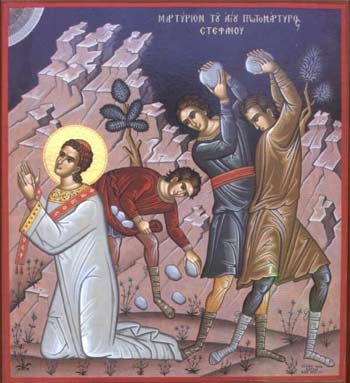 From the white of Christmas to the red of martyrdom, the paraments remind us that Christmas and its joy is celebrated in the very face of hatred, death, and destruction. As it was for our Lord, so it must be for His followers. He has made that clear. The Introit for this day calls out: "These are the ones coming out of the great tribulation. They have washed their robes and made them white in the blood of the Lamb. In You, O Lord, do I take refuge; let me never be put to shame." The Collect of the day asks for the grace to "follow the example of the first martyr, Stephen, that we also may look to the One who suffered and was crucified in our behalf and pray for those who do us wrong." Here is the light that has come into the darkness: a love so strong that it cannot be overcome! A love that prays for those who wrong us, and that seeks their salvation. A saint alive in such a love is a saint that death cannot destroy, and so "Lord Jesus, receive my spirit." (Epistle) Indeed "precious in the sight of the Lord is the death of His saints." (Alleluia Verse)
Praise for the first of martyrs,
Who saw You ready stand
To help in time of torment,
To plead at God's right hand.
Like You, our suff'ring Savior,
His enemies he blessed,
With "Lord, receive my spirit,"
His faith, by death, confessed.
Another Hymn for a Martyr\'s Day
25 December 2007


Christmas Moments
Cindi's huge Christmas Eve brunch... Freshly ground coffee from the new coffee maker - sweet!... Hannah and Johanna singing so sweetly the Quempas Carol... Friends gathered for goodies and visiting... Censing the church... Lauren and Anna letting lose on "Mary Did You Know"... Bekah, Abbey, and Robyn singing "Breath of Heaven"... Cindi on guitar and Diane doing some haunting flute selections... Jonathan and Kristi singing and playing recorder... Richard preaching with joy and conviction... The Eucharist shared as Cindi sings "O Holy Night"... "Break Forth" by the Weedon clan and Anna and Diane as the candles were being lighted... "Silent Night" and the ringing of the bell to welcome the Birth of the Savior (big Don pulled the rope on the great bell for must have been five minutes)... Lucky arriving, so feeble and aged that it's hard to conceive... Christmas eve night spent worried about the church catching fire (I do this every year, despite both thurible and candles spending the night OUTSIDE)... The reading of the Christmas announcement from the Martyrology, concluding in "O Come, All Ye Faithful"... The joy of the Christmas Day Gospel... The bells ringing in a "Joy to the World!"... The choir's astounding "He is Born, the Divine Christ Child" during distribution... "Now Sing We Now Rejoice" as the exit hymn, not quite Praetorius' Mass for Christmas morning, but close... More food and visiting than you could shake a stick at, but sad that Russell ended up not feeling well and unable to join us... Jo's famous popovers... Telling stories on Sandy to Kayla... Pies, pies and more pies... The quiet in the house when everyone is napping and the tree is lighted and Lucy is contentedly snoring at my feet... A joyous feast indeed.
Luke's Christmas and John's Christmas
We had a guest last night who had attended our Christmas Eve Service and wondered whether we were doing the same service the next day. How does one explain the difference between Christmas Eve and the Christmas Day services? I call them St. Luke's Christmas and St. John's - due to the tenor of the Gospels prescribed for either day. The St. Luke's Christmas is the one that everyone loves the best, I suspect. The gathering together at the late hour to celebrate the Holy Eucharist, light our candles, and sing with the angels and adore with the shepherds. St. John's Christmas has a totally different atmosphere - gone the contemplative hymns of the night before, and over and over again the triumph of the Word Made Flesh trumpets forth. Christmas Midnight is the service of "O Little Town" and "It Came Upon a Midnight Clear" and "All My Heart This Night Rejoices" and "Silent Night." Christmas Day is the service of "O Come All Ye Faithful" and "Of the Father's Love" and "Joy to the World" and "Now Sing We Now Rejoice." Christmas Eve is quiet contemplation and Christmas Day is overflowing jubilation. I think the Church is wise to include both (and also the halfway service at Christmas Dawn that is largely, sadly unobserved among us). Christmas celebrations need both Luke and John. I can't fathom choosing between them. I'm glad so many in our parish are there for both Divine Services.


24 December 2007
FEAST OF THE NATIVITY
 In the year 2015 from the birth of Abraham, in the year 1510 from the exodus of the people of Israel out of Egypt, in the year 1032 from the enthronement of David the Prophet and King, in the sixtieth "week" of the prophecy of Daniel, in the forty-second year of the reign of Caesar Augustus, in the thirty-third year of the reign of Herod, when the staff had gone from Judah has had been prophesied by Jacob the Patriarch, at a time when the whole world was at peace, it pleased God to send His only-begotten Son and Eternal Word to the world to become Man and to teach us God's love, to suffer, die, and rise from the dead for our salvation.
At that time, the Lord Jesus was born in a humble cave in Bethlehem of Judah, and no one knew of it but the immaculate Virgin Mary his Mother and Joseph her spouse. No one heard of this miracle surpassing all miracles but a few humble shepherds who had been told by angels in the sky that sang this hymn: "Glory to God in the highest, and on earth peace, good will towards men." Then the Magi came from the East, led by a star in the heaven: they found their way to where the Divine Infant rested, and they adored Him, and opening their treasures, they offered Him gifts of gold, incense and myrrh.
To God Incarnate, to the suckling Infant who humbled Himself and took our form, becoming one of us to make us divine; to the One who later walked among us to teach us the way of salvation and who loved us so much as to give His life for it: to Him be glory, honor, and adoration forever and ever. Oh, come, let us adore Him! (From the Roman Martyrology)
23 December 2007
Last Advent Service
Just got back from our final Advent liturgy: the Catechism Service. I had not originally scheduled that service on this day, but I needed a make up session after I came down with that flu-thingy. So meet we did. We substituted a few carols for the regular OT and NT Canticles. Our attendance was down by half, but that was expected - so many folks are out of town already or finishing up last minute preparations. What a blessing our sound/video team is! Those who miss, just pick up the DVD of the service, watch and discuss at home, and they're back on track!
Today we dealt with the third, fourth, and fifth petitions of the Our Father. I have become utterly convinced that the key to peace reigning in our hearts is to learn to pray the third petition. Anxiety arises from our fear that OUR WILL will not be done. When we have learned to surrender that will and instead seek that God's good, gracious, and perfect will be done, then we begin to enjoy a peace that cannot be shaken.
Today we dealt with the third, fourth, and fifth petitions of the Our Father. I have become utterly convinced that the key to peace reigning in our hearts is to learn to pray the third petition. Anxiety arises from our fear that OUR WILL will not be done. When we have learned to surrender that will and instead seek that God's good, gracious, and perfect will be done, then we begin to enjoy a peace that cannot be shaken.
O Emmanuel!
 O Emmanuel, our King and our Lord, the anointed for the nations and their Savior: Come and save us, O Lord our God!
And so we come to the last Vespers of Advent. Tonight the great O antiphon will be "O Emmanuel" for tomorrow we will celebrate that the Child of Mary is none other than God Himself with His people. If you read the titles for the great O Antiphons backwards from this day, you have ERO CRAS: "I will be (here) tomorrow." Advent is nearly over, and the joys of the Nativity are about to begin.
O come, O come, Emmanuel
And ransom captive Israel
That mourns in lonely exile here
Until the Son of God appear:
Rejoice! Rejoice! Emmanuel
Shall come to thee, O Israel.
22 December 2007
A Touch of Heaven
Tonight Cindi sang (and Millie played - using the harpsichord setting) from Bach's Cantata on Nun Komm (BWV 61) "Open Now My Heart to Jesus" during the distribution. We'll use it tomorrow also at Distribution at 7:45 and preservice at 10. I thought I'd died and gone to heaven...or at least to Leipzig.
Patristic Quote of the Day
The divine nature and the nature of a servant were united in one person so that the Creator of time might be born in time, and he through whom all things were made might be brought forth in their midst. - St. Leo the Great, Letter (Christian Prayer, p. 1951)
Old Lutheran Quote of the Day
He came as the Physician to the spiritually sick, as the Redeemer to the captives of sin, as the Way to those who had wandered afar off, as the Life to the dead in trespasses and sins, and as the Saviour to the lost. - Johann Gerhard, *Sacred Meditations* XV
Short Advent
At the Divine Service tonight I couldn't help but think how short our Advent season was this year - last year it was even a day shorter, but somehow it seemed to fly even faster this year. Tonight we already began our celebration of Advent IV and will conclude it tomorrow and put away the Advent wreath, only to find Christmas Eve awaiting us the following day.
O Rex Gentium
 O King of the nations, the ruler they long for, the cornerstone uniting all people: Come and save us all, whom You formed out of clay.
"You are a king, then" Pilate said. "You have said so" our Lord answered. He was always a tad reluctant about that title "King." The Gentiles have their idea of what it means and it didn't sit very comfortably upon the shoulders of the Man who reigns in triumphant love by shouldering the sin of the world on Calvary's cross and leaving death in pieces on Easter morning. And yet He is a King, and He is the King that the Gentiles long for, ache for, dream of and hope for. The King who will bring in true justice and who will put an end to all abuse of the poor and the downtrodden. The King who bring an end to all the "us" vs. "them" and unite humanity as a whole, as one family. In days when human divisions seem to be growing stronger and ever more bitter, the hope of the human race remains in the Child who comes to reign among us by serving, bearing, and dying.
O come, Desire of nations, bind
In one the hearts of all mankind;
Bid Thou our sad divisions cease,
And be Thyself our King of Peace.
Rejoice! Rejoice! Emmanuel
Shall come to thee, O Israel!
21 December 2007
You know my favorite Christmas ornament?
A long nail. Kenny and Sharilyn gave it to us years ago. It reminds us as we decorate the tree celebrating our Lord's birth each year of WHY He came into the world and where His love and determination to save us would land Him.
Some Provocative Quotes on Our Lord's Blessed Birth
"She is blessed above all other women, not only because she gave birth without labor, pain, and injury to herself, not as Eve and all other women, but because by the Holy Spirit and without sin she became fertile, conceived, and gave birth in a way granted to no other woman." - Martin Luther, Personal Prayer Book 1521 (and reprinted throughout his life), AE 43:40.
"Now, although Mary was not required to do this - the law of Moses having no claim over her, for she had given birth without pain and her virginity remained unsullied - nevertheless, she kept quiet, and submitted herself to the common law of all women and let herself be accounted unclean. She was without doubt a pure, chaste virgin before the birth, in the birth, and after the birth, and was neither sick nor weakened from the birth, and could certainly have gone out of the house after giving birth, not only because of her exemption from the Law, but also because of the uninterrupted soundness of her body." - Martin Luther, preached at the parish church in 1541 on the Eve of the Circumcision, House Postil III:256.
"He employed this mode of presence when He left the closed grave and came through the closed door, in the bread and wine in the Supper, and, as people believe, when He was born in His mother." 1577, SD VII:100
"He showed His divine majesty even in His mother's womb, because He was born of a virgin without violating her virginity. Therefore, she is truly the mother of God and yet has remained a virgin." 1577, SD VIII:24
"Now, although Mary was not required to do this - the law of Moses having no claim over her, for she had given birth without pain and her virginity remained unsullied - nevertheless, she kept quiet, and submitted herself to the common law of all women and let herself be accounted unclean. She was without doubt a pure, chaste virgin before the birth, in the birth, and after the birth, and was neither sick nor weakened from the birth, and could certainly have gone out of the house after giving birth, not only because of her exemption from the Law, but also because of the uninterrupted soundness of her body." - Martin Luther, preached at the parish church in 1541 on the Eve of the Circumcision, House Postil III:256.
"He employed this mode of presence when He left the closed grave and came through the closed door, in the bread and wine in the Supper, and, as people believe, when He was born in His mother." 1577, SD VII:100
"He showed His divine majesty even in His mother's womb, because He was born of a virgin without violating her virginity. Therefore, she is truly the mother of God and yet has remained a virgin." 1577, SD VIII:24
A Gift
 It was Christmas in 1970. I think it was also the year that my sister-in-law Peggy was so sick - she almost died from a viral infection that stopped her lungs. Under the tree I found a gift, a brand new King James Bible with my name imprinted on the front and a beautiful silver bookmark to go in it. On the gift page was inscribed "To Billy from Mom and Dad." I remember falling in love with it right away - the book itself, I mean, not its contents. It had the most wonderful smell (the ink, I suppose) and that smell still lingers in it somewhat. The KJV was a steep hill for a 9 year old. It took me a while to actually be able to read it and appreciate how it sings, how even in prose it speaks like a poet. Throughout my teen years I scribbled in it, studied it, and it came to be my regular Bible for praying the Psalter. The zipper long since came loose. I had to duct tape the covers together. The pages have yellowed a bit. But I keep it in the washstand that serves as my night stand. I still love pulling it out and reading through the Psalms now and again. It was truly a wonderful gift to give a 9 year old. Thanks, Mom and Dad.
Patristic Quote of the Day
Christ has only one mother in the flesh, but we all bring forth Christ by faith. - St. Ambrose, Homily (Christian Prayer, p. 1954)
Old Lutheran Quote of the Day
O let us admire the marvelous goodness of our God,, who, when we could not ascend to Him, hesitated not to descend to us. Let us stand in wonder at the marvelous power of our God, who was able to unite in one two natures so diverse as the divine and human, so that one and the same Person is now both God and man. -- Johann Gerhard, *Sacred Meditations* XIV


Christmas Trees
smell good, but I don't imagine they taste good. Salmon patties (MUST be made with the red sockeye salmon - costs more for a good reason!) taste wonderful, but they don't smell good. When salmon and Christmas tree do battle, I'm afraid that the salmon wins. Well, hopefully with a little help from candles and some cookies baking the not so wonderful smell of embertide lunch will fade away?


O Oriens!
 O Dayspring, Splendor of light everlasting, Come and enlighten those who sit in darkness and in the shadow of death.
There is a darkness about this world. And this darkest day of the year is but an image of that deeper darkness. The darkness of our sin, which locks us in a prison of old habits and fears. The darkness of our death and the death of those we love, which brings a darkness into the soul that is palpable. Dylan Thomas urged his father to "rage and fight against the dying of the light" - but he went into that dark night all the same. For those in such darkness, there is no fight left. The people sit. They sit and wait and know they cannot fight it, overcome it, destroy it. It's far bigger and badder than they. But in the darkness they can still do one thing: they can pray. They can call to Him who is a Light that no darkness ever has or ever will overcome, and pray for His gracious visitation. They can ask for His presence to lighten the darkness and lead them to that place "where the angels singing with all His saints unite, sweetest praises bringing, in heavenly joy and light!" This the Church does on this darkest day, calling out:
O come, Thou Dayspring from on high
And cheer us by Thy drawing nigh.
Disperse the gloomy clouds of night
And death's dark shadows put to flight!
Rejoice! Rejoice! Emmanuel
Shall come to thee, O Israel!
St. Thomas' Day
 Today our Synod (together with Lutherans worldwide and Western Rite Orthodox and Anglicans) commemorates St. Thomas, the Twin, the disciple who doubted, and whose doubt was healed by Christ a week after the original Easter. The whole story is told in the wonderful hymn: "O Sons and Daughters of the King!"
When Thomas first the tidings heard
That they had seen the risen Lord,
He doubted the disciples' word. Alleluia.
"My pierced side, O Thomas, see,
And look upon My hands, My feet;
Not faithless but believing be." Alleluia!
No longer Thomas then denied;
He saw the feet, the hands, the side;
"You are my Lord and God!" he cried. Alleluia!
How blest are they who have not seen
And yet whose faith has constant been,
For they eternal life shall win. Alleluia! (LSB 471:5-8)
The collect rejoices that God strengthened Thomas with firm and certain faith in the resurrection, and asks that we may be given such faith also and so never be found wanting in God's sight. St. Thomas' Day, falling so close to Christmas as it always does, reminds us that in the days to come we must press beyond what we see to what God reveals about what we see. We see a Child, lying in the manger, nursing at his mother's breast. But faith, which is the certainty of what is not seen, assures us that this Child is indeed "my Lord and my God" - the One through whom all things were made and without whom nothing was made that has been made; that this Child is the Life and Light of men that shines into the darkness; that in Him we meet and embrace a Forgiveness greater than all our sin and a Life stronger than all our death.
And St. Thomas and the Nativity tie together in another way. For at the consecration when He comes to us again in the Body born of Mary and the Blood poured out on the tree - the very Body Thomas touched - it is an ancient and salutary practice to confess with St. Thomas at the elevation: "My Lord and my God."
20 December 2007
It Wouldn't Be Christmas Without Reading It:
CHRISTMAS
John Betjeman
The bells of waiting Advent ring,
The Tortoise stove is lit again
And lamp-oil light across the night
Has caught the streaks of winter rain
In many a stained-glass window sheen
From Crimson Lake to Hooker’s Green.
The holly in the windy hedge
And round the Manor House the yew
Will soon be stripped to deck the ledge,
The altar, font and arch and pew,
So that the villagers can say
“The church looks nice” on Christmas Day.
Provincial public houses blaze
And Corporation tramcars clang,
On lighted tenements I gaze
Where paper decorations hang,
And bunting in the red Town Hall
Says “Merry Christmas to you all.”
And London shops on Christmas Eve
Are strung with silver bells and flowers
As hurrying clerks the City leave
To pigeon-haunted classic towers,
And marbled clouds go scudding by
The many-steepled London sky.
And girls in slacks remember Dad,
And oafish louts remember Mum,
And sleepless children’s’ hearts are glad,
And Christmas-morning bells say “Come!”
Even to shining ones who dwell
Safe in the Dorchester Hotel.
And is it true? And is it true,
This most tremendous tale of all,
Seen in a stained-glass window’s hue,
A Baby in an ox’s stall?
The Maker of the stars and sea
Become a Child on earth for me?
And is it true? For if it is,
No loving fingers tying strings
Around those tissued fripperies,
The sweet and silly Christmas things,
Bath salts and inexpensive scent
And hideous tie so kindly meant,
No love that in a family dwells,
Nor carolling in frosty air,
Nor all the steeple-shaking bells
Can with this single Truth compare--
That God was Man in Palestine
And lives to-day in Bread and Wine.
The bells of waiting Advent ring,
The Tortoise stove is lit again
And lamp-oil light across the night
Has caught the streaks of winter rain
In many a stained-glass window sheen
From Crimson Lake to Hooker’s Green.
The holly in the windy hedge
And round the Manor House the yew
Will soon be stripped to deck the ledge,
The altar, font and arch and pew,
So that the villagers can say
“The church looks nice” on Christmas Day.
Provincial public houses blaze
And Corporation tramcars clang,
On lighted tenements I gaze
Where paper decorations hang,
And bunting in the red Town Hall
Says “Merry Christmas to you all.”
And London shops on Christmas Eve
Are strung with silver bells and flowers
As hurrying clerks the City leave
To pigeon-haunted classic towers,
And marbled clouds go scudding by
The many-steepled London sky.
And girls in slacks remember Dad,
And oafish louts remember Mum,
And sleepless children’s’ hearts are glad,
And Christmas-morning bells say “Come!”
Even to shining ones who dwell
Safe in the Dorchester Hotel.
And is it true? And is it true,
This most tremendous tale of all,
Seen in a stained-glass window’s hue,
A Baby in an ox’s stall?
The Maker of the stars and sea
Become a Child on earth for me?
And is it true? For if it is,
No loving fingers tying strings
Around those tissued fripperies,
The sweet and silly Christmas things,
Bath salts and inexpensive scent
And hideous tie so kindly meant,
No love that in a family dwells,
Nor carolling in frosty air,
Nor all the steeple-shaking bells
Can with this single Truth compare--
That God was Man in Palestine
And lives to-day in Bread and Wine.
You all know
that I love LSB. I think it is a great Hymnal and Service Book. BUT there are times I get very irritated with it. Christmas Day's collect is one of them.
The Latin original for this beautiful collect contrasts the new birth in the flesh of Christ with our ancient servitude under the yoke of sin - and rejoices that in Christ the newness breaks through the oldness of sin and death to liberate us.
Well, the LSB collect retained the notion of freedom from the bondage of sin, but totally left out "the new" and "the old" and I can't for the life of me figure out why. With the birth of Christ in the flesh all is new ("Behold, I make all things new!" and "the old has passed away, the new has come!") and the old yoke is smashed - a new world opens up.
Hand in hand with that is the way that some translate the "Everlasting Father" of Isaiah 9 as "Father of the Age to Come." In other words, Christ as the new constitutive center of the coming age stepping into the place parallel to Adam in this old age. In Christ's new birth all things can become new again. Sad that it was dropped.
The Latin original for this beautiful collect contrasts the new birth in the flesh of Christ with our ancient servitude under the yoke of sin - and rejoices that in Christ the newness breaks through the oldness of sin and death to liberate us.
Well, the LSB collect retained the notion of freedom from the bondage of sin, but totally left out "the new" and "the old" and I can't for the life of me figure out why. With the birth of Christ in the flesh all is new ("Behold, I make all things new!" and "the old has passed away, the new has come!") and the old yoke is smashed - a new world opens up.
Hand in hand with that is the way that some translate the "Everlasting Father" of Isaiah 9 as "Father of the Age to Come." In other words, Christ as the new constitutive center of the coming age stepping into the place parallel to Adam in this old age. In Christ's new birth all things can become new again. Sad that it was dropped.
A Christmas Eve Homily from Yesteryear
 (I'm not preaching Christmas Eve this year, but here is an offering from years past)
Tonight the angels rejoice! Tonight the Shepherds wonder! Tonight in the darkness of the stable-cave, she who had known no man, nor ever would, gives birth! Joseph held in his arms the little Child who created the world, who in unfathomable love for us has taken on our poor flesh and blood to restore that which had fallen. Tonight God visits us: not by taking the mere appearance of a man, nor the body of an angel. He visits us by being born a little Child “to bear and fight and die.” That is the mystery of this night, its joy and its light.
For the Babe laid in the manger is the Light that shines in the darkness of this world. And the darkness does not understand and has not overcome Him! He shines with the brightness of the Father’s love! Without this birth, this Child, life itself would be meaningless, filled with darkness, despair, death. But this Child is born and darkness is banished! This Child is born and despair takes flight! This Child is born and death cries out in anguish, knowing that its dominion over the human race is at an end.
The shepherds are astonished. The night around them shines likes the day. No, brighter, for it is no light of this world that shines upon them, but the unending light of heaven’s courts. As they stand, awe-struck, the Flaming Spirit, the Angel of the Lord, speaks: “Fear not! Fear not, for I am not sent to you watchers in the night with a message of woe. It is true that you are not worthy to so much as gaze upon the splendor of the light in which we live, but ere this night is over you shall gaze upon that which is so much greater! Listen, O Watchers! For I bring you good news of great joy – joy such as this earth has not heard since the days of Paradise. Joy that shall flood your hearts and lives, and not yours alone. Oh, no! The joy that I speak of is for you and for all people, for the high and the low, the rich and the poor, and the harlot and the virgin. Today, this very night, in the City of David, a Savior has been born. Born to you! Born for you! This is He whom seers in old time chanted of with one accord, whom the voices of the Prophets promised in their sacred Word. Now He shines, the long-expected, let creation praise it’s Lord, evermore and evermore!”
“O Shepherds, ask me not how it can be! We marvel! We worship and adore! This Child, this Savior that is born for you, is He who sits upon His eternal throne: God, the Word, the Everlasting Son, of the Father’s love begotten ere the worlds began to be! He is Alpha and Omega! He the Source, the Ending He, of the things that are, that have been, and that future years shall see. Evermore and evermore!”
“And do you seek some sign? Oh, Shepherds, listen well. Do not expect to find him wrapped in velvets soft and silken stuff! Not all the furs and jewels of this world are worthy of Him who is Maker of all. You will find Him wrapped in swaddling bands! You will find Him lying in a manger! O mystery of mysteries, Shepherds in the night! His mother wraps swaddling bands about Him and confines God’s feet and hands. So great His love for you, O sons of Adam!”
And even as the Angel speaks the hosts of heaven can hold back their joy no more. The skies blaze with even greater light. The air fills with endless song. The hills echo it back: “Glory! Glory! Glory to God in the highest! And peace! Peace on earth, good will toward men.” And as suddenly as the light appeared, it is gone.
Silence. Awe. Wonder. Eyes turned up to the skies, filled with tears of joy inexpressible. Eyes that slowly lower and look into one another. “To Bethlehem! To the Child! Let us see! Hurry! Let us behold with our own eyes what the Lord has declared to us!” Running. Skipping. Laughing. Crying. To Bethlehem.
The stable cave is quiet now. The Child asleep. He who feeds the ravens and all creatures when they call, has fed at Mary’s breast. Mary resting. Joseph standing in silence and looking down on the Wonder of the ages. The sound of running feet. Awkward looks. “Shhh! This is the place!” Coming in, kneeling down, looking at the rhythmic pattern of His breathing. Tears again. Overflowing. Daring to touch, to touch even Him. And then whispers. The story retold. Angel. Light. Message. Savior. Music. Glory. Peace. The mother’s eyes shining. Her heart bursting as stores it all away. Treasures it all. Blesses God in heart for it all. For the Child. Her Child. The Child of promise. The Child whose coming sets us free from sin and death.
Slowly, reluctantly, leave-taking. Back to the fields. Once outside, the joy filling again. Singing. Glorifying God and praising Him. Echoes of heaven’s song. Telling everyone what has happened.
O people loved by God, the story is true. Christ is born! Born for you and born for me! Born our Savior. Sent out of the Father’s love to bring us life and light, torestore us to joy! In a garden, when the world was young, a woman handed man the fruit from a tree and death came upon us all. We were banished from paradise, exiled from home. In a stable-cave, in the darkness of the night, a woman gave to us a Child, who is Himself the Tree of Life. Paradise is opened again, when Jesus is born of the pure Virgin! In true faith, eat of Him and live! In true faith, welcome Him into your heart and into your life, the Savior promised long. Christ is born! Glorify Him! Christ from heaven! Receive Him! Christ is now on earth! Exalt Him! O earth, sing to the Lord! O people so loved and so favored, praise the Savior born for you! Amen.
All My Heart
All my heart again rejoices
As I hear
Far and near
Sweetest angel voices.
"Christ is born!" their choirs are singing
Till the air
Everywhere
Now with joy is ringing.
Hear! The Conqueror has spoken:
"Now the foe, sin and woe,
Death and hell are broken!"
God is man, man to deliver,
And the Son
Now is one
With our blood forever.
Should we fear our God's displeasure,
Who, to save,
Freely gave
His most precious treasure?
To redeem us He has given
His own Son
From the throne
Of His might in heaven.
See the Lamb, our sin once taking,
To the cross,
Suff'ring loss,
Full atonement making.
For our life, His own He tenders,
And His grace
All our race
Fit for glory renders.
Softly from His lowly manger,
Jesus calls
One and all,
"You are safe from danger.
Children, from the sins that grieve you
You are freed;
All you need
I will surely give you."
Come, then, banish all your sadness!
One and all,
Great and small,
Come with songs of gladness.
We shall live with Him forever
There on high
In that joy
Which will vanish never.
by Paul Gerhardt, LSB #360
As I hear
Far and near
Sweetest angel voices.
"Christ is born!" their choirs are singing
Till the air
Everywhere
Now with joy is ringing.
Hear! The Conqueror has spoken:
"Now the foe, sin and woe,
Death and hell are broken!"
God is man, man to deliver,
And the Son
Now is one
With our blood forever.
Should we fear our God's displeasure,
Who, to save,
Freely gave
His most precious treasure?
To redeem us He has given
His own Son
From the throne
Of His might in heaven.
See the Lamb, our sin once taking,
To the cross,
Suff'ring loss,
Full atonement making.
For our life, His own He tenders,
And His grace
All our race
Fit for glory renders.
Softly from His lowly manger,
Jesus calls
One and all,
"You are safe from danger.
Children, from the sins that grieve you
You are freed;
All you need
I will surely give you."
Come, then, banish all your sadness!
One and all,
Great and small,
Come with songs of gladness.
We shall live with Him forever
There on high
In that joy
Which will vanish never.
by Paul Gerhardt, LSB #360
Plans for the Feast
Our plans, God willing, begin with opening of gifts on Christmas Eve morning (an expedient we adopted many years ago since the service schedule doesn't really permit much else), at which Cindi will serve up her famous Kringler. Then in the early afternoon we'll have a big brunch. We hope that Aunt Sandy will be up and about by then (she's a night owl) and join Jo and Dave and the Herberts and Weedons for Cindi's "pull out all the stops" breakfast. Then a quiet afternoon and preparation for the evening services.
At 6:30 on Christmas eve, the preservice music begins. Then at 7 p.m. is the Children's Service. As the children leave the church, they pick up a bag of goodies. Many folks then migrate over to the parsonage to visit and share good cheer until time rolls around for the Candle-light Divine Service. This starts at 11 and finishes up at midnight. This year, Seminarian Richard Rikli (former principal at Trinity-St. Paul) will be homilist. This quiet service in the late night is one of my favorites of the year. Cindi sings during distribution of the sacrament "O Holy Night" and the kids provide some special music too.
The main Christmas celebration takes place the next morning at 9:00 with the Divine Service for Christmas Day. Bell Choir and Adult Choir lead us in our celebration and adoration of the Word made Flesh, who comes to us still in the very body and blood He received from His mother Mary and in which our salvation was won. "Oh, come, let us adore Him, Christ the Lord!"
Christmas dinner may run up to 13, we're thinking. Jo's making roast beef, potatoes and gravy, and popovers. We're also serving a smoked turkey, cornbread, and assorted other goodies. Cindi informs me that no less than five desserts will grace the occasion: Cherry-peach pie, chocolate pie, apple pie, chocolate-almond cheesecake, and (low carb???) pecan pie. To be a Weedon means that PIE is the dessert of choice and should be served in overflowing abundance!
Aunt Sandy and her former husband, Lucky, will be joining us, together with their son Russell and his wife Kayla. Also Dave and Jo, the Weedon clan, and Dean and Lauren Herberts. Looking forward to it a great deal, and hope that all of you have a joyous and blessed festival of the Lord's Nativity also!
At 6:30 on Christmas eve, the preservice music begins. Then at 7 p.m. is the Children's Service. As the children leave the church, they pick up a bag of goodies. Many folks then migrate over to the parsonage to visit and share good cheer until time rolls around for the Candle-light Divine Service. This starts at 11 and finishes up at midnight. This year, Seminarian Richard Rikli (former principal at Trinity-St. Paul) will be homilist. This quiet service in the late night is one of my favorites of the year. Cindi sings during distribution of the sacrament "O Holy Night" and the kids provide some special music too.
The main Christmas celebration takes place the next morning at 9:00 with the Divine Service for Christmas Day. Bell Choir and Adult Choir lead us in our celebration and adoration of the Word made Flesh, who comes to us still in the very body and blood He received from His mother Mary and in which our salvation was won. "Oh, come, let us adore Him, Christ the Lord!"
Christmas dinner may run up to 13, we're thinking. Jo's making roast beef, potatoes and gravy, and popovers. We're also serving a smoked turkey, cornbread, and assorted other goodies. Cindi informs me that no less than five desserts will grace the occasion: Cherry-peach pie, chocolate pie, apple pie, chocolate-almond cheesecake, and (low carb???) pecan pie. To be a Weedon means that PIE is the dessert of choice and should be served in overflowing abundance!
Aunt Sandy and her former husband, Lucky, will be joining us, together with their son Russell and his wife Kayla. Also Dave and Jo, the Weedon clan, and Dean and Lauren Herberts. Looking forward to it a great deal, and hope that all of you have a joyous and blessed festival of the Lord's Nativity also!
O Clavis David!
 O Key of David and scepter of the house of Israel, You open and no one can close, You close and no one can open: Come and rescue the prisoners who are in darkness and the shadow of death!
Revelation and Isaiah are dancing in the background of this name for our Lord. But the thought is clearly the opening of paradise, the door that was shut in the fall. Our Lord can set before us that open door and bid us come through, out of our death-bound prison into a life that never ends. For some reason I always think of the Last Battle, and the door to the stable. "In our world too a stable once had something inside that was bigger than our whole world," Lucy said. And that stable door which is opened for us at Bethlehem opens to a world where the "higher up and further in" never can be exhausted. This is the door that Christ opens for us. The door that He is. The door that He is the key to unlock. In HIM we find paradise restored and more. He lifts us higher than from where Adam fell. He invites us to step through the door with Him and become by grace what He is by nature: children of God.
O come, Thou Key of David, come,
And open wide our heav'nly home;
Make safe the way that leads on high
And close the path to misery.
Rejoice! Rejoice! Emmanuel
Shall come to thee, O Israel!
19 December 2007
SWEET!
You know, one of my all time favorite pieces from that Praetorius Christmas Mass is the Puer Nobis / Ein Kind Geboren. I was bumming that I've not seen it in any of our English hymnals, but I tried googling and look at what I found!!!
click here
There's the music. Now, I like the words that Krauth translated better. There are available here:
click here
I think the Weedon family just found an assignment for sometime during the Christmas season!!!
P.S. Better yet, Pastor Jerry Gernander has pointed out to me that the version from the Oxford Book of Carols may be found at ELH #112 - with Praetorius' setting no less! Truly ELH is one of the gems of the new hymnals when it comes to the musical content!
click here

There's the music. Now, I like the words that Krauth translated better. There are available here:
click here
I think the Weedon family just found an assignment for sometime during the Christmas season!!!
P.S. Better yet, Pastor Jerry Gernander has pointed out to me that the version from the Oxford Book of Carols may be found at ELH #112 - with Praetorius' setting no less! Truly ELH is one of the gems of the new hymnals when it comes to the musical content!
Old Lutheran Quote of the Day
 Let us with glad voices join in the angels' song, and render unto the Lord the thanks due unto His name for His marvelous benefits to us. Let us rejoice and shout for joy with the whole multitude of the heavenly host. For if the angels rejoiced so greatly on our account, how much more ought we to rejoice to whom this Child is born, to whom this Son is given. If the Israelites lifted up their voices in jubilant shouts when the Ark of the Covenant was brought back to them, which was a type and a shadow of the incarnation of our dear Lord, how much more ought we to rejoice, since our Lord Himself hath come down to us in the assumption of our human nature. - Johann Gerhard, *Sacred Meditations* XIV.
Patristic Quote of the Day
That the Creator is in his creature and God is in the flesh brings dignity to man without dishonor to Him who made him. - St. Peter Chrysologus, Homily
O Radix Jesse!
 O Root of Jesse, standing as an ensign before the peoples, before whom all kings are mute, to whom the nations will do homage: Come quickly to deliver us!
The Root of Jesse? Is our Lord not the flower of Jesse's stem? He is both root and flower, the Alpha and the Omega. As the Root of Jesse He stands as an ensign, a signal and banner, a rallying point for the nations. We, the Gentiles, come before Him and bow in silence as our King reigns in Triumph upon His cross, the Victor over sin and death. Jesse ties specifically to the promises of the kingship, and we see His kingly power displayed chiefly in showing mercy and pity.
Today the Head Gardener in the monastery might be privileged to give a special gift to the brothers and to sing the great O Antiphon.
O come, Thou Branch of Jesse's tree,
Free them from Satan's tyranny
That trust Thy mighty pow'r to save,
And give them vict'ry o'er the grave:
Rejoice! Rejoice! Emmanuel
Shall come to thee, O Israel! (LSB 357:4)
Homily for Advent IV
[Deuteronomy 18:15-19 / Philippians 4:4-7 / John 1:19-28]
Most people like to talk about themselves, whether they admit it or not. I am reminded of two southern belles visiting, and the one was rather monopolizing the conversation. At last she took a breather and said: “Well, enough of me talking about myself, honey. Why don’t you talk about me for a little bit?”
Yet nothing could be further from the spirit of St. John the Baptist. Not only do his short, clipped answers come across like a typical New Englander, but what answers you can squeeze out of him seem to tell you mostly who he is not. He is not the Christ. He is not Elijah. He is not the prophet (that’s the one promised in our Old Testament reading today from Deuteronomy who would be like Moses, a mediator between God and the people). In sheer exasperation the Jerusalem delegation demands: “Give us something to report to those who sent us. Who are you? What do you say about yourself?”
“Me?” John seems to say. “I don’t have anything to say about myself, but Isaiah had a thing or two to say. He called me a voice out in the wilderness crying ‘Prepare the way of the Lord.’”
A voice? Did he say he was just a voice? A wilderness voice? A voice calling for folks to get ready for the coming of the Lord? Yep. That’s what the man said alright. He was just a voice.
Well, then, they wanted to know, “Tell us. voice, who gave you the authority to baptize, to promise forgiveness of sins, if you are not the Christ and not Elijah and not the prophet? By whose authority?”
John’s answer at first doesn’t sound like an answer at all. He says: “I baptize with water, but there stands One among you whom you do not know. It is He who coming after me is preferred before me, whose sandal strap I am not worthy to untie.”
That’s John’s answer. The One among them, whom they do not recognize, is the One who has authorized John to preach and invite people to repentance. He is the One who has authorized John to summon all people to leave behind the old ways of sinful self-sufficiency and pride, and to embrace the new life that depends entirely on the mercy of God. This is the One who is so much greater than John, preferred before Him because He was before Him. You see, though our Lord was born six months after His kinsman, John, John knows that He is the One who was before all ages. He is the Word through whom John and you and I and all things were made. He is the Word become flesh and dwelling among us.
And look at what that One has come to do! He did not come among us to be served, not even to have sandals latched, but He came among us in order to serve us! For the water of Baptism flows at His authorization and what it grants is nothing less than washing clean of sins – freeing us both from sin’s guilt and from sin’s power over our lives. He stoops to serve us!
John was content to be nothing but a voice announcing the coming of that One who serves us all by being the Lamb of God that takes away the sin of the world. Being that voice defined John’s whole life. He didn’t want to talk about himself, because he was sent to talk about the Greater One who is among us and whose sandals we are not worthy to untie, but who comes to be our Savior. In that he points all pastors and all Christians to what they are always to be talking about.
In the Church, the talk is not about us. No, “enough of me talking about me, why don’t you talk about me for a while.” In the Church, the talk is always all about Another. It is about the One whose sandals we are not worthy to untie. It is about the One who is infinitely greater than we, because He was before us all, for we are surely, each one, the work of His hands even as we are also, each one, the creatures of His own redeeming. He came among us as one of us precisely so that could serve all of us. He shouldered our sins as He carried His cross, and He died our death, and shattered our hell, and by overcoming the sharpness of death He opened up the Kingdom of heaven to all believers. Truly, the Son of Man did not come among us to be served, but to serve, and to give His life as the ransom for the many, indeed, for all.
Advent is almost over, and the time of overflowing joy is about to begin. And so John does us the service yet again this year of focusing all the joy of the Church entirely in Jesus. John’s words remind us that the joy of the coming days is not found in presents and memories and family gatherings and sentiments of good will and cheer – blessings though they are. It is certainly not found in gluttony and drunkenness – blessings they are not. In the next few days, God willing, we’ll be staring with Mary and Joseph and the Shepherds in wonder at the Child who is indeed among us, our Immanuel. We’ll be singing songs of greeting to Him and rejoicing that He came among us and most of all rejoicing in why He came among us. John teaches us that the joy of the Church, and the joy of each of our lives is found in the One who is among us, Immanuel, in Jesus Christ, our Lord, because only in Jesus is there forgiveness of sins. Only in Jesus is the remedy for those who sit in darkness and the shadow of death. “Behold, the Lamb of God who takes away the sin of the world.” Before we greet Him in the manger, one more time let us welcome Him as He comes to us at His Table, bearing the only Christmas gifts that any of us need, gifts that none of us can live without. To Him alone with His Father and All-holy and life giving Spirit be all glory and honor now and unto the ages of ages! Amen.
Most people like to talk about themselves, whether they admit it or not. I am reminded of two southern belles visiting, and the one was rather monopolizing the conversation. At last she took a breather and said: “Well, enough of me talking about myself, honey. Why don’t you talk about me for a little bit?”
Yet nothing could be further from the spirit of St. John the Baptist. Not only do his short, clipped answers come across like a typical New Englander, but what answers you can squeeze out of him seem to tell you mostly who he is not. He is not the Christ. He is not Elijah. He is not the prophet (that’s the one promised in our Old Testament reading today from Deuteronomy who would be like Moses, a mediator between God and the people). In sheer exasperation the Jerusalem delegation demands: “Give us something to report to those who sent us. Who are you? What do you say about yourself?”
“Me?” John seems to say. “I don’t have anything to say about myself, but Isaiah had a thing or two to say. He called me a voice out in the wilderness crying ‘Prepare the way of the Lord.’”
A voice? Did he say he was just a voice? A wilderness voice? A voice calling for folks to get ready for the coming of the Lord? Yep. That’s what the man said alright. He was just a voice.
Well, then, they wanted to know, “Tell us. voice, who gave you the authority to baptize, to promise forgiveness of sins, if you are not the Christ and not Elijah and not the prophet? By whose authority?”
John’s answer at first doesn’t sound like an answer at all. He says: “I baptize with water, but there stands One among you whom you do not know. It is He who coming after me is preferred before me, whose sandal strap I am not worthy to untie.”
That’s John’s answer. The One among them, whom they do not recognize, is the One who has authorized John to preach and invite people to repentance. He is the One who has authorized John to summon all people to leave behind the old ways of sinful self-sufficiency and pride, and to embrace the new life that depends entirely on the mercy of God. This is the One who is so much greater than John, preferred before Him because He was before Him. You see, though our Lord was born six months after His kinsman, John, John knows that He is the One who was before all ages. He is the Word through whom John and you and I and all things were made. He is the Word become flesh and dwelling among us.
And look at what that One has come to do! He did not come among us to be served, not even to have sandals latched, but He came among us in order to serve us! For the water of Baptism flows at His authorization and what it grants is nothing less than washing clean of sins – freeing us both from sin’s guilt and from sin’s power over our lives. He stoops to serve us!
John was content to be nothing but a voice announcing the coming of that One who serves us all by being the Lamb of God that takes away the sin of the world. Being that voice defined John’s whole life. He didn’t want to talk about himself, because he was sent to talk about the Greater One who is among us and whose sandals we are not worthy to untie, but who comes to be our Savior. In that he points all pastors and all Christians to what they are always to be talking about.
In the Church, the talk is not about us. No, “enough of me talking about me, why don’t you talk about me for a while.” In the Church, the talk is always all about Another. It is about the One whose sandals we are not worthy to untie. It is about the One who is infinitely greater than we, because He was before us all, for we are surely, each one, the work of His hands even as we are also, each one, the creatures of His own redeeming. He came among us as one of us precisely so that could serve all of us. He shouldered our sins as He carried His cross, and He died our death, and shattered our hell, and by overcoming the sharpness of death He opened up the Kingdom of heaven to all believers. Truly, the Son of Man did not come among us to be served, but to serve, and to give His life as the ransom for the many, indeed, for all.
Advent is almost over, and the time of overflowing joy is about to begin. And so John does us the service yet again this year of focusing all the joy of the Church entirely in Jesus. John’s words remind us that the joy of the coming days is not found in presents and memories and family gatherings and sentiments of good will and cheer – blessings though they are. It is certainly not found in gluttony and drunkenness – blessings they are not. In the next few days, God willing, we’ll be staring with Mary and Joseph and the Shepherds in wonder at the Child who is indeed among us, our Immanuel. We’ll be singing songs of greeting to Him and rejoicing that He came among us and most of all rejoicing in why He came among us. John teaches us that the joy of the Church, and the joy of each of our lives is found in the One who is among us, Immanuel, in Jesus Christ, our Lord, because only in Jesus is there forgiveness of sins. Only in Jesus is the remedy for those who sit in darkness and the shadow of death. “Behold, the Lamb of God who takes away the sin of the world.” Before we greet Him in the manger, one more time let us welcome Him as He comes to us at His Table, bearing the only Christmas gifts that any of us need, gifts that none of us can live without. To Him alone with His Father and All-holy and life giving Spirit be all glory and honor now and unto the ages of ages! Amen.
Subscribe to:
Posts (Atom)