Tonight, we meditate upon a single verse in our Gospel. These words: “So then, after the Lord had spoken to them, He was received up into heaven, and sat down at the right hand of God.”
When you hear, “sat down” what do you think of? Do you picture Jesus sitting up in heaven, twiddling his thumbs, and waiting patiently for His Father to give Him the signal that the time has come to return again in glory? What is He up to as He sits at the right hand of the Father?
First thing we need to clear up is this right hand business. The sacred writer is not giving you hints about heavenly geography, so that when you get to heaven you’ll know on which side of the Father to look to see the Lord Jesus. Right hand is bigger than that!
Recall the words of the Psalmist: “The right hand of the Lord does valiantly. The right hand of the Lord is exalted. The right hand of the Lord does valiantly.” Ps. 118:16
The right hand of the Lord in scripture is not a place, but a power! It is almighty power. And so to say that Jesus is seated at the right hand of God is to say that He has all power, that He rules and governs all things! Listen to how Paul said it in Ephesians: “He raised Christ from the dead and seated him at His right hand in the heavenly places, far above all principality and power and might and dominion, and every name that is named, not only in this age, but also in the age to come. And He put all things under His feet, and gave Him to be head over all things to the Church, which is His body, the fullness of Him who fills all in all.” Eph 1:20-23
So, when we confess in the Creed that Jesus is seated at the right hand of the Father we confess that the human nature which He assumed from the womb of the Blessed Virgin, and in which He offered to God the sufficient ransom to release all people from the debt of sin and the power of death, that this human nature has now been exalted and raised above every height imaginable, given the exercise of all power in heaven and on earth. The One who bears in His hands the scars of the nails now rules over all!
So when I complain about the way things go in my life, when I gripe about the troubles of the world or of the Church, I am actually complaining about the way the Crucified and Risen One sees fit to govern, aren’t I? Puts a different perspective on life, doesn’t it? Me pitting my puny wisdom and ideas against the omnipotence and wisdom of Christ.
In the early days of the Church, this was not forgotten. Even as the persecutions raged and people died for the faith, they never forgot the One in charge. There’s a writing called the Martyrdom of St. Polycarp that comes down to us from those earliest days of the Church. It’s a fascinating little document, but where it really soars is at the end. Listen: “It was the second day of the first fortnight of Xanthicus, seven days before the calends of March, when our blessed Polycarp died his martyr’s death two hours after midday on the Greater Sabbath. The official responsible for his arrest was Herod; the High Priest was Philip of Tralles; and the proconsul was Statius Quadratus – BUT THE RULING MONARCH WAS JESUS CHRIST, WHO REIGNS FOREVER AND EVER. TO HIM BE ASCRIBED ALL GLORY, HONOR, MAJESTY, AND AN ETERNAL THRONE FROM GENERATION TO GENERATION.” (Martyrdom of Polycarp, par. 21)
What confidence and peace those early Christians had as they remembered and confessed who sits upon the throne of this universe! It can give the same confidence and peace to us.
But there’s even more to being seated at the right hand of God. Our Lord Jesus not only rules all things for the well-being of His holy Church! He also constantly intercedes for us before the Father. The writer to Hebrews put it this way: “Therefore He is able to save to the uttermost those who come to God through Him, since He always lives to make intercession for them!” (Hebrews 7:25) For you, He prays. When you sin, He says to His Father, “Father, forgive. Look not upon the sin, but upon these scars that testify that I have answered for all their sin.” Thus He is our Mediator, the one who stands in the breach between us and God. His being Mediator did not cease when the work of the cross was done. He continues to be our Mediator by His unceasing intercession for us by which He saves us to the uttermost.
And yet there’s even more. Since the “right hand of God” is not to be thought of as a place, but as a power, the Ascension of our Lord does not remove Him from us, but brings Him closer to us. Oh, His visible presence is removed. But He is not removed. His promise stands forever: “Lo, I am with you always, to the end of the age.” Matt 28 St. Leo the Great got the hang of it. He preached to his parish in Rome: “The visible presence of Christ has passed into His sacraments.” When you come to the altar today, you not only receive the Body and Blood that were offered in your place on Calvary’s tree for the forgiveness of your sin! You receive the Body and Blood of Him who sits at the right hand of the Father, ruling over all things. Thus Paul could rejoice that “He has raised us up together and made us sit together in the heavenly places in Christ Jesus.” (Eph 2) The Sacrament lifts you that high!
How great then are the treasures contained in: “And sat down at the right hand of God.” Ruling every circumstance, and so peace displaces our complaining. Interceding constantly for us, and joy drives out our anxieties. Constantly with us in His sacraments, and so we are never alone, but always with Him who sits at the right hand of God. Jesus, our Mediator. Jesus, our King. Jesus, our Risen, Ascended, and Glorified Lord. To whom with the Father and the Holy Spirit be all glory and honor now and ever and unto the ages of ages. Amen.
22 May 2006


A few more Chrysologus gems
"He ascended into heaven." He ascended to bring us there, not to bring himself back, since he never left heaven. (Sermon #58, par. 8)
"In the forgiveness of sins." Gain for yourself the pardon coming from faith, since he is his own worst enemy who does not believe that he is given what the very generous Bestower of mercy promises in all kindness. (Sermon #58, On the Creed, par. 13)
"The forgiveness of sins." How can one who believes that the kingdom of heaven is given him not believe that sins are forgiven him? Heaven receives the innocent, not the guilty. For we believe that all sins must be forgiven us, because unless we are holy we cannot possess what is holy. (Sermon #62A, On the Creed, par. 12)
Pharisee, admit your sin, so that you might be able to come to the table of Christ; so that you might have Christ as your Bread, and he the Bread might be broken in forgiveness for your sins; so that Christ might become your Cup to be poured out in remission of your offenses. Pharisee, eat with sinners so that you can eat with Christ. Acknowledge that you are a sinner, so that Christ might eat with you. (Sermon 30, on Matt 9:9ff., par. 4)
Brothers, let us be sinners by our own admission, so that with Christ's forgiveness we may be sinners no more. (Sermon 30, on Matt 9:9ff, par. 5)
Patristic Quote for the Day
"Do not fear!" (John 20:36)
Do not fear, Peter, on account of your denial; John, on account of having fled; all of you, on account of having deserted me, of forming judgments about me with every one of your thoughts devoid of faith, and of still not believing even though you see me. Do not fear, it is I, who have called you by means of grace, have chosen and pardoned you, have sustained you by my steadfast kindness, have supported you with my love, and out of goodness alone I now take you back, because when a father receives his son, and when affections recovers its own, neither one is able to see any faults.
--St. Peter Chrysologus, Sermon 81, par. 3
21 May 2006

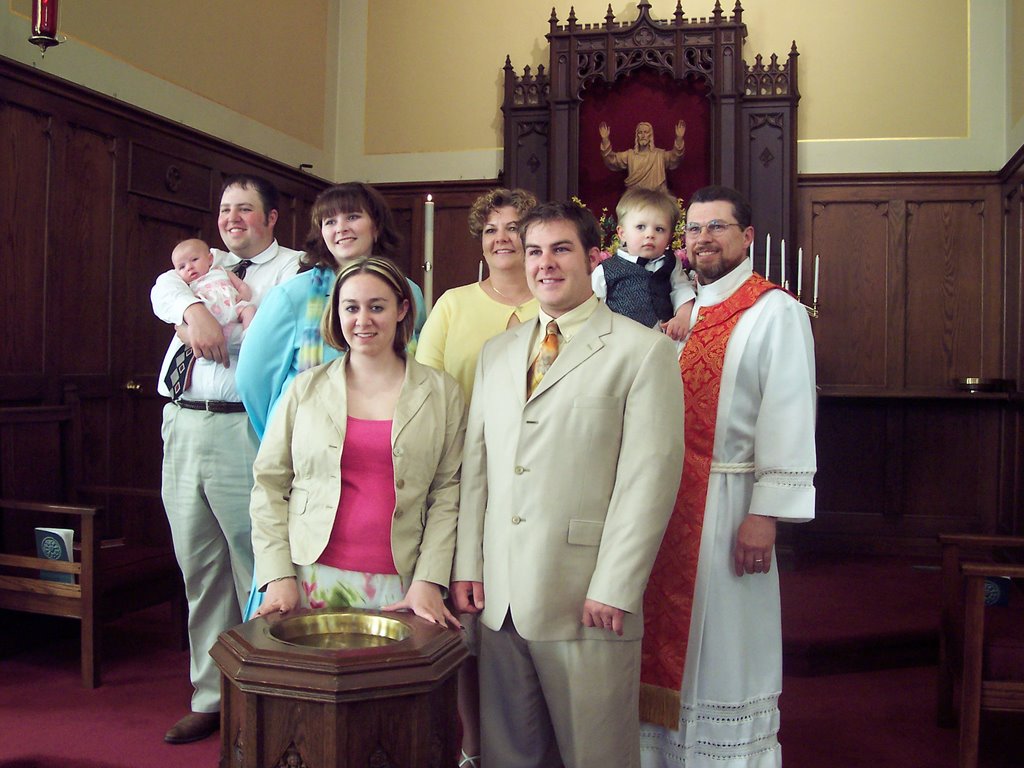
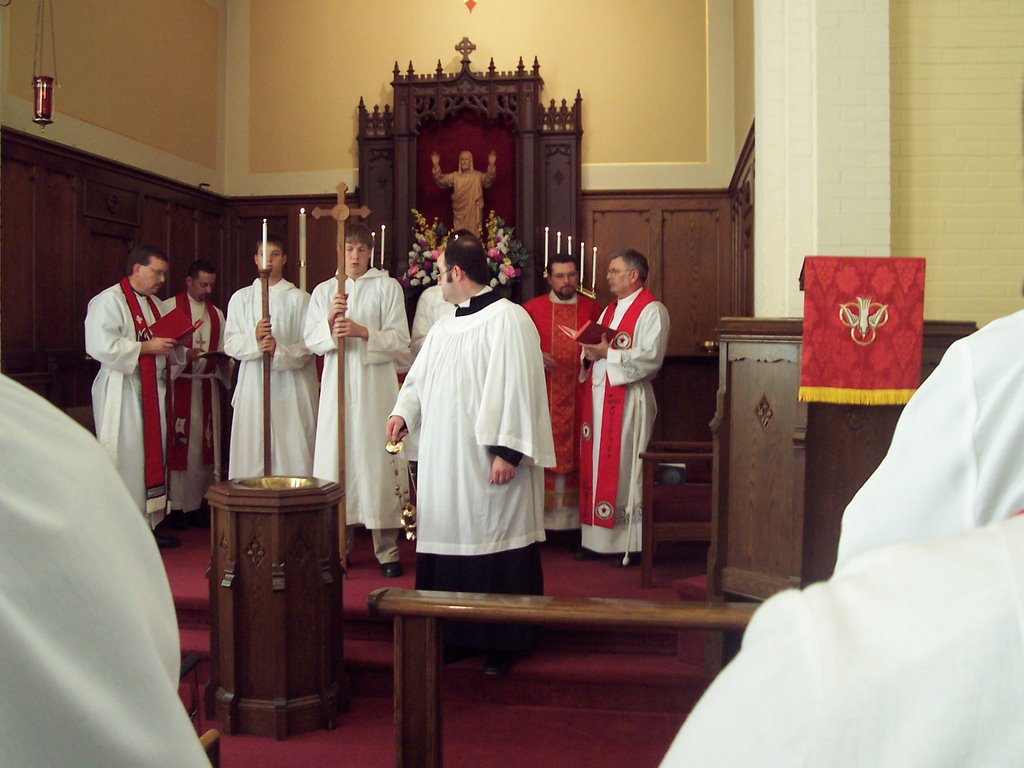
KARL GREGORY - AXIOS!
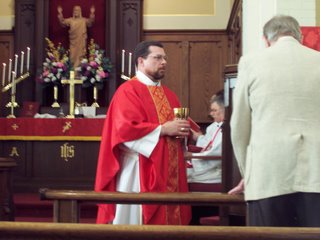
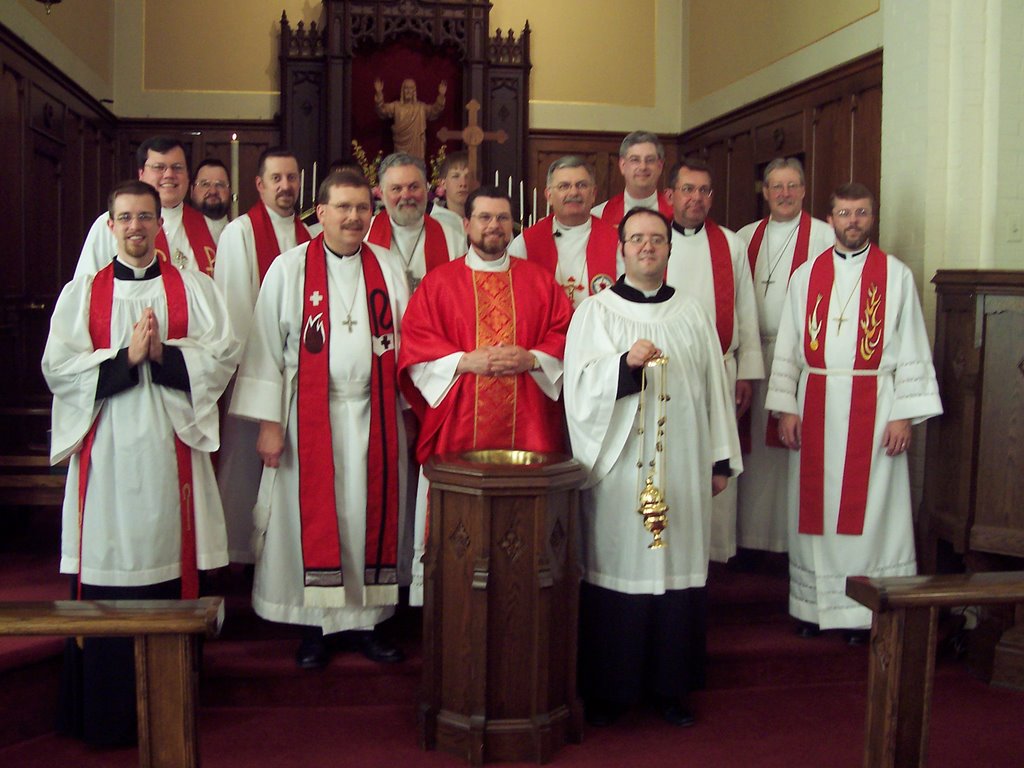
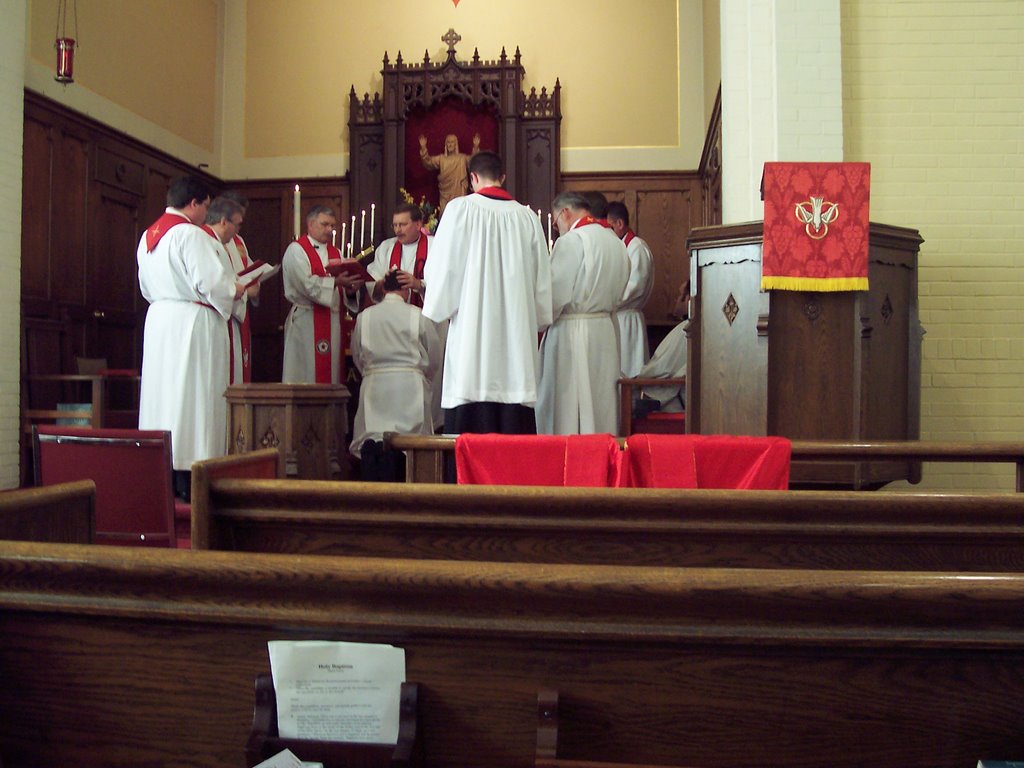
The Ordination of Karl Gregory into the Office of the Holy Ministry at St. Paul Lutheran Church, Hamel IL


Tears of Joy, Tears of Sorrow
It is going to be one of those up and down days.
This morning Paul Anthony Kostich received the washing of regeneration and renewal in the Holy Spirit. His mother had been confirmed at the Vigil of Easter. Then we had joy of the Holy Eucharist.
Later this afternoon at 3:00 former vicar Karl Wesley Gregory will be put into the Office of the Holy Ministry with the laying on of hands at St. Paul's. Karl will make a great pastor, I believe. He has the personality that obsesses to get all the little duckies in a row! He's more prepared than any person I've ever met. Axios!
Then word reached me just moments ago that God has taken home one of his saints - Leola Engelke.
Leola is mother of David Engelke whom we buried a few weeks ago. Charles, David, Leola, Sarah, Kathy - all delight in the gift of music. And Leola had not only the gift of music, she had an overflowing a gift of laughter. She would make folks smile and laugh. She was full of love and kindness and a real sweetness - her hospitality was legendary. She was just FUN!
She's been through a lot in the last few years. I told Charles I was beginning to think she would lick everything that came her way. But at last her heart has stopped beating. No matter. She LIVES. She lives because was baptized into Christ, fed with His body and blood, and His precious Gospel promises. And how the Word and Sacrament bore fruit in her life! God bless and keep you, Leola!
20 May 2006
Another Patristic quote for the Day
I'm too impatient. This one is such a joy; I just HAD to share it now:
Death, brothers, is the mistress of Despair, the mother of Unbelief, the sister of Corruption, the parent of hell, the wife of the devil, the queen of all evils, who is so insatiable and so deliberate in her attacks against the whole human race that she first sends ahead Despair to murmur and seduce on her behalf as follows. So Despair says: “O man, why are you wasting your time? Look, Death, your mistress is coming, and she is going to reduce your soul to nothing and consume your flesh with decay and your bones with aging, so as to make you, who did not exist before your birth, nonexistent after death. So, you who are about to die, do not delay to pay what you owe to the various stages in life before you die: spend your childhood in games, spend your adolescence in delights, spend your youth in pleasures, spend your old age with me, so that you will not image that you have no reason to have despaired of hope.”
After she sends her daughter Unbelief, who makes the following threats: “Are you thus disposing of your life as if you are not going to die, as if you will avoid death? O man, faith is deceiving you; you trust faith, which promises future blessings in order to take away present ones; and pledges that there are all sorts of unseen things after death, in order to remove the things that do exist before death. Who has come from there, or what wise person believes in things that have been promised for so long but never fulfilled? Oh, if only you would eat and drink! Eat and drink, for tomorrow you will die!”
Third, she directs Corruption, her sister in wickedness, with such fury that she assaults, lays hold of, and seizes what can be seen of human beings throughout their graves, and revealing her ultimate prisons she points out those who lie there bound and immobile, and in order to throw all the senses of the human being into turmoil with complete horror and complete fear, she oozes decay, she belches gore, she strews stenches, and she proclaims that she has supplied worms from herself as countless butchers to one human body.
Why should Christians not trust Despair or Unbelief? They are the way Death wages war; with these generals and with these tactics in a battle of this sort she captures, crushes and kills al those whom nature brings forth into the present life. She holds sway over kings, she conquers peoples, she routs nations. It has never been possible to bribe her with wealth, or to move her by entreaties, or to soften her by tears, or to conquer her by strength.
Brothers, how wrong those authors have been who have tried to write about the good of death. And what is so surprising about that? In this case the worldly-wise think that they are great and remarkable if they convince simple folks that the thing that is the greatest evil is the greatest good…. But these things, brothers, truth dispels, the Law banishes, faith attacks, the Apostle censures, and Christ blots out, who, while restoring the good that life is, discloses, condemns, and banishes the evil of death.
--St. Peter Chyrsologus, Sermon 118 pars. 3-6
[Corruption - anyone else think Shelob?]
Patristic Quote for the Day
He receives sinners (Luke 15:2). They do not say: "He assumes" them. What was it that he who receives had lost? Whoever finds what he lost pardons faults, turns wrath into joy, and transforms grief into grace. He receives sinners. God receives sinners, but God does not allow those whom he receives to remain sinners. The approach of the sinner does no harm to God. God sanctifies the sinner who draws near to him. O Pharisee, Christ does not receive sins when he receives sinners, because God is the recipient not of the offense, but of the human being. So the Pharisee should not have been looking at the condition the sinners were in when they arrived, but at their condition upon their return. A case in point, let them see that Paul, whom they had sent as a persecutor, returned thereafter as a preacher. - St. Peter Chrysologus, Sermon 168 par. 3
[Note: a nice exposition of the oft-heard, "The Lord loves you just the way you are; and He loves you entirely too much to leave you that way!"]
[Note: a nice exposition of the oft-heard, "The Lord loves you just the way you are; and He loves you entirely too much to leave you that way!"]
19 May 2006
Patristic Quote for the Day
 Both of them, it says, were righteous in the sight of God. Both righteous in the sight of God: and what about the passage that says: 'No living person can be counteded righteous in your sight?' Perhaps in the sight of human beings one may be thought to be righteous, since human beings, aware as they are of sins of the body, are equally unaware of vices of the mind. But in God's sight, before whom the secrets of the heart are laid bare, by whom hidden thoughts do not go unnoticed, who is judged innocent and righteous?
Is there a human being who does not sin in his heart, who does not have a bad thought, who is not guilty of harboring doubts, who does not incur blame through fear? Moses doubts, Aaron goes astray, Peter denies; so who is righteous? And were they both righteous in the sight of God? In the sight of God, yes, but by means of God. Both righteous in the sight of God, not by their effort but by grace.
Listen to the Apostle: They are justified gratuitously through the grace of Christ. And again: Not from ourselves; it is God's gift. Not from our works, lest anyone boast. Yet again: What do you have that you have not received? And if you have received it, why do you boast as if you did not receive it? Therefore this is more or less what the evangelist is saying: not that they did not have it, but that they received it; not that it was earned, but that it was bestowed. - St. Peter Chyrsologus, Sermon 91 par. 3 (On Luke 1:6)
18 May 2006
Another Patristic quote for the Day
The man who has a hundred sheep is Christ the Good Shepherd, the merciful Shepherd, who in the one sheep, that is, in Adama, had constituted the whole flock of the human race. He had set this sheep amid the delights of paradise, in a place of life-giving pasture. But that sheep forgot the voice of its Father while paying heed to the howling of wolves, and it lost the safety of the sheepfold, and was injured all over by deadly wounds. Therefore, Christ came into the world to look for it, and found it in a womb belonging to the Virgin. He came into the flesh of his Nativity; raising it onto the cross he placed it on the shoulders of his Passion, and rejoicing in the complete joy of the Resurrection, by means of the Ascension he bore it up and carried it off to his heavenly dwelling. - St. Peter Chrysologus, Homily 168, par. 6
Patristic Quote for the Day
The deed depends on the gift and not the gift on the deed; otherwise, grace would no longer be grace. Gifts precede every deed, even though the gifts may be increased by the deed that follows. - St. Gregory the Great (Dialog 1)
17 May 2006
Patristic Quote for the Day
 Christ takes on the appearance of each of the poor and assimilates Himself to all of them so that no one who believes in Him will be arrogant toward his fellow beings. On the contrary, he will look on his fellow beings and his neighbor as his God, regarding himself least of all in comparison just as much with his neighbor as with his Creator, and exhausting his all in his service, just as Christ our God poured out His blood for our salvation. - St. Symeon the New Theologian (Practical and Theologiccal Texts, #114)
16 May 2006
Patristic Quote for the Day
“This Sacrifice was the Christ of God, from far distant times foretold as coming to men, to be sacrificed like a sheep for the whole human race. As Isaiah the prophet says of him: “As a sheep he was led to slaughter, and as a lamb dumb before her shearers.” And he adds: “He bears our sins and is pained for us; yet we accounted him to be in trouble, and in suffering and in affliction. But he was wounded on account of our sins, and he was made sick on account of our iniquities, the chastisement of our peace was upon him, and with his stripe we are healed. …And the Lord hath given him up for our iniquities …for he did no sin himself, nor was guile found in his mouth.'’ Jeremiah, another Hebrew prophet, speaks similarly in the person of Christ: “I was led as a lamb to the slaughter.” John Baptist sets the seal on their predictions at the appearance of our Saviour. For beholding Him, and pointing Him out to those present as the one foretold by the prophets, he cried: “Behold the Lamb of God, which taketh away the sin of the world.'’
“Since then according to the witness of the prophets the great and precious ransom has been found for Jews and Greeks alike, the propitiation for the whole world, the life given for the life of all men, the pure offering for every stain and sin, the Lamb of God, the holy sheep dear to God, the Lamb that was foretold, by Whose inspired and mystic teaching all we Gentiles have procured the forgiveness of our former sins, and such Jews as hope in Him are freed from the curse of Moses, daily celebrating His memorial, the remembrance of His Body and Blood, and are admitted to a greater sacrifice than that of the ancient law, we do not reckon it right to fall back upon the first beggarly elements, which are symbols and likenesses but do not contain the truth itself. And any Jews, of course, who have taken refuge in Christ, even if they attend no longer to the ordinances of Moses, but live according to the new covenant, are free from the curse ordained by Moses, for the Lamb of God has surely not only taken on Himself the sin of the world, but also the curse involved in the breach of the commandments of Moses as well. The Lamb of God is made thus both sin and curse—sin for the sinners in the world, and curse for those remaining in all the things written in Moses’ law. And so the Apostle says: “Christ has redeemed us from the curse of the law, being made a curse for us”; and “Him that knew no sin, for our sakes he made sin.” For what is there that the Offering for the whole world could not effect, the Life given for the life of sinners, Who was led as a lamb to the slaughter, and as a lamb to the sacrifice, and all this for us and on our behalf? And this was why those ancient men of God, as they had not yet the reality, held fast to their symbols. (St. Cyril of Jerusalem, Catechetical Lectures, XIII)
“Since then according to the witness of the prophets the great and precious ransom has been found for Jews and Greeks alike, the propitiation for the whole world, the life given for the life of all men, the pure offering for every stain and sin, the Lamb of God, the holy sheep dear to God, the Lamb that was foretold, by Whose inspired and mystic teaching all we Gentiles have procured the forgiveness of our former sins, and such Jews as hope in Him are freed from the curse of Moses, daily celebrating His memorial, the remembrance of His Body and Blood, and are admitted to a greater sacrifice than that of the ancient law, we do not reckon it right to fall back upon the first beggarly elements, which are symbols and likenesses but do not contain the truth itself. And any Jews, of course, who have taken refuge in Christ, even if they attend no longer to the ordinances of Moses, but live according to the new covenant, are free from the curse ordained by Moses, for the Lamb of God has surely not only taken on Himself the sin of the world, but also the curse involved in the breach of the commandments of Moses as well. The Lamb of God is made thus both sin and curse—sin for the sinners in the world, and curse for those remaining in all the things written in Moses’ law. And so the Apostle says: “Christ has redeemed us from the curse of the law, being made a curse for us”; and “Him that knew no sin, for our sakes he made sin.” For what is there that the Offering for the whole world could not effect, the Life given for the life of sinners, Who was led as a lamb to the slaughter, and as a lamb to the sacrifice, and all this for us and on our behalf? And this was why those ancient men of God, as they had not yet the reality, held fast to their symbols. (St. Cyril of Jerusalem, Catechetical Lectures, XIII)
15 May 2006
Hands
Have you ever followed our Lord’s hands? The Psalmist invites us to: “As the eyes of servants look to the hands of their master, so our eyes look to the Lord our God, till He have mercy on us.” Ps. 123:2
Tiny hands, clinging to his mother’s finger as he nurses in the warmth of her embrace.
Dirty hands of a little child at play all day.
Calloused hands of a young man who knew how to shape wood and touched his work with loving satisfaction.
Hands raised tirelessly in prayer to His Father.
Hands that held the Torah and followed along as he read aloud in the Synagogue.
Hands that knew how to make and use a whip on those who sought to sell the gifts of God.
Hands that touched the leper as he said: “I do wish. Be clean!”
Hands that held and hugged little children and gave them both welcome and blessing.
Hands that reached out and grabbed Peter as he sank beneath the waves.
Hands that touched a young girl who had died and raised her to life again.
Hands that touched a bier holding a dead young man and stopped death right in its tracks.
Hands that broke the loaves and fed thousands.
Hands that plucked the heads of grain on the Sabbath and ate.
Hands that held the bread and broke it and gave it to His disciples on the night of His betrayal.
Hands that lifted up the cup and blessed His Father and gave His own His blood to drink.
Hands that refused to rise in self-defense.
Hands used only to bless and to bestow.
Hands that for all the good that they did and gave were pierced with nails.
Hands held lifelessly in His mother’s own hands beneath a bloody cross.
Hands that Thomas was offered to touch on the other side of the grave.
Hands that are raised in blessing over the disciples as Jesus ascends.
Hands that never cease to be lifted in prayer and in blessing for His people for all eternity.
“He’s got the whole world in His hands” sings the Negro spiritual. Indeed, He does. Redemption's story can be read out entirely by following His blessed hands.
Do This and You Will Live
Yesterday in Bible Class we studied the story of the Good Samaritan. One of the things I have become convinced of is that Jesus meant exactly what He said to the lawyer in the verses preceding that story. It was not just that our Lord was using the Law to crush the self-righteous pride out of the fellow (and us). He was doing that too. But there is more here. "Do this and you will live."
We mishear these words if hear our Lord saying: "Love like this and then you will be rewarded with eternal life." Love is not what you must do in order to GET eternal life. Rather, I believe our Lord is saying: love like this and that IS eternal life - that is the life of God Himself. "Do this, love like this, and you will live! You will share the life of God Himself." For surely our Lord IS the Good Samaritan in the parable, and He doesn't mean that "life" is something dangling out there after you get done loving, for you will never get done loving. Rather, life is precisely love itself.
"In Him was life and that life was the light of men." "God is love." They go hand in hand together. And that is why at the end of the story, our Lord invites that man and all of us: "Go and do likewise!" Not telling us how to earn the kingdom, for it is always and only gift. But telling us how to live the kingdom - that joyous "fervent love toward one another" that we pray for at the Eucharist.
Random Thoughts on the Passing of Pelikan
 "The Strife is O'er, the Battle Done" - we often sing that at funerals. Especially when we see how it is true not just for our Lord, but for the person He has gathered home to Himself.
I wish I could have known Jaroslav Pelikan - just to have thanked him for all his work; I've relied on his scholarship for many years.
Anytime a person picks up a volume of Luther's Works (American Edition), you can't help but think of him. Anytime a person turns to "Tappert's" Book of Concord, one thinks of Pelikan (and Piepkorn!). Anytime I need a quick answer to something from the early centuries, where to look but his series on Church History? His *Riddle of Roman Catholicism* remains a classic, even after some of its points were mooted after the Second Vatican Council. His insight into the interplay of catholic substance and protestant principle in the Reformation remains a most helpful light to those seeking to understand the history of Lutheranism in particular and the Reformation in general.
A mind that absorbed and processed such a staggering amount of data - and all in service to Christ and His Bride! He was a great gift of God to the Church in these "gray and latter days." Rest in peace, Father in Christ! Rest in peace!
Patristic Quote for the Day
Mary came to the tomb. She came to the womb of the Resurrection, she came to the birth of Life, so that Christ, who had been brought forth from the womb of the flesh, would be born a second time from the tomb of faith; and so that the sealed tomb would render to eternal life him whom the sealed womb of the Virgin had brought forth into the present life. It is a characteristic of divinity to have left the Virgin intact after birth; it is a characteristic of divinity to have come out of the tomb with his body. (St. Peter Chrysologus, Sermon 75:3)
14 May 2006
Patristic Quote for the Day
O man, receive faith, since it is given for free; believe in the resurrection, because he who promises it charges no price. (St. Peter Chrysologus, Sermon 118:10)
13 May 2006
Patristic Quote for the Day
So too is it with God, who on account of the massive extent of the wound has applied a massive and strong dose of medicine; and he has bestowed grace not on sin, but on the human being; he has rained down the shower of his mercy not to multiply but to blot out offenses. ((St. Peter Chrysologus, Sermon 113:3)
12 May 2006
Patristic Quote for the Day
Let no one boast about his merits, let no one boast about his works, because it is the peace of God that has re-established and restored life, which the first transgression had removed. (St. Peter Chrysologus, Sermon 110:5)
11 May 2006
Patristic Quote for the Day
Therefore, since the sin of our first parent had doomed us by giving death the right to hold us under its sway, Christ, our heavenly and true Parent, by having removed our condemnation to death by means of his own death, justifies us by his Resurrection, so that it would not be the guilty, but their guilt, that would perish; and so that the punishment itself, that is, death, which had been ordered to strike down the guilty, would rightly fail and lose the power that was its trademark. (St. Peter Chrysologus, Sermon 110:4)
10 May 2006
Patristic Quote for the Day
He was handed over for offenses, not so that this Life which was unable to die might be punished, but solely that the offenses which had banished us from life would be blotted out. (St. Peter Chrysologus, Sermon 110:3)
09 May 2006
Patristic Quote for the Day
Recognize this, brothers: be glad, brothers, that after the triumph of Christ the prison of the saints has been broken open, and the netherworld no longer exercises any jurisdiction over the saints, since Christ penetrated all the way to the netherworld in order to free the just, not the unjust. Let us realize, brothers, how great a benefit Christ has provided, or rather, how without Christ no one possessed salvation, since, besides the wretched dissolution of their bodies, the souls, too, of the saints were being held in confinement in the underworld. - St. Peter Chrysologus, Sermon 123, par. 7 (On Lazarus and the Rich Man)
08 May 2006
Patristic Quote for the Day
God did not order the sabbath, the new moons and the feasts to be honored because He wanted men to honor the days themselves; this would have been tantamount to decreeing by the Law that men should worship creation rather than the Creator, and should regard the days as holy in themselves and therefore to be venerated.
On the contrary, He indicated that he Himself was to be honored symbolically through these days. For He is the sabbath, as the soul's respose after its exertions in the flesh, and as the cessation of its sufferings in the cause of righteousness. He is the Passover, as the liberator of those held in the bitter slavery of sin. He is the Pentecost, as the origin and consummation of all created things, and as the principle through which all things by nature exist.
--St. Maximos the Great, Fifth Century of Various Texts, par. 46
07 May 2006
Patristic Quote for the Day
 Great indeed is the Baptism which is offered you. It is ransom to captives; the remission of offences; the death of sin; the regeneration of the soul; the garment of light; the holy seal indissoluble; the chariot to heaven; the luxury of paradise; a procuring of the kingdom; the gift of adoption. - St. Cyril of Jerusalem, *The Protocatechesis* par. 16
05 May 2006
Oh, and go figure
WHEN we get home (and the house had been completely locked up) there was dead bird in the kitchen with its head stuck under the stove. And it had obviously flown around a bit, if you take my drift. HOW on earth did that thing get in here??? [Please ignore any complaints from the wife about HER having to deal with it; I mean, it landed in the KITCHEN!]
Whew!
So, Bekah, Cindi and I left bright and early on Thursday to pick Lauren up from Concordia University in Seward, Nebraska. It ended up being a bit more than an eight hour drive if you add in the lunch stop and breaks along the way. We packed Lauren up on Thursday night, enjoyed dinner in Lincoln with the kids and Dean, and then back to Joe and Jenny Herl's. Anna is still as cute as a button. Joe took me on a whirl-wind tour of the campus. We were up by six and finished packing Lauren's left-overs, when Dean (what a scholar and a gentleman!) showed up with a thermos of some fresh ground, fresh brewed coffee. It kept me going through St. Joe's. We got home by about four after 16 hours in the car in the last two days (more than that, truthfully).
David was trying to figure out how to put on his bow-tie for the prom. Here's a couple pics of the finished result (one with the lovely Misha):


Then a hospital call to Highland - I think that will turn out okay. Laverne, you're in our prayers.
So a crazy, crazy couple days! But for a while I've got all three kids home, and that makes for one happy papa.
David was trying to figure out how to put on his bow-tie for the prom. Here's a couple pics of the finished result (one with the lovely Misha):


Then a hospital call to Highland - I think that will turn out okay. Laverne, you're in our prayers.
So a crazy, crazy couple days! But for a while I've got all three kids home, and that makes for one happy papa.
03 May 2006
+In Memoriam David Engelke+
(to be delivered May 6, 2006)
Alleluia! Alleluia! Christ is risen! R. He is risen indeed! Alleluia! And THAT makes all the difference. And David knew it, believed it, confessed it,and lived it.
When you first told me about David’s falling asleep in Jesus, Sarah, you said: God took dad to heaven yesterday. Right on! As Jesus promised in the Gospel reading we just heard: “I know my sheep and am known of my own, and I give them eternal life and they shall never perish, neither shall anyone snatch them out of my hand.”
Eternal life - the life that cannot be destroyed by death, the life that rose from the grave with Jesus in His incorruptible body on Easter morning - THAT life is what Jesus promises and delivers into his sheep.
It was a week ago Thursday that David received the Holy Eucharist for the last time in this world. Into his poor body, which had gone through so much, went the very Body and Blood of the Son of God - the Body that carried David’s sins, and yours and mine upon the Cross. The Blood that was shed for our forgiveness. The Body and Blood of Him who not only died for us but rose again on that first Easter, forever beyond the grasp of the grave. How David hungered for that food! He knew what it delivered to him, and how desperately he needed it. Indeed in that Eucharist David rejoiced to receive into Himself “Christ, the Solid Rock” and he knew that all other ground was just “sinking sand.”
Way too often we think of death only from our own perspective. The voice that we will never hear again as long as this age of the world lasts. The eyes that will never look at us again until the great day of Resurrection. But that is to miss out on a fundamental joy: Sarah, you said, God took Dad to heaven. You were so right! Ponder for a moment what that was like from God’s perspective. To be able to welcome home David, his beloved child. To show him the joys of heaven. To see him join in the singing and the music - and you know as well as I what joy that was for him! All of life was a dress rehearsal for the performance that then began and whose sweet melody never comes to an end. The music rises and goes on and on forever. And David was enveloped in that, welcomed into that, and how precious it was to the Blessed Trinity to see the look upon his face when that melody rang through and carried him home. “Precious in the sight of the Lord” says King David “is the death of His saints.” Now you know why it is so precious, why it is so holy a thing.
As awful and hideous and hateful as death is here in this world, when we look at from the other side where the Lord Jesus gathers His saints around the throne and into the music that never ends, well, you can see why joy itself tinges your very sorrow today.
The sorrow today is so real. You will miss him so much. We will too. His kindness, his curiosity, his firmness in the faith, his love of the Bible and his devotion to his family. But there is none of us who can begrudge him the rest he has entered. As Isaiah pictured it, he’s already at the great feast which God throws to celebrate the destruction of death itself.
Today David’s coffin is covered with the pall. I think David would have wanted that. And he would have wanted you all to know what it means. You see, when he was just a baby, not even a month old, his mother and father carried him to Jesus in the font of Baptism, and there Jesus put upon Him the robe of His righteousness. All David’s sins were covered, forgotten, gone from the sight of God. And God said to him: Kid, you’re mine forever. We shall never be separated again.
Which is all to say that David would not want this funeral homily to be about David. He’d say: “Tell them about Jesus, remind them of the cross, remind them of the gifts He gives in Baptism, and at the Table. Remind them to be faithful and remind them that I am praying for each of them until I have the joy of them joining me in this place, covered alike with the righteousness of the Son of God and singing the Song of praise to the Lamb. Remind them.” And so I hope I have.
David, we love you and we always will.
Alleluia! Alleluia! Christ is risen!
He is risen indeed. Alleluia!
Patristic Quote for the Day
In honor of David Engelke - a blessed sleep in Christ, dearest brother!
Have no fear, then. Now that the common Savior of all has died on our behalf, we who believe in Christ no longer die, as men died aforetime, in fulfilment of the threat of the law. That condemnation has come to an end; and now that, by the grace of resurrection, corruption has been banished and done away, we are loosed from our mortal bodies in God's good time for each, so that we may obtain thereby a better resurrection. - St. Athanasios, *On the Incarnation of the Word of God* par. 21
Have no fear, then. Now that the common Savior of all has died on our behalf, we who believe in Christ no longer die, as men died aforetime, in fulfilment of the threat of the law. That condemnation has come to an end; and now that, by the grace of resurrection, corruption has been banished and done away, we are loosed from our mortal bodies in God's good time for each, so that we may obtain thereby a better resurrection. - St. Athanasios, *On the Incarnation of the Word of God* par. 21
01 May 2006
Patristic Quote for the Day
So, since we are full of good cheer we sing over our corpses psalms that urge us to feel confident about death. "Commit, my soul, into your rest," it says, "because the Lord has been kind to you." (Ps. 114.7) Do you see that death is a kindness and a rest? For the person entering that resting rests from their labors, just as God did from his own affairs. - St. John Chrysostom, *Homily on Saints Bernike, Prosdoke, and Domnina* par. 10
29 April 2006
Proud Pappa
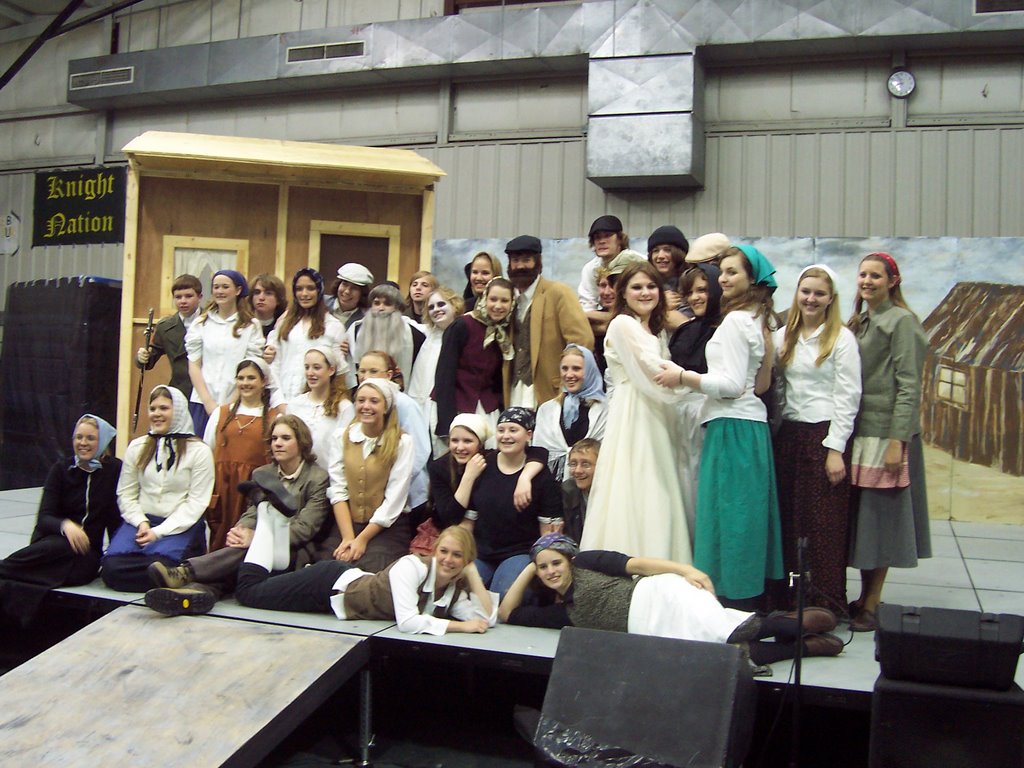
I just have to tell you how proud I am of David and Bekah for their work in the play. One of our members sat beside me at intermission and asked if I hadn't done drama as a teenager. I told her: No way. I was way too frightened to get up on stage and act. She was surprised. But it's true: in high school I don't think you could have dragged me onto the stage with a team of horses. My wife is another story!
But watching David and Bekah up on stage tonight, I was filled with great joy. I'm so thankful they go to a Lutheran High School that encourages them to stretch the bounds of what they think possible. When they gave David a gift tonight for being a senior (all the seniors got gifts who were in the play) they introduced him as: David Weedon, our amazing Tevye. And he really was amazing.
Next year I hope that Bekah seeks a more active role. She seemed quite comfortable with what she did in this play, but I know she's afraid of memorizing lots of lines (David is a natural at memory, and both Lauren and Bekah have to work at it a bit more). Lauren pulled it off and simply SHOCKED us in Little Shop of Horrors. I know Bekah can too, and I hope she really goes for it next year.
There's a sentimental song they play on KEZK: "I hope you dance." Sentimental, but it is the way I feel for my kids: "I hope you dance!" I love you Lauren, David, and Bekah. Dance, sing, act! Have a blast, you three wonderful kids! - Your Crazy Pappa
Homily for Good Shepherd Sunday
When Christ announces that He is the Good Shepherd and the Good Shepherd lays down His life for the sheep, he is teaching us that He is the only One to whom his disciples can look for help and protection against sin, death, and the devil. He calls these things that would devour and scatter his little flock “the wolf.” And He teaches that He alone can help the sheep because the sheep are His; they belong to Him.
He contrasts Himself with the hired-hands. According to Dr. Luther, do not mistake these to be false preachers and pastors, but the hired hands are all who came before our Lord’s incarnation. Yes, even Moses and all the prophets. You see, they were servants of the Lord’s sheep, but they did not own the flock. And no matter how much they preached and taught, neither Moses nor the prophets had the wherewithall to stop the wolf from devouring and scattering the flock.
So because this was the situation, the Son of God himself took on our flesh and blood from the Blessed Virgin Mary to fulfill the prophecy of Ezekiel: “I myself will seek out my sheep.” Thus He came among us as one of us, He who had created us in the beginning - “for all things were made through Him and without Him was not anything made that was made.” He thus came to those who were His own by virtue of their creation, and even though we had fallen into sin and become the prey of the devil, sin, and death, He came to redeem us, to buy us back, to lay down His life for us, so that He might not merely be our Creator, but also our divine Redeemer, our Savior, our Shepherd. Thus He “did not cease to do all things until He had brought us up to heaven and bestowed on us His kingdom to come.” But all this is only in Him.
Whoever hopes to survive the onslaught of the devil, our own sinfulness, and death, has no other help or hope. In the end, either the Good Shepherd or the wolf will have you.
So hear the voice of your Shepherd, people loved by God! He comes to you not to take from you, but to give to you. He laid down His perfect life in place of your forfeited and imperfect life. He says to the Wolf - “You cannot have that one. You must have me instead.” And so He gives His life into death to destroy your death. And so He places His sinless soul over you to protect you from the terrifying teeth of the wolf.
Thus when the wolf comes howling at you and tries to frighten and alarm you, you must not listen to what it says. Rather, you listen to the voice of your Good Shepherd, the One who laid down his life for you. The One who waged war with that Wolf and won long ago. It is the voice of Your Shepherd who speaks to calm you: “Do not let the sin you struggle with or the thought of your death or the devil’s accusations frighten you. I have forgiven all your sins by my death; I have destroyed death’s power over you by My rising; and I descended into hell and took the keys of hell and death that Satan could never again have any right or claim on you. You are mine, my very own. Mine because I made you and doubly mine because I redeemed you. Did I not wash you in the baptismal water and mark you with my cross as my own dear possession forevermore. You are my sheep and I am your Good Shepherd. And so every need of yours I can and I will provide for. Only trust me.”
This is the voice of the Good Shepherd that the sheep hear. And they soon learn to know when it is His voice they are hearing, and they learn to flee from anyone who comes to them speaking something else. Any voice that invites them to fear the wolf, to run from God in panic over sin and guilt, or from fear of death or the devil. No, they know that any voice urging such things is NOT the voice of their Shepherd.
And where does our Good Shepherd’s lovely voice ring out more clearly, more sweetly for you, than at the Table He prepares for you in the presence of your enemies? “For this Sacrament is the Gospel.” What sin can accuse the one who trusts and receives the Blood of Christ? That is the blood that atoned for the sin of the world! Our Good Shepherd spilled it in your place. Given to you it marks you as His, blood-bought and paid for. What death can attack the one who trusts and receives the Body of Christ? This is one Body that Death will never forget. Death took hold of that body once but could not hold onto it; rather death was shattered by it. When that body enters you, death groans that it has lost another!
“I am the Good Shepherd. The Good Shepherd lays down His life for the sheep....I have other sheep not of this fold, them also I must bring and they will listen to my voice. So there will be one flock and one Shepherd.”
And that’s where you and I come in, so that all He first said to the Apostles applies to us. We are the other sheep He was speaking of, Gentiles not of the fold of Israel originally, but led into the joys and privileges of Jesus’ flock by hearing the Voice of our Shepherd and following where He leads. And herein is the true and only unity of the Christian Church - that we are all but little sheep who hear and know the voice of our Shepherd, and that we have no other Shepherd but Him alone, our Good Shepherd, the One who laid down His life for us. “For you were straying like sheep, but have now been returned to the Shepherd and Bishop of your souls, even Jesus Christ.” In the name of the Father and of the Son and of the Holy Spirit. Amen.
Funeral Homily for Albert Brandt
 It was in the year 1915 on St. Valentine's Day that your godly parents, Alberta, picked up their child, Albert, and carried him to the old Saint Paul’s, where Pastor Hansen reached out his hands and marked him with the sign of the cross: “Nimm hin das Zeichen des heiligen Kreuzes, beide an der Stirn + und an der Brust +.” Then a few moments later Pastor Hansen’s hands poured water three times over that little one’s head: Albert, Ich taufe dich im Namen des Vaters und des Sohns und des Heiligen Geistes. Amen. Then Pastor Hansen’s hands were laid upon Albert’s head with this prayer: “Der almächtiger Gott und Vater unsers Herrn Jesu Christi, der dich wiedergeboren hat durch das Wasser und den Heiligen Geist, und hat dir all deine Sünde vergeben, der stärke dich mit seiner Gnade zum ewigen Leben. Amen!” The Almighty God and Father of our Lord Jesus Christ, who has birthed you anew through water and the Holy Spirit and forgiven you all your sins, strengthen you with grace to eternal life.
That prayer was made 91 years ago. It was answered this past Wednesday. The God who had given to Albert the new birth, forgiven him his every sin and strengthened him with grace each day of his life, finally took Albert to eternal life.
For this is the conviction of the Christian Church: that to die in the Lord is not to die but to begin to live. We know that Christ’s own death has destroyed death! We know that He has flung wide open the Kingdom of heaven to all believers! And we know and rejoice today that Albert was indeed a believer in Jesus Christ.
“I was glad when they said unto me, let us go into the house of the Lord” cried the Psalmist, and if ever there were a person who made those words their own, it was Albert Brandt. When were the doors of this house open and he was not here? It next to never happened. When there was a service, Albert was here. An hour early even. I can still see him sitting right over there, praying and meditating, waiting for the service to begin. “Sing unto the Lord a new song for He has done marvelous things!” cried the Psalmist, and those words too Albert made his own. Singing in the choir until just two years ago – climbing those stairs from the basement, in order to “make a joyful noise” to the Lord.
Why? Why would a man devote so much energy, so much love to the Church? Because Albert knew that here, here in the Church he found “heaven on earth.” Several years back he had given a song to Cindi and asked her to sing it for his funeral. You heard it a few minutes ago. The song celebrates that the soul cannot find a place of rest here in this world – it will only find such rest in heaven, in the arms of Jesus. But Albert knew that he didn’t have to wait till he died to taste the joys of heaven. Now way! He knew that the love of Jesus surrounded him throughout his life, and most of all that love touched him right here in this room.
He knew that this was no ordinary place. This is the place where Jesus comes to His people to give them rest. At this altar times beyond count, Albert received into his mouth the very Body and Blood of the Savior. Here he listened to His Savior’s sweet promises. Here his soul drank deeply of the heavenly rest that Jesus brings into this world.
Anyone who knew him, knew that Albert was a man of who tasted that rest. His soul was at peace. His mind was inquisitive and he was always reading and pondering and learning. But there was nothing frantic about his learning. He was quintessentially a man at peace – and that was because he knew the heavenly peace of sins forgiven, death destroyed, and the certainty of eternal life with His Savior and all the saints. He knew that His Savior had prepared a great banquet to celebrate death’s overthow and that He was a welcome guest at that banquet. Peace and kindness, then, marked his presence.
The stories he could tell! He knew and remembered the history of this place like none other. The anniversary committee is planning on having his words be read at the anniversary banquet of the congregation this coming fall. They give a glimpse not just into a vanished past but into a great soul, a giant among men who never suspected he was anything other than a simple Christian. And that’s what made him so great.
Was he a sinner too? Well, of course! He knew that about himself and freely confessed as much every time he received Christ’s body and blood. A poor sinner who knew that His only hope was in His Savior who called him to Himself to give him rest. “Take my yoke upon you, for I am gentle and humble of heart, and you shall find rest for your souls.”
Such rest Albert did enjoy all the days of his earthly pilgrimage, but all of that was only a teasing taste of the rest he entered on Wednesday. Then indeed came true the words that Cindi sang: “How blessed the rest with Jesus in the light! Death, sin, and sorrow are not known there. The sound of harps and their beautiful music welcome the soul with sweetest sound: Rest, rest, rest, rest, heavenly rest, in the Palace of our Mediator, I promise you.”
Ruh, himmlische Ruh. Albert has entered this rest and we may all look forward to it through our Baptism into Him trampled down death by death and bestows life to those in the tombs. Amen!
Albert E. Brandt, age 91, of Worden, died at 10:45 a.m. on Wednesday, April 26, 2006, at Community Memorial Hospital in Staunton.
He was born on Jan. 27, 1915, in Hamel, the daughter of the late Ernst and Mary Flachsbart Brandt.
He is survived by a sister: Alberta Suhre and husband, Otto of Granite City.
In addition to his parents, he was preceded in death by a sister: Rhoda Brandt; and a brother: Julius Brandt.
Mr. Brandt lived on the family farm. He attended St. Paul Lutheran School. After completing school, he took over the family farm and farmed his entire life. His memberships included St. Paul Lutheran Church, where he was a member of the choir; a charter member of the Alhambra Mens Community Club; the Southwestern Electric Board; the Madison County Farm Bureau; and a member of the Soil Conservation Board.
Patristic Quote for the Day
Thou, who desirest the salvation of the sons of men, have compassion on this soul that has withdrawn from Thee. Accept her, O Lord, with Thy usual mercy. At the righteous judgment, may Thy compassion shelter me, who am sinful, and deliver me from torment. Thou, who forgivest sins and freely grantest mercy, forgive me the sins of my soul at Thy righteous judgment! - St. Ephrem the Syrian, *A Spiritual Psalter* #100
Book Recommendation
As I've read blogs, listened to radio shows, and read papers dealing with how the Orthodox teach about salvation, I have at times felt myself completely befuddled. I couldn't even recognize what was being described AS Orthodoxy!
A little book (but not little in price for its size!) that a friend recommended to me the other day I have found to be outstanding: "How Are We Saved? The Understanding of Salvation in the Orthodox Tradition" by His Grace Kallistos Ware.
It is written in a simple format and offers a fine summary of the Orthodox approach to salvation. I especially appreciated the section where he quotes another bishop who spoke of the relationship between justification and sanctification in terms of "saved from" and "saved for." It's worth the read, no matter what one's confessional persuasion. Another choice moment is when he quotes Luther, but notes that most Lutherans would disagree with Luther on the point he was citing (the famous: this life is not holiness but growth in holiness...).
28 April 2006
Oh, and in case you are wondering...
...what it looks like out the backdoor, one of the kids (I think David) took this pic the other day:


Fiddler
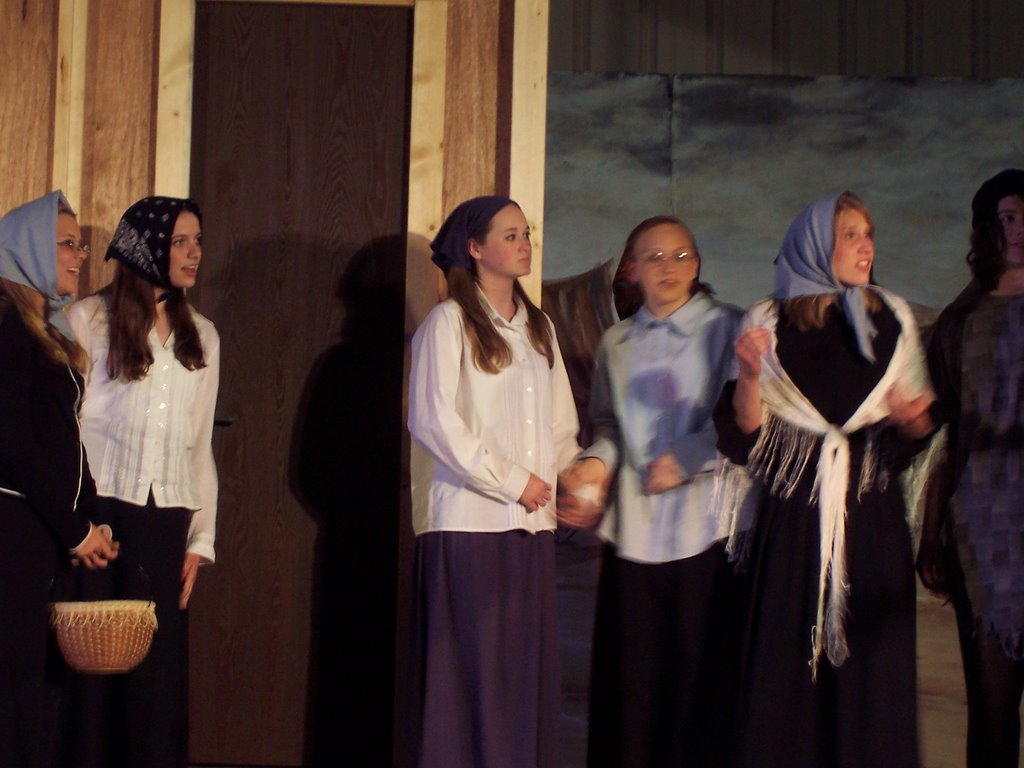
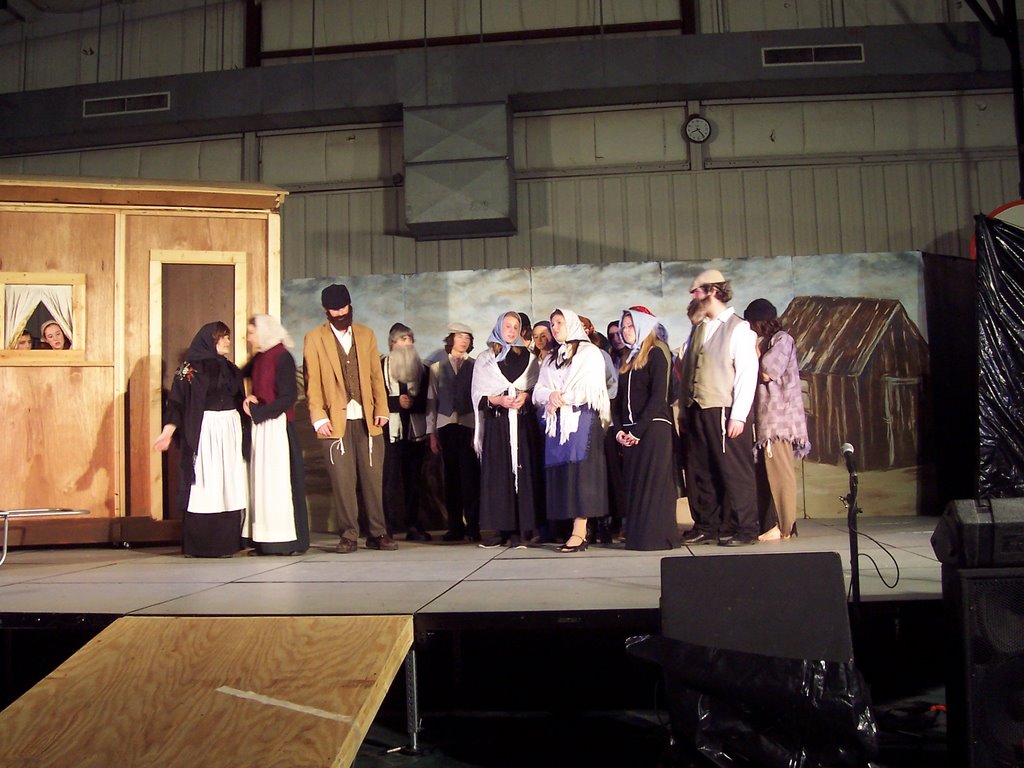
Tonight Metro East Lutheran High School's drama department put on Fiddler on the Roof. It was fabulous. But I am no doubt prejudiced: both David and Bekah were in it, and David played Tevye. He was super! And Bekah was too! Not to mention Robyn and Tara and the list goes on and on! Some pics. Oh, and David? He's the tall one.



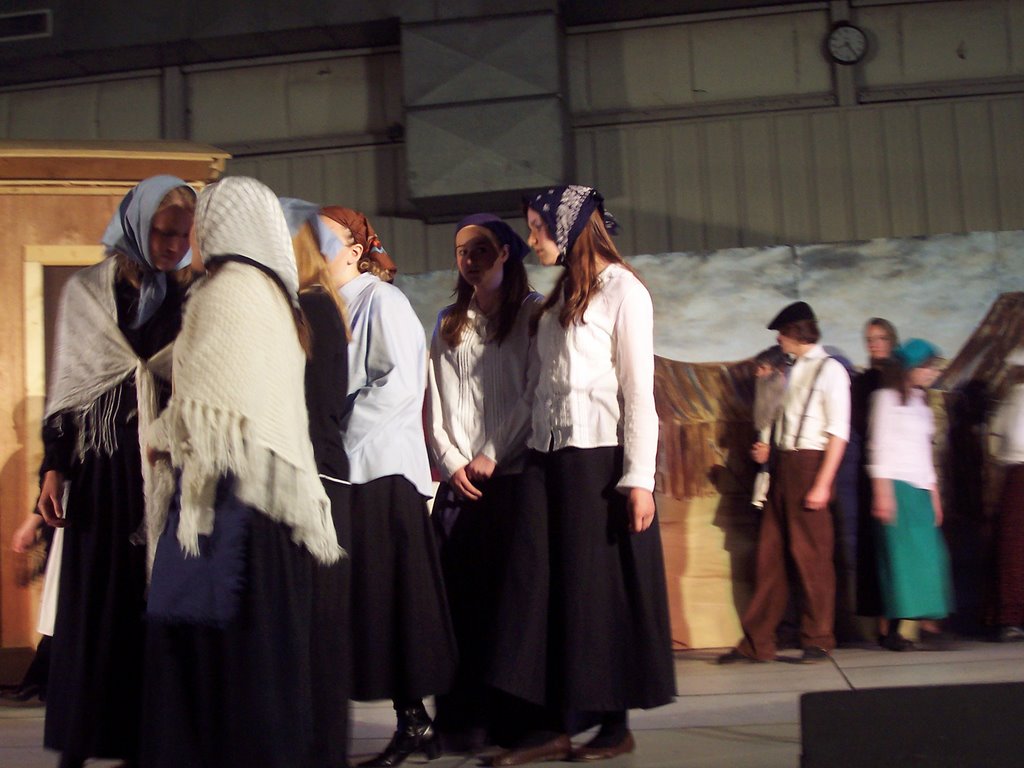
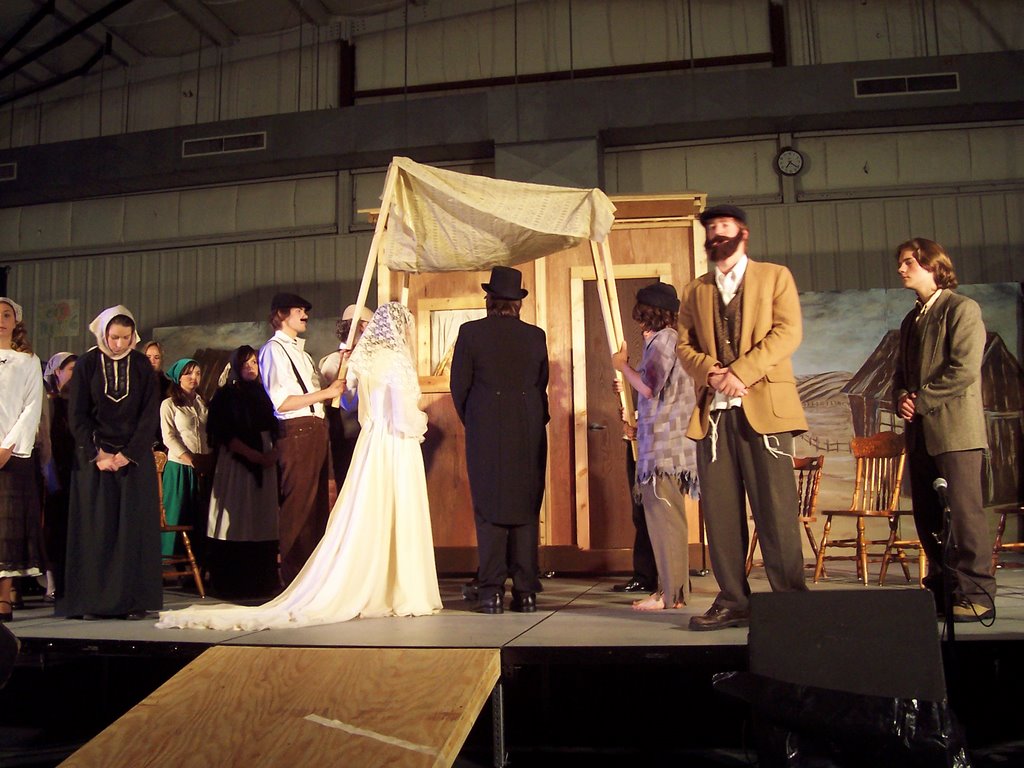
27 April 2006
Patristic Quote for the Day
To Thee, O Victor pierced by nails on the cross Who calleth out ot sinners saying: come, receive forgiveness freely - to Thee I unrelentingly pray, O my Savior: turn Thine eyes away from my lawlessness, and by Thy sufferings heal my sores that i may glorify Thy kindness. - St. Ephrem the Syrian, *A Spiritual Psalter* #8
26 April 2006
Patristic Quote for the Day
I bow down to Thee, O Master; I bless Thee, O Good One; I beseech Thee, O Holy One; I fall down before Thee, O Lover of Mankind; and I glorify Thee, O Christ, for Thou, O Only-begotten Master of all, O Only Sinless One, wast, for the sake of me, an unworthy sinner, given up to the death of the cross in order to free the soul of a sinner from the bondage of sin.
And how shall I repay Thee, O Master?
Glory to Thee, O Lover of Mankind!
Glory to Thee, O Merciful One!
Glory to Thee, O Longsuffering One!
Glory to Thee, Who forgivest every fall into sin!
--St. Ephrem the Syrian, *A Spiritual Psalter* #2
And how shall I repay Thee, O Master?
Glory to Thee, O Lover of Mankind!
Glory to Thee, O Merciful One!
Glory to Thee, O Longsuffering One!
Glory to Thee, Who forgivest every fall into sin!
--St. Ephrem the Syrian, *A Spiritual Psalter* #2
25 April 2006
Patristic Quote for the Day
Effects comprise all created things in heaven and earth, while the causes that have brought them into being are the three Persons of the Holy Trinity. It is therefore clear that there can be no exact resemblance between the two. - St. Maximos the Confessor, Fifth Century on Various Texts, par. 67 (aka "farewell to analogia entis?")
24 April 2006
AC XIV Thoughts
[The following thoughts were shared with a friend a few months ago; I post them in full here as a fuller explanation of my thoughts on the subject as it was introduced by my friend David Juhl on his blog Uneasy Priest. They might provide some further good discussion.]
Such a short little article to cause so much trouble over the years! And at the heart of the controversy is the even littler Latin phrase: rite vocatus. “Our Churches teach that no one is to preach, teach or administer the Sacraments *nisi rite vocatus*” - without being called by rite, or regularly called, or orderly called.
The Augsburg Confession is very bold in its insistence: “As can be seen, there is nothing that varies from the Scriptures, or from the Church universal, or from the Church of Rome, as known from its writers.” (Conclusion of first half of the AC) “In doctrine and ceremonies we have received nothing contrary to Scriptures or the Church universal.” (Conclusion of the second half of the Augsburg Confession).
I would contend, however, that precisely at the point of AC XIV Melanchthon KNEW that something needed to be introduced that was new in both doctrine and in ceremony. But he was betting the farm that his opponent, Johann Eck, would NOT notice what he had done. And so what Melanchthon did was to scrounge up a term from canon law that might be a tad ambiguous – rite voctaus – and hope that Eck wouldn’t notice that the term was being used in a novel manner.
Fat chance. Eck was a careful student of the Lutheran movement and watched it with growing alarm. He did not let AC XIV slip by without telling commentary:
“When in the fourteenth article, they confess that no one ought to administer in the Church the Word of God and the sacraments unless he be rightly called, it ought to be understood that he is rightly called who is called in accordance with the form of law and the ecclesiastical ordinances and decrees hitherto observed everywhere in the Christian world, and not according to a Jerobitic (cf. 1 Kings 12:20) call, or a tumult or any other irregular intrusion of the people. Aaron was not thus called. Therefore, in this sense the Confession is received; nevertheless, they should be admonished to persevere therein, and to admit in their realms no one either as a pastor or as a preacher unless he be rightly called.” (Reu’s *A Collection of Sources for the Augsburg Confession*, p. 357)
Eck seems to have had in mind some of Luther's writings and deeds on the subject. See especially Babylonian Captivity (AE 36:116) and the fact that in 1525 Luther himself ordained Georg Rörer. [Notes: While it is certainly true (as Piepkorn has amply demonstrated) that there were exceptions to the rule of bishops only ordaining here and there in the medieval West, it appears that this practice was limited to the conditions obtaining in the mission field or to the privelege granted by certain popes for abbots in presbyteral orders to ordain to diaconate or presbyterate within their monasteries; but that a university professor should undertake this task was in all points a novelty that would have troubled Eck and other traditionalists among the "old believers".]
This means quite simply that Melanchthon’s bluff did not work. He was called to explain what he had apparently hoped to avoid: detailing what he meant by “rite vocatus.” If the meaning was not the old canonical meaning – priestly ordination in apostolic succession – then what DID it mean?
The Apology is not terribly helpful in answering that. It more or less admits the bluff, with a “well we WANTED to, but you guys were too mean to allow it!” But nowhere in this article does Melanchthon actually provide a positive definition of the term. I suspect he hadn’t worked one out yet. What could “rite vocatus” mean if not employed of “canonical ordination” (Ap XIV:24)?
After searching in vain through the Apology for an answer, a number of years later a possible answer emerged in the much-neglected Tractatus. The answer Melanchthon had been searching for was implied in his reading of St. Jerome, who pointed out that priests and bishops in Scripture hold the same rank (Tractatus 61-64) – an argument that Jerome no doubt relished, being himself a presbyter and never elevated to the Episcopal throne unlike the other three “doctors” of the Western Church. Melanchthon then made the argument that the distinction between bishop and presbyter was a matter of discipline rather than doctrine, and therefore not strictly speaking
something that could be considered divinely mandated. Thus, “it is clear that ordination administered by a pastor in his own church is valid by divine law. Therefore, when the regular bishops become enemies of the Church or are unwilling to administer ordination, the churches retain their own right to ordain their own ministers.” (Tractatus 65, 66) And in summary: “From this it is clear that the Church retains the right to elect and ordain ministers. Therefore, when the bishops are heretics or refuse to administer ordination, the churches are by divine right compelled to ordain pastors and ministers for themselves by having their pastors do it (Latin: adhibitis sui pastoribus).” (Tractatus 72)
The Churches are authorized here to do what the bishops are unwilling to do, and the Churches do so by using their own priests to get the job done. Thus, in this first “positive” definition of rite vocatus, we may define this as a case of presbyteral succession in case of necessity.
But the phrase rendered “by having their pastors do it” is soon lost from the Tractatus and does not even make it into the 1580 or 1584 Book of Concord (this is why it is absent in the Triglotta). The loss of this phrase meant that the Symbols, while mandating the rule “nisi rite vocatus” (without a call according to rite) never then
define what this phrase means. Each successive generation of Lutherans have squabbled over it – and it has been defined in accordance with the whims of each. All Lutherans agree that no one should preach, teach or administer the Word and Sacraments “nisi rite vocatus” but no group of Lutherans can come to agreement on what that
“rite vocatus” consists of!
To some it is a term for ordination (albeit, a non-canonical presbyteral ordination). To some it means that the congregation asks an elder to administer the Sacrament on a Sunday when the pastor is on vacation.
Each side may legitimately argue from Lutheran tradition – for it has come to mean all that and more! Just listen to the current Synodical president talk about it. He admitted in the 2006 convention of the Southern Illinois Convention that the seminary faculties can’t agree on its meaning! And of course they cannot. It HAS no definitive
meaning in the BOC of 1580 except this: it doesn’t mean what it always HAD meant, canonical ordination.
Thus the AC XIV is somewhat of a question mark behind the claim that the Lutherans did not introduce anything "new" in doctrine or in ceremonies. Here is something NEW – and it is new both in doctrine and in ceremony. The sad story of the Lutheran inability to speak with clarity about the Office of the Ministry is the result.
[Addendum: An area that I find fascinating and would like to explore further is the comment by Piepkorn that where the Symbols do not allege any support from the Word of God, it is questionable whether one is bound by what they teach. He uses as prime example the affirmation of the perpetual Virginity of the Holy Theotokos. But also note that the Symbols nowhere allege any Scriptural support for what is found in AC XIV! Does this explain the reason, perhaps, that growing sectors of Missouri feel free to dispense with it entirely?]
Patristic Quote for the Day
But it is not only the martyrs who share in his passion by their glorious courage!
The same is true, by faith, of all who are born again in Baptism.
That is why are are to celebrate the Lord's paschal sacrifice with the unleavened bread of sincerity and truth.
The leaven of our former malice is thrown out, and a new creature is filled and inebriated with the Lord himself.
For the effect of our sharing in the body and blood of Christ is to change us into what we received.
As we have died with him, and have been buried and raised to life with him, so we bear him within us, both in body and in spirit, in everything we do.
--Pope St. Leo the Great, Paschal Homily
Patristic Quote for the Day
All the achievements of the saints were clearly gifts of grace from God. None of the saints had the least thing other than the goodness granted to him by the Lord God according to the measure of his gratitude and love. And what he acquired he acquired only so far as he surrendered himself to the Lord who bestowed it. - St. Maximos the Confessor, Third Century of Various Texts, par. 29
23 April 2006
Father Arseny, A Cloud of Witnesses
"Sometimes this was a positive influence, but it also happened that being too intellectual got in the way of knowing God, of believing in him, of loving others; it got in the way of a spiritual understanding of the world and of the human soul. You could see this during the talks led by Father Arseny, you could see it in the questions that were asked and even in the heated debates. Some people lived their faith not with their soul and heart, but by rationally weighing it against the bulk of knoweldge that they had acquired. Questions and arguments continued after the talks had come to a close while people were leaving to go home. But the longer the community continued, the fewer the arguments we had. They were replaced by mutual understanding and love for each other." (p.203)
Patristic Quote for the Day
In that dreadful place of night where He had tarried for three long days, He retained inviolate the splendor of His majesty and shone with the glory of His eternal nature. Light was not overcome by darkness, but darkness was overcome by Light. Let us therefore rejoice, dearly beloved, and be glad in the Lord; for today the Light of salvation is given to us by the Lord according to which the psalmist has written: the Lord is God, and has illumined us. - St. John Chrysostom, A Paschal Homily [Note: the Paschal Gospel in the Eastern rite is John 1:1-18]
22 April 2006
A fine homily
Here's a link to a fine homily by Father James Shadid from St. George's Cathedral in Wichita, KS. I found it quite comforting. You might too (sermon starts in about 1/2 way - first there is chanting of epistle, alleluia, prokeimenon and Gospel).
http://www.stgeorgecathedral.net/audio/04-09-06-F.wma
http://www.stgeorgecathedral.net/audio/04-09-06-F.wma
A Homily for Quasimodogeniti (preached in 2005)
Did you catch the pattern? Sunday. Disciples gathered. Doors shut. Jesus. The sight of His wounds in a living body. Overflowing joy. A commission to carry forgiveness out into the world.
But Thomas missed the gathering. Maybe he was golfing. Maybe he was finshing. Maybe he was moping. Maybe his siesta lasted a bit longer than usual. We’re not told why he wasn’t there, and there’s a reason for that.
Because it doesn’t matter WHY he wasn’t there. The only thing that matters is that he missed out. And look at what happened because he missed out on that special gathering: Thomas refuses to believe.
Thomas in his unbelief lays down his conditions. He’s got to see with his own eyes those wounds and touch them. Then he’ll see about believing.
And the Lord could have appeared to Thomas by himself on Monday or Tuesday or Wednesday or Thursday or Friday or Saturday. Any of them would have done. But the Lord didn’t. He let Thomas stew in his unbelief for a solid week. And then look at what happened. Deja vu!
Sunday. Disciples gathered. Doors shut. Jesus. The sight of His wounds. Overflowing joy. This time the truant was present and the presence of Jesus in the midst of the gathered disciples brings Thomas from unbelief to full-blast confession: “My Lord and my God!”
Jesus responds to that. Thomas had been brought to faith by seeing. By seeing the wounds in hands and side, he came to confess that his Lord and his God had been raised from the dead just as He had promised He would be. But Jesus is setting a pattern now and he is thinking of more than Thomas on that night. He is thinking of you. And so he says to Thomas: “You believe because you have seen. Blessed are those who have not seen and yet have believed.”
But if it isn’t the seeing that brings to faith, then what? The Gospel holds the answer. It’s all about what happens on the First Day of the week, which is also the 8th day, the day beyond all our sevens - one of which will carry us to death. On the First and 8th Day, a miracle. The disciples of Jesus gather. And into their midst comes the Risen One. He comes with His wounds, His Spirit, His breath, AND His Words. “These have been written that you may believe that Jesus is the Christ, the Son of God, and that by believing you may have life in His name.”
As His people gather, the miracle happens again and again. Even though there is more Jesus than can ever be fit into a book, nevertheless He has given His people a book around which to gather. A book where the breath of Jesus that IS the Spirit of God still blows and calls from unbelief to faith. A book that is opened and read.
Words. Concrete words. Words about Jesus. Jesus’ own words. The Spirit breathed them all. They all come from and are all about Jesus. We read them, and when we do, it is not just a matter of remembering our Lord. No. We confess that Jesus is with us in His Words. He still speaks to us! That’s why we stand. That’s why we sing out: “Alleluia!” in greeting to the One who comes to us in His words. The One who has promised: “If anyone loves Me, he will keep My words and My Father will love Him and We will come to Him and make Our home with him.” (Jn 14:23)
But the One who comes to us in His words is the One who comes to show the wounds and speak peace and bring joy. And so when the words of Jesus are spoken over bread and wine, then we have what those words promise: This is my body, given for you. This is my blood, shed for you. For the forgiveness of sin. Thomas was invited to touch and believe. You are invited to taste and believe. Oh, taste and see that the Lord is good!
Body and blood correspond to the wounds, for you only get body and blood separated from one another when there is a wound. So it is His death that is proclaimed every time we gather at this holy Table and the Resurrected One feeds us with His body and His blood. You can’t see it from where you sit, but a reminder of it is upon the altar cloth. Five little crosses. Two on each end and one in the middle. What are they there for? To be pretty? Hardly! They are there by way of confession that what is placed upon this altar cloth is that which resulted from five piercings: two in the hands, two in the feet, and one in the side. They are there to confess that on this altar is the very body and blood which hung upon the cross for you. That that is what is given you to eat and to drink. And with the sight and taste of the wounds comes the word of peace (“the peace of the Lord be with you always”) and then the joy.
When? On the Lord’s Day. When Jesus comes into the midst of His gathered disciples and speaks His peace and brings the joy of sins forgiveness and calls from unbelief to faith. But the joy isn’t to end here.
The disciples go out and announce - as they did to Thomas - “We have seen the Lord!” So we are sent out from this gathering where Jesus has come to be with us, where we have known Him in His Words and in His Wounds, His body and blood. We are sent forth to tell people like Thomas who are left in the sadness of thinking that death is the end of the road, that there is One who went farther. We are sent to tell people like Thomas who think that their sins still hang around their own neck, that there is one who lifted that burden and carried it Himself long ago to give them peace and joy. We are sent to tell one and all. And not just that there is such a One and such a forgiveness and such an eternal life. But sent to tell WHERE He can be found and where faith is given and forgiveness and joy and peace. To tell them about the secret of the 8th and first day, the Lord's Day when our Savior Jesus still comes to be with us as we gather together in His name, around His words, and His wounds. Amen.
Patristic Quote for the Day
The purifying Spirit came upon a virgin
within whom the Word was formed into a man,
the total price of redemption for the total mortal man.
And, seeing as God has no admixture of flesh,
while soul and mind stand, as it were, in middle ground,
the flesh, then, is both God's housemate and his icon:
God's nature mingles with what is akin to it,
and from there has communion also with the flesh.
Thus, both what deifies and what is deified are the one same God.
- St. Gregory of Nazianzus, Against Apollinarius
21 April 2006
Patristic Quote for the Day
From dirt to mud, then back to dust again.
For earth is reunited again with earth,
and in earthly swaddling clothes is swaddled,
and dirt once more flies forward like the dust
which the violent twisting of the wind
lifts up on high, then throws back down.
And so it is with our much-swirling life
which the heady winds of wickedness
raise up on high, to spurious acclaim.
But again the dirt drops down, and stays below,
until the Creator's Word accords
the things conjoining their necessary parting.
But now there peers out, as if from some depth,
the dirt, made spiritual by the divine image,
and cries aloud in earthly tragedies,
and weeps for this life, which seems to be a joke.
--St. Gregory Nazianzus, Concerning Human Life
19 April 2006
Patristic Quote for the Day
Paul cried with all exactness of truth, "For if we have been planted together in the likeness of his death, we shall also be in the likeness of his resurrection." Well has he said, "planted together." For since the true vine was planted in this place, we also by partaking in the baptism of death, have been planted together with him. - St. Cyril of Jerusalem, Catechesis.
18 April 2006
Patristic Quote for the Day
My point is that such has been God's custom right from the start, to turn whatever plots the Devil contrives against us back onto that demon's head and to set things in place for our salvation. Consider! The Devil expelled humankind from Paradise, and God opened up heaven to them. He drove them from governing on earth, and God gave them the Kingdom of heaven, and set our nature firmly on the royal throne. In this way He always gives more abundant blessings than the Devil attempts to strip away. - St. John Chrysostom, Homily on St. Romanus, par. 9
16 April 2006
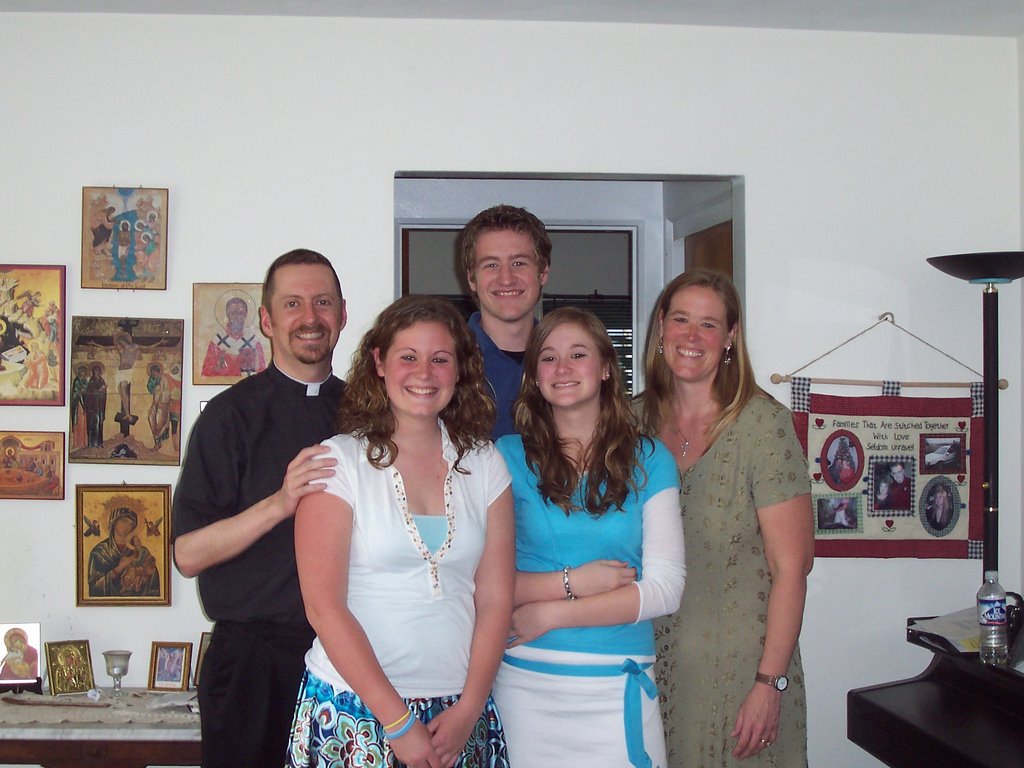


More Easter Joys...
Matins is just ahead - we will gather to pray this joyful liturgy at 6:30. Following that we recess for breakfast (yes, before Mass - see we are NOT legalists!). Then the Easter Eucharist itself. This is the high point of the Church's worship. It is the fountain of joy from which each Sunday of the year is filled. The Preface today expresses the joy perfectly:
It is truly good, right, and salutary
that we should at all times and in all places
give thanks to You,
holy Lord, almighty Father, everlasting God.
And most especially are we bound to praise You on this day
for the glorious resurrection of Your Son, Jesus Christ,
the very Paschal Lamb,
who was sacrificed for us and bore the sins of the world.
By His dying, He has destroyed death,
and by His rising He has restored to us everlasting life.
Therefore, with Mary Magdalene, Peter and John,
and all the witnesses of the resurrection,
with angels and archangels and with all the company of heaven,
we laud and magnify Your glorious name,
evermore praising You and saying:
HOLY! HOLY! HOLY!
15 April 2006
EASTER GREETING
Christos anesti!
Alithos anesti! Alleluia!
A most blessed and joyous Pascha to you all!!!
At Vigil we were blessed to baptize an adult and to confirm three others. As always the Vigil Service is one of the most joyous of the year. As it moves from darkness to light, as the singing becomes ever louder, as the joy of HEARING of Christ's resurrection moves to the joy of RECEIVING the Risen One who will never die again in His body and blood - the very pledge of forgiveness and resurrection - the joy of the people of God overflows and the Alleluias that begin now will NEVER die away!!!
Paschal Homily of St. John Chrysostom
PASCHAL HOMILY OF ST. JOHN CHRYSOSTOM
Are there any who are devout lovers of God?
Let them enjoy this beautiful bright festival!
Are there any who are grateful servants?
Let them rejoice and enter into the joy of their Lord!
Are there any weary with fasting?
Let them now receive their wages!
If any have toiled from the first hour,
let them receive their due reward;
If any have come after the third hour,
let him with gratitude join in the Feast!
And he that arrived after the sixth hour,
let him not doubt; for he too shall sustain no loss.
And if any delayed until the ninth hour,
let him not hesitate; but let him come too.
And he who arrived only at the eleventh hour,
let him not be afraid by reason of his delay.
For the Lord is gracious and receives the last even as the first.
He gives rest to him that comes at the eleventh hour,
as well as to him that toiled from the first.
To this one He gives, and upon another He bestows.
He accepts the works as He greets the endeavor.
The deed He honors and the intention He commends.
Let us all enter into the joy of the Lord!
First and last alike receive your reward;
rich and poor, rejoice together!
Sober and slothful, celebrate the day!
You that have kept the fast, and you that have not,
rejoice today for the Table is richly laden!
Feast royally on it, the calf is a fatted one.
Let no one go away hungry. Partake, all, of the cup of faith.
Enjoy all the riches of His goodness!
Let no one grieve at his poverty,
for the universal kingdom has been revealed.
Let no one mourn that he has fallen again and again;
for forgiveness has risen from the grave.
Let no one fear death, for the Death of our Savior has set us free.
He has destroyed it by enduring it.
He destroyed Hell when He descended into it.
He put it into an uproar even as it tasted of His flesh.
Isaiah foretold this when he said,
"You, O Hell, have been troubled by encountering Him below."
Hell was in an uproar because it was done away with.
It was in an uproar because it was mocked.
It was in an uproar, for it was destroyed.
It is in an uproar, for it is annihilated.
It is in an uproar, for it is now made captive.
Hell took a body, and discovered God.
It took earth, and encountered Heaven.
It took what it saw, and was overcome by what it did not see.
O death, where is thy sting?
O Hell, where is thy victory?
Christ is Risen, and you, O death, are annihilated!
Christ is Risen, and the evil ones are cast down!
Christ is Risen, and the angels rejoice!
Christ is Risen, and life is liberated!
Christ is Risen, and the tomb is emptied of its dead;
for Christ having risen from the dead,
is become the first-fruits of those who have fallen asleep.
To Him be Glory and Power forever and ever. Amen!
An Easter Homily
“And they said nothing to anyone, for they were afraid.”
So ends the Holy Gospel for the high feast of Easter. If ever there were an ending to the story that is all wrong, that is it. Fear shutting up the mouths of those who have the best news that could ever be uttered on the face of the earth. Fear locking fast the lips of those whose words could set free a despairing world to sing for joy.
The more things change, the more they stay the same. Bad news spreads like wildfire, but the good news struggles to overcome the reluctant fear of the messengers. Why? What is that the women were afraid of? Afraid that they were losing their minds. Afraid that they would be laughed at? Afraid that they wouldn’t say it just right? What?
The text doesn’t even give us a hint. There might be a purpose in that. You see, it does not matter one whit what ties the tongue, what matters is simply that the tongue is tied. The message unspoken. The joy unshared.
My friends, we must see this in perspective. We must understand the setting. God made a world filled with life and love and joy. We changed all that. We made of God’s world a place of sadness, a place of death. We turned this home God gave us into a great cosmic cemetery. That is rock bottom reality. Death is. It devours the people of this world one by one and it enjoys the fear that its advent brings. It chews on little children and old men, on young people “in their prime” and on the middle aged. It is a hideous and hateful reality. Death is. And death devours us long before we actually expire. We die a thousand deaths for the loss of those we love, for the loss of our homes, our families, our friends. Death devours. Death is.
BUT! Enter Jesus of Nazareth. Enter the Man who does something about death. Enter the Man who was born of the Virgin Mother and sent into this world by God the Father to actually slay death. To undo its damage. To change it forever. To make it something it was not before. When Jesus is through with Death, you can’t even recognize it as the same thing. Jesus make death a passover, a passage into endless life. It was to overcome death and destroy its power that He came.
And you know how He did it. He did it by offering Himself up to death. Death took Him. On the cross, Death took Him. Devoured Him. Munched on Him till He was just a corpse. Never had Death eaten such a deadly meal. But the Lord Jesus was not just any man. He was at one and the same time true God and true man. Death tried to swallow down Life itself. Death tried to digest in its stinking gullet the very Author of Life. In the picture language of the early Church, Death began to feel quite sick on Holy Saturday and then on Easter morning Death itself keeled over, a gaping hole in its stomach from which the Prince of Life emerged alive again, never to die again, shining with His endless life and calling His people to follow Him into death and then out of it again. You see, He has really made of death a passage. It is not the End. It is not the final word. Life is the final word: “the resurrection of the dead and the life of the world to come.”
All of that the angel communicated to the spice-bearing women inside of the tomb. Mirth bubbled up from within him. He laughed as he spoke. “Don’t be afraid!” he said. “Never be afraid again! You are looking for Jesus. Here in a tomb. Not the place, my friends. Why do you seek the Living among the dead? Why do you seek the Incorrupt among corruption? The Crucified One is not to be found among the dead, for He is risen. Living. He goes before you to Galilee, and you’ll see Him there just as He promised. Now run and tell Peter and the disciples!”
But what happened? “They said nothing to anyone, for they were afraid.” Thanks be to God, we know that that was not quite the end of the story. Mary Magdalene at least overcame her fear and finally went to tell Peter and John and the disciples. Jesus Himself appeared to them and charged them with telling everyone the good news of His resurrection and what it means. And what He told them, He tells us all. He sends us everyone out into a world where sadness reigns, where death terrifies, where despair is endemnic. He says: “Go and tell them that I have risen and that Death has been destroyed! Tell them to trust me and so have eternal life.”
But, “they said nothing to anyone, for they were afraid.” Too often that’s the story today also. Who’s the last person you told about Jesus’ victory over death? When’s the last time the joy that Christ’s resurrection brings to your heart so shown on your face that people said: “What are you so happy about? What’s up with you?” When’s the last time you shared with a relative or a friend what it means that Jesus has risen from the dead and they don’t need to fret over sin or death? When? And why not? “For they were afraid.”
Such a silly thing that fear is. I mean, what’s the worst that could happen if you shared the Good News of Jesus’ resurrection? Well, the early Church soon found out that the worst that could happen to the sharer of the Gospel is that the messenger be killed. And when the early church thought about that, they laughed. Right. No problem. What a glorious way to die. To say to the world: “See, we are not afraid of death. Look! We go into it with confidence. We know that there is a hole in its side and our Lord will bring us through that hole to life everlasting.” Thus even by the way the early martyrs met death they preached powerfully about the resurrection. Their very dying was a proclamation: “Don’t be afraid of this Death anymore! Christ is risen! Believe in Him and be free!”
Now, I think I would be quite safe to say that the probability of any of you being killed for witnessing to Jesus is rather slim, at least as things stand now. So what else are we afraid of? Why don’t we shout our joy? Fear of what others may think of us? Fear of not getting it “just right”? Set aside all such fears today! We have good news that is too great to keep to ourselves.
So today, as the joy of the resurrection of Jesus fills our hearts, today as we know that our Passover has been sacrificed for us and so death must leave us unharmed, today as we sing the glories of His resurrection, as we keep the feast and eat His immortal body and drink His incorruptible blood, let His joyful presence overcome all fear so that we leave this place today so filled with His love and bringing to a sad and despairing world the most joyful news it could ever hear: “Christ is risen from the dead, trampling down death by death, and upon those in the tomb, bestowing life.” Amen.
Patristic Quote for the Day
"The soul, having obtained union with the Word, descended into hell; but using its divine power and efficacy, it said to the ones in bondage, 'Go forth!'" - St. Cyril of Alexandria (De Recta Fide ad Theodosium, MPG, 76:1166a. Note that this passage from Cyril is included in the Catalog of Testimonies, appended to the Book of Concord)
14 April 2006
Patristic Quote for the Day

[Addressing the Cross:]
We do not acknowledge you because of the cruelty that godless and foolish men prepared you to effect upon the most gentle Lord, but because of the wisdom and goodness of Him who of His own free will took you up.
For they could not have done anything unless His wisdom had permitted it, and He could not suffer except that in his mercy He willed it.
They chose you that they might carry out their evil deeds; He chose you that He might fulfill the work of His goodness.
They that by you they might hand over the Righteous to death; He that through you He might save sinners from death.
They that they might kill Life; He that He might destroy death.
They that they might condemn the Savior; He that He might save the condemned.
They that they might bring death to the Living; He to bring life to the dead.
They acted foolishly and cruelly; He wisely and mercifully.
Therefore, O Cross to be wondered at, we do not value you because of the intention of their cruel folly, but according to the working of mercy and wisdom.
- St. Anselm of Canterbury, *Prayer to the Holy Cross*
13 April 2006
Patristic Quote for the Day
On this holy day when the Western Church celebrates the Institution of the Eucharist, some wise words from St. Cyril of Jerusalem:
Therefore with fullest assurance let us partake of the body and blood of Christ: for in the figure of the bread is given thee His body and in the figure of the wine His blood; that thou, by partaking of the body and blood of Christ, mightest be made of the same body and blood with Him. For thus we come to bear Christ in us, because His body and blood are diffused through our members; thus it is that, according to the blessed Peter, we become partakers of the divine nature... Contemplate therefore the bread and wine not as bare elements, for they are, according to the Lord's declaration, the body and blood of Christ; for though sense suggests this to thee, let faith establish thee. Judge not the matter from taste, but from faith be fully assured without misgiving, that thou hast been vouchsafed the body and blood of Christ. - On the Eucharistic Food, par. 3, 6 - St. Cyril of Jerusalem
Therefore with fullest assurance let us partake of the body and blood of Christ: for in the figure of the bread is given thee His body and in the figure of the wine His blood; that thou, by partaking of the body and blood of Christ, mightest be made of the same body and blood with Him. For thus we come to bear Christ in us, because His body and blood are diffused through our members; thus it is that, according to the blessed Peter, we become partakers of the divine nature... Contemplate therefore the bread and wine not as bare elements, for they are, according to the Lord's declaration, the body and blood of Christ; for though sense suggests this to thee, let faith establish thee. Judge not the matter from taste, but from faith be fully assured without misgiving, that thou hast been vouchsafed the body and blood of Christ. - On the Eucharistic Food, par. 3, 6 - St. Cyril of Jerusalem
12 April 2006
Happy Birthday, Dear Cindi!
 On this very day, the lovely Cindi turns 46. Unbelievable. We've been friends for over 34 years, and married for almost 24 years. She remains the light of my life, my joy and dearest friend. And God forgive me for all the trouble I've given her over the years, but her love has remained to me a true ikon of God's unfathomable grace. Cynthia Lauren, I am proud to say in this very public spot, I love you!
Liturgical Quote for the Day
Antiphon 15 of the Holy Thursday Passion Gospels Service:
Today is suspended upon the Tree, He who suspended the land upon waters.
Today is suspended upon the Tree, He who suspended the land upon waters.
Today is suspended upon the Tree, He who suspended the land upon waters.
A crown of thorns crowns Him, who is the King of the angels.
He is wrapped in the purple robe of mockery, who wraps the heavens with clouds.
He received smitings, who freed Adam in the Jordan.
He was tranfixed with nails, Who is the Son of the Virgin.
We worship Thy passion, O Christ.
We worship Thy passion, O Christ.
We worship Thy passion, O Christ.
Show us also Thy glorious resurrection!
Today is suspended upon the Tree, He who suspended the land upon waters.
Today is suspended upon the Tree, He who suspended the land upon waters.
Today is suspended upon the Tree, He who suspended the land upon waters.
A crown of thorns crowns Him, who is the King of the angels.
He is wrapped in the purple robe of mockery, who wraps the heavens with clouds.
He received smitings, who freed Adam in the Jordan.
He was tranfixed with nails, Who is the Son of the Virgin.
We worship Thy passion, O Christ.
We worship Thy passion, O Christ.
We worship Thy passion, O Christ.
Show us also Thy glorious resurrection!
11 April 2006
Patristic Quote for the Day
What earthly joy remains untouched by grief?
What glory stands forever on the earth?
Frail shadows - all, delusive dreams;
Which death will one day sweep away.
But in the light of Your countenance, O Christ,
And in the enjoyment of Your beauty,
Give rest to those whom You have chosen and taken
For You are the Lover of mankind.
--St. John of Damascus, Friday Evening Aposticha Verse
10 April 2006
Father Arseny, the Second Volume
I've only begun, but what a beautiful thought already in the first chapter. Father Arseny is listening to a discussion on which was more important: faith in God or love for the neighbor. He, of course, proceeds to show their inseparability. He then adds this curious thought:
...if a man does good deeds, loves people, perhaps even gives his life for others but does not love God, does not believe in God, then, in spite of his goodness he is spiritually dead because he does not want to know God. I happen to have met such people. They may be good, warm-hearted, ready to give away their last piece of bread, but they are indifferent to God, not accepting of Him - they may even be God's enemies. And, you know, in spite of all their 'goodness' I could see something missing in their behavior, their character, their outlook on life: *they had made a religion out of their own goodness, and for them that had replaced God.*
...if a man does good deeds, loves people, perhaps even gives his life for others but does not love God, does not believe in God, then, in spite of his goodness he is spiritually dead because he does not want to know God. I happen to have met such people. They may be good, warm-hearted, ready to give away their last piece of bread, but they are indifferent to God, not accepting of Him - they may even be God's enemies. And, you know, in spite of all their 'goodness' I could see something missing in their behavior, their character, their outlook on life: *they had made a religion out of their own goodness, and for them that had replaced God.*
Patristic Quote for the Day
Let us glorify and worship Jesus, the Word of God, Who, according to His love, came to save us by His cross and is coming again to resurrect Adam's children in the great day when His majesty shall shine forth. Grieve not, ye mortals, over your corruption. Christ the King shall shine forth from on high; He who is omnipotent shall beckon and thus raise the dead from their graves, and clothe them with glory in His kingdom. - St. Ephrem the Syrian, *A Spiritual Psalter* #149
08 April 2006
De-Supersizing
 Today was a busy day, and after service tonight, I ended up taking Bekah and David out to McDonald's (Cindi had to bowl). But I told them before we went that we weren't ordering a bunch of food. Each of us got:
A cheeseburger
A small fries
A small shake
That's it. They protested at first, but we ate slowly and talked. And you know what? We walked away satisfied, just not stuffed. And I remembered that this is how much we ALWAYS used to eat at McDonald's back in the old days when I was a youngster. And it was sufficient.
I was reminded of the words of St. John Cassian: "They (the holy fathers) have not given us one single rule for fasting or a single standard and measure for eating, because not everyone has the same strength; age, illness, or delicacy of body create differences. But they have given us all a single goal: avoid over-eating and filling of our bellies." (On the Eight Vices)
I've decided that this is the way to go: forget the supersizing of everything under the sun! I hope I can convince the family that a little treat with thankfulness to God and walking away from the table without the belly-ache is most definitely worth it. : )
More Genus Maiestaticum...
...another important thought on the Genus Maiestaticum is that it is not possible to teach this if there is not an ontological distinction between the attributes (energies) and essence of God. For it is the attributes of the divine nature which are communicated to the human nature, NOT the divinity itself. Thanks to Father Gregory Hogg for pointing this out to me a while ago. To go back to the iron and fire analogy that the Fathers loved so much and which Chemnitz relies upon quite heavily: the heat of the fire is what communicates the properties of the fire to the iron, but the heat that is communicated is an energy of the fire and not the fire itself. All of which leads one to cry out: Glory to Your condescension, O Lover of Man!
Confirmation at St. Paul's
Tomorrow the following young people will be examined publicly, confess their faith in the Savior who named them His own in Holy Baptism, and receive the Body and Blood of Jesus Christ (truly their baptismal birthright, but that is a matter for another day...):

07 April 2006
Weird Thought for the Day
What is the genus maiestaticum? Theosis in action!
In Christ our Lord, it is the confession that because of the personal union, the divine nature communicated its energies to the human nature, truly divinizing it, without the human nature becoming itself the divine nature. The iron placed in the fire takes on the attributes of fire without ever essentially ceasing to be iron.
So too with the Christian, a similar thing happens, though not through personal union but through mystical union which is accomplished via faith. The God-Man Christ communicates to us His divine energies, thus divinizing us without those properties of His divine nature ever becoming essential characteristics of the human nature.
How far does such divinization reach? Luther in Great Galatians:
"The one who has faith is a completely divine man, a son of God, the inheritor of the universe. He is the victor over the world sin, death, and the devil. Hence he cannot be praised enough... Therefore the Abraham who has faith fills heaven and earth; thus every Christian fills heaven and earth by his faith." (LW 26:247,248)
The implications of the above for the intercession of the saints is significant, it seems to me, for whom it is true that "they know" even as they have been known.
Patristic Quote for the Day
When I say Paul, I don't mean just him, but also Peter and James and John and their whole company. For just as in a single lyre the strings are different, but they make a single harmonious sound, so too in the company of the Apostles the persons were different but the teaching was one and the same, since there was also a single artist, the Holy Spirit, who was setting their souls in motion. - St. John Chrysostom, *Homily on the Holy Martyr Ignatius of Antioch* par. 4.
06 April 2006
Patristic Quote for the Day
"And they learnt from the enthusiasm and experience of that noble man [St. Ignatius of Antioch], that it was not death toward which he ran, but a migration and translation, and ascent to heaven." - St. John Chrysostom, upon the Martyrdom of the Holy Martyr Ignatius (par. 13)
05 April 2006
Patristic Quote for the Day
God, who yearns for the salvation of all men and hungers after their deification, withers their self-conceit like the unfruitful fig tree (Matt 21:19-21). - St. Maximos, *First Century of Various Texts* Par. 74
04 April 2006
Tagged....
My SIL tagged me for these questions:
1. How many Bibles in your home? 30 (not counting the ones I use most often IN my iBook!)
2. What rooms are they in? The study, every bedroom, the family room.
3. What translations do you have? The Septuagint (hey, it's a translation!), NIV, NKJV, ESV, KJV, Philips, Good News, Spanish, German, AAT, New American, NASB, Jerusalem
4. Do you have a preference? My new 1611 KJV with Apocrpypha and funky spelling, saints days calendar, and other goodies.
5. Nominate an interesting verse.
How about 2 verses? Wisdome of Solomon II:23,24
For God created man to bee immortall, and made him to be an image of his owne eternitie. Neueverthelesse through enuie of the deuil came death into the world and they that doe holde of his side doe finde it.
Who to tag?
Petersen http://www.redeemer-fortwayne.org/blog.php
Fenton http://conversiaddominum.blogspot.com/
My buddy Sal (only person I know who gives me a run for my money in the hyper category!) http://lutherlebensstil.blogspot.com/
Chris Orr http://orrologion.blogspot.com
Okay, so this was too juicy not to share...
 So I'm reading on in St. Augustine, and he talks about the fall. About how as a consequence of Adam's sin, humanity is handed over to the devil. How does Scripture teach this handing over to the devil? Because God told the serpent: On your belly you shall go and *dust you shall eat.* Then he turns to the man and says: And you, sir, ARE dust! Do you think Adam looked at the serpent a little differently as it licked its chops? Is to that too cool or what?
Oh, and we have to see and rejoice that the Eternal Word of the Father became DUST so that swallowing him down unjustly the serpent might choke and death itself be undone! St. Augustine dwells extensively on the injustice of Satan taking Christ down in death as the cause of death's destruction and the end of Satan's reign over us.
Subscribe to:
Posts (Atom)