17 June 2007

Heermann Hymn

Among the great treasures of the Lutheran chorales are the hymns of Johann Heermann. This is one of my favorites.

O God, my faithful God,
True fountain ever flowing,
Without whom nothing is,
All perfect gifts bestowing:
Give me a healthy frame,
And may I have within
A conscience free from blame,
A soul unstained by sin.

Grant me the strength to do
With ready heart and willing
Whatever You command,
My calling here fulfilling;
That I do what I should,
While trusting You to bless
The outcome for my good,
For You must give success.

Keep me from saying words
That latter need recalling;
Guard me lest idle speech
May from my lips be falling;
But when within my place
I must and ought to speak,
Then to my words give grace
Lest I offend the weak.

Lord, let me win my foes
With kindly words and actions
And let me find good friends
For counsel and correction.
Help me, as You have taught,
To love both great and small
And by Your Spirit’s might
To live in peace with all.

Let me depart this life
Confiding in my Savior;
By grace receive my soul
That it may live forever;
And let my body have
A quiet resting place
Within a Christian grave;
And let it sleep in peace.

And on that final day
When all the dead are waking,
Stretch out Your mighty hand,
My deathly slumber breaking.
Then let me hear Your voice,
Redeem this earthly frame,
And bid me to rejoice
With those who love Your name.
LSB 696:1-6

Old Lutheran Quote of the Day

True faith is absolutely necessary when approaching the Supper for sacramental eating so that which was instituted for life is received by us for life. Therefore, I approach this heavenly Meal with true faith, firmly convinced that the body I eat is the one given into death for me, that the blood I drink is the blood shed for my sins. - Johann Gerhard, *Meditations on Divine Mercy* p. 87

Patristic Quote for the Day

Nor was He content merely to summon us back from death to life; he also bestowed on us the dignity if His own divine nature and prepared for us a place of eternal rest where there will be joy so intense as to surpass all human imagination. - St. Basil the Great, *Detailed Rules for Monks* in *Christian Prayer* p. 2016

Fun Day

After services today, I came home to find this in the livingroom:


What could it be? I unpacked it to find this:


Which is megacool, since my old bike was stolen from our garage something like ten years ago and I've talked about replacing it for years and never got around to it. Now Cindi and I can ride together again.

But today was much too hot to ride the bike. Instead, after Cindi prepared a delicious shrimp fest for us, the girls decided to do this:


Then we headed out for some Coldstone Creamery goodies, and back for liverpool. Yours truly got to go out on the last hand, but that made no difference. Yours truly also had a ton of points before he went out. :(

Jo and Dave are headed back to MD tomorrow. May God's angels guard and protect them, and bring them back to us in safety again.

Now the old tummy is suggesting that some left over shrimp might be exactly what is needed to kill the appetite.

16 June 2007

Good gravy!

Pool is STILL filling up! We enjoyed it today, even though it was only part way inflated. What a LOT of water that is. I am hoping that it finishes up before 10 or 10:30 tonight so I can TRY to turn on the pump. I've been warned that it doesn't always work. :(

I must say, though, that the set up was quite simple, despite a few hiccups along the way. I'm wondering if it will be hot enough (and warm enough in the water) to enjoy it tomorrow for Father's Day. We decided to order the saltwater system to see if it will make it easier than dealing with chemicals. As far as chemicals today, I just dumped a bit of bleach in it to see if it would clean up the water. If the pump starts up tonight, it *should* be ready for use tomorrow.

And the order of the day tomorrow will be shrimp - after church we're planning on firing up the grill and doing some shrimp on that, and we've got shrimp to heat up in the oven and shrimp cocktail to serve cold. It will be great celebrating Father's Day with Dave around. They're getting ready to head to Md for a nephew's wedding next weekend, and I'm already missing them. :( Hopefully, they won't be gone long, though.

While waiting for the pool to finish up, turned on EWTN to check out today's mass. AWFUL! So much about the Blessed Virgin and next to nothing about the Blessed Virgin's Son. Grr! And Fr. Mark was the preacher - he's usually better than that. Nothing like the Saturday masses dedicated to the Virgin to remind me of why I am a Lutheran Christian!!!

15 June 2007

One of those nights...

...when I woke up in the middle and could not get back to sleep. But that's okay, because there is something beautiful about Matins as the sun is actually just beginning to poke its head up over the trees. So here it is, seven o'clock, I'm on my second cup of Irish Breakfast Tea, the coffee is just finishing up, and I've read the assigned Book of Concord reading for today and done another 8 pages in the update to Starck's Prayer book, posted my quotes for the day on the blog, and caught up with email.

We're off in a bit to buy one of those Walmart pools. Bekah has been begging for it, and it will be fun to have it in place when she gets back from camp tonight. I suspect we'll all enjoy it, and hopefully it will last more than one summer?

Cindi is singing in the Collinsville Chorale this evening - all Patriotic Music. Including that wretched "Battle Hymn." I told her that I do not know if this southern boy can sit through THAT.

Well, that coffee calls.

Patristic Quote of the Day

Let us fix our thoughts on the Blood of Christ; and reflect how precious that Blood is in God's eyes, inasmuch as its outpouring for our salvation has opened the grace of repentance to all mankind. -- Clement of Rome, To the Corinthians, par. 7

Old Lutheran Quote of the Day

God does not want to satisfy us with visible, temporal, perishable goods. He wants to give us Himself, the eternal highest good. -- C. F. W. Walther, *God Grant It!* p. 498

14 June 2007

Prayer for Those Present After the Dying Person has Breathed His Last.

O holy and righteous God, it has pleased Thee to call hence the departed here lying before us by temporal death. Let us learn from this death that we, too, must die and leave this world, in order that we may prepare for it in time by repentance, a living faith, and the avoidance of the vanities and sin of the world. Refresh the soul that has now departed with heavenly consolation and joy, and fulfil unto it all the gracious promises which in Thy holy Word Thou hast made to those who believe in Thee. Grant to the body a soft and quiet rest in the earth till the Last Day, when Thou wilt reunite body and soul and lead them into glory, so that the entire person that served Thee here may be filled with heavenly joy yonder. Comfort all who are in grief over this death and be and remain to the bereaved their Father, Provider, Guardian, Helper, and Support. Do not forsake them, and do not withdraw Thy hand from them, but let them abundantly experience Thy goodness, grace, love, and help, until Thou shalt grant them also a happy and blessed end. Hear us for Thy mercy's sake. Amen. (Starck's Prayer-Book, p. 454)

[Makes an interesting contrast with Synodical Catechism question #201, eh? You tell ME which is in better accord with Apology XXIV:94, 96]

Homily for Trinity 2 (2007)

[Proverbs 9:1-10; Ephesians 2:13-22; Luke 14:15-24]

The master of the feast made doubly sure that the guests received their invites. He issued two to each: the first was to tell each one that he was invited; and second, on the day of the great supper itself, He sent a special messenger to announce that dinner is served: "Come for everything is now ready!"

All of which teaches us much about the Gospel of Jesus Christ. "Come!" The Gospel is not so much a command as an offer; not so much a demand, as a gift -- an invitation to share in the unbelievable joy of the kingdom of God.

"Come!" God is expecting you! He is ready for the poor, the maimed, the blind, the lame. He is ready for those who spend their lives in the highways and byways of life. He invites all: "Come; for all is now ready."

As a shepherd seeks for the lost sheep, as a woman gets down on her knees to look for a lost coin, and, yes, as a father looks down the road, waiting for his lost son to come home again, so God is ever seeking, calling, inviting us into relationship and communion with Himself. In that he shows us what "fatherhood" is to be about: seeking opportunity and opening doors for relationships, for sharing both hurts and happiness, sorrows and joys. The godly father is the one who keeps the door of his heart open to his children, a picture of God the Father's open heart and constant invitation to us.

God cries out: "Come; for all is now ready!" Come, you who seek meaning for life. Come, you who hunger and thirst for righteousness. Come, you who falter under the burden of sin and shame. Come, you who are anxious and fearful. Come, you who mourn.

"Come you all; enter into the joy of your Lord. The table is richly loaded: enjoy its royal banquet. The calf is a fatted on; let no one go away hungry. All of you enjoy the banquet of faith; all of you receive the riches of his goodness. Let none grieve over their poverty, for the universal kingdom has been revealed; let no weep over their sins, for pardon has shone forth from the grave; let none fear death, for the death of the Savior has set us free." (John Chrysostom - Easter homily)

Christianity is not first and foremost a "should" religion. It is first and foremost a "come" religion. The great drawing power of Jesus Christ is not in His "Thou shalts and thou shalt nots" but in His "Come to me." Come, be filled with the Holy Spirit. Come, be filled with the power of God's presence. If we come to him, then we shall do certain things, not because we "should" do them, but because we delight in doing them as an expression of our love for the One who laid down His life to give us life.

Commenting on this word "Come" and in particular on the words of Jesus, "Come to me all you who labor..." John Chrysostom wrote these precious words: "His invitation is one of kindness, His goodness is beyond description. 'Come to me, all' not only rulers but also their subjects, not only the rich, but also the poor, not only the free, but also the slaves, not only men but also women, not only the youth, but also the old, not only those of sound body, but also the maimed. All of you, He says, come! For such are the Master's gifts. He knows no distinction of slave and free, nor of rich and poor, but all such inequality is cast aside. 'Come,' He says, 'all you who labor and are burdened!' And see whom He calls! Those who have spent their strength in breaking the law, those who are burdened with their sins, those who can no longer lift up their heads, those who are filled with shame, those who can no longer speak out. Why does He call them? Not to demand an accounting, nor to hold court. But why? To relieve them of their pain, to take away their heavy burdens."

Now when Jesus says, "Come!" He does not stand on the top rung of a long, high ladder in heaven to signal us to start climbing. For He himself has climbed down the ladder to stand at our very elbows. He has come to us. "Who for us men and for our salvation, came down from heaven and was incarnate by the Holy Spirit of the Virgin Mary and was made man." "She brought forth her firstborn Son and wrapped him in swaddling clothes and laid him in a manger." He came, born in a stable. He came and died on the cross. He came to prepare the banquet of salvation for us. And now--today--He sends His servants to extend us His invitation: "Come, for all things are now ready." There is nothing you can add to this feast. He has done the lot. "It is finished!" He cried from the cross. He has prepared the feast of salvation for you and the only request He asks of you is that you let Him serve it to you.

Ah, but far from being accepted, this gracious invitation was rejected. "I have bought a field...I have bought five yoke of oxen...I have married a wife...I cannot come. Have me excused..." This was the response. The response of so many of His own people. "He came to His own and His own received Him not." Is it not the same response today? Our great tragedy is that we end up accepting the wrong invitations in life. We miss the banquet, the abundant life of Christ, and settle for the lesser, for the fleeting. And Jesus still laments, "O Jerusalem, Jerusalem! How often would I have gathered your children together as a hen gathers her brood under her wing, and you would not."

"Come, for all is now ready." "But" you object "I am not worthy to come. My clothes are not suitable. I wouldn't know how to act in the Master's palace." None of this makes any difference. The invitation goes out to all:to those who are on the back streets, to those who live in little, dirty places, as well as to those who live in fine houses. Come! The good news is that you don't have to be perfect to come. Come as you are -- with all of your sins and sorrows, weaknesses and failures, problems and anxieties. Come to the only one who can forgive you and heal you. Come to the one who on His cross opened His arms wide to you. "Come, for all is now ready."

Coming to Jesus isn't a one time thing. None can say: "Oh, I did that years ago." Coming to Jesus is a way of life. It begins with baptism. It involves living out our baptism in daily repentance and sorrow for sin and turning from sin to God. We come to Him and find Him where He has promised to be for us. We come to Him in worship for "where two or three gather in my name, there am I in the midst of them." We come to Him in Bible reading, for "if anyone loves me, he will keep my word; and my Father love him, and we will come to him and make our home with him." We come to Him in regular communion, for "he who eats my flesh and drinks my blood abides in Me and I in Him." You see He who came down from heaven to meet us on our level, meets us on our level still.

No, He doesn't stand at the top of the ladder and call us home. He stands at the bottom and lifts us up on His strong shoulders and carries us up the ladder Himself. None of us will ever know the wonder of the brightly lit banquet hall, the goodness of the food, and the joy of being part of this amazing fellowship until we lay aside the excuses and dare to accept the invitation. Yes, dare to accept it daily! Come to Him now, come to Him today and tomorrow and the next day and the next and so live in the assurance that on the last day He will direct to you the greatest "Come" of all: "Come, O blessed of my Father, inherit the kingdom prepared for you from the foundation of the world." Amen

Walther

A beautiful reading for today on part of last Sunday's epistle: 1 John 4:16-18. Here's just a snippet:

Therefore, if the love of God does not reside in a person's heart, he boasts of faith and relies upon it in vain. Faith is not an intention to acquire all the comfort of the Gospel. It is a heavenly light, a divine power that God, with His grace, implants in the heart. Faith without love for God is an empty product of our imagining, a hull without fruit, a shell without kernel, a painted picture without life. Wherever there is true faith, love comes forth like the shining of the sun. Wherever love is absent from the heart, God, the eternal love, cannot be found there.... If you do not remain in love, you also will not remain in faith. *God Grant It!* p. 495

Old Lutheran Quote of the Day

If we eat Him spiritually, through the Word He abides in us spiritually in our souls; if one eats Him physically He abides in us physically and we in Him. As we eat Him, He abides in us and we in Him. For He is not digested or transformed but ceaselessly He transforms us, our soul into righteousness, our body into immortality. So the ancient fathers spoke of the physical eating. --Blessed Martin Luther (AE 37:132)

Patristic Quote of the Day

What, then, we read concerning Lazarus we ought to believe of every sinner who is converted, who, though he may have been stinking, nevertheless is cleansed by the precious ointment of faith. For faith has such grace that there where the dead stank the day before, now the whole house is filled with good odour. St. Ambrose - On Repentance, Book II, Par. 63

From Today's BOC Reading...

"Therefore, it would be wicked to remove private Absolution from the Church. If anyone despises private Absolution, he does not understand what the forgiveness of sins or the Power of the Keys is." - Apology VI:3,4 (Concordia)

From this morning's Matins

First, the incomparable hymn: "Father, most holy" usually attributed to St. Gregory the Great.

What never ceases to strike me in this hymn is stanza three:

Maker of all things, all Thy creatures praise Thee;
All for Thy worship were and are created;
Now, as we also worship Thee devoutly,
Hear Thou our voices! (LSB 504:3)

Everything there is was created to worship the Blessed Trinity. The flowers worship by being flowers. The trees worship by being trees. The dogs worship by chasing their tails. And humans worship by being humans - being what we were intended to be: the image and temple of God upon the earth. We were created to worship. To spend our time in anything else is to miss out.

And because that is so, because of the fallness of our world, we had in today's reading from Proverbs 14:11

The house of the wicked will be destroyed;
But the tent of the upright will flourish.

House verses tent. It's the difference between the wicked and the upright. The wicked have here in this world their permanent home. They settle down and live it for all its worth. But its worth, its true worth, is how it manifests and declares to us ceaselessly that it is NOT our final home, but that we are meant be pilgrims, that we are passing through this age to the age that is to come, which is our true and lasting home. Here the righteous live only in tents - even if the tents are made of brick and mortar. They know that nothing here lasts. "The form of this world is passing away." We are journeying to that Age and that home where praise and worship of the Blessed Trinity will be all in all. Even now we get the teasing taste of what it will be in the Church - the colony from the future, the life of the age to come planted on this soil so that we might ever remember that we live in tents.

13 June 2007

Old Lutheran Quote of the Day

Since the payment for my sin and reconciliation has cost so much, the bitter death of my God, may God keep me from sins. - Urbanus Rhegius, *Preaching the Reformation* p. 75

Patristic Quote of the Day

We have a good Lord, Whose will it is to forgive all, Who called you by the prophet and said: "I, even I, am He that blots out your transgressions, and I will not remember, but you remember that we may plead together." "I," He says, "will not remember, but remember," that is to say, "I do not recall those transgressions which I have forgiven you, which are covered, as it were, with oblivion, but remember them. I will not remember them because of My grace, remember them in order to correction; remember, you may know that the sin is forgiven, boast not as though innocent, that you aggravate not the sin, but you will be justified, confess your sin." For a shamefaced confession of sins looses the bands of transgression. - St. Ambrose, On Repentance, Book II, par. 40

On Being Lutheran

A friend wrote me a sad note a bit ago about not enjoying identifying himself as a Lutheran anymore. I have to confess that it is something that I do not quite understand. Yes, I know being a Lutheran is mega-uncool. All the self-professed "thinkers" have left or are leaving. My friend mentioned being fed up with the whole Lake Woebegone schtick, disgusted over reading the latest Reporter and stuff about the upcoming Synodical Convention. I have sympathy with his revulsion to the way many contemporary Lutherans are headed, of course. But the name Lutheran? It's still one that brings good associations.

What does it mean to me? This is just personal reflection, understand. But when I hear Lutheran...

It calls to mind my first encounter with the Eucharist as the true body and blood of Christ. I can still see the young people at St. Andrew kneeling to receive and then walking back and spending time in prayer afterwards. Their heads bowed, their faces, well, grateful.

It calls to mind my brother Maupin ribbing my side as the water was poured into the font and him saying: "That's for you!"

It calls to mind Palm Sunday services with palms! Maundy Thursday solemn celebrations of the Supper. Good Friday with seven sermons on the seven last words. And Easter with overflowing joy. It calls to mind Advent and Lenten Vespers in the middle of the week, and learning Psalm 130 by heart from the back of TLH, with pastor singing the bass-line.

It calls to mind spending six weeks each year with the Passion of Jesus in sermon, hymn, anthem, and prayer.

It calls to mind joining the choir and processing in to the music of "Built on the Rock" as we celebrated a jubilant Reformation Day; and this was when I still had not the foggiest notion how to sing in parts. But the others did - and what a rich sound.

It calls to mind Bible studies that wrestled with the sacred text and invited us not to be afraid to hear what was being said and honestly to react to it.

It calls to mind the beautiful Christmas trees and the real branches around the Advent wreath. The acolytes standing on tiptoe to reach the tall candles on the gradine.

It calls to mind the ringing of bells, the chanting of psalms, the huge "for you ness" of it all.

It calls to mind evangelism visits and visiting the booth at the county fair, replete with tracts from LLL.

It calls to mind listening to sermons that did not fail week after week to deliver the goods: real law that exposed and stripped me of all excuses and real Gospel that refreshed me and sent me on my way with joy.

It calls to mind hymns and chants that sounded different from anything I'd ever heard before. I still remember the first time Herzliebster Jesu made itself known to me.

It calls to mind memorizing the catechism and reciting it for Mrs. Bleckley and receiving her kind chastisement for not having it down exactly correct.

It calls to mind the heady years at Bronxville where the music of the Lutheran Church opened before me like a vast ocean waiting to be explored, and into which I got to plunge in chapel choir, tour choir, and chorus.

Lutheran to me calls to mind the people, the vast numbers of people, to whom p. 15; Trinity Sunday and the Athanasian Creed; and "this is most certainly true" brings the smile of shared experience to the face.

To me the word "Lutheran" conjures up all that to me and so much more. A negative? No way. A joy. The joy of a forgiven sinner, welcomed home to the Father's house and learning to rejoice in grace from so many who have gone before. Indeed, "this is most certainly true."

12 June 2007

Ambrosian Joys

Spent part of today studying St. Ambrose's fine little work on Repentance. It's in two books. Finished the first. He's writing against the Novatians. The gleanings are pretty danged rich, so thought I'd through them out for any who collect such things:

Ambrose:

Consider, too, the point that he who has received the Holy Ghost has also received the power of forgiving and of retaining sin. For thus it is written: "Receive the Holy Spirit: whosesoever sins ye forgive, they are forgiven unto them, and whosesoever sins ye retain, they are retained." John 20:22-23 So, then, he who has not received power to forgive sins has not received the Holy Spirit. The office of the priest is a gift of the Holy Spirit, and His right it is specially to forgive and to retain sins. How, then, can they claim His gift who distrust His power and His right? – Repentance, Book I, par. 8

For we men are all born under sin, and our very origin is in evil, as we read in the words of David: "For lo, I was conceived in wickedness, and in sin did my mother bring me forth." -- Repentance, Book I, par 13

Is it not evident that the Lord Jesus is angry with us when we sin in order that He may convert us through fear of His indignation? His indignation, then, is not the carrying out of vengeance, but rather the working out of forgiveness, for these are His words:"If you shall turn and lament, you shall be saved." He waits for our lamentations here, that is, in time, that He may spare us those which shall be eternal. He waits for our tears, that He may pour forth His goodness. So in the Gospel, having pity on the tears of the widow, He raised her son. He waits for our conversion, that He may Himself restore us to grace, which would have continued with us had no fall overtaken us. But He is angry because we have by our sins incurred guilt, in order that we may be humbled; we are humbled, in order that we may be found worthy rather of pity than of punishment. – Repentance Book I, par 22

He does not bring down the sinner even to the earth with His whole heart Who raises the poor even from the dust and the needy from the dunghill. For He brings not down with His whole heart Who reserves the intention of forgiving. –Repentance Book I, par 23

Your Church does not excuse herself from Your supper, Novatian makes excuse. Your family says not, "I am whole, I need not the physician," but it says: "Heal me, O Lord, and I shall be healed; save me, and I shall be saved." The likeness of Your Church is that woman who went behind and touched the hem of Your garment, saying within herself: "If I do but touch His garment I shall be whole." Matthew 9:21 So the Church confesses her wounds, but desires to be healed. Repentance Book I, par 31

[David Schütz, this next is for you!]

And this confession is indeed rightly made by them, for they have not the succession of Peter, who hold not the chair of Peter, which they rend by wicked schism; and this, too, they do, wickedly denying that sins can be forgiven even in the Church, whereas it was said to Peter: "I will give unto you the keys of the kingdom of heaven, and whatsoever you shall bind on earth shall be bound also in heaven, and whatsoever you shall loose on earth shall be loosed also in heaven." Matthew 16:19 – Repentance, Book I, par 33

do you say, "I am clean," when, as it is written, not even an infant of a day old is pure? – Repentance, Book I, par 38

Do you see that the same God Who requires repentance promises forgiveness? Repentance, Book I, par 46

If, then, you wish to reclaim any one of the lapsed, do you exhort him to believe, or not to believe? Undoubtedly you exhort him to believe. But, according to the Lord's words, he who believes shall have everlasting life. Repentance, Book I, par 48

He then who has faith has life, and he who has life is certainly not shut out from pardon; "that every one," it is said, "that believes in Him should not perish." Since it is said, Every one, no one is shut out, no one is excepted, for He does not except him who has lapsed, if only afterwards he believes effectually. Repentance, Book I, par 48

Therefore it is said: "That every one that believes in Him should not perish." Let no one, that is, of whatever condition, after whatever fall, fear that he will perish. Repentance, Book I, par. 51

Let us consider another similar passage: "He that believes in the Son has eternal life, but he that believes not the Son shall not see life, but the wrath of God abides on him." John 3:36 That which abides has certainly had a commencement, and that from some offence, viz., that first he not believe. When, then, any one believes, the wrath of God departs and life comes. To believe, then, in Christ is to gain life, for "he that believes in Him is not judged." John 3:18. Repentance, Book I, par. 53

And that you may not think that it is only our arguments which press you, consider the decision of Christ, Who said: "If the servant knew his Lord's will and did it not, he shall be beaten with many stripes, but if he knew it not, he shall be beaten with few stripes." Luke 12:47-48 Each, then, if he believes, is received, for God "chastens every son whom He receives," Hebrews 12:6 and him whom He chastens He does not give over unto death, for it is written: "The Lord has chastened me sore, but He has not given me over unto death." Repentance, Book I, par 58

For this is the sentence of condemnation on the serpent: "Dust shall be your food." Genesis 3:14 What dust? Surely that of which it is said: "Dust you are, and into dust shall you return." Genesis 3:19 Repentance, Book I, par. 67

Nicea

Today our Synod remembers with thanks to the most Blessed Trinity the holy council at Nicea, the first ecumenical council. From the Synod's website:

The Ecumenical Council of Nicaea, A.D. 325

The first Council of Nicaea was convened in the early summer of 325 by the Roman Emperor Constantine at what is today Isnuk, Turkey. The emperor presided at the opening of the council. The council ruled against the Arians, who taught that Jesus was not the eternal Son of God but was created by the Father and was called Son of God because of his righteousness. The chief opponents of the Arians were Alexander, bishop of Alexandria, and his deacon, Athanasius. The council confessed the eternal divinity of Jesus and adopted the earliest version of the Nicene Creed, which in its entirety was adopted at the Council of Constantinople in 381.

Yet another Magdeburg gem

This coming Thursday, the German Litany was prescribed between the Epistle and the Gospel. The introduction to the litany is the beautifully penitential Precatio Ecclesiae that teaches us in the litany our intercession is being joined to that our Lord for us:

Remove from us, Lord,
our sins and transgressions
so that we may appear before You
with clean hearts and humility.
Have mercy, have mercy, have mercy, dear Lord,
upon the people
that You have redeemed with Your blood, O Christ,
and do not be angry with us forever.
Hear, hear, hear our prayer, O Lord God,
Christ, our Redeemer, pray for us to your dear Father.

Old Lutheran Quote of the Day

The problem of Church Union will be solved only by holding firmly to the pure faith of the Gospel, once delivered to the saints, and heartily uniting with all who upon the basis of this pure faith, and for the sake of advancing this pure faith, thankfully accept and appropriate everything developed in the Church's experience, that is not contrary to God's Word. With purity of teaching guarded in other respects the rule applies: "Submitting to one another in the fear of God," Eph. 5:21 - Henry E. Jacobs, *Elements of Religion* p. 215

Patristic Quote of the Day

Others think that licence is granted them to sin, because the hope of penitence is before them, whereas penitence is the remedy, not an incentive to sin. For the salve is necessary for the wound, not the wound for the salve, since a salve is sought because of the wound, the wound is not wished for on account of the salve. - St. Ambrose of Milan, *On Repentance* Book II, par. 90

For Brian

Here you go! I'm not guaranteeing that the verses actually match up exactly between the English and the Latin, so there are no doubt rough edges. Note that the overwhelming majority of the time, the epistle is the same for the previous Sunday - though there are exceptions to this, and all of Lent is an exception. But this is the set of Thursday Mass readings from the 1613 Lutheran Magdeburg Cathedral Service Book.

Readings for the Thursday after:
Trinity: 1 Cor. 11:23-29 / John 5:55-58
Trinity 1: 1 John 4:9-21 / Luke 17:1-10
Trinity 2: Joel 2:23-27 / Luke 8:41-56
Trinity 3: 1 Peter 5:6-12 / Mark 11:11-24
Trinity 4: Romans 8:18-23 / Mark 6:1-7
Trinity 5: 1 Peter 3:8-15 / Mark 6:31-44
Trinity 6: Romans 6:3-11 / Mark 5:1-10
Trinity 7: Romans 6:19-24 / Matt 12:1-7
Trinity 8: Romans 8:12-24 / Matthew 23:13-23
Trinity 9: 1 Cor. 10:6-13 / Luke 11:37-46
Trinity 10: 1 Cor. 12:1-11 / Luke 21:34-36
Trinity 11: 1 Cor. 15:1-10 / Luke 17:20-37
Trinity 12: 2 Cor. 3:4-9 / Matthew 11:20-27
Trinity 13: Gal. 3:18-22 / Luke 13:22-30
Trinity 14: Hosea 14:2-10 / Luke 7:36-50
Trinity 15: Galatians 5:26-6:10 / Luke 20:1-8
Trinity 16: Ephesians 3:13-21 / Mark 8:22-26
Trinity 17: Ephesians 4:1-6 / Luke 19:12-28
Trinity 18: 1 Cor. 1:4-8 / Matt 13:31-35
Trinity 19: Eph 4:22-28 / Mark 13:14-23
Trinity 20: Eph 5:15-21 / Luke 6:22-36
Trinity 21: Eph 6:10-19 / Matt 8:14-17
Trinity 22: Phil. 1:3-11 / Mark 4:14-20
Trinity 23: Phil 3:17-21 / Mark 7:1-8
Trinity 24: Col. 1:9-14 / Matt 24:37-44
Trinity 25: Jeremiah 23:5-8 / Mark 13:33-37
Trinity 26: 2 Thes. 1:3-11 / Luke 19:1-10
Trinity 27: 1 Thes 5:1-11 / Matt 17:1-8

Advent 1: Romans 13:11ff / Luke 3:7-18
Advent 2: Romans 15:4-13 / John 1:15-18
Advent 3: Isaiah 11:1-5 / Luke 1:39-47
Advent 4: 2 Thes. 2:1-8 / Luke 3:1-6

After Epiphany: Romans 12:1-6 / Luke 2:42-52
2 Epiphany: Romans 12:6-16 / Luke 4:31-37
3 Epiphany: Roman 12:16-21 / Mark 3:6-15
4 Epiphany: Romans 13:8-10 / Matt 8:23-27
5 Epiphany: Col. 3:8-17 / Matt 13:24-30
6 Epiphany: 1 Thes 5:4-23 / Matt 17:1-8

Septuagesima: 1 Cor. 9:24-10:5 / Luke 9:51-56
Sexagesima: 2 Cor. 11:19-12:9 / Luke 17:20-37
Quinquagesima: Isaiah 58:1-9 / Matt 5:43-6:4

Invocabit: Ezekiel 18:1-8 / John 8:31-47
Reminiscere: Jeremiah 17:5-10 / John 5:30-47
Oculi: Jeremiah 7:1-7 / John 6:27-35
Laetare: 2 Kings 4:25-37 / John 5:17-20
Judica: Daniel 3:24-45 (Apocrypha) / John 7:40-52

Easter 1: Acts 8:26-end / John 20:11-18
Easter 2: 1 John 5:4-10 / Matt 28:8-15
Easter 3: 1 Peter 2:21-25 / Matt 9:14-17
Easter 4: 1 Peter 2:11-19 / John 12:46-50
Easter 5: James 1:17-21 / John 13:33-36
Easter 6: ASCENSION
Easter 7: 1 Peter 4:7-11 / Luke 24:49 to end

Pentecost: Acts 8:5-8 / Luke 9:1-6

11 June 2007

Change in Calendar

St. Paul's has been carefully observing the sanctoral calendar of LSB, but the irregularity of these feasts has led to a bit of confusion. It is with joy that I announce that beginning the second week in July, we'll be offering virtually every Thursday a spoken Divine Service at which various saints days will be observed. Service will begin at 6:15 p.m. and be over by 6:45. If a day appointed in the sanctoral cycle falls in the octave, it will be observed on the Thursday. Since the LSB does not appoint readings for the Divine Service on those weeks when there is no saint's day or other feast transferred or observed, we'll use the assigned readings from the 1613 Magdeburg Book for the Thursday Eucharists. Pastor Lehmann told me that Pr. Petersen also recommends Thursdays in continual remembrance that it was upon that day our Lord gave us the Supper. Here is the schedule:

Thursday Eucharists:

July 12 Thursday of Trinity 5
July 19 Thursday of Trinity 6
July 26 St. James, the Elder
August 2 Thursday of Trinity 8
August 9 Thursday of Trinity 9
August 16 St. Mary, Mother of Our Lord
August 23 St. Bartholomew
August 30 The Martyrdom of St. John the Baptist
September 6 Thursday of Trinity 13
September 13 Holy Cross
September 20 St. Matthew
September 27 Thursday of Trinity 16
Oct 4 Thursday of Trinity 17
Oct 11 Thursday of Trinity 18
Oct 18 St. Luke
Oct 25 St. James of Jerusalem
Nov. 1 Sts. Simon and Jude (All Saints observed on Sunday)
Nov. 8 Thursday of Trinity 22
Nov 15 Thursday of Trinity 23
Nov 22 (NO EUCHARIST – Thanksgiving Day)
Nov 29 St. Andrew, Apostle
Dec 6 Thursday of Advent 1
Dec 13 Thursday of Advent 2
Dec 20 St. Thomas
Dec 27 St. John
Jan 3 Holy Innocents
Jan 10 Thursday after Epiphany
Jan 17 Transfiguration
Jan 24 Conversion of St. Paul
Jan 31 Purification of Mary
Feb 7 Thursday after Ash Wednesday
Feb 14 Thursday after Invocabit
Feb 21 Thursday after Reminscere
Feb 28 St. Matthias
Mar 6 Thursday after Laetare
Mar 13 St. Joseph, Guardian of Our Lord
Mar 20 Maundy Thursday – Sung Eucharist at 7:15
Mar 27 Annunciation
Apr 3 Thursday of Easter 2
Apr 10 Thursday of Easter 3
Apr 17 Thursday of Easter 4
Apr 24 St. Mark the Evangelist
May 1 Ascension – Sung Divine Service at 7:15
May 8 Philip and James
May 15 Pentecost Thursday
May 22 Corpus Christi
May 29 Thursday of Trinity 2
June 5 Thursday of Trinity 3
June 12 St. Barnabas, Apostle
June 19 Thursday of Trinity 5
June 26 Nativity of St. John the Baptist

On Elders

Schmemann has a great piece in *Church, World, and Mission* (I think!) on the conciliar nature of the Church. He points out that this was originally manifested in that the local bishop had gathered around him his council, his presbyters. When the task of presiding over the Eucharist was given over to presbyters as the normal way of things, it was inevitable, Schmemann argues, given the nature of the Church, that a council would arise around him. He can't and shouldn't do his work alone. I think Schmemann is correct. Hence the "elders" in the Missouri Synod.

I have to tell you openly and honestly: I love my elders. They are not "yes" men or "no" men. They take time to think over what I propose. At times they tell me: "You're off your rocker." At times they say: "go for it." But I know this: I would never act without hearing them out. Even if I end up disagreeing with their consensus (which honestly has never happened), I would be a fool of the first order not to consider prayerfully whatever insights they offer me. They are the living embodiment of Proverbs 15:22, "Without counsel plans fail, but with many advisers they succeed."

I pray for this group of men each day, and I know they pray for me. The pastor without his council of elders would be a rather sorry sight. I shudder to think of my own ministry had I not had the collective wisdom of their words and insights.

Only the Germ

The Apostolic Church was only the germ in doctrine, in life, in worship, in government, of that which was to follow. Everything that was added in the way of true and legitimate development, is a permanent possession of the Church which cannot be renounced unless abused for the purpose of defeating the very end for which the Church has been organized. -- Henry E. Jacobs, *Elements of Religion* p. 214

Thee We Adore, O Hidden Savior

Thee we adore, O hidden Savior, Thee,
Who in Thy Sacrament art pleased to be;
Both flesh and spirit in Thy presence fail,
Yet here Thy presence we devoutly hail.

Fountain of goodness, Jesus, Lord and God:
Cleanse us, unclean, with Thy most precious blood;
Increase our faith and love, that we may know
The hope and peace which from Thy presence flow.

O Christ, whom now beneath a veil we see,
May what we thirst for soon our portion be:
To gaze on Thee unveiled and see Thy face,
The vision of Thy glory, and Thy grace. Amen.

LSB 640:1,4,5

Old Lutheran Quote of the Day

The efficacy of the Word, even when administered in an irregular way, is no justification for carelessness and indifference concerning the regular order. Men sin in despising and breaking through a regular order, even though, notwithstanding their irregularity, their efforts may not be without marks of God's blessing. - Henry E. Jacobs, *Elements of Religion* p. 212

Patristic Quote of the Day

Why do you fear to confess your sins to our good Lord? "Set them forth," He says, "that you may be justified." The rewards of justification are set before him who is still guilty of sin, for he is justified who voluntarily confesses his own sin; and lastly, "the just man is his own accuser in the beginning of his speaking." Proverbs 18:17 The Lord knows all things, but He waits for your words, not that He may punish, but that He may pardon. It is not His will that the devil should triumph over you and accuse you when you conceal your sins. Be beforehand with your accuser: if you accuse yourself, you will fear no accuser; if you report yourself, though you were dead you shall live. - St. Ambrose of Milan, On Repentance, Book II, par. 53

AC XIV in Action!


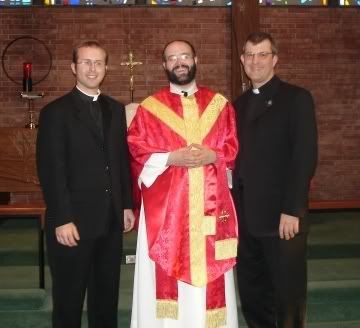
Our former vicar, Charles Lehmann, was ordained into the Office of the Holy Ministry last Saturday. Here's a pic of the new pastor (love the maniple! - I think I see a D.K. Brunner and Son outfit there) and the outstanding homily that was delivered by Pastor Cage. Here's AC XIV in action, folks. Beautiful! Enjoy.

The Reverend Peter Cage
Grace Evangelical Lutheran Church
Muncie, IN

Ordination of Charles Lehmann
Zion, Beecher IL (9 JUN 07)

John 20

All of heaven is interested in what is happening in this place. All of heaven with its unending, continuous praise of Christ is on to what happens here tonight. As the Father has sent His Son, so His Son, this Christ, is sending ... now ... another in a long line of those bound by divine arrangement with the ministry that our Lord Jesus Christ gave to His apostles-Sts Peter, James and John, and Paul and those who came after, to Silas, Timothy and Titus, to Mark and Luke and all faithful pastors and teachers long before you, Charles. It's good to be a little frightened with this-and in awe of what happens tonight before the LORD God of Sabaoth, before Whom even the seraphim veil their faces.

There's an order there. And God putting you in an order, ordering you. And so an ordination. But I suppose it must seem--even to the experience of those of us who have been part of one or more ordinations -to be something kind of ord-inary. So we're not terribly surprised that some cars are driving past and not stopping or taking much notice. Charles, the world cares more about Paris Hilton than you. If they gave it much more thought-I suppose they'd hate or at least laugh at why we're here tonight. And the vast majority of the city of Fort Collins, CO would never even notice if you don't show up. The world's got their orders, too, whether they realize it or not, from their Prince. But in the face of all this satanically influenced indifference and opposition, the one, holy, catholic and apostolic Church rejoices. God is doing something. And in this company your bride-to-be, your mother and father, your friends and family-and old pastors have gathered to pray and to hear, too, as you are bound up under orders.

As a former military chaplain, I know a little about orders from that side of things. You don't go anywhere without orders-paper with your name on it that tells you where to be and what you'll be doing there. Tonight the church gives pause, and heaven rejoices because God is ordaining, God is giving a man set apart for His Church. Putting now this one under orders. And what God does is marvelous even more so when our senses aren't especially dazzled by the goings-on.

Christ gathers His church in this place [with Prs. Rock and Moldenhauer] with great regularity week after week, and tonight for this. Shepherd and sheep you've been gathered. Heaven and heavenly things right here on earth no less-heaven just beyond what your senses can fully take in. God speaking and giving and serving from His Word and altar and putting into beggar's hands and ears and mouths--ours. And as the promised gifts are given by Him, again and again, we say, "Amen," "yes, yes, it shall be so." And special this night because a son of this congregation is being ordered into the Office of the Ministry-for which the whole Church is thankful. Soon you will take your vows, this church and people who know you well will speak with the church catholic and give the "Amen" to what is done. And what God is giving for His Church this hour will be received by His Church.

Like that. That what God has done in giving a pastor He has done well despite the sometimes messy look of things in the years and the process of how you got to this moment and that chair on this night, and the rather humble, ordinary appearance of the whole thing. Now the world who refuses Him who speaks from heaven will just ignore what is happening tonight in Christ's Church-this thing that God is doing among us and for us. Well, to be honest we scarcely believe it ourselves. That God's things happen in a place like this amidst people like us. At an altar and font. From a pulpit. In a place like Zion in Beecher IL, or Grace in Muncie, IN or Peace With Christ in Fort Collins, CO. But like Christ, none of these places are floating out in space. They are locatable, earthly places you can point to and be at, holy ground where He has been promising Himself and delivering Himself up for dying people all along-long before any of us. These aren't airy abstractions but body and blood places-God in flesh, God-with-us places. Immanuel. Incarnate. All those good words! In a place. In His Person. Heaven and earth are full of His glory. Sounds so terribly important. So life-and-death, and then life ... again. It is. God has made all the arrangements, speaks every gracious word, washes every infant, serves every communicant real flesh and blood. God's service to sinners-He is unwilling to let me sink into real hell with my sin and death on. He sends His Son. A serpent-Crusher. A Die-er and Riser. An Absolver and Life-Giver. It is His public ministry amidst His Church. It is never done in secret, though the God of heaven and earth does come gently and even plainly:

in the preaching of the Child born of Mary, and hidden-ly in the tap water that gave you birth "from above", and in mere bread and wine delivered by a very plain and ordinary man with the Word. A man with a Word ordered by God. One set apart not for all the other things that need doing for us, but for these things that God Himself is doing. All this is so because the Giver of the gifts declares it so.

And all this in a world and culture where so many things are advertised and promised but are not so at all. This should make you, Charles, humble at all your personal inadequacies, and yet supremely confident in the One who makes you a pastor and sends you. 'Cos what God promises, God is doing. And for the Church you serve, in the place you will serve, they too can be confident that what is done by Word and Supper is done not by a man, but by the God-Man Jesus Christ. He has promised.

By this act, this ordination, tonight you lose some of your freedom. At your installation later on you'll be bound up even more. It is not up to you what you will do or where you will do it. God has seen to that. Check your orders-your call that tells you where to go and who you must serve, and your vows will tell you what to do: preach the Gospel and serve the Sacraments. You haven't taken these things like a thief, you are being given them to do now. Under the obligation of your ordination into the Holy Christian Church now, and the people you will serve now. And as the liturgy says it so well, you will speak the words and work the works of Christ as a pastor of His Church. Not by your virtue, but by virtue of your office as a called and ordained servant of the Word. You will forgive sins, and preach the Gospel of our Lord's completely unfair and untiring mercy. You will instruct the uninstructed. You baptize the un-baptized, absolve those who are sorry for sins [and retain the sins of those who are not], and distribute the Body and Blood of Christ into their mouths, care for the sick and the homebound with our Lord's sacramental gifts ... in the Name of the Father and of the Son and of the Holy Spirit. Always in that Name and never your own--none of these things are yours, but you are to give them!

For you are sent not to merely tell "about" Jesus, "about" the Gospel, "about" the forgiveness of sin. You are not a conveyer of "God-information". God gives the pastor to be in a place, to embody the Gospel in His office. To handle a Law that always accuses and really kills real people, and a Gospel that enfleshes God's mercy and life for sinners. As Christ, their dear Lord, deals with them Himself.

This is heady, breath-taking stuff. And Charles, you are not up to it. You're not that special. No man is and you will learn repeatedly how frail you are. St. Peter talks big but denies Christ in the courtyard when a young girl puts the pressure on. Great St. Paul wants the title "chief of sinners" and maybe he deserves it. And who are you among these? So like every other, you must live from that same Word you preach, from that same Body and Blood that you administer, and in those same holy waters with which you baptize. Forgiveness in your ears and hands and mouth, and so in your heart and life, for this vocation into which God is ordering you. And God has gifted you for His work-like always. How terrible if He did not! Things from outside of you (thanks be to God), that come without any merit or worthiness in you. To deliver Christ.

Speaking the Word of God-pointing to Christ--is something every Christian has the freedom to do. But you are not so free. Now you must do it. Obligated to preach-and soon-bound to a place and to a people in a way that very few are. It is a blessed work. Not a slavery-it is a dear and noble task--but "woe to you if you do not preach the Gospel" to God's people in the place God puts you. It is the greatest place on earth because it is where God is bringing salvation in a ministry He has created and given and is present in.

Over thousands of years and in a thousand thousand places it is the Holy Ministry established by God-the same in every time, land and culture. It is all so terribly un-hip and counter-culture in the most severe way, but it remains forever: the Office of Christ, His ministry, His gifts, His blood as a ransom for the many. By His arrangement and choice. Jonah took a boat in the opposite direction and was dragged to the bottom of the sea in a fish before he understood God's arrangement. Galileean fisherman were taken out of their boats, left their livelihood, while a father looked on in astonishment. John the Baptist from his conception was given to be a prophet, and finally given a prophet's reward of dungeon and decapitation. [Isaiah thought it best if he just die on the spot.] But God has His way.

This day you will be ordained by the laying on of hands and receive the gift for the office He has readied you for. A gift not from any man, but from God, for His ministry. It won't make you any better or change your character-it is for the Church. The Spirit breathed on the apostles sent that first Easter like you are sent. The Spirit by which Jesus was conceived in the Virgin Mary when He took on our flesh. The Spirit who led Him into the desert for 40 days. The Spirit which He gave up when He bowed His head and breathed His last on the cross. The Spirit the now risen Lord pours out on His apostles, for His Church. To do what? The very thing Jesus is always about: forgiveness for sinners. And how is the Risen Jesus about it?

By that Easter ordination that night in the upper room. Making pastors, sending what was left of the Twelve on that evening. And now even on this evening. "Even so I am sending you," He says. To forgive. And where there is forgiveness, there is also life and salvation.

If you find yourself doing something else then "You're wrong!" For He has ordered you for this task-your life is not your own in the way it was before today. You are not here to pursue any personal triumphs or goals, to puff out your chest. The Lord of the harvest ordains you and puts you back in this world for one purpose: to announce that the
apocalypse is now, not just the future; the Kingdom is here, not "up there" someplace; now is the time fulfilled-this is the Day of Salvation. And so you will stand next to bread and wine and proclaim with the Church the same high mystery, the miracle, that John the Baptist proclaimed in the middle of a wilderness: "Behold, the Lamb of God, who takes away the sin of the world." The Christ who forgives my sin with the Body and Blood He sacrificed for it. Take, eat and drink right here.

So, of course all of heaven is taking note of what happens here. All of heaven is riveted on Christ at work for His Church. Because this is Mt. Zion, the city of the living God, the heavenly Jerusalem, the innumerable company of angels and archangels. Here is the general assembly of the firstborn, the baptized who are registered in heaven. Here is God the judge of all, and the spirits of just men made perfect. All those who have gone before, our loved ones who have died in Christ and so are alive forever, worshipping. Here is Jesus the Mediator of the New Testament in His Blood-blood that speaks this best of all sentences to you: 'I forgive you all your sins'. See that you do not refuse Him who speaks from heaven (Heb. 12).

That's God's own description for us, God's promise of what happens at His altar, at a thousand altars like this one. You must expect no less. Charles, you will find your comfort there (so will we tonight)-and so will all the baptized at Peace With Christ, Fort Collins, by whom God has called you into this ministry.

Rest assured (!) that none of it comes from you. God has ordered it like this out of our great mess and confusion so it is done well: He makes a pastor to preach and deliver a crucified Christ for His hearers to hear ... and to have. Of course, heaven is rejoicing, and we with them. Amen.
09 June 2007

Patristic Quote of the Day - #2

I can revel in none of my deeds, I have nothing to boast about; therefore, I will glory in Christ. I will not glory because I am just, but I will glory because I have been redeemed. I will not glory because I am exempt from sins, but I will glory because my sins have been forgiven. I will not glory because I have been a help nor because someone has helped me, but because Christ is my advocate with the Father, and Christ's blood was poured out for me. My sin has become for me the price of the Redemption, through which Christ came to me. For my sake, Christ tasted death. Sin is more profitable than innocence. Innocence had made me arrogant, sin made me humble. - St. Ambrose of Milan (Jacob and the Blessed Life, I, 6, 21)

June

My mother always recited this poem on days like today:

AND what is so rare as a day in June?
Then, if ever, come perfect days;
Then Heaven tries earth if it be in tune,
And over it softly her warm ear lays;
Whether we look, or whether we listen,
We hear life murmur, or see it glisten;
Every clod feels a stir of might,
An instinct within it that reaches and towers,
And, groping blindly above it for light,
Climbs to a soul in grass and flowers;
The flush of life may well be seen
Thrilling back over hills and valleys;
The cowslip startles in meadows green,
The buttercup catches the sun in its chalice,
And there's never a leaf nor a blade too mean
To be some happy creature's palace;
The little bird sits at his door in the sun,
Atilt like a blossom among the leaves,
And lets his illumined being o'errun
With the deluge of summer it receives;
His mate feels the eggs beneath her wings,
And the heart in her dumb breast flutters and sings;
He sings to the wide world, and she to her nest,
In the nice ear of Nature which song is the best?

Now is the high-tide of the year,
And whatever of life hath ebbed away
Comes flooding back with a ripply cheer,
Into every bare inlet and creek and bay;
Now the heart is so full that a drop overfills it,
We are happy now because God wills it;
No matter how barren the past may have been,
'Tis enough for us now that the leaves are green;
We sit in the warm shade and feel right well
How the sap creeps up and the blossoms swell;
We may shut our eyes but we cannot help knowing
That skies are clear and grass is growing;
The breeze comes whispering in our ear,
That dandelions are blossoming near,
That maize has sprouted, that streams are flowing,
That the river is bluer than the sky,
That the robin is plastering his house hard by;
And if the breeze kept the good news back,
For our couriers we should not lack;
We could guess it all by yon heifer's lowing,
And hark! How clear bold chanticleer,
Warmed with the new wine of the year,
Tells all in his lusty crowing!

Joy comes, grief goes, we know not how;
Everything is happy now,
Everything is upward striving;
'Tis as easy now for the heart to be true
As for grass to be green or skies to be blue,
'Tis for the natural way of living:
Who knows whither the clouds have fled?
In the unscarred heaven they leave not wake,
And the eyes forget the tears they have shed,
The heart forgets its sorrow and ache;
The soul partakes the season's youth,
And the sulphurous rifts of passion and woe
Lie deep 'neath a silence pure and smooth,
Like burnt-out craters healed with snow.

James Russell Lowell

Patristic Quote of the Day

However great and good your natural gifts may be, it takes true piety to make them pure and perfect; with impiety, they merely end in loss and pain. Choose now your course, not to seek glory in yourself, but to find it infallibly in the true God. - St. Augustine, *City of God* Book II, Chapter 29

Old Lutheran Quote of the Day

If you regard yourself as one of the elect, do not forget that you have been chosen not only for adoption and salvation but also for holiness. Remember that you cannot do anything to be saved but there is much you can do to forfeit that salvation. - C. F. W. Walther, *God Grant It!* p. 484

08 June 2007

This-n-that

We got an early start to the day. David was flying out to MD to join his cousin Andrew for a backpacking trip in the West Virginia mountains. He'll be gone for a week. He was a tad nervous about doing the airport thing by himself, but I figured if you're almost 19 and sporting a beard, the airport folks aren't going to buy that I need to walk my little boy down to his gate! He arrived in MD safe and sound - and was picked up at the airport there by his cousins Dorothy and Andrew.

Cindi and I stopped for breakfast at Sergeant Pepper's on the way home. Also picked up a few perennials to plant in the garden. Weird to get all our Friday running around done by 8:30 a.m.!

Bekah is still recovering from having her four wisdom teeth removed yesterday. Poor thing is still bleeding, which concerns us a bit. She looks very chipmunky at present! She's planning on driving herself down to Camp Wartburg on Sunday and doing a week of counseling. I hope she feels up to it.

Tonight we're hosting a gathering for the Circuit pastors and families. Many folks are out of town, of course, but I'm sure we'll still have a nice crowd.

Next week promises to be rather quiet. With David and Bekah gone for the week, and Lauren nannying every day from 6 till about 6, Cindi and I will be the only ones about - at least during the day.

07 June 2007

Old Lutheran Quote of the Day

With man's constantly expanding capacity to know and love and admire, there will be incessant revelations of what Christ, and of what God in Christ is; and with every new revelation, there will be the development within man of new capacities for knowing and loving and admiring. Thus, while the negative side of holiness, freedom from sin, is complete with his entrance into another world, its positive side, or the ever-increasing growth of capacities for new bestowals of grace, ever advances. -- Henry E. Jacobs, *Elements of Religion* p. 200

Patristic Quote of the Day

The hour of the mysteries opens heaven, the choir of angels is present, the lowest things are joined with the highest, earthly things are joined with heavenly, and the visible and invisible are made one. Gregory the Great, Dialog 4, chap. 58 (MPL 77, 428)

Handy Comparison Chart

Another gift from Jacobs:

Regeneration: An act. Of God alone. Internal. Instantaneous. Equal. Perfect. From death. Gives faith. Quickens man.

Justification: An act. Of God alone. External. Instantaneous, but constantly repeated. Equal. Perfect. From guilt. Pardon and title to heaven. Reconciles God.

Sanctification: A process. God and man. Internal-external. Gradual. Unequal. Partial in this life. From defilement. Holiness. Restores God's image.

My Priceless Treasure

Lord Jesus Christ, You have prepared
This feast for my salvation;
It is Your body and Your blood,
And at Your invitation
As weary souls, with sin oppressed,
We come to You for needed rest,
For comfort and for pardon.

Although You did to heaven ascend,
Where angel hosts are dwelling,
And in Your presence they behold
Your glory, all excelling,
And though Your people shall not see
Your glory and Your majesty
Till dawns the judgment morning,

Yet, Savior, You are not confined
To any habitation;
But You are present even now
Here in Your congregation.
Firm as a rock this truth shall stand,
Unmoved by any daring hand
Or subtle craft and cunning.

We eat this bread, we drink this cup,
Your precious Word believing
That Your true body and Your blood
Our lips are here receiving.
This Word remains forever true,
All things are possible with You,
For You are Lord Almighty.

Though reason cannot understand
Yet faith this truth embraces:
Your body, Lord, is even now
At once in many places.
I leave to You how this can be;
Your Word alone suffices me;
I trust its truth unfailing.

Lord, I believe what You have said:
Help me when doubts assail me.
Remember that I am but dust
And let my faith not fail me.
Your supper in this vale of tears
Refreshes me and stills my fears
And is my priceless treasure.

Grant that we worthily receive
Your Supper, Lord, our Savior,
And, truly grieving for our sins,
May prove by our behavior
That we are thankful for Your grace
And day by day may run our race,
In holiness increasing.

For Your consoling supper, Lord,
Be praised throughout all ages!
Preserve it, for in ev'ry place,
The world against it rages.
Grant that this sacrament may be
A blessed comfort unto me
When living and when dying.
LSB 622

Blessed Feast of...the Thursday after Trinity

to you all! Our Roman brothers and sisters celebrate this day as Corpus Christi. In 17th century Magdeburg the Lutherans celebrated it as the Thursday after Trinity. But they nevertheless read 1 Cor. 11:23-29 as the Epistle. Sang an ever so slightly "improved" form of St. Thomas Aquinas' sequence. And read the Gospel as John 6:55-58. And of course, they celebrated the Sacrament. They did that EACH Sunday, Tuesday, and Thursday.

The "improved" version of the sequence is interesting. It's "Lauda Sion salvatorem" all the way except for the beginning of the sixth stanza:

Dogma datur christianis,
quod in carnem transit panis,
et vinum in sanguinem.

[A teaching given to Christians,
That the bread is changed into flesh,
And the wine into blood.]

Which is rendered,

Dogma sacrum Christiano,
Quod cum pane datur caro,
Et cum vino sanquis Christi.

[A sacred Christian teaching,
That with the bread is given flesh,
And with the wine the blood of Christ]

You can see what they're shying away from there - and especially on THIS day. But the sequence itself is really beautiful, and a very fruitful meditation upon this day.

Oops. I found ANOTHER change I had not noted previously. It's in stanza 7. Here's the original:

Sub diversis speciebus,
Signis tantum, et non rebus,
Latent res eximiae:
[Beneath different species
Only signs and not the thing itself,
Hidden the thing extraordinary]


This becomes:

Sub diversis elementis,
Pane et vino, retentis,
Latent res eximiae:
[Beneath different elements,
Bread and wine, remaining,
Hidden the thing extraordinary]

Hmm! That's VERY interesting. Not that they changed the first bit, but that they had zero compunction about going on to sing that the entire Christ is present under either species in the rest of that verse:

Caro cibus, sanguis potus,
Manet tamen Christus totus
Sub untraque specie.
[flesh as food, blood as drink,
Remains still the entire Christ
Under either species]

06 June 2007

Blogging

This is the mandatory self-reflection that every blogger does on the blogging endeavor. I mean, why does one do it? I have a simple reason: it saves on the phone bill.

You have to know me. I tend to GET EXCITED when I come across something that I find neat - a quote I like, or a thought that comes to the mind. And I love to run them by other people.

There are those of you reading this who have been my victims in the past. Bachman always said it was like putting a quarter in the vending machine (dates him, eh? QUARTER???) and out pops the quote or whatever.

This way, when I find something I get excited about, I can throw out it out to cyberspace and see if there's another soul out there who finds it worth talking about. It is MUCH more polite than calling on the phone and MAKING them listen while I read the sermon or the quote, or expressed the idea.

And besides, dang it all, it is so much fun meeting other people. I have a host of friends that I'd never have known except for this crazy free-for-all medium. Yes, this is the same person who complained about folks getting too worked up about things when they wrote. Don't you see - it's different when it is ME? :( Lord, have mercy!

So anyway, you guys have saved me a ton on my phone bill and freed up lots of time for my friends that used to be consumed with "listening to Weedon." I think you're doing a public service, frankly. And that is why I like to blog. So there.

Patristic Quote of the Day - #2

[I'm preparing to teach on Cain and Abel tonight and was reviewing St. Augustine's treatment of the same, when was reminded of this gem:]

As for ruling over sin, each man will do that as soon as he subdues sin by his contrition and gives up defending it and so yielding to it. Otherwise, if a man offers protection to his sin, he will end as its slave. (City of God, Book XV, Chapter 7)

Old Lutheran Quote of the Day

When the children of God are said to 'rest from their labors,' it is the toil and trouble of this life that are referred to, and not the cessation of works of love or of constant progress in ever new enjoyments of the Life Everlasting. - H. E. Jacobs, *Elements of Religion* p. 199

Patristic Quote of the Day

All you that have received this forgiveness, all you to whom it has been vouchsafed to attain unto faith, learn, I beseech you, the greatness of the Gift, and study not to be insolent to your Benefactor. For we obtained forgiveness, not that we should become worse, but to make us far better and more excellent. - St. John Chrysostom, Homily 23 on Acts

Church Bells

To say that the land around Saint Paul's is flat for miles is a bit of an understatement. The result of the flatness, though, is that the bell tower of St. Paul's is the outstanding feature of the landscape for miles. I took my usual noonday walk - a mile down church road - and when I turned around and glanced up, there the Church and above all the tower stand. It looms over the corn, the empty fields.

And the tower led me to think about the great bell housed in it. She's written around with Allein Gott in der Höh' sei Ehr - the German Gloria. I think she sounds a G, but I'm not entirely sure. She's a big bell. Not the clangy sort, but the booming sort. And she rings out regularly. We ring her before all services, during confirmations (when we remember!), after weddings, and she is tolled (a hammer mechanism that strikes her side by a separate rope) after funerals.

But it's the before service ring that I was thinking about as I walked home. The one we sing about:

Built on the Rock the Church shall stand
Even when steeples are falling.
Crumbled have spires in ev'ry land;
Bells still are chiming and calling,
Calling the young and old to rest,
But above all the souls distressed,
Longing for rest everlasting. (LSB 645:1)

I think of how through these many, many years, the bell of St. Paul has rung out, calling people to come and receive God's gifts, to come and live from His proferred mercy, to come and taste the goodness of the Lord and enjoy His unending rest.

And how many times the call goes unheeded. It sounds over homes where people used to come to receive the gifts of God and they come no more. But the bell still rings out, still invites, still summons. I know on the very few occasions when I've been sick and unable to conduct the service, there is a lump that rises in my throat when I hear the bell sound. It calls and its call reaches deep. I can't believe that it doesn't do something similar to those who heeded its calling for years but now choose not to. May the Holy Spirit use the Church bell as He uses so many other things to call His lost and wondering children to come home:

Grant, then, O God, Your will be done,
That when the church bells are ringing,
Many in saving faith may come
Where Christ His message is bringing:
"I know My own; My own know Me.
You, not the world, My face shall see.
My peace I leave with you. Amen." (LSB 645:5)

Yet More Jacobs Joys

Regeneration and Conversion are often confounded. The former refers to the implanting within man of new powers; and the latter to the exercise of these powers in turning from sin. In the former, the Gospel is the instrument; in the latter, both Law and Gospel. Regeneration in the proper sense is the work of God alone, in which man's will is absolutely passive. Conversion, when distinguished from Regeneration, is the impulse given the regenerated will by the Holy Spirit, and its consequent activity in turning from sin to God. (p. 165)

The greater the faith, the deeper the Repentance. Contrition is not a matter of the emotions; it is simply man's aversion to sin. (p. 165)

If Conversion refer to that which occurs in the regenerate, there is undoubtedly a concurrence of man's will, as it has been liberated and quickened with new powers by the Holy Spirit. (p. 166, 167)

[Faith] is the disposition towards God, by which man makes God the center of his life with all its thoughts and activities. God is to Faith the standard of all truth, and holiness, and right, the foundation of all being, the object of every hope and aspiration. Faith is the forsaking of all that is not God or of God, and the seeking for and cleaving to God alone. It is taking God to myself as my all, and my commending my all to God, in life, death, and eternity. (p. 169)

Faith has its intellectual side, but it is not mere assent to any doctrine or to any number of doctrines. It is essentially a matter of the heart and will. It is sinking my will into God's will; the harmonizing of my heart with God's heart. (p. 169)

We believe the doctrine, and we obey the commandment, because both doctrine and commandment rest upon the Word of God in whom we believe. Faith is a relation of person to person. (p. 170)

Faith in Christ implies, therefore, man's conviction that he is a sinner, that by nature he is beneath God's wrath, and that he is helpless and needs a Savior. It implies the acceptance of Christ, in His divine-human person, and in His various offices and works. It means that I make all that Christ is my own, and give myself over to Christ to be entirely His. (p. 171)

Faith not only has its degrees, but it also has its perils. Faith may be lost. The restored spiritual life may depart. We cannot interpret the constant warnings of the New Testament to believers in any other way. (p. 172)

God does not recall His promises, or withdraw His grace; but man casts himself outside of the sphere within which grace works. God's side of the covenant is permanent. When it is broken, it is broken by man; and when it is restored, it is restored through the reclaiming efforts of the Holy Spirit in influencing man's return to its terms. (pp. 173, 174)

The question here has to do exclusively with the ground upon which sinful man is forgiven and declared worthy of everlasting life. This is entirely what Christ is to him, and not what he is to Christ. (p. 183)

Wherever there is faith, there is love and a holy life, because wherever there is faith, there is Justification, and wherever there is Justification a holy life immediately begins. (p. 186)

It is the person and not the sins that are forgiven. When the sins are said to be forgiven, the meaning is that person is forgiven his sins. (p. 188)

Unlike Justification, Sanctification is gradual and has its degrees. The old man is more and more put off, and the new man more and more put on... The power of grace more and more subdues the remnants of natural depravity, which constantly tempt to sin. Through this struggle, the child of God constantly advances towards perfection. He works out his salvation, while God works in him. Phil. 2:12,13 (p. 191)

05 June 2007

Old Lutheran Quote of the Day

The Cross casts its shadow forward in the morning, as well as backward in the evening of this world's history. Every event of the old world, if it could be read, was a prophesy of Christ's Coming, and a link in the chain, whereby God was bringing to fallen men the riches of His love. Everything was preparatory to the Kingdom of God. -- H. E. Jacobs, *Elements of Religion* p. 118

Patristic Quote of the Day

Peace is deliverance from the passions, and is not found except through the action of the Holy Spirit --St. Mark, the Ascetic *On the Spiritual Law* #192

Tis the Day

It was on this day, 25 years ago, before the holy altar at the Lutheran Church of St. Andrew in Silver Spring, Maryland, that the lovely Cynthia DeVries became Cynthia Weedon and our lives were joined together.

Well, sort of. I mean, our lives had been joined together a long time before that. We've been buddies since we met in seventh grade. Long before we got married, we had made memories of trips to the beach with the whole DeVries clan camping out at "The Purple Pad," camping under the stars in Georgia on the way down to Jesus '77, singing and playing piano and guitar together whenever we got the chance.

Doug asked us which was the best year of our life together. We had to confess: this one. Each has been a blessing in its own way - countless ups and downs (very real downs, mind you) and sorrows and grief and aggravations and the constant need to live in forgiveness - but the best is definitely the present.

"The fruit you're eating now is always the best fruit." That Lady of Perelandra was no dummy.

Cynthia Lauren DeVries Weedon, you will always remain to me an astonishing icon of God's grace and forgiveness. I love you, Cin. And I can never thank God enough for bringing us together.

04 June 2007

Ya know...

...when it comes to sticking to Atkins, I sure wish that my dear wife wouldn't do things like make home-made cinnamon rolls (aka cinnabon) "for the kids." Yeah. Sure. Grr. SHE was good. Show off.

Someone Needs to Write a Book...

...that was my first thought on beginning to read the paper that Christopher Orr linked up on his blog from erstwhile LCMS, Robert C. Koons. The book I was thinking of was a thorough treatment of Chrysostom's treatment of justification. It needs to be by someone who reads Chrysostom in the Greek (that's not me!) and who will be able to deal with the data without trying to fit it into either an "Orthodox" or "Lutheran" straight-jacket, let alone a "Roman" one. I say this because it seems to me that Mr. Koons does not do justice to the complex picture of this doctrine that Chrysostom presents. There are so very many passages that popped into my mind in reading his work (and I'm not done it yet - but this is one of the topics he tackles up top), but a few that I think need to be reckoned with are these:

God does not wait for time to elapse after repentance. You state your sin, you are justified. You repented, you have been shown mercy. – Homily 7 On Repentance and Compunction, p. 95 in FOTC, vol. 96.

And he well said, "a righteousness of mine own," not that which I gained by labor and toil, but that which I found from grace. If then he who was so excellent is saved by grace, much more are you. For since it was likely they would say that the righteousness which comes from toil is the greater, he shows that it is dung in comparison with the other. For otherwise I, who was so excellent in it, would not have cast it away, and run to the other. But what is that other? That which is from the faith of God, i.e. it too is given by God. This is the righteousness of God; this is altogether a gift. And the gifts of God far exceed those worthless good deeds, which are due to our own diligence. Chrysostom, Homily on Philippians 3

God is a great lover of man. He did not hesitate to surrender His Son as prey in order to spare His servant. He surrendered His only-begotten to purchase hard-hearted servants. He paid the blood of His Son as the price. O the philanthropy of the Master! And do not tell me again, “I sinned a lot; how can I be saved?” You cannot save yourself, but your Master can, and to such a great degree as to obliterate your sins. Pay attention very carefully to the discourse. He wipes out the sins so completely that not a single trace of them remains. – Homily 8 On Repentance and the Church FOTC: vol 96, pp. 116,117

What does this mean? That he has justified our race not by right actions, not by toils, not by barter and exchange, but by grace alone. Paul, too, made this clear when he said: “But now the justice of God has been made manifest apart from the Law.” But the justice of God comes through faith in Jesus Christ and not through any labor and suffering. --Discourse Against Judaizing Christians, VII:III:2

They said that he who adhered to faith alone was cursed; but he, Paul, shows that he who adhered to faith alone is blessed." - Homily on Galatians 3 (Schaff)

Here he shows God's power, in that He has not only saved, but has even justified, and led them to boasting, and this too without needing works, but looking for faith only. Homily 7 on Romans (Schaff)

There are many others that I've collected over the years in reading this great father that speak similarly, but how anyone can interpret these passages in harmony with Trent's doctrine of justification is beyond me. Still, I would be the first to admit that I am at a distinct disadvantage in reading him in a different language than his own, and that I have read only a fraction of his works - most of the quotes I've collected from him, though, come from his preaching on the passages in the NT that deal with the topic of justification directly. But it needs a thorough research. Some young enterprising grad student should go for it!

Patristic Quote of the Day

When you have done something good, remember the words "without Me you can do nothing." (John 15:5) - St. Mark the Ascetic, *On the Spiritual Law* par. 41

Old Lutheran Quote of the Day

It is the office of faith to change the plural pronouns of the Gospel into the singular number. Instead of saying God loved the world, it says with Paul: "Christ loved me and gave Himself for me" and instead of "Christ died for all men," "Christ died for me," and instead of "our Lord," with Thomas "my Lord and my God." - H. E. Jacobs, *Elements of Religion* pp. 149, 150

03 June 2007

Holy Trinity

What joy this feast day brings us! I know there are those who dread it because we get to confess the Athanasian Creed, but I must confess that I dearly love it. The hymns, the readings, the Anthanasian Creed, the preface - all of it points us to the God whose love was poured out in creation, manifested even more brightly in redemption, and shines within us by the Spirit of holiness. It's the last regular "feast" and thus stands between the half year of the Lord and the half year of the Church. The long green season is about to begin (with a few interruptions) and it will not be till next December that the crowded season of feasts resumes. But I'm definitely ready for some "ordinary time" as the Roman brothers and sisters call it. Plain old boring green is good: the season of growth.

02 June 2007

Watch out!

Lutherans bite! "But if you bite and devour one another, watch out that you are not consumed by one another." Gal. 5:15

Sitting back and observing how Lutherans interact on the net can be totally disconcerting. Mix in the pride and the arrogance with which we treat one another together with the sense of individual infallibility (each Christian replacing an infallible pope?) and you've got a terrifying scenario.

Only thing is, no matter how much I encounter this tragedy online, it's not at all descriptive of the Lutherans I live among in the flesh. Most are kind and gentle, and rather hesitant to chew out another person. They may think the other person is dead wrong, and reluctantly tell them so, but it is mostly said with great love and a deep look of concern - with both humility and gentleness. Most love to sing in four part harmony. They love the Sacred Scriptures and ponder their meaning. They are not ashamed to be Lutheran Christians. They love their church and sacrifice to spread the Gospel. They have the highest regard for the Holy Eucharist and want others to come and share the joy they've found in Christ's forgiving love. They tend to be kind to a fault and are content to do a lot of "behind the scenes" work with no recognition whatsoever.

So why the disconnect? What is it about these blasted pixels that seems to unleash and focus on the worst and to cover over the actual lived reality? Not that Lutheran Christians are perfect by any stretch of the imagination. It's that what's often experienced of them on the net just doesn't fit reality. At least in my experience.

A Few Other Jacobs Gems...

[Said to self: Man, this Jacobs is one insightful Lutheran! Why not share with others the fruit of today's study? And so...]

God called other beings into existence in order to communicate to them His own goodness and happiness. In communicating these gifts, He manifests His glory to the highest degree. (43)

The Son of God was, therefore, the model according to which man was created. (48)

Happy and holy as man was when created, there were within him possibilites for the infinite development of all that the divine image included. The reflection of the Infinite within the finite implied that the finite should ever approach more nearly to the perfection of the Infinite. The image of God in Adam was only the feeblest germ of what was to proceed from it. (49)

If angels or men ultimately attain a state of perfection, in which they are removed from the possibility of doing otherwise, or being otherwise than God desires, such impeccability is not an original endowment, but is the fruit and reward of effort and struggle. The holiness in which men and angels were created was an undeveloped holiness, viz., a potential, but not an absolute impeccability. (54)

The sum total of humanity was in the first pair. By their obedience, the race would have risen above the possibility of a fall. By their disobedience, the whole race fell with them into the state of sin. (55)

The union of God with man was man's life, as first created; the sunderance of God from man by man's apostasy and sin was his death. For what the soul is to the body, that God is to the soul. Man had turned from God, and involuntarily lost God, and could not regain Him, until God would Himself re-enter into a communion of life and love with man. (56)

Redemption is no afterthoguht in God's mind, simply for the purpose of counteracting and thwarting what He either could not or would not prevent. (64)

The world was created, in order that, in Redemption, it might be the theatre for the display of God's love. (65)

What is lost in Adam is far more than regained in Christ. (65)

...man was created, in order, by the appropriation of Redemption, through a long continued conflict with sin, to attain among God's countless creatures and highest intelligences, the very next place to the throne of God Himself....to share eternally the blessedness and glory of God's own nature. (65)

While man is helpless to deliver himself, or to prepare himself for divine grace, or even to respond to this grace as it approaches him, and thus his acceptance of God's grace comes from new powers which grace has brought, nevertheless, the freedom of the will is preserved in man's ability to resist God's grace. All man's help must thus come from God; all his ruin comes from himself. (67)

Every child is born a child of wrath and a child of grace. It is a child of wrath, since by inheritance its state is that of spiritual death. It is a child of grace, in so far as it has been comprised in the Scheme of Redemption, and the love and mercy of God that devised that scheme go forth in efforts for the application to it of this Redemption. It remains a child of wrath so far as the efforts of divine grace to aid it are defeated by the perverse resistance of its will. It become a child of grace, not only potentially, but in reality, when divine grace overcomes the natural resistance of its will, and it submits to God; the state of regeneration succeeding that of spiritual death. (67,68)

Old Lutheran Quote of the Day

The Holy Scriptures are the infallible and inerrant record of God's revelation of His saving grace to men. Since the revelation was made long before it was committed to writing, the record is not the sole source of the truths which it contains. The first source of the New Testament message was the oral communication of this revelation by Christ and his Apostles. As it is not the record, but the truth borne by the record, which is the organ of the regenerating and converting influences of the Holy Spirit, this same truth orally communicated in the Apostolic days and since them, is just as efficient as when it is read from the pages of Scripture. - Henry Eyster Jacobs, *Elements of Religion* p. 23

Patristic Quote of the Day

Taken separately, we are many, and Christ sends the Spirit, who is both the Father's Spirit and His own, to dwell in each of us. Yet that Spirit, being one and indivisible, gathers together those who are distinct from each other as individuals, and causes them all to be seen as a unity in himself. Just as Christ's sacred flesh has power to make those in whom it is present into one body, so the one, indivisible Spirit of God, dwelling in all, causes all to become one in spirit. - St. Cyril of Alexandria, Commentary on the Gospel of St. John (Christian Prayer, p. 2004)

01 June 2007

The Holy Spirit, Scripture, Tradition

"But the process did not cease with the completion of the New Testament Canon and the days of inspiration. The Holy Spirit came to God's people on the Day of Pentecost, to abide with them forever, John 14:16. He is no less present in the Church of the Nineteenth, than He was in the Church of the First Century. Under His leading and inner impulse, believing men have been ever brought to a clearer and fuller apprehension of the doctrines given once for all in Holy Scripture. All the products of this working of the Holy Spirit in the experience of the Church are to be carefully treasured and thankfully used. The Holy Scriptures afford the test whereby to discriminate a true from a false development. All that is not contrary to Holy Scripture in the life of the Church, belongs to the Providential development of its capacities, as the witness of the truth and the bearer of salvation." - Henry Eyster Jacobs, *Elements of Religion* p. 20

[This book is really a very fine volume; another gem of bygone years that we can now enjoy thanks to the unflagging zeal and vision of Pastor James Heiser, Bishop of the Evangelical Lutheran Diocese of North America, and Repristination Press]

Remembering...

...Today our churches pause to remember St. Justin, the Martyr. Here's the little bio from our Synod's web page:

June 1
Justin, Martyr

Born at the beginning of the second century, Justin was raised in a pagan family. He was student of philosophy who converted to the Christian faith and became a teacher in Ephesus and Rome. After refusing to make pagan sacrifices, he was arrested, tried and executed, along with six other believers. The official Roman court proceedings of his trial before Rusticius, a Roman prelate, document his confession of faith. The account of his martyrdom became a source of great encouragement to the early Christian community. Much of what we know of early liturgical practice comes from Justin.

Justin is of special importance for students of the liturgy because of the rather full description he gives of early Christian worship, a description that rings quite familiar to all who know the pattern of Lutheran liturgy (or any of the historic liturgies of the church)!

"And on the day called Sun-day an assembly is held in one place of all who live in town or country, and the records of the apostles or writings of the prophets are read for as long as time allows. Then when the reader has finished, the president in a discourse admonishes and exhorts us to imitate these good things. Then we all stand up together and offer prayers; and we said before, when we have finished praying, bread and wine and water are brought up, and the president likewise offers prayers and thanksgiving to the best of his ability, and the people assent, saying the Amen; there is a distribution, and everyone partakes in the elements over which thanks has been given; and they are sent through the deacons to those who are not present."

Old Lutheran Quote of the Day

For as soon as Christ says: "This is my body," his body is present through the Word and the power of the Holy Spirit. If the Word is not there, it is mere bread; but as soon as the words are added they bring with them that of which they speak. - Martin Luther, *The Sacrament - Against the Fanatics* 1526 AE 36:341

Patristic Quote of the Day

As in the former case, in which the grace of the Word made holy that body the substance of which is from bread, and in a certain manner is itself bread, so in this case too, the bread, as the Apostle says, "is consecrated by God's word and by prayer"; not through its being eaten does it advance to become the Body of the Word, but it is made over immediately into the Body by means of the word, just as was stated by the Word, "This is My Body!" - St. Gregory of Nyssa, The Great Catechism, 37

Scary words...

...during a haircut.

For several years now, my dear wife has cut my hair for me. During those years, she's scared me twice.

Once when there was a quiet: "Oops."

Not good.

Today, when she said: "I could probably do this better if I had my glasses on."

!!!

Psalm 51

It's back! Well, in a sense it has not been gone. There's not a Sunday that goes by that we do not sing and pray some of its words after the homily ("Create in me a clean heart, O God..."), and words from it open Matins and Vespers in LSB. But the whole Psalm was prayed weekly during Lent (Wednesday evening Vespers) and the more one prays it, the more one loves it. All throughout the days of Easter, that Psalm was omitted from the psalm schedule, but today in the General section, it returned (Friday morning, the first week; Monday morning, the third week). It was like welcoming an old friend back, to speak those words again. Especially the "bulls upon Your altar" part - I have really come to think of that in terms of the sacrifice of the old Adam (our "animal self", if you will) and with the humble and contrite heart we offer that old animal self up to God ("if it itches, scratch it!") and ask him to burn it up entirely inside of us. Amen! May it be so.

What Does the Building Say?

Kevin Spaeth has a fine piece here:

http://kjslutherisch.blogspot.com/2007/06/is-it-really-just-building.html