It is one and the same God Whom both the Old and the New Testament proclaim, Who is praised and glorified in the Trinity: I am come, saith the Lord, not to destroy life law but to fulfil it. For He Himself worked out our salvation for which all Scripture and all mystery exists. And again, Search the Scriptures for they are they that testify of Me. And the Apostle says, God, Who at sundry times and in diverse manners spake in time past unto the fathers by the prophets, hath in these last days spoken unto us by His Son. Through the Holy Spirit, therefore, both the law and the prophets, the evangelists and apostles and pastors and teachers, spake.
All Scripture, then, is given by inspiration of God and is also assuredly profitable. Wherefore to search the Scriptures is a work most fair and most profitable for souls. For just as the tree planted by the channels of waters, so also the soul watered by the divine Scripture is enriched and gives fruit in its season, viz. orthodox belief, and is adorned with evergreen leafage, I mean, actions pleasing to God. For through the Holy Scriptures we are trained to action that is pleasing to God, and untroubled contemplation. For in these we find both exhortation to every virtue and dissuasion from every vice. If, therefore, we are lovers of learning, we shall also be learned in many things. For by care and toil and the grace of God the Giver, all things are accomplished. For every one that asketh receiveth, and he that seeketh findeth, and to hint that knocketh it shall be opened. Wherefore let us knock at that very fair garden of the Scriptures, so fragrant and sweet and blooming, with its varied sounds of spiritual and divinely-inspired birds ringing all round our ears, laying hold of our hearts, comforting the mourner, pacifying the angry and filling him with joy everlasting: which sets our mind on the gold-gleaming, brilliant back of the divine dove, whose bright pinions bear up to the only-begotten Son and Heir of the Husbandman of that spiritual Vineyard and bring us through Him to the Father of Lights. But let us not knock carelessly but rather zealously and constantly: lest knocking we grow weary. For thus it will be opened to us. If we read once or twice and do not understand what we read, let us not grow weary, but let us persist, let us talk much, let us enquire. For ask thy Father, he saith, and He will shew thee: thy elders and they will tell thee. For there is not in every man that knowledge. Let us draw of the fountain of the garden perennial and purest waters springing into life eternal. Here let us luxuriate, let us revel insatiate: for the Scriptures possess inexhaustible grace. But if we are able to pluck anything profitable from outside sources, there is nothing to forbid that. Let us become tried money-dealers, heaping up the true and pure gold and discarding the spurious. Let us keep the fairest sayings but let us throw to the dogs absurd gods and strange myths: for we might prevail most mightily against them through themselves.
[He goes on to list the canon, listing the canon of the Hebrew Bible (without Apocrphya) and the NT plus the Apostolic Canons and Clement]
--St. John of Damascus, *Exposition of the Orthodox Faith* Book IV, chapter 18
14 June 2006


13 June 2006
Patristic Quote for the Day - Glorying in the Cross
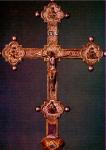 Moreover we worship even the image of the precious and life-giving Cross, although made of another tree, not honouring the tree (God forbid) but the image as a symbol of Christ. For He said to His disciples, admonishing them, Then shall appear the sign of the Son of Man in Heaven, meaning the Cross. And so also the angel of the resurrection said to the woman, Ye seek Jesus of Nazareth which was crucified. And the Apostle said, We preach Christ crucified. For there are many Christs and many Jesuses, but one crucified. He does not say speared but crucified. It behoves us, then, to worship the sign of Christ. For wherever the sign may be, there also will He be. But it does not behove us to worship the material of which the image of the Cross is composed, even though it be gold or precious stones, after it is destroyed, if that should happen. Everything, therefore, that is dedicated to God we worship, conferring the adoration on Him.
The tree of life which was planted by God in Paradise pre-figured this precious Cross.
For since death was by a tree, it was fitting that life and resurrection should be bestowed by a tree. Jacob, when He worshipped the top of Joseph's staff, was the first to image the Cross, and when he blessed his sons with crossed hands he made most clearly the sign of the cross. Likewise also did Moses' rod, when it smote the sea in the figure of the cross and saved Israel, while it overwhelmed Pharaoh in the depths; likewise also the hands stretched out crosswise and routing Amalek; and the bitter water made sweet by a tree, and the rock rent and pouring forth streams of water, and the rod that meant for Aaron the dignity of the high priesthood: and the serpent lifted in triumph on a tree as though it were dead, the tree bringing salvation to those who in faith saw their enemy dead, just as Christ was nailed to the tree in the flesh of sin which yet knew no sin. The mighty Moses cried, You will see your life hanging on the tree before your eyes, and Isaiah likewise, I have spread out my hands all the day unto a faithless and rebellious people. But may we who worship this obtain a part in Christ the crucified. Amen.
--St. John of Damascus, Exposition of the Orthodox Faith, Book Four, Chapter Eleven
12 June 2006
Patristic Quote for the Day
 Always be revolving, in speech and in your mind, upon the words of God: for God gave this to be a prize for labors, a little light for seeing something hidden; or else, to be a blessing that by the holy God's great laws you might be pierced; or, third, that by these cares you might withdraw your mind from earthly things. But, lest you be stolen in mind by foreign books (for in them many evil things have been inserted) receive, friend, this list of mine of books which are approved. (He goes to list the canon of the Hebrew Scriptures and of the NT - without Revelation. He skips over the Apocrypha entirely). If there is anything else besides these, it is not among the genuine.
 - St. Gregory of Nazianzus, On God and Man, "Concerning the Genuine Books of Scripture" (PG 37, 471-474)
11 June 2006
God bless all the Michaels of the world!
Today, as Michael left church, he informed me: "I am not a catholic. I am a Lutheran."
An odd thing to say, you might think, but Michael has this reaction once a year. It invariably happens on Trinity Sunday when we confess the Athanasian Creed. You see, Michael USED to be a Roman Catholic, and he has never forgotten his conversion to Lutheranism and the joy that it brought to his heart. He just doesn't get this Creed that shows up in the liturgy once a year here.
The key, as always, to attend to what is confessed. The Creed leaves you in zero doubt as to what the Catholic faith is:
"And the catholic faith is this: that we worship one God in in trinity and Trinity in unity, neither confusing the persons nor dividing the substance." (LSB translation)
Friends, the Romans do NOT have the word "catholic" copyrighted as their own. It belongs to those who worship one God in three persons and three persons in one God. THAT is the catholic faith, nothing else. Let this bring joy and comfort to your hearts. To be catholic is nothing more and nothing less than to join the countless multitude who stand before the throne of God and proclaim:
Glory be to the Father and to the Son and to the Holy Spirit;
As it was in the beginning, is now, and will be forever! Amen.
So, to Michael and any others who were disconcerted by what was confessed today: focus on the words of the Athanasian Creed and rejoice in true catholicity - join in the glorification of the Holy, Consusbstantial, Life-creating, and Undivided Trinity, always, now and ever, and unto the ages of ages! Amen!
An odd thing to say, you might think, but Michael has this reaction once a year. It invariably happens on Trinity Sunday when we confess the Athanasian Creed. You see, Michael USED to be a Roman Catholic, and he has never forgotten his conversion to Lutheranism and the joy that it brought to his heart. He just doesn't get this Creed that shows up in the liturgy once a year here.
The key, as always, to attend to what is confessed. The Creed leaves you in zero doubt as to what the Catholic faith is:
"And the catholic faith is this: that we worship one God in in trinity and Trinity in unity, neither confusing the persons nor dividing the substance." (LSB translation)
Friends, the Romans do NOT have the word "catholic" copyrighted as their own. It belongs to those who worship one God in three persons and three persons in one God. THAT is the catholic faith, nothing else. Let this bring joy and comfort to your hearts. To be catholic is nothing more and nothing less than to join the countless multitude who stand before the throne of God and proclaim:
Glory be to the Father and to the Son and to the Holy Spirit;
As it was in the beginning, is now, and will be forever! Amen.
So, to Michael and any others who were disconcerted by what was confessed today: focus on the words of the Athanasian Creed and rejoice in true catholicity - join in the glorification of the Holy, Consusbstantial, Life-creating, and Undivided Trinity, always, now and ever, and unto the ages of ages! Amen!
Homily for Trinity 1
Homily for Trinity 1 (2006)
Why Abraham? Why not say: “He went to heaven” or some such? What’s so special about Abraham and his side that he gets picked out?
Abraham was not a poor man, after all, not by any measure. A wealthy man - every bit as rich as the rich man in the parable, if not far richer. So why pick him? We get a clue if we remember what happened when unknown visitors appeared on Abraham’s doorstep by the Oaks of Mamre? Do you recall?
“When he saw them, he ran from the tent door to meet them and bowed himself to the earth and said: ‘O Lord, if I have found favor in your sight, do not pass by your servant. Let a little water be brought, and wash your feet and rest yourselves, and after that you may pass on - since you have come to your servant.” And then Abraham and his wife prepared an unbelievable feast for these three men. Sarah kneaded up 21 quarts worth of flour (Pastor Feicho tells me that amount to 187 biscuits per person!) and made cakes and Abraham had his servants prepare a young calf, and served it with curds and milk. A feast indeed. And all for men he never knew. Just because they landed on his doorstep.
Do you see the contrast then with the other rich man - the one in the parable? He can call Abraham “Father” but this is not a case of “like father, like son.” This son may have shared Abraham’s blood, but he did not share his mercy, his kindness, or his faith. His faith did not extend itself in hospitality to any who came to him. His was a life without mercy.
Think of our lives today. We are so busy. We run from one thing to the next. Is it any wonder that loneliness is epidemic among us? We have neither time for the silence of withdrawal for personal reflection nor the time for hospitality, for welcoming people into our homes. And we’ve simply accepted this state of affairs as normal. Today’s Gospel challenges that.
In Bible Class a couple weeks ago we were looking at another passage in Luke’s Gospel - chapter 11, verse 41. There Jesus said: “But give as alms those things that are within, and behold, everything is clean to you.”
Give alms from within - in other words, our mercy, our hospitality, can never just be a matter of setting THINGS in front of others: gifts to buy them off so that they leave us alone. What we must give alms of is the stuff within: our very selves. Lazarus hungered for more than just the crumbs from the Rich Man’s table. He hungered for a friend to talk to, to share with. It was the Rich Man himself that could have provided for Lazarus - not just “charity” (as we’ve come to think of it) but love, giving alms of self to another. Time, friendship, and food.
That’s how Abraham was. He didn’t just give food to strangers and walk away; he welcomed them to his home. He celebrated that they had come to him. And that, of course, points to the true Son of Abraham: He who, though He was rich, yet for our sakes became poor that we through his poverty might become rich: our Lord Jesus.
God didn’t just send us some food so that we could put fuel into our bodies and keep on going. With the food, God gives Himself. That’s vital. That’s what the Eucharist is all about. “A loaf of bread, a jug of wine, and thou.” That’s salvation. It’s what human beings ache for in the depths of their heart whether they know it or not.
When our Lord went to His cross He embraced fully the horrid loneliness that we fallen humans have chosen for themselves. He took it all into Himself and out of that horrible depth He cried out. “Eli, Eli, lama sabachthani?” Entering that loneliness and filling it with His forgiveness, His love, His presence, He destroyed it forever. Sin is always loneliness - man going his own way: “they have turned every one to His own way.” But when “the Lord laid on Him the iniquity of us all” the power of sin to separate us from Him - and also from each other - was broken entirely! Loneliness is destroyed by the Son of Mary!
And it is no accident that He shared a meal where He gave more than bread to His own - where He gave them His very self, His true body and blood. “Do this as the memorial of me!” he told them. As the memorial of the One who was not content to give things - but who gave Himself.
Our turn now. We know that we still feast at the table where our Lord gives us Himself - the Body that shattered the grave and the Blood that forever blots out the handwriting against us. He gives us Himself without holding anything back. The Father sends us the Son who sends us the Spirit to bring us to the Son who brings us to the Father. That is how entirely God has given Himself to us. And we know that this is life.
Such life then He sets before us on His Table. If gathering together and receiving from God the gift of Himself pours life itself into us and renews us - how can we ever fail to see that what happens here should not be a blip on the screen of our lives? What happens here in this holy place manifests what all of life is created and meant to be! All that it can be when it is lived by faith in Him! Do you think it was an accident that when the Spirit came upon the disciples at Pentecost, one of the things we learn about them is that “day by day...together breaking bread in their homes, they received their food with glad and generous hearts!”
In their homes as in our ours, in every one of them, stands a table. Whether we are single or whether we are married; whether we are blessed with children or whether we are not. In each home there stands a table, and that table testifies to the will of God for us humans: to be family to each other, sisters and brothers of the Son of God. Such a simple vision God has: all of us members of one family, eating from one table, and giving ourselves fully and completely to one another. No such thing as strangers to each other, because every human is a welcome guest! Simple, but powerful. And that’s life! It starts here, it goes on forever in eternity.
Let our tables at home begin to reflect the heavenly Father’s table. Be done with token charity, and instead open wide our hearts, our lives, yes, our homes to each other and to all whom God brings our way. Rejoice to extend to others the hospitality of Abraham, knowing it is a joyous reflection of the hospitality of Him who has gone before us to prepare us a place at His Father’s table and a welcome in His Father’s home, to whose Kingdom may He grant us all to attain through His mercy and love for mankind. Amen.
Why Abraham? Why not say: “He went to heaven” or some such? What’s so special about Abraham and his side that he gets picked out?
Abraham was not a poor man, after all, not by any measure. A wealthy man - every bit as rich as the rich man in the parable, if not far richer. So why pick him? We get a clue if we remember what happened when unknown visitors appeared on Abraham’s doorstep by the Oaks of Mamre? Do you recall?
“When he saw them, he ran from the tent door to meet them and bowed himself to the earth and said: ‘O Lord, if I have found favor in your sight, do not pass by your servant. Let a little water be brought, and wash your feet and rest yourselves, and after that you may pass on - since you have come to your servant.” And then Abraham and his wife prepared an unbelievable feast for these three men. Sarah kneaded up 21 quarts worth of flour (Pastor Feicho tells me that amount to 187 biscuits per person!) and made cakes and Abraham had his servants prepare a young calf, and served it with curds and milk. A feast indeed. And all for men he never knew. Just because they landed on his doorstep.
Do you see the contrast then with the other rich man - the one in the parable? He can call Abraham “Father” but this is not a case of “like father, like son.” This son may have shared Abraham’s blood, but he did not share his mercy, his kindness, or his faith. His faith did not extend itself in hospitality to any who came to him. His was a life without mercy.
Think of our lives today. We are so busy. We run from one thing to the next. Is it any wonder that loneliness is epidemic among us? We have neither time for the silence of withdrawal for personal reflection nor the time for hospitality, for welcoming people into our homes. And we’ve simply accepted this state of affairs as normal. Today’s Gospel challenges that.
In Bible Class a couple weeks ago we were looking at another passage in Luke’s Gospel - chapter 11, verse 41. There Jesus said: “But give as alms those things that are within, and behold, everything is clean to you.”
Give alms from within - in other words, our mercy, our hospitality, can never just be a matter of setting THINGS in front of others: gifts to buy them off so that they leave us alone. What we must give alms of is the stuff within: our very selves. Lazarus hungered for more than just the crumbs from the Rich Man’s table. He hungered for a friend to talk to, to share with. It was the Rich Man himself that could have provided for Lazarus - not just “charity” (as we’ve come to think of it) but love, giving alms of self to another. Time, friendship, and food.
That’s how Abraham was. He didn’t just give food to strangers and walk away; he welcomed them to his home. He celebrated that they had come to him. And that, of course, points to the true Son of Abraham: He who, though He was rich, yet for our sakes became poor that we through his poverty might become rich: our Lord Jesus.
God didn’t just send us some food so that we could put fuel into our bodies and keep on going. With the food, God gives Himself. That’s vital. That’s what the Eucharist is all about. “A loaf of bread, a jug of wine, and thou.” That’s salvation. It’s what human beings ache for in the depths of their heart whether they know it or not.
When our Lord went to His cross He embraced fully the horrid loneliness that we fallen humans have chosen for themselves. He took it all into Himself and out of that horrible depth He cried out. “Eli, Eli, lama sabachthani?” Entering that loneliness and filling it with His forgiveness, His love, His presence, He destroyed it forever. Sin is always loneliness - man going his own way: “they have turned every one to His own way.” But when “the Lord laid on Him the iniquity of us all” the power of sin to separate us from Him - and also from each other - was broken entirely! Loneliness is destroyed by the Son of Mary!
And it is no accident that He shared a meal where He gave more than bread to His own - where He gave them His very self, His true body and blood. “Do this as the memorial of me!” he told them. As the memorial of the One who was not content to give things - but who gave Himself.
Our turn now. We know that we still feast at the table where our Lord gives us Himself - the Body that shattered the grave and the Blood that forever blots out the handwriting against us. He gives us Himself without holding anything back. The Father sends us the Son who sends us the Spirit to bring us to the Son who brings us to the Father. That is how entirely God has given Himself to us. And we know that this is life.
Such life then He sets before us on His Table. If gathering together and receiving from God the gift of Himself pours life itself into us and renews us - how can we ever fail to see that what happens here should not be a blip on the screen of our lives? What happens here in this holy place manifests what all of life is created and meant to be! All that it can be when it is lived by faith in Him! Do you think it was an accident that when the Spirit came upon the disciples at Pentecost, one of the things we learn about them is that “day by day...together breaking bread in their homes, they received their food with glad and generous hearts!”
In their homes as in our ours, in every one of them, stands a table. Whether we are single or whether we are married; whether we are blessed with children or whether we are not. In each home there stands a table, and that table testifies to the will of God for us humans: to be family to each other, sisters and brothers of the Son of God. Such a simple vision God has: all of us members of one family, eating from one table, and giving ourselves fully and completely to one another. No such thing as strangers to each other, because every human is a welcome guest! Simple, but powerful. And that’s life! It starts here, it goes on forever in eternity.
Let our tables at home begin to reflect the heavenly Father’s table. Be done with token charity, and instead open wide our hearts, our lives, yes, our homes to each other and to all whom God brings our way. Rejoice to extend to others the hospitality of Abraham, knowing it is a joyous reflection of the hospitality of Him who has gone before us to prepare us a place at His Father’s table and a welcome in His Father’s home, to whose Kingdom may He grant us all to attain through His mercy and love for mankind. Amen.
St. Barnabas, Apostle
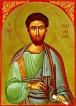 Today the Western Church observed the Feast of the Holy Trinity. But this day is also set aside to remember St. Barnabas, the Apostle, whose commemoration is then transferred to tomorrow:
Almighty God, Your faithful servant Barnabas sought not his own renown but gave generously of his life and substance for the encouragement of the apostles and their ministry. Grant that we may follow his example in lives given to charity and the proclamation of the Gospel; through Your Son, Jesus Christ, our Lord, who lives and reigns with You and the Holy Spirit, one God, now and forever.
Is 42:5-12 / Acts 11:19-30; 13:1-3 / Mark 6:7-13
It is truly good, right, and salutary that we should at all times and in all places give thanks to You, holy Lord, almighty Father, everlasting God, for You have mightily governed and protected Your holy Church, in which the blessed apostles and evangelists proclaimed Your divine and saving Gospel. Therefore with patriarchs and prophets, apostles and evangelists, with Your servant Barnabas, and with all the company of heaven, we laud and magnify Your glorious name, evermore praising You and saying: Holy, holy, holy...
Patristic Quote for the Day
Brothers, he who has bestowed upon you the gift of faith has also taught you how to pray, and he has fitted the whole formula of supplication into a few words, because when asking something of his father, a son does not have the arduous task of making a lengthy petition. For just as need forces a child to make a request, so too charity compels a father to give. Therefore, the Father, who gives willingly, shows us not so much that he should be asked as what should be asked for, in order that the son should please him by asking for what is right, since he can displease him by making a request for what is foolish. Listen to the Father, and believe that you are already his children, so that you may obtain without delay what you are asking for. - St. Peter Chrysologus, Sermon #71 (Fifth Sermon on the Lord's Prayer), par. 1
10 June 2006
Patristic Quote for the Day
That is, when there is hope of mercy, when it is the time of pardon, when there is opportunity for repentance, let us confess to him as Father, so that we do not experience him as Judge; let us disclose to his kindness what we have done so that we are not forced to explain to his severity what we hide in silence; let us tell our sins in the time of indulgence, lest if we keep silent we weep when we receive a sentence. And why should I say more, brothers? This most compassionate prophet exhorts us to stay ahead, not of the Judge, but of judgment. - St. Peter Chrysologus, On Psalm 94 (95), Sermon #46 par 3
We're the Tops!
St. Louis's Race for the Cure, that is. This year's effort in behalf of fighting breast cancer was the largest such race in the whole U.S. of A. Participating this year, among many thousands, were three special people:
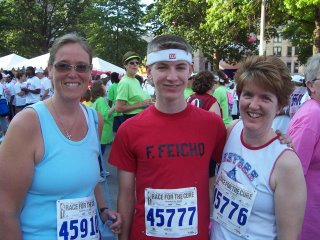
Cindi Weedon, Forrest Feicho, and Tanya Feicho (Pastors Feicho and Weedon did their part by cheering on from the sidelines!)
I thought about my sister (who finished treatments for breast cancer last year), our good friend Gail Cogswell (battling it right now), Jane Krauser (who died of it this past year), my Aunt Kitty (who died of it back in the 1980's), and Lois who has survived many years. God grant that today's efforts bring us much closer to a cure.

Cindi Weedon, Forrest Feicho, and Tanya Feicho (Pastors Feicho and Weedon did their part by cheering on from the sidelines!)
I thought about my sister (who finished treatments for breast cancer last year), our good friend Gail Cogswell (battling it right now), Jane Krauser (who died of it this past year), my Aunt Kitty (who died of it back in the 1980's), and Lois who has survived many years. God grant that today's efforts bring us much closer to a cure.
09 June 2006
Watch out, world!

This boy has just earned his black belt in Tae Kwon Do. And he broke a brick with his hand to prove it. OUCH! Congratulations, David! Pictured are Master Winkler, David Weedon, and Master Dave.
The Love of God
Ah! how much then ought we to love Him who first so dearly loved us. He loved us before we had any being, for it is because of His divine love that we were born into the world. He loved us when we were yet enemies; for it is because of His divine love and compassion that He sent His Son to redeem us. He loved us when we had fallen into sin; for it is because of His divine love that He does not instantly deliver us over to death, when we transgress against him, but patiently awaits our conversion. It is because of His divine love that above what we deserve, aye, even in very opposition to our just deserts, He is leading us to His heavenly mansions.
Without the love of God never couldst thou come to a saving knowledge of God. Without that love all knowledge would be worthless; nay, more, would be harmful to thee. Why does love exceed the knowledge of all mysteries? Because the latter may be found even in the devil, but the former only in the gody. Why is the devil the most unhappy being? Because he cannot love the Highest Good. Why is God, on the other hand, the most happy and blessed of all beings? Because He loves a things and takes delight in all the works of His own hands....
Love unites and transforms; if thou lovest carnal things, thou art carnal; if thou lovest earthly things, thou shalt become earthly. But flesh and blood cannot inherit the Kingdom of God. If thou lovest God and divine things, thou shalt become divine....
The love of God is the seal of God upon His elect and believing children. God will not acknowledge as His own in the last Judgment, those who are not sealed with this seal. For faith itself, which is the sole means of our justification and salvation, is not genuine unless it shows itself by love (Gal. v:6); it is not true faith unless it be also an unwavering trust, and such trust is not possible without the love of God.
--Johann Gerhard, Sacred Meditation IX
Without the love of God never couldst thou come to a saving knowledge of God. Without that love all knowledge would be worthless; nay, more, would be harmful to thee. Why does love exceed the knowledge of all mysteries? Because the latter may be found even in the devil, but the former only in the gody. Why is the devil the most unhappy being? Because he cannot love the Highest Good. Why is God, on the other hand, the most happy and blessed of all beings? Because He loves a things and takes delight in all the works of His own hands....
Love unites and transforms; if thou lovest carnal things, thou art carnal; if thou lovest earthly things, thou shalt become earthly. But flesh and blood cannot inherit the Kingdom of God. If thou lovest God and divine things, thou shalt become divine....
The love of God is the seal of God upon His elect and believing children. God will not acknowledge as His own in the last Judgment, those who are not sealed with this seal. For faith itself, which is the sole means of our justification and salvation, is not genuine unless it shows itself by love (Gal. v:6); it is not true faith unless it be also an unwavering trust, and such trust is not possible without the love of God.
--Johann Gerhard, Sacred Meditation IX
Patristic Quote for the Day
But you say: "Granted that I can ask: how shall I be able to knock at heaven in its hidden mystery?" How? By repeating your prayers, and by waiting to see what judgment the Benefactor makes; by very patiently putting up with the delays of the Giver; because the one who, as soon as he knocks, becomes angry if he is not given an immediate hearing, is not a humble suppliant but an overbearing bully....Even if he continues to delay into the future, patiently wait for your Lord. - St. Peter Chrysologus, Homily #39 on Luke 11:5-10, par. 6
08 June 2006
Patristic Quote for the Day
 In her voyage across the ocean of this world, the Church is like a great ship being pounded by the waves of life's different stresses. Our duty is not to abandon ship but to keep her on course.
 The ancient fathers showed us how we should carry out this duty: Clement, Cornelius, and many others in the city of Rome, Cyprian at Carthage, Athanasius at Alexandria. They all lived under emperors who were pagan; they all steered Christ's ship - or rather his most dear spouse, the Church. This they did by teaching and defending her, by their labors and sufferings, even to the shedding of blood.
I am terrified when I think of al of this. Fear and trembling came upon me and the darkness of my sins almost covered me. I would gladly give up the task of guiding the Chruch which I have accepted if I could find such an action warranted by the example of the fathers or by Holy Scripture.
Since this is the case, and since truth can be assaulted but never defeated or falsified, with our tired mind let us turn to the words of Solomon: trust in the Lord with all your heart and do not rely on your own prudence. Think on him in a your ways, and he will guide your steps. In another place he says: The name of the Lord is an impregnable tower. The just man seeks refuge in it and he will be saved.
Let us stand fast in what is right and prepare our souls for trial. Let us wait upon God's strengthening aid and say to him: O Lord, you have been our refuge in all generations. Let us trust in him who has placed this burden upon us. What we ourselves cannot bear let us bear with the help of Christ. For he is all-powerful and he tells us: My yoke is easy and my burden is light.
--(a few days late, but...) St. Boniface, Letter 78
07 June 2006
Patristic Quote for the Day
Do you think that a mortal heart grasps the extend of the Lord's charity towards us? Do you think that a mind burdened by the weight of an earthly body can understand or realize God's affection towards us? For whatever sparkles, shines, and gleams with the splendor of heaven, whatever on earth bursts forth with flowers, whatever pleasant taste there is in fruit, and whatever joy there is in living beings, have all been made out of love for us, and have been designed to serve us. But althought they are great, nevertheless, they are small insofar as indicating heavenly love towards us. To us the principalities of heaven, the heavenly powers, the celestial dominions, to us the choirs of angels give service with tireless vigilance. But even these are small and inferior as signs of the intimate bond God has with us,and as paltry in value as the creature is inferior to his Creator.
...
But he considered this to be still too little, if he were to show his affection toward us by bestowing blessings on us,but not by enduring adversities. After all this he entered his own world in poverty, he lay in a cradle: thus as a human being by his crying he implores, he seeks, he pleads for the loving kindness that he himself has shown to you. ... The Ruler of all ages is seized, the Founder of the earth is arrested, the Bestower of all pardon to humanity is judged, the Giver and Restorer of life is punished, the Resurrection of all is buried, so that the slow mind of human beings and their very dull intellect would learn of God's fondness towards them by his death at least. For that intellect has not perceived or recognized God's charity toward humanity from his prophecies and innumerable gifts. God, therefore, who made us to exist, who granted us life, also taught us how to pray, because he wanted to furnish everything, sine he willed that he be invoked by means of his own prayer.
--St. Peter Chrysologus, Homily #69, par. 2 *On the Lord's Prayer*
...
But he considered this to be still too little, if he were to show his affection toward us by bestowing blessings on us,but not by enduring adversities. After all this he entered his own world in poverty, he lay in a cradle: thus as a human being by his crying he implores, he seeks, he pleads for the loving kindness that he himself has shown to you. ... The Ruler of all ages is seized, the Founder of the earth is arrested, the Bestower of all pardon to humanity is judged, the Giver and Restorer of life is punished, the Resurrection of all is buried, so that the slow mind of human beings and their very dull intellect would learn of God's fondness towards them by his death at least. For that intellect has not perceived or recognized God's charity toward humanity from his prophecies and innumerable gifts. God, therefore, who made us to exist, who granted us life, also taught us how to pray, because he wanted to furnish everything, sine he willed that he be invoked by means of his own prayer.
--St. Peter Chrysologus, Homily #69, par. 2 *On the Lord's Prayer*
06 June 2006
Who said it?
"The Church is fulfillment - here at length all is as it ought to be. The Church is fulfillment, and what is fulfilled without it? Behold the Church! It is the contrary of loneliness - blessed fellowship! Millions of the blessed and of believers - who are becoming blessed - and, in the midst of their songs of praise, the Lord! No longer lonely, but permeated, satisfied, yes, blessed is he who is one of the Millions, each of whom has Christ, adn with Him heaven and earth!"
???
???
For Amber Waves of Grain...
Lloyd is our next door neighbor. I'd say his wheat is just about ready to harvest. It was so beautiful, I had to take a picture. Gonna make Vicar Roemke hanker after the midwest again...


WOW!!!!
My friend Jeff Bull just pointed me to this link:
Click Here
Check this puppy out! St. Paul's - looking incredible.
Click Here
Check this puppy out! St. Paul's - looking incredible.
Certainty vs. Security
Okay, let's have some thoughts on this topic. I confess that I have never understood the drive to say: "I KNOW I will go to heaven." The reason for this is quite simple: I live with the very real possibility that I may reject the grace of God. I have no question that "God has given us eternal life and this life is in His Son." I have no question that God's will for me is to remain in saving faith in my Lord until the end. He wills that for all people! But I also know that God will never coerce me in this regard. Salvation remains gift; and gifts are always rejectable.
So it seems to me that when our Lord warns: "He who endures to the end will be saved," He meant it!
St. Paul also seems to speak this way quite clearly in Philippians 3:12,13; 1 Cor 9:27.
There IS certain salvation in Christ; there is NO certainty that I will be in Christ when I die. Therefore this calls for constant and unending vigilance and attendance upon the promises of God and the Means of Grace.
Gerhard speaks of this in his meditation on carnal security where he stresses that such absolute security is not possible in any place: an angel fell in heaven; Adam fell in paradise; Judas fell under the tutelage of Christ Himself.
Note that this does not drive one to despair, but to attend to the promises of God in the preaching of the Gospel, the reception of the Sacrament, the promises of Baptism and Absolution. Because there is no "once saved, always saved" business; because our Lord could reference "those who believe for a while and then fall away" we must guard against all forms of carnal security until our dying breath.
Okay, you all. Ducking!
So it seems to me that when our Lord warns: "He who endures to the end will be saved," He meant it!
St. Paul also seems to speak this way quite clearly in Philippians 3:12,13; 1 Cor 9:27.
There IS certain salvation in Christ; there is NO certainty that I will be in Christ when I die. Therefore this calls for constant and unending vigilance and attendance upon the promises of God and the Means of Grace.
Gerhard speaks of this in his meditation on carnal security where he stresses that such absolute security is not possible in any place: an angel fell in heaven; Adam fell in paradise; Judas fell under the tutelage of Christ Himself.
Note that this does not drive one to despair, but to attend to the promises of God in the preaching of the Gospel, the reception of the Sacrament, the promises of Baptism and Absolution. Because there is no "once saved, always saved" business; because our Lord could reference "those who believe for a while and then fall away" we must guard against all forms of carnal security until our dying breath.
Okay, you all. Ducking!
Patristic Quote for the Day
To be in heaven in a wondrous thing; to live in heaven is majestic. But how great it is to reign in heaven is beyond our mortal intelligence to judge. Nevertheless, O man, you have learnt that you are unable to make such a judgment from the following words of the Apostle: "What eye hath not seen nor ear heard is what God has prepared for those who love Him." - Sermon 25 on "Fear not little flock, for the Father has chosen to give you the kingdom!" - St. Peter Chrysologus
05 June 2006
Happy anniversary to us!
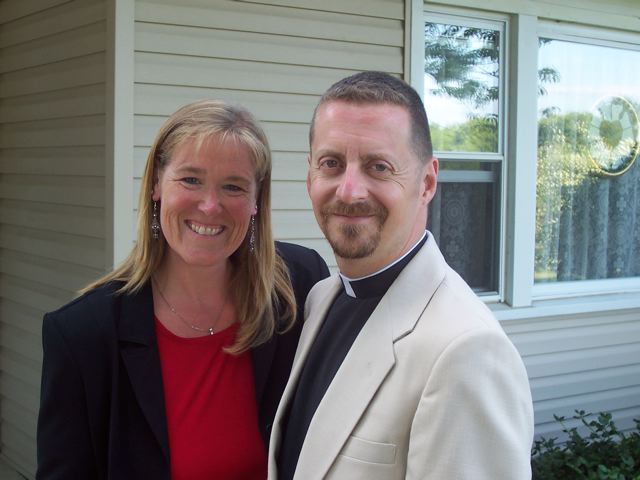 It was on this day, June 5, some 24 years ago that Cindi and I were united in holy marriage before the altar of the Lutheran Church of St. Andrew in Silver Spring, MD. Babe, I love you! You are the greatest!!!
Life on a Highway
I live 2 miles north of a small community of just over 600 people. The area is rural. I look out my office window and see trees, fields, and the Church. It sounds so idyllic. The only problem is the INTERSTATE. Interstate 55, winding its way from St. Louis to Chicago happens to lie a couple hundred feet from my office. Of course, a tad closer are the remnants of the Mother Road - Route 66. St. Paul's sits right on the old Route 66, but literally three feet from Route 66 at this point is I-55.
It makes for an odd juxtaposition. Pr. Haun referenced it in his sermon yesterday, and I've felt it myself for a number of years. Here we sit and things change oh, so slowly here. But roaring by us night and day without let up is the highway. The Church and the world. The world in such hurry, racing and roaring, slaves to the urgent. And then the Church - in a way unmoving, set back and not just watching the world race by, but inviting the world to get off the highway for a while and enjoy the calm, the peace, the unchanging God whose merciful compassions never fail, for they are grounded in Jesus Christ who is the same, "yesterday, today, and forever."
It was a couple winters ago. There was a light snow on the ground. The early service had just let out - the day was the Sunday after Christmas. The organ was still playing the postlude. We looked up in amazement and a whole herd of deer were running through the meadow opposite the Church. There must have been 20 of them. Immediately I felt I was in the carol: "The Holly and the Ivy." It was a beautiful moment. But if you were racing down I-55, chances are very good you'd never have seen it. It was a sight visible only to those who had taken the exit and rested for a bit in the peace of God. "Be still and know that I am God."
It makes for an odd juxtaposition. Pr. Haun referenced it in his sermon yesterday, and I've felt it myself for a number of years. Here we sit and things change oh, so slowly here. But roaring by us night and day without let up is the highway. The Church and the world. The world in such hurry, racing and roaring, slaves to the urgent. And then the Church - in a way unmoving, set back and not just watching the world race by, but inviting the world to get off the highway for a while and enjoy the calm, the peace, the unchanging God whose merciful compassions never fail, for they are grounded in Jesus Christ who is the same, "yesterday, today, and forever."
It was a couple winters ago. There was a light snow on the ground. The early service had just let out - the day was the Sunday after Christmas. The organ was still playing the postlude. We looked up in amazement and a whole herd of deer were running through the meadow opposite the Church. There must have been 20 of them. Immediately I felt I was in the carol: "The Holly and the Ivy." It was a beautiful moment. But if you were racing down I-55, chances are very good you'd never have seen it. It was a sight visible only to those who had taken the exit and rested for a bit in the peace of God. "Be still and know that I am God."
Patristic Quote for the Day
[In the following, St. Peter Chrysologus answers the question of why keep the martyr's days, their "heavenly birthdays"?]
Dearly beloved, when you hear about the birthday of the saints,do not think that mention is being made of their birth from flesh into life on earth. There is a question of their birth from earth to heaven; from toil to repose; from temptations to rest; from tortures to delights which are not fleeting, but strong, firm, and everlasting; from worldly hilarity to a crown of glory.
Such birthdays of the martyrs are celebrated in a fitting way. Therefore, when a festival of this kind is being kept, do not think, dearly beloved, that the birthdays of the martyrs should be ceebrated only by meals and more elegant banquets. Rather, what you celebrate in memory of a martyr is something proposed for your imitation. Consequently, dearly beloved, observe the ardor of the congregation which is present. At one time on this date a mob of evil men stood by, when, through the tyrant's orders, St. Cyprian was being maltreated. There were crowds of evil-doers and bands of onlookers. Now, a devout multitude of the faithful has assembled to rejoice. Then, there was a crowd of furious agitators; now, one of those who rejoice - then, a band of men without hope; now, one of the men who are full of it.
It is for a purpose that the birthdays of the martyrs are celebrated every year with joy: that that which happened in the past should remain in the memory of devout men of every century. The festival is carried out, dearly beloved, that you may not say that you know nothing about it. The festivities are celebrated annually to keep you from saying: I forgot.
- Homily 129 on St. Cyprian the Martyr
Dearly beloved, when you hear about the birthday of the saints,do not think that mention is being made of their birth from flesh into life on earth. There is a question of their birth from earth to heaven; from toil to repose; from temptations to rest; from tortures to delights which are not fleeting, but strong, firm, and everlasting; from worldly hilarity to a crown of glory.
Such birthdays of the martyrs are celebrated in a fitting way. Therefore, when a festival of this kind is being kept, do not think, dearly beloved, that the birthdays of the martyrs should be ceebrated only by meals and more elegant banquets. Rather, what you celebrate in memory of a martyr is something proposed for your imitation. Consequently, dearly beloved, observe the ardor of the congregation which is present. At one time on this date a mob of evil men stood by, when, through the tyrant's orders, St. Cyprian was being maltreated. There were crowds of evil-doers and bands of onlookers. Now, a devout multitude of the faithful has assembled to rejoice. Then, there was a crowd of furious agitators; now, one of those who rejoice - then, a band of men without hope; now, one of the men who are full of it.
It is for a purpose that the birthdays of the martyrs are celebrated every year with joy: that that which happened in the past should remain in the memory of devout men of every century. The festival is carried out, dearly beloved, that you may not say that you know nothing about it. The festivities are celebrated annually to keep you from saying: I forgot.
- Homily 129 on St. Cyprian the Martyr
04 June 2006
150 Years and Pentecost
 Today was the first special anniversary service for St. Paul's parish in our 150th anniversary year. The focus of this service was the school, and we had an all-school reunion dinner in the gym following the second divine service. Lois Senechal Rimbau won the prize for the teacher who came the furthest (Manhattan); Tara Sauerwein Januhowski was the former student who travelled furthest (from Texas) - we also learned that Tara was the expert at dealing with mice in the classroom; she stomped on them! Pr. Monte Haun - son of the parish and former Lutheran teacher and now pastor - delivered a fine homily at the two morning services. And to add to all the joy: today was the glorious feast of Pentecost, and we got to sing one of my all-time favorite hymns (both in text and tune):
Come, Holy Ghost, God and Lord!
Be all Thy graces now outpoured
On each believer's mind and heart;
Thy fervent love to them impart.
Lord, by the brightness of Thy light,
Thou in the faith dost men unite
From ev'ry land and ev'ry tongue.
This to Thy praise,
O Lord our God be sung.
Hallelujah! Hallelujah!
Come, holy Light, Guide divine,
Oh, cause the Word of Life to shine!
Teach us to know our God aright
And call Him Father with delight.
From ev'ry error keep us free;
Let none but Christ our Master be
That we in living faith abide,
In Him, our Lord,
With all our might confide.
Hallelujah! Hallelujah!
Thou holy Fire, Comfort true,
Grant us the will of Thy work to do
And in Thy service to abide;
Let trials turn us not aside.
Lord, by Thy pow'r prepare each heart
And to our weakness strength impart
That bravely here we may contend,
Through life and death
To Thee, our Lord, ascend.
Hallelujah! Hallelujah!
Patristic Quote for the Day
The Son is thus the icon of the Father, and the Holy Spirit the icon of the Son. Whoever, therefore, has seen the Son, has seen the Father, and whoever has seen the Holy Spirit has seen the Son. As the Apostle says: The Lord is the Spirit; and again, The Spirit himself intercedes for us with sighs too deep for words...crying, Abba Father. He says rightly that the Lord is the Spirit when He cries "Abba! Father!" not that the Son is the Spirit - far from it! - but that the Son is seen and beheld in the Holy Spirit, and that never is the Son revealed without the Spirit nor the Spirit without the Son. Instead, it is in and through the Spirit that the Son Himself cries "Abba, Father!"
--St. Symeon the New Theologian, Third Ethical Discourse
--St. Symeon the New Theologian, Third Ethical Discourse
03 June 2006
Patristic Quote for the Day
And, before the ages, He predestined that as many as should believe in Him and be baptized in His name, that is, in the name of the Father and of the Son and of the Holy Spirit, and eat the pure body of His Son and drink His precious blood, would be justified from sin, that is to say, would be freed and glorified, and become partakers of life everlasting - just as He Himsef, the Master of all, has said: "He who eats My flesh and drinks My blood has everlasting life" and "He does not come into judgment, but has passed from death to life." So then, my brother, see how you were foreknown by God, and predestined, and glorified, and justified, and called up into everlasting life through faith in Christ and holy Baptism. - St. Symeon the New Theologian, Second Ethical Discourse.
02 June 2006
Patristic Quote for the Day
What is more awesome: that God gives Himself to earth, or that He places you in Heaven?
That He Himself enters a union with flesh, or that He causes you to enter into a sharing of the Divinity?
That He Himself accepts death, or that He recovers you from death?
That He Himself is born into your state of slavery, or that He makes you to be free children of His own?
That He takes your poverty upon Himself, or that He makes you His heirs, yes, co-heirs of His unique Self?
It is indeed more awesome that earth is transformed into a heaven,
that man is changed by deification,
and that those who lot is slavery get the rights of domination.
All this is indeed something to fill us with fear.
Nevertheless, the present situation has reference not to the one instructing
but to the One who gives the command.
Therefore, my little children,
let us approach where charity summons, love draws, and affection invites us.
May our hearts perceive God as our Father!
Our voice should proclaim this,
our tongue should utter it,
our spirit should shout it aloud;
and everything that is in us should be in tune with grace, not fear.
For, He who has changed from a judge into a Father has wished to be loved, not feared.
--St. Peter Chrysologus, *Sermon 67* - to the Catechumens on the Our Father
That He Himself enters a union with flesh, or that He causes you to enter into a sharing of the Divinity?
That He Himself accepts death, or that He recovers you from death?
That He Himself is born into your state of slavery, or that He makes you to be free children of His own?
That He takes your poverty upon Himself, or that He makes you His heirs, yes, co-heirs of His unique Self?
It is indeed more awesome that earth is transformed into a heaven,
that man is changed by deification,
and that those who lot is slavery get the rights of domination.
All this is indeed something to fill us with fear.
Nevertheless, the present situation has reference not to the one instructing
but to the One who gives the command.
Therefore, my little children,
let us approach where charity summons, love draws, and affection invites us.
May our hearts perceive God as our Father!
Our voice should proclaim this,
our tongue should utter it,
our spirit should shout it aloud;
and everything that is in us should be in tune with grace, not fear.
For, He who has changed from a judge into a Father has wished to be loved, not feared.
--St. Peter Chrysologus, *Sermon 67* - to the Catechumens on the Our Father
01 June 2006
Ascension Day Words from Blessed Johann Gerhard
[the Western Church is still in Ascensiontide; today Ascensiontide begins for our sisters and brothers in the Eastern Church. Some great words for both:]
O blessed Lord Jesus, how gloriously Thy passion hath ended!
What a blessed and sudden transformation is here!
Ah, in what awful anguish I saw Thee upon Mount Calvary,
and now in what glory I behold Thee upon Mount Olivet!
There Thou didst suffer alone;
here Thou art attended by a vast multitude of the angelic hosts;
There Thou didst ascend to the cross;
here Thou dost ascend in a cloud to heaven;
There Thou wast crucified between two thieves;
here Thou dost exult among angelic choirs;
There Thou wast nailed to the cross as a condemned criminal;
here, free from all condemnation, Thou art the deliverer of those condemned to eternal death;
There Thou didst bleed and die;
here Thou dost rejoice and triumph.
Christ is our glorious head; we are the members of His body; rejoice thou and shout for joy, O faithful soul, in the ascension to heaven of thy Head. The glory of the Head is the glory also of the members. Where our flesh reigns there let us believe that we too shall reign. Where our blood rules, there let us hope that we too shall be glorious; though our sins would forbid this, yet our participation in His holy nature makes it possible. Where the Head is there shall also the other members of the body be; Christ, our Head, hath gone into the heavens, hence the other members of the body with good reason hope to enter heaven, and not only so, but even now already have a possession in heaven. Christ came from heaven for our redemption; He returns thither for our glorification. He was born in the flesh for us, He suffered for us, and therefore He ascended for us. The passion of Christ wins our love; the resurrection of Christ strengthens our faith; the ascension of Christ confirms our hope.
We ought, however, to follow our heavenly Bridegroom not only in ardent desires, but also in good works. Into the celestial city shall enter nothing that defileth, in token of which angels appeared at Christ's ascension as coming from the heavenly Jerusalem and clothed in white apparel, as tokens of innocence and purity.
Pride cannot ascend to heaven with the great Master of humility;
Nor evil with the Author of all goodness;
Nor discord with the Prince of Peace;
Nor lust and wantonness with the Son of the Virgin;
Nor vice with the Parent of all virtue;
Nor sin with the Holy One,
Nor our sinful infirmity with the Great Physician.
Does any one desire to behold God in the future life; let him live worthily in the sight of God in this life.
Does anyone hope for the blessedness of heaven by and by; let him love not the world now.
O Bessed Lord Jesus, draw our hearts after Thee, we beseech Thee!
O blessed Lord Jesus, how gloriously Thy passion hath ended!
What a blessed and sudden transformation is here!
Ah, in what awful anguish I saw Thee upon Mount Calvary,
and now in what glory I behold Thee upon Mount Olivet!
There Thou didst suffer alone;
here Thou art attended by a vast multitude of the angelic hosts;
There Thou didst ascend to the cross;
here Thou dost ascend in a cloud to heaven;
There Thou wast crucified between two thieves;
here Thou dost exult among angelic choirs;
There Thou wast nailed to the cross as a condemned criminal;
here, free from all condemnation, Thou art the deliverer of those condemned to eternal death;
There Thou didst bleed and die;
here Thou dost rejoice and triumph.
Christ is our glorious head; we are the members of His body; rejoice thou and shout for joy, O faithful soul, in the ascension to heaven of thy Head. The glory of the Head is the glory also of the members. Where our flesh reigns there let us believe that we too shall reign. Where our blood rules, there let us hope that we too shall be glorious; though our sins would forbid this, yet our participation in His holy nature makes it possible. Where the Head is there shall also the other members of the body be; Christ, our Head, hath gone into the heavens, hence the other members of the body with good reason hope to enter heaven, and not only so, but even now already have a possession in heaven. Christ came from heaven for our redemption; He returns thither for our glorification. He was born in the flesh for us, He suffered for us, and therefore He ascended for us. The passion of Christ wins our love; the resurrection of Christ strengthens our faith; the ascension of Christ confirms our hope.
We ought, however, to follow our heavenly Bridegroom not only in ardent desires, but also in good works. Into the celestial city shall enter nothing that defileth, in token of which angels appeared at Christ's ascension as coming from the heavenly Jerusalem and clothed in white apparel, as tokens of innocence and purity.
Pride cannot ascend to heaven with the great Master of humility;
Nor evil with the Author of all goodness;
Nor discord with the Prince of Peace;
Nor lust and wantonness with the Son of the Virgin;
Nor vice with the Parent of all virtue;
Nor sin with the Holy One,
Nor our sinful infirmity with the Great Physician.
Does any one desire to behold God in the future life; let him live worthily in the sight of God in this life.
Does anyone hope for the blessedness of heaven by and by; let him love not the world now.
O Bessed Lord Jesus, draw our hearts after Thee, we beseech Thee!
St. Justin, Martyr
 Today we remember St. Justin, the Martyr.
Precious in the sight of the Lord is the death of His saints.
Jesus Christ the same: Yesterday, today, and forever.
Almighty God, who didst give Thy servant Justin boldness to confess the Name of our Savior Jesus Christ before the rulers of this world, and courage to die for this faith: Grant that we may likewise ever be ready to give a reason for the hope that is in us, and to suffer gladly for His sake; through the same Jesus Christ, Thy Son, our Lord, who liveth and reigneth with Thee and the Holy Ghost, ever one God, world without end.
(Brotherhood Prayer Book)
Patristic Quote for the Day
And really, my brothers, when does a doctor ever seek or regard the will of his patients, inasmuch as one who is sick always desires and asks for the opposite treatment? This is why he administers and prescribes now iron, now fire, now bitter potions against their will, in order for them to be able to appreciate the cure when they are well, which they could not appreciate when ill. And if a man pays no heed to insults and disregards curses, in order to confer of his own accord life and health to those afflicted with diseases, how much more so does Christ the Physician with divine goodness draw to salvation those afflicted with diseases, that is, laboring under the madness of sins and offenses, even when they are unwilling and do not want it?
O, if only we were willing, my brothers, if only we all were willing to give our full attention to the paralysis of our minds! We would then discern that our soul was deprived of virtue and lying prostrate on a bed of vice; it would be clear to us how Christ each day both regards our damaged wills, and drags us and urges us on against our wills to remedies that can heal and save us.
- Homily #50, par. 4 (On the Paralytic), St. Peter Chyrsologus
O, if only we were willing, my brothers, if only we all were willing to give our full attention to the paralysis of our minds! We would then discern that our soul was deprived of virtue and lying prostrate on a bed of vice; it would be clear to us how Christ each day both regards our damaged wills, and drags us and urges us on against our wills to remedies that can heal and save us.
- Homily #50, par. 4 (On the Paralytic), St. Peter Chyrsologus
31 May 2006
Eine kleine Nachtmusic
I just got back from Bible study and Compline.
Compline. There is something so beautiful about standing in a darkening Church still smelling of incense (thanks, Vicar!) and singing those ancient Psalms to Gregorian tones, knowing that we're praying and singing as Western Christians have prayed at nightfall since the days of St. Benedict. Almost like Cadfael is praying right along with us! If he ever existed, he would have been. What Ben Mayes gave to the Church with his Brotherhood Prayer Book is a treasure indeed. I can't help but think it will be a tad different when LSB is in the pews and we use that for this service...
Guide us waking, O Lord, and guard us sleeping, that awake we may watch with Christ, and asleep we may rest in peace. Lord, now lettest thou thy servant depart in peace...
Compline. There is something so beautiful about standing in a darkening Church still smelling of incense (thanks, Vicar!) and singing those ancient Psalms to Gregorian tones, knowing that we're praying and singing as Western Christians have prayed at nightfall since the days of St. Benedict. Almost like Cadfael is praying right along with us! If he ever existed, he would have been. What Ben Mayes gave to the Church with his Brotherhood Prayer Book is a treasure indeed. I can't help but think it will be a tad different when LSB is in the pews and we use that for this service...
Guide us waking, O Lord, and guard us sleeping, that awake we may watch with Christ, and asleep we may rest in peace. Lord, now lettest thou thy servant depart in peace...
Patristic Quote for the Day
We believe in the Holy Spirit, whom the divine voice proclaims as God to us, when it says: "That God is Spirit." We believe in the Holy Spirit, who is the fellow worker of the Father and the Son, as the prophet sings: "By the Word of the Lord were the heavens established, and by the Spirit of His mouth all their powers." Entirely God and the entire power of God is He who is shown to be the Creator of the heavenly powers. - St. Peter Chrysologus, Sermon 60, par. 13 "On the Creed"
30 May 2006
On Diet
My wife and I have been fans of Atkins ever since we used that diet to lose a whole person between us six years ago or so. But we let our diet slip this Easter - and one of the remarkable things is how SLUGGISH and icky we feel. Today we returned to Atkins in earnest and no joke: I'm already feeling better. I can't believe how much energy that way of eating gives. People sometimes worry about what Atkins does to the other measures of health besides weight. At least as far as Cindi and I are concerned, our doctors agree: Atkins works fabulously for us. All the indicators have been great the entire time we've been on the diet. To all the nay-sayers, I say: give Atkins a chance!
By the way, people sometimes wonder about snack food on Atkins. You know one of my favorites? You take a plate of pepperonis and microwave 2 minutes until crispy. Let cool a bit, and you've got some great pepperoni chips. Just perfect to wash down with you Mic Ultra! :)
By the way, people sometimes wonder about snack food on Atkins. You know one of my favorites? You take a plate of pepperonis and microwave 2 minutes until crispy. Let cool a bit, and you've got some great pepperoni chips. Just perfect to wash down with you Mic Ultra! :)
Look who be gradiated
and all edumicated:
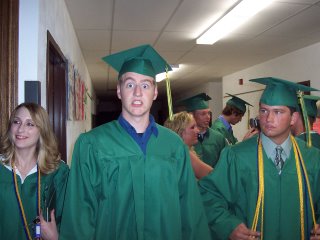
Where'd he ever get those big eyes from?
More pics here if interested:
http://web.mac.com/weedon/iWeb/Site/Library.html

Where'd he ever get those big eyes from?
More pics here if interested:
http://web.mac.com/weedon/iWeb/Site/Library.html
Patristic Quote for the Day
See how he shows us that, just as Eve was taken from the flesh and bones of Adam and the two were one flesh, so also Christ gives Himself to us to the extent of communion of His flesh and bones. He showed them to His apostles, saying: "Handle Me and see, for a spirit has not flesh and bones as you see that I have." From the same flesh and bones He gives us to eat, and through this communion, makes us, too, one with Him. - St. Symeon the New Theologian, *First Ethical Discourse*
Crazy Time Comes to an End...
...or so I HOPE!
The end of the school year at both Metro East Lutheran High School and Trinity-St. Paul Lutheran School really made the last couple weeks insane - mix in some funerals, a son graduating from said MELHS, Cindi's parents visiting, an ordination and such and it was really wild. I attended or was part of 15 services from last Saturday to the end of services this Sunday.
This week promises to be slow, and I am SOOOO looking forward to that! I am waiting for one of those "June days" that my mom always to talk about, quoting this poem:
What is So Rare As a Day in June
AND what is so rare as a day in June?
Then, if ever, come perfect days;
Then Heaven tries earth if it be in tune,
And over it softly her warm ear lays;
Whether we look, or whether we listen,
We hear life murmur, or see it glisten;
Every clod feels a stir of might,
An instinct within it that reaches and towers,
And, groping blindly above it for light,
Climbs to a soul in grass and flowers;
The flush of life may well be seen
Thrilling back over hills and valleys;
The cowslip startles in meadows green,
The buttercup catches the sun in its chalice,
And there's never a leaf nor a blade too mean
To be some happy creature's palace;
The little bird sits at his door in the sun,
Atilt like a blossom among the leaves,
And lets his illumined being o'errun
With the deluge of summer it receives;
His mate feels the eggs beneath her wings,
And the heart in her dumb breast flutters and sings;
He sings to the wide world, and she to her nest,
In the nice ear of Nature which song is the best?
Now is the high-tide of the year,
And whatever of life hath ebbed away
Comes flooding back with a ripply cheer,
Into every bare inlet and creek and bay;
Now the heart is so full that a drop overfills it,
We are happy now because God wills it;
No matter how barren the past may have been,
'Tis enough for us now that the leaves are green;
We sit in the warm shade and feel right well
How the sap creeps up and the blossoms swell;
We may shut our eyes but we cannot help knowing
That skies are clear and grass is growing;
The breeze comes whispering in our ear,
That dandelions are blossoming near,
That maize has sprouted, that streams are flowing,
That the river is bluer than the sky,
That the robin is plastering his house hard by;
And if the breeze kept the good news back,
For our couriers we should not lack;
We could guess it all by yon heifer's lowing,
And hark! How clear bold chanticleer,
Warmed with the new wine of the year,
Tells all in his lusty crowing!
Joy comes, grief goes, we know not how;
Everything is happy now,
Everything is upward striving;
'Tis as easy now for the heart to be true
As for grass to be green or skies to be blue,
'Tis for the natural way of living:
Who knows whither the clouds have fled?
In the unscarred heaven they leave not wake,
And the eyes forget the tears they have shed,
The heart forgets its sorrow and ache;
The soul partakes the season's youth,
And the sulphurous rifts of passion and woe
Lie deep 'neath a silence pure and smooth,
Like burnt-out craters healed with snow.
James Russell Lowell
The end of the school year at both Metro East Lutheran High School and Trinity-St. Paul Lutheran School really made the last couple weeks insane - mix in some funerals, a son graduating from said MELHS, Cindi's parents visiting, an ordination and such and it was really wild. I attended or was part of 15 services from last Saturday to the end of services this Sunday.
This week promises to be slow, and I am SOOOO looking forward to that! I am waiting for one of those "June days" that my mom always to talk about, quoting this poem:
What is So Rare As a Day in June
AND what is so rare as a day in June?
Then, if ever, come perfect days;
Then Heaven tries earth if it be in tune,
And over it softly her warm ear lays;
Whether we look, or whether we listen,
We hear life murmur, or see it glisten;
Every clod feels a stir of might,
An instinct within it that reaches and towers,
And, groping blindly above it for light,
Climbs to a soul in grass and flowers;
The flush of life may well be seen
Thrilling back over hills and valleys;
The cowslip startles in meadows green,
The buttercup catches the sun in its chalice,
And there's never a leaf nor a blade too mean
To be some happy creature's palace;
The little bird sits at his door in the sun,
Atilt like a blossom among the leaves,
And lets his illumined being o'errun
With the deluge of summer it receives;
His mate feels the eggs beneath her wings,
And the heart in her dumb breast flutters and sings;
He sings to the wide world, and she to her nest,
In the nice ear of Nature which song is the best?
Now is the high-tide of the year,
And whatever of life hath ebbed away
Comes flooding back with a ripply cheer,
Into every bare inlet and creek and bay;
Now the heart is so full that a drop overfills it,
We are happy now because God wills it;
No matter how barren the past may have been,
'Tis enough for us now that the leaves are green;
We sit in the warm shade and feel right well
How the sap creeps up and the blossoms swell;
We may shut our eyes but we cannot help knowing
That skies are clear and grass is growing;
The breeze comes whispering in our ear,
That dandelions are blossoming near,
That maize has sprouted, that streams are flowing,
That the river is bluer than the sky,
That the robin is plastering his house hard by;
And if the breeze kept the good news back,
For our couriers we should not lack;
We could guess it all by yon heifer's lowing,
And hark! How clear bold chanticleer,
Warmed with the new wine of the year,
Tells all in his lusty crowing!
Joy comes, grief goes, we know not how;
Everything is happy now,
Everything is upward striving;
'Tis as easy now for the heart to be true
As for grass to be green or skies to be blue,
'Tis for the natural way of living:
Who knows whither the clouds have fled?
In the unscarred heaven they leave not wake,
And the eyes forget the tears they have shed,
The heart forgets its sorrow and ache;
The soul partakes the season's youth,
And the sulphurous rifts of passion and woe
Lie deep 'neath a silence pure and smooth,
Like burnt-out craters healed with snow.
James Russell Lowell
27 May 2006
Patristic Quote for the Day
Via Gerhard's *Theological Commonplaces*:
Augustine, Marcarius, and Gregory call Scripture "the letters of invitation that God has transmitted to us through holy men that invite us to our eternal fatherland." (p. 48)
Augustine, Marcarius, and Gregory call Scripture "the letters of invitation that God has transmitted to us through holy men that invite us to our eternal fatherland." (p. 48)
26 May 2006
CPH Gem
 Good news for all Gerhard lovers! CPH has published the first volume of the monumental *Theological Commonplaces*. Before addressing the content, just a note on the book itself: it's beautiful and it has nice wide margins for the notes you will no doubt want to be making.
Now as to the content, well, I've only just begun to dig in, but let Gerhard speak for himself:
"Theology takes its name from God: first, by reason of its principal effective cause, that it is a divinely revealed teaching; second, and indeed especially, by reason of its subect or object, that it makes men divine or 'partakers of the divine nature'." p. 27
"The subject of theology is Christ, a knowledge of whom no one can have scientifically. Rather, one must seek him out of divine revelation." p. 30
"Some slight remnants of the divine image survive." p. 34
"Supernatural theology, which rises from the light of grace, is acquired either through extraordinary means by God's immediate illumination and inspiration, as in the case of the prophets and apostles, or through ordinary means by prayer, meditation, temptation, etc." p. 34
[quoting Thomas approvingly] "Grace does not remove nature, but perfects it." p. 36
[quoting Augustine approvingly] "This is that very wisdom that we call devotion by which we worship the Father of lights, from whom comes every good and perfect gift. Furthermore, we worship him with a sacrifice of praise and thanksgiving so that he who worships glories not in himself, but in him." p. 40
"Theology...is the teaching drawn from the Word of God that instruct man in true faith and pious living for eternal life." p. 42
Among the dogmaticians, Gerhard is truly second to none in his knowledge of the holy fathers, and this gives his theological work a grounding that is profoundly catholic; additionally, he has no use for a theology that does not issue in a life of faith and worship, and this gives his theological work a grounding that is profoundly practical.
In sum: tolle et lege!
25 May 2006
O. P. Kretzmann Joy on Ascension
Now He was going home... In seven words the years of labor and sorrow end: "While they beheld, He was taken up."... There were no bells and banners on earth, but surely all the trumpets on the other side sounded as they never sounded before... Surely the chiming golden bells of heaven sang their welcome, and angel choirs intoned the song of the throne: "Worthy is the Lamb that was slain to receive power and riches and wisdomand strength."... On the anvils of God the nails had been forged into the scepter of a king... "He was taken up"... The angel hosts sweep to either side, leaving the way clear to the Eternal Light that no longer blinds the eyes of us who stand gazing after Him... He leads a procession which comes from the ends of time and space, all the harvest of all the white fields the world has ever known, the pilgrims of the night who come at last to the dawn of an everlasting day... "He was taken up." The Child of the manger, the praying heart on the starlit lanes of Galilee, the hunger in the wilderness, the weariness of the Sychar Well, the tears of the Garden and the Hill, the thirst of the Cross - all over now... The robes of the Transfiguration once momentary, now clothe Him forever, and angels and archangels sound the great doxology of the Waiting Church: "Thine is the kingdom and the power and the glory forever and ever."...
An old story - perhaps too old for us to do more than glimpse its glory... And yet - we ought to remember it more clearly... It was the solemn moment in the story of God and man when the visible Christ became the invisible Christ... From that hour everything concerning Him became visible only to the eyes of faith... The final line of demarcation in the world - between those who believe and those who refuse to believe - was now clear... Men can say that all this is not true and use the mind of man to reject the mind of God, or they can know that God once walked among them and that they now have a Friend in heaven who knows all that earth and time and pain can do to man...
The Ascension did not take Jesus away... It brought heaven near... In the realm in which He now reigns time and space have no meaning... There is no up and down, no near and far, no darkness, and no distance in the world of faith... He is as near as yesterday's prayer, today's joy, tomorrow's sorrow... His homecoming has made heaven a home for us who still walk far from home... Wherefore stand we gazing into heaven?... Our momentary task is here, but through the slow dimming of the years we see the evening lamps of home tended by the pierced hands of Him who has gone to prepare a place for us... Is there a better way to live - or die? ... All that we have to do now is believe and follow:
The lapping of the sea of death before his feet
Crept near; the wind was wild;
But he, who knew the One he came to meet,
Saw it and smiled.
Stepping without a hesitating word
Into the icy tide,
As if he saw the footprints of his Lord
Gleam at his side,
Borne up by Love that gave as he had given,
He crossed the midnight foam
And laid his hand upon the door of heaven
Like one returning home.
An old story - perhaps too old for us to do more than glimpse its glory... And yet - we ought to remember it more clearly... It was the solemn moment in the story of God and man when the visible Christ became the invisible Christ... From that hour everything concerning Him became visible only to the eyes of faith... The final line of demarcation in the world - between those who believe and those who refuse to believe - was now clear... Men can say that all this is not true and use the mind of man to reject the mind of God, or they can know that God once walked among them and that they now have a Friend in heaven who knows all that earth and time and pain can do to man...
The Ascension did not take Jesus away... It brought heaven near... In the realm in which He now reigns time and space have no meaning... There is no up and down, no near and far, no darkness, and no distance in the world of faith... He is as near as yesterday's prayer, today's joy, tomorrow's sorrow... His homecoming has made heaven a home for us who still walk far from home... Wherefore stand we gazing into heaven?... Our momentary task is here, but through the slow dimming of the years we see the evening lamps of home tended by the pierced hands of Him who has gone to prepare a place for us... Is there a better way to live - or die? ... All that we have to do now is believe and follow:
The lapping of the sea of death before his feet
Crept near; the wind was wild;
But he, who knew the One he came to meet,
Saw it and smiled.
Stepping without a hesitating word
Into the icy tide,
As if he saw the footprints of his Lord
Gleam at his side,
Borne up by Love that gave as he had given,
He crossed the midnight foam
And laid his hand upon the door of heaven
Like one returning home.
24 May 2006
Patristic Quote for the Day
 (Hope you're not tired of you know who yet...)
The Apostle continues: 'But thanks be to God that you were the slaves of sin.' Is he giving thanks as one who rejoices because man was the slave of sin? Far from it. He is giving thanks not because we were previously slaves of such a cruel master, but because we are slaves no longer. He expressly makes that point clear by his next words: 'but you have now obeyed from the heart that form of doctrine into which you have been delivered, and having been set free from sin, you have become the slaves of justice.' We have become obedient, brethren, through the gift of Him who calls us, not through our own will, for we were being held as captives by it.
- St. Peter Chrysologus, Homily 114 (On Romans 6:15-21)
23 May 2006
This guy is unbelievable!
So it is with the Law, brethren. In itself it was just and holy enough. But, while it demanded rigid self-control from fragile man, it more and more burdened him and proved his delinquency.
And why this, brethren? That through the grace and forgiveness of his Creator he might return to life - he who through his swelling pride and ignorance was being led into the debt and penalty of his ancestor, even when he was wickedly boasting about his innocence. So, an undetected disease was hiding within him. Through it the inmost parts of his bones and the blood coursing through his veins were tending to destroy his vital organs. He was generating a contagious infection in his interior members.
The Law came to reveal the sore and tell that a heavenly Physician was coming for his long-standing disease. The Law came to bring up to the skin, by means of the poultices of the commandments, that sore that was developing so fatally inside. The Law came to open up that long-standing ulcer by the knife of the commandments, and to effect a healthy draining of the long-gathered pus.
However, brethren, the Law could not by its own power either close up the wound or give perfect health to the patient. When the poor patient saw this and at length recognized his unfortunate state, he began to hasten to the Physician. He hoped that this great Physician's skill and grace would cure that sore which the Law had revealed and long aggravated. We say that the wound was aggravated because, after the lancing, brethren, foulness, stench, noisomeness, and distress were produced in the wound itself as a result of the incision. Through this care his pitiful appearance of weakness grows worse than it was when he was unaware of the danger.
So the Physician ccame, and by the mere assurance of His voice He aided the man who was tired of cures and wearied of his vexations. The centurion acknowledges this when he says: 'Say the word, adn my servant will be healed.' Consequently the prophetical statement was fulfilled: 'He sent his word and healed them.' That is why this follows: 'Where the offense has abounded, grace abounded yet more' - as if he were saying: 'Where the wound was opened wide, health has been poured in.'
Let no one, therefore, be ungrateful to the Law, because it lifted up and nursed man whom it found prostrate and sick. Hoping to restore him to health, it led him with healthful joy all the way to the Physician. So that, as the Apostle said: 'As sin has reigned unto death, so also grace may reign by justice to life everlasting through Jesus Christ our Lord.' Grace reigns unto life, sin unto death. Correct faith attributes to God, man's Creator, not death or destruction, but salvation. Let death be from man, let it be from sin, in order that life may be believed to have been created and restored only through Christ!
--Homily of St. Peter Chrysologus on Romans 5:15-21
And why this, brethren? That through the grace and forgiveness of his Creator he might return to life - he who through his swelling pride and ignorance was being led into the debt and penalty of his ancestor, even when he was wickedly boasting about his innocence. So, an undetected disease was hiding within him. Through it the inmost parts of his bones and the blood coursing through his veins were tending to destroy his vital organs. He was generating a contagious infection in his interior members.
The Law came to reveal the sore and tell that a heavenly Physician was coming for his long-standing disease. The Law came to bring up to the skin, by means of the poultices of the commandments, that sore that was developing so fatally inside. The Law came to open up that long-standing ulcer by the knife of the commandments, and to effect a healthy draining of the long-gathered pus.
However, brethren, the Law could not by its own power either close up the wound or give perfect health to the patient. When the poor patient saw this and at length recognized his unfortunate state, he began to hasten to the Physician. He hoped that this great Physician's skill and grace would cure that sore which the Law had revealed and long aggravated. We say that the wound was aggravated because, after the lancing, brethren, foulness, stench, noisomeness, and distress were produced in the wound itself as a result of the incision. Through this care his pitiful appearance of weakness grows worse than it was when he was unaware of the danger.
So the Physician ccame, and by the mere assurance of His voice He aided the man who was tired of cures and wearied of his vexations. The centurion acknowledges this when he says: 'Say the word, adn my servant will be healed.' Consequently the prophetical statement was fulfilled: 'He sent his word and healed them.' That is why this follows: 'Where the offense has abounded, grace abounded yet more' - as if he were saying: 'Where the wound was opened wide, health has been poured in.'
Let no one, therefore, be ungrateful to the Law, because it lifted up and nursed man whom it found prostrate and sick. Hoping to restore him to health, it led him with healthful joy all the way to the Physician. So that, as the Apostle said: 'As sin has reigned unto death, so also grace may reign by justice to life everlasting through Jesus Christ our Lord.' Grace reigns unto life, sin unto death. Correct faith attributes to God, man's Creator, not death or destruction, but salvation. Let death be from man, let it be from sin, in order that life may be believed to have been created and restored only through Christ!
--Homily of St. Peter Chrysologus on Romans 5:15-21
Patristic Quote for the Day
However, man began to hear about the virtues, and he began to will them, but he did not attain them. He began to detect the vices, but to follow them; to hate the offenses, but to commit them; to stand aghast at the crimes, but to carry them out. Consequently, he slowly perceived that he was a captive slave, condemned to the evil of madness, and he began to cry out: 'Unhappy man that I am! Who will deliver me from the body of this death?' He received the reply: 'The grace of God through our Lord Jesus Christ.'
After hearing that, he began to seek freedom through his Creator, salvation through forgiveness, and to hope for life through grace alone. For long he had failed to know where difficult innocence comes from, and arduous justice, and toilsome sanctity, and laborious virtue, and faith completely full of dangers. He had not known whence the offences get such great force, whence vices grow strong even while they are being pruned, why virtues fail even while they are being cultivated. The Law opened this up, and taught it, and showed with full light that in human hearts and human minds crimes rule through sin and virtues through God. It made evident that offences cannot be overcome until their source has been extinguished, that is, sin which Christ took away, as John testifies: 'Behold the lamb of God, who takes away the sin of the world.' - St. Peter Chrysologus, *Sermon 116 (On Rom 7:7-12)*
After hearing that, he began to seek freedom through his Creator, salvation through forgiveness, and to hope for life through grace alone. For long he had failed to know where difficult innocence comes from, and arduous justice, and toilsome sanctity, and laborious virtue, and faith completely full of dangers. He had not known whence the offences get such great force, whence vices grow strong even while they are being pruned, why virtues fail even while they are being cultivated. The Law opened this up, and taught it, and showed with full light that in human hearts and human minds crimes rule through sin and virtues through God. It made evident that offences cannot be overcome until their source has been extinguished, that is, sin which Christ took away, as John testifies: 'Behold the lamb of God, who takes away the sin of the world.' - St. Peter Chrysologus, *Sermon 116 (On Rom 7:7-12)*
22 May 2006
Ascension Day Hymn
Up through endless ranks of angels,
Songs of triumph in his ears,
To His Father's throne ascending
Having vanquished all their fears:
Christ looks down upon the faithful,
Leaving them in happy tears.
Death destroying, Life restoring,
Proven equal to our need,
Now for us before the Father
As our Brother intercede.
Flesh that for our flesh was wounded,
Living for the wounded plead.
--Jaroslav Vajda, tune by Henry Gerike
Songs of triumph in his ears,
To His Father's throne ascending
Having vanquished all their fears:
Christ looks down upon the faithful,
Leaving them in happy tears.
Death destroying, Life restoring,
Proven equal to our need,
Now for us before the Father
As our Brother intercede.
Flesh that for our flesh was wounded,
Living for the wounded plead.
--Jaroslav Vajda, tune by Henry Gerike
Ascension Day Homily
Tonight, we meditate upon a single verse in our Gospel. These words: “So then, after the Lord had spoken to them, He was received up into heaven, and sat down at the right hand of God.”
When you hear, “sat down” what do you think of? Do you picture Jesus sitting up in heaven, twiddling his thumbs, and waiting patiently for His Father to give Him the signal that the time has come to return again in glory? What is He up to as He sits at the right hand of the Father?
First thing we need to clear up is this right hand business. The sacred writer is not giving you hints about heavenly geography, so that when you get to heaven you’ll know on which side of the Father to look to see the Lord Jesus. Right hand is bigger than that!
Recall the words of the Psalmist: “The right hand of the Lord does valiantly. The right hand of the Lord is exalted. The right hand of the Lord does valiantly.” Ps. 118:16
The right hand of the Lord in scripture is not a place, but a power! It is almighty power. And so to say that Jesus is seated at the right hand of God is to say that He has all power, that He rules and governs all things! Listen to how Paul said it in Ephesians: “He raised Christ from the dead and seated him at His right hand in the heavenly places, far above all principality and power and might and dominion, and every name that is named, not only in this age, but also in the age to come. And He put all things under His feet, and gave Him to be head over all things to the Church, which is His body, the fullness of Him who fills all in all.” Eph 1:20-23
So, when we confess in the Creed that Jesus is seated at the right hand of the Father we confess that the human nature which He assumed from the womb of the Blessed Virgin, and in which He offered to God the sufficient ransom to release all people from the debt of sin and the power of death, that this human nature has now been exalted and raised above every height imaginable, given the exercise of all power in heaven and on earth. The One who bears in His hands the scars of the nails now rules over all!
So when I complain about the way things go in my life, when I gripe about the troubles of the world or of the Church, I am actually complaining about the way the Crucified and Risen One sees fit to govern, aren’t I? Puts a different perspective on life, doesn’t it? Me pitting my puny wisdom and ideas against the omnipotence and wisdom of Christ.
In the early days of the Church, this was not forgotten. Even as the persecutions raged and people died for the faith, they never forgot the One in charge. There’s a writing called the Martyrdom of St. Polycarp that comes down to us from those earliest days of the Church. It’s a fascinating little document, but where it really soars is at the end. Listen: “It was the second day of the first fortnight of Xanthicus, seven days before the calends of March, when our blessed Polycarp died his martyr’s death two hours after midday on the Greater Sabbath. The official responsible for his arrest was Herod; the High Priest was Philip of Tralles; and the proconsul was Statius Quadratus – BUT THE RULING MONARCH WAS JESUS CHRIST, WHO REIGNS FOREVER AND EVER. TO HIM BE ASCRIBED ALL GLORY, HONOR, MAJESTY, AND AN ETERNAL THRONE FROM GENERATION TO GENERATION.” (Martyrdom of Polycarp, par. 21)
What confidence and peace those early Christians had as they remembered and confessed who sits upon the throne of this universe! It can give the same confidence and peace to us.
But there’s even more to being seated at the right hand of God. Our Lord Jesus not only rules all things for the well-being of His holy Church! He also constantly intercedes for us before the Father. The writer to Hebrews put it this way: “Therefore He is able to save to the uttermost those who come to God through Him, since He always lives to make intercession for them!” (Hebrews 7:25) For you, He prays. When you sin, He says to His Father, “Father, forgive. Look not upon the sin, but upon these scars that testify that I have answered for all their sin.” Thus He is our Mediator, the one who stands in the breach between us and God. His being Mediator did not cease when the work of the cross was done. He continues to be our Mediator by His unceasing intercession for us by which He saves us to the uttermost.
And yet there’s even more. Since the “right hand of God” is not to be thought of as a place, but as a power, the Ascension of our Lord does not remove Him from us, but brings Him closer to us. Oh, His visible presence is removed. But He is not removed. His promise stands forever: “Lo, I am with you always, to the end of the age.” Matt 28 St. Leo the Great got the hang of it. He preached to his parish in Rome: “The visible presence of Christ has passed into His sacraments.” When you come to the altar today, you not only receive the Body and Blood that were offered in your place on Calvary’s tree for the forgiveness of your sin! You receive the Body and Blood of Him who sits at the right hand of the Father, ruling over all things. Thus Paul could rejoice that “He has raised us up together and made us sit together in the heavenly places in Christ Jesus.” (Eph 2) The Sacrament lifts you that high!
How great then are the treasures contained in: “And sat down at the right hand of God.” Ruling every circumstance, and so peace displaces our complaining. Interceding constantly for us, and joy drives out our anxieties. Constantly with us in His sacraments, and so we are never alone, but always with Him who sits at the right hand of God. Jesus, our Mediator. Jesus, our King. Jesus, our Risen, Ascended, and Glorified Lord. To whom with the Father and the Holy Spirit be all glory and honor now and ever and unto the ages of ages. Amen.
When you hear, “sat down” what do you think of? Do you picture Jesus sitting up in heaven, twiddling his thumbs, and waiting patiently for His Father to give Him the signal that the time has come to return again in glory? What is He up to as He sits at the right hand of the Father?
First thing we need to clear up is this right hand business. The sacred writer is not giving you hints about heavenly geography, so that when you get to heaven you’ll know on which side of the Father to look to see the Lord Jesus. Right hand is bigger than that!
Recall the words of the Psalmist: “The right hand of the Lord does valiantly. The right hand of the Lord is exalted. The right hand of the Lord does valiantly.” Ps. 118:16
The right hand of the Lord in scripture is not a place, but a power! It is almighty power. And so to say that Jesus is seated at the right hand of God is to say that He has all power, that He rules and governs all things! Listen to how Paul said it in Ephesians: “He raised Christ from the dead and seated him at His right hand in the heavenly places, far above all principality and power and might and dominion, and every name that is named, not only in this age, but also in the age to come. And He put all things under His feet, and gave Him to be head over all things to the Church, which is His body, the fullness of Him who fills all in all.” Eph 1:20-23
So, when we confess in the Creed that Jesus is seated at the right hand of the Father we confess that the human nature which He assumed from the womb of the Blessed Virgin, and in which He offered to God the sufficient ransom to release all people from the debt of sin and the power of death, that this human nature has now been exalted and raised above every height imaginable, given the exercise of all power in heaven and on earth. The One who bears in His hands the scars of the nails now rules over all!
So when I complain about the way things go in my life, when I gripe about the troubles of the world or of the Church, I am actually complaining about the way the Crucified and Risen One sees fit to govern, aren’t I? Puts a different perspective on life, doesn’t it? Me pitting my puny wisdom and ideas against the omnipotence and wisdom of Christ.
In the early days of the Church, this was not forgotten. Even as the persecutions raged and people died for the faith, they never forgot the One in charge. There’s a writing called the Martyrdom of St. Polycarp that comes down to us from those earliest days of the Church. It’s a fascinating little document, but where it really soars is at the end. Listen: “It was the second day of the first fortnight of Xanthicus, seven days before the calends of March, when our blessed Polycarp died his martyr’s death two hours after midday on the Greater Sabbath. The official responsible for his arrest was Herod; the High Priest was Philip of Tralles; and the proconsul was Statius Quadratus – BUT THE RULING MONARCH WAS JESUS CHRIST, WHO REIGNS FOREVER AND EVER. TO HIM BE ASCRIBED ALL GLORY, HONOR, MAJESTY, AND AN ETERNAL THRONE FROM GENERATION TO GENERATION.” (Martyrdom of Polycarp, par. 21)
What confidence and peace those early Christians had as they remembered and confessed who sits upon the throne of this universe! It can give the same confidence and peace to us.
But there’s even more to being seated at the right hand of God. Our Lord Jesus not only rules all things for the well-being of His holy Church! He also constantly intercedes for us before the Father. The writer to Hebrews put it this way: “Therefore He is able to save to the uttermost those who come to God through Him, since He always lives to make intercession for them!” (Hebrews 7:25) For you, He prays. When you sin, He says to His Father, “Father, forgive. Look not upon the sin, but upon these scars that testify that I have answered for all their sin.” Thus He is our Mediator, the one who stands in the breach between us and God. His being Mediator did not cease when the work of the cross was done. He continues to be our Mediator by His unceasing intercession for us by which He saves us to the uttermost.
And yet there’s even more. Since the “right hand of God” is not to be thought of as a place, but as a power, the Ascension of our Lord does not remove Him from us, but brings Him closer to us. Oh, His visible presence is removed. But He is not removed. His promise stands forever: “Lo, I am with you always, to the end of the age.” Matt 28 St. Leo the Great got the hang of it. He preached to his parish in Rome: “The visible presence of Christ has passed into His sacraments.” When you come to the altar today, you not only receive the Body and Blood that were offered in your place on Calvary’s tree for the forgiveness of your sin! You receive the Body and Blood of Him who sits at the right hand of the Father, ruling over all things. Thus Paul could rejoice that “He has raised us up together and made us sit together in the heavenly places in Christ Jesus.” (Eph 2) The Sacrament lifts you that high!
How great then are the treasures contained in: “And sat down at the right hand of God.” Ruling every circumstance, and so peace displaces our complaining. Interceding constantly for us, and joy drives out our anxieties. Constantly with us in His sacraments, and so we are never alone, but always with Him who sits at the right hand of God. Jesus, our Mediator. Jesus, our King. Jesus, our Risen, Ascended, and Glorified Lord. To whom with the Father and the Holy Spirit be all glory and honor now and ever and unto the ages of ages. Amen.
A few more Chrysologus gems
"He ascended into heaven." He ascended to bring us there, not to bring himself back, since he never left heaven. (Sermon #58, par. 8)
"In the forgiveness of sins." Gain for yourself the pardon coming from faith, since he is his own worst enemy who does not believe that he is given what the very generous Bestower of mercy promises in all kindness. (Sermon #58, On the Creed, par. 13)
"The forgiveness of sins." How can one who believes that the kingdom of heaven is given him not believe that sins are forgiven him? Heaven receives the innocent, not the guilty. For we believe that all sins must be forgiven us, because unless we are holy we cannot possess what is holy. (Sermon #62A, On the Creed, par. 12)
Pharisee, admit your sin, so that you might be able to come to the table of Christ; so that you might have Christ as your Bread, and he the Bread might be broken in forgiveness for your sins; so that Christ might become your Cup to be poured out in remission of your offenses. Pharisee, eat with sinners so that you can eat with Christ. Acknowledge that you are a sinner, so that Christ might eat with you. (Sermon 30, on Matt 9:9ff., par. 4)
Brothers, let us be sinners by our own admission, so that with Christ's forgiveness we may be sinners no more. (Sermon 30, on Matt 9:9ff, par. 5)
"In the forgiveness of sins." Gain for yourself the pardon coming from faith, since he is his own worst enemy who does not believe that he is given what the very generous Bestower of mercy promises in all kindness. (Sermon #58, On the Creed, par. 13)
"The forgiveness of sins." How can one who believes that the kingdom of heaven is given him not believe that sins are forgiven him? Heaven receives the innocent, not the guilty. For we believe that all sins must be forgiven us, because unless we are holy we cannot possess what is holy. (Sermon #62A, On the Creed, par. 12)
Pharisee, admit your sin, so that you might be able to come to the table of Christ; so that you might have Christ as your Bread, and he the Bread might be broken in forgiveness for your sins; so that Christ might become your Cup to be poured out in remission of your offenses. Pharisee, eat with sinners so that you can eat with Christ. Acknowledge that you are a sinner, so that Christ might eat with you. (Sermon 30, on Matt 9:9ff., par. 4)
Brothers, let us be sinners by our own admission, so that with Christ's forgiveness we may be sinners no more. (Sermon 30, on Matt 9:9ff, par. 5)
Patristic Quote for the Day
"Do not fear!" (John 20:36)
Do not fear, Peter, on account of your denial; John, on account of having fled; all of you, on account of having deserted me, of forming judgments about me with every one of your thoughts devoid of faith, and of still not believing even though you see me. Do not fear, it is I, who have called you by means of grace, have chosen and pardoned you, have sustained you by my steadfast kindness, have supported you with my love, and out of goodness alone I now take you back, because when a father receives his son, and when affections recovers its own, neither one is able to see any faults.
--St. Peter Chrysologus, Sermon 81, par. 3
Do not fear, Peter, on account of your denial; John, on account of having fled; all of you, on account of having deserted me, of forming judgments about me with every one of your thoughts devoid of faith, and of still not believing even though you see me. Do not fear, it is I, who have called you by means of grace, have chosen and pardoned you, have sustained you by my steadfast kindness, have supported you with my love, and out of goodness alone I now take you back, because when a father receives his son, and when affections recovers its own, neither one is able to see any faults.
--St. Peter Chrysologus, Sermon 81, par. 3
21 May 2006

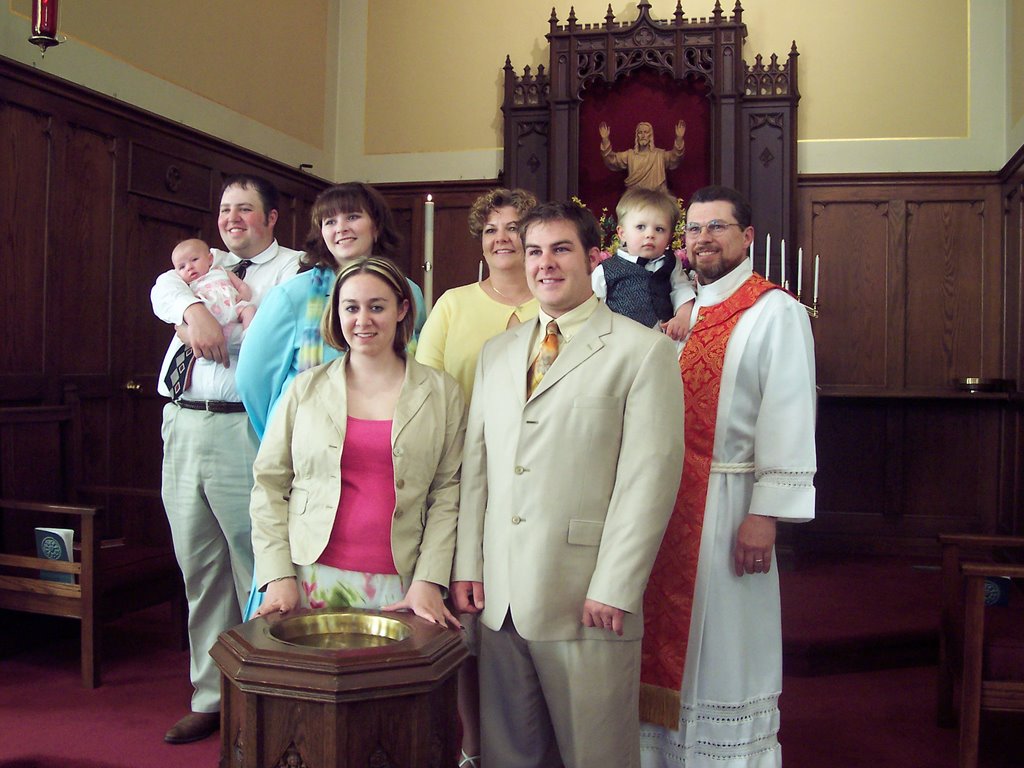
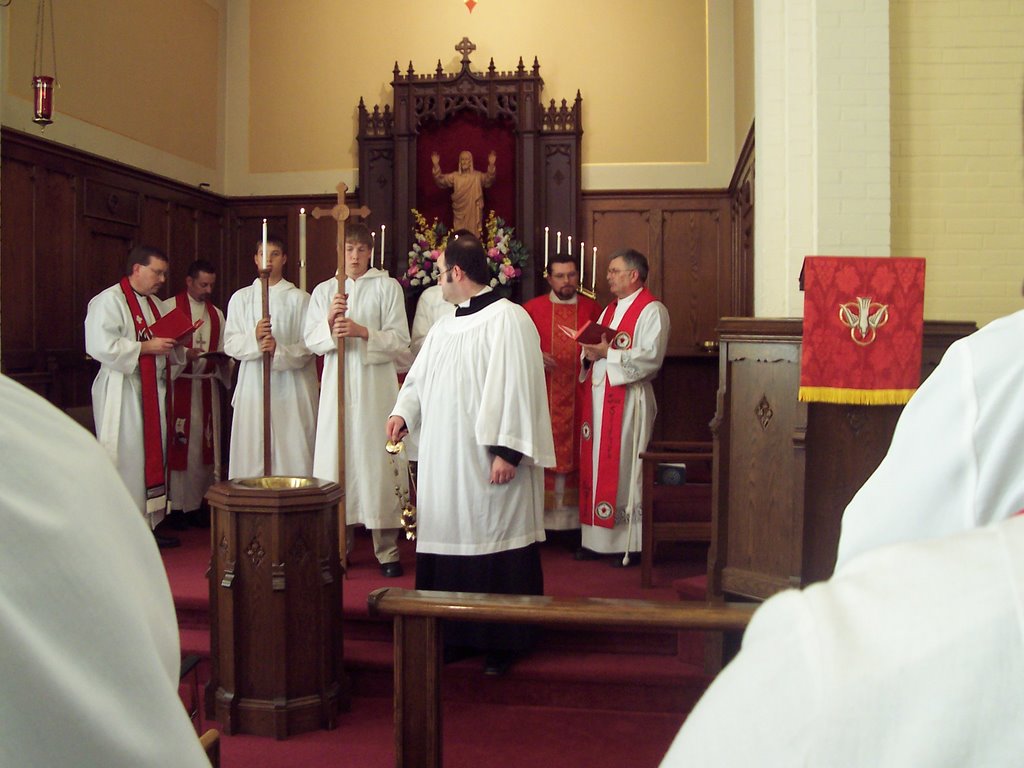
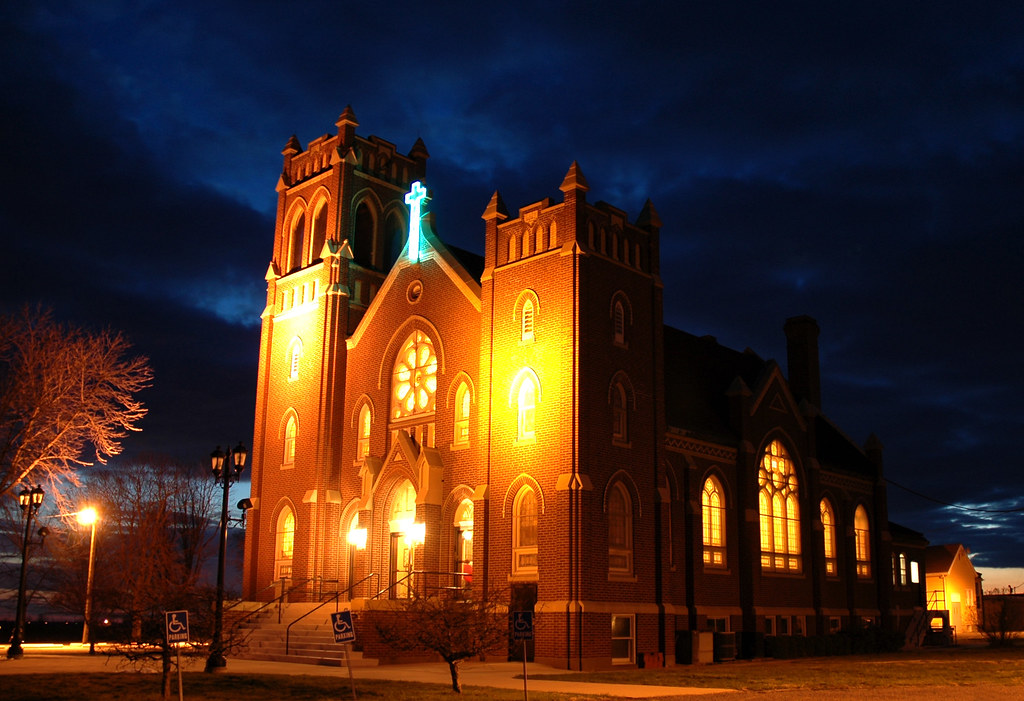
KARL GREGORY - AXIOS!
The Ordination of Karl Gregory into the Office of the Holy Ministry at St. Paul Lutheran Church, Hamel IL

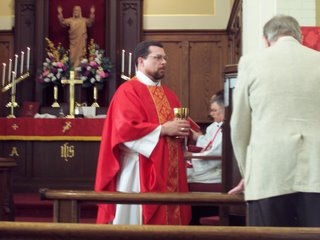
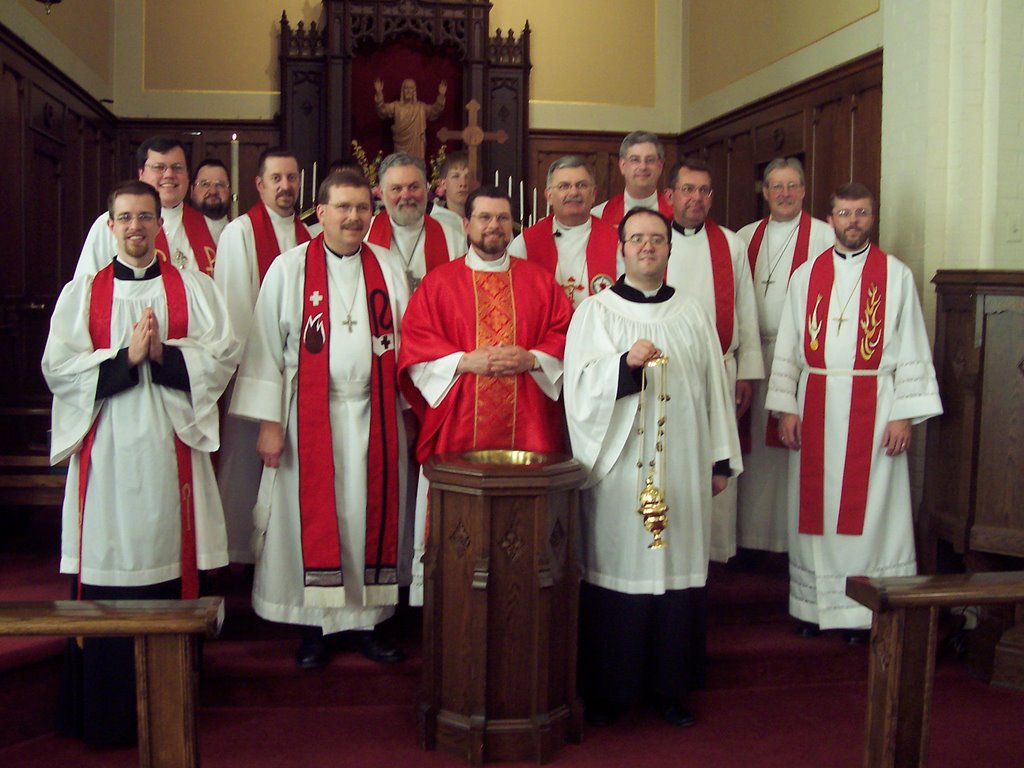
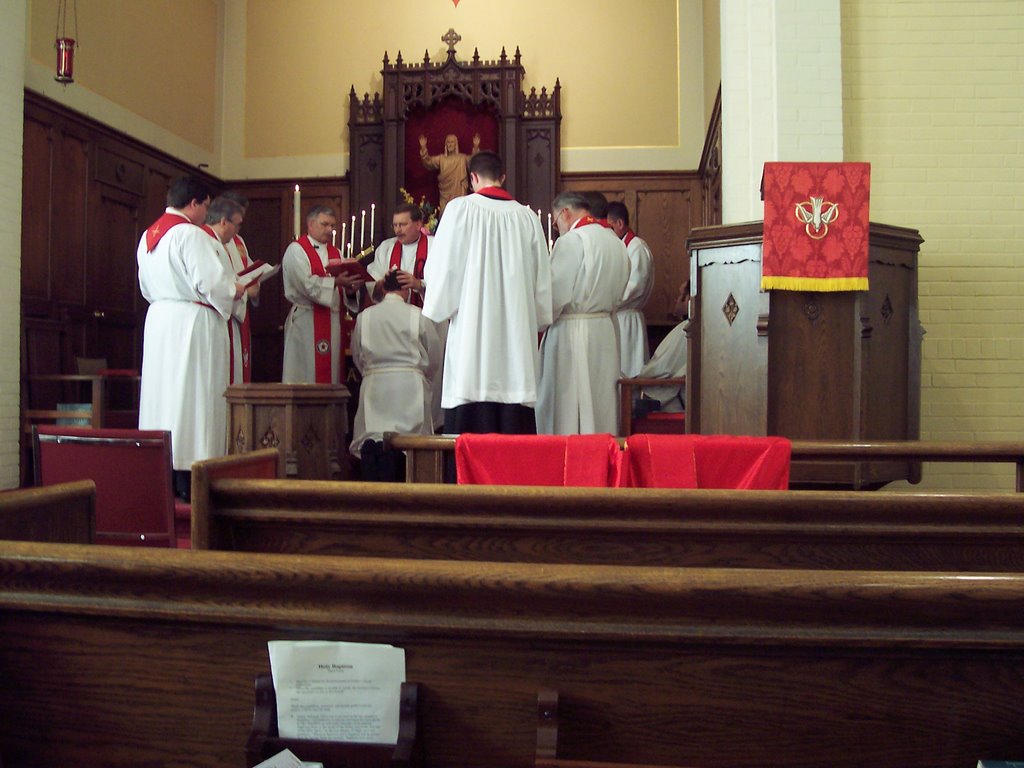

Tears of Joy, Tears of Sorrow
It is going to be one of those up and down days.
This morning Paul Anthony Kostich received the washing of regeneration and renewal in the Holy Spirit. His mother had been confirmed at the Vigil of Easter. Then we had joy of the Holy Eucharist.
Later this afternoon at 3:00 former vicar Karl Wesley Gregory will be put into the Office of the Holy Ministry with the laying on of hands at St. Paul's. Karl will make a great pastor, I believe. He has the personality that obsesses to get all the little duckies in a row! He's more prepared than any person I've ever met. Axios!
Then word reached me just moments ago that God has taken home one of his saints - Leola Engelke.
Leola is mother of David Engelke whom we buried a few weeks ago. Charles, David, Leola, Sarah, Kathy - all delight in the gift of music. And Leola had not only the gift of music, she had an overflowing a gift of laughter. She would make folks smile and laugh. She was full of love and kindness and a real sweetness - her hospitality was legendary. She was just FUN!
She's been through a lot in the last few years. I told Charles I was beginning to think she would lick everything that came her way. But at last her heart has stopped beating. No matter. She LIVES. She lives because was baptized into Christ, fed with His body and blood, and His precious Gospel promises. And how the Word and Sacrament bore fruit in her life! God bless and keep you, Leola!
This morning Paul Anthony Kostich received the washing of regeneration and renewal in the Holy Spirit. His mother had been confirmed at the Vigil of Easter. Then we had joy of the Holy Eucharist.
Later this afternoon at 3:00 former vicar Karl Wesley Gregory will be put into the Office of the Holy Ministry with the laying on of hands at St. Paul's. Karl will make a great pastor, I believe. He has the personality that obsesses to get all the little duckies in a row! He's more prepared than any person I've ever met. Axios!
Then word reached me just moments ago that God has taken home one of his saints - Leola Engelke.
Leola is mother of David Engelke whom we buried a few weeks ago. Charles, David, Leola, Sarah, Kathy - all delight in the gift of music. And Leola had not only the gift of music, she had an overflowing a gift of laughter. She would make folks smile and laugh. She was full of love and kindness and a real sweetness - her hospitality was legendary. She was just FUN!
She's been through a lot in the last few years. I told Charles I was beginning to think she would lick everything that came her way. But at last her heart has stopped beating. No matter. She LIVES. She lives because was baptized into Christ, fed with His body and blood, and His precious Gospel promises. And how the Word and Sacrament bore fruit in her life! God bless and keep you, Leola!
20 May 2006
Another Patristic quote for the Day
I'm too impatient. This one is such a joy; I just HAD to share it now:
Death, brothers, is the mistress of Despair, the mother of Unbelief, the sister of Corruption, the parent of hell, the wife of the devil, the queen of all evils, who is so insatiable and so deliberate in her attacks against the whole human race that she first sends ahead Despair to murmur and seduce on her behalf as follows. So Despair says: “O man, why are you wasting your time? Look, Death, your mistress is coming, and she is going to reduce your soul to nothing and consume your flesh with decay and your bones with aging, so as to make you, who did not exist before your birth, nonexistent after death. So, you who are about to die, do not delay to pay what you owe to the various stages in life before you die: spend your childhood in games, spend your adolescence in delights, spend your youth in pleasures, spend your old age with me, so that you will not image that you have no reason to have despaired of hope.”
After she sends her daughter Unbelief, who makes the following threats: “Are you thus disposing of your life as if you are not going to die, as if you will avoid death? O man, faith is deceiving you; you trust faith, which promises future blessings in order to take away present ones; and pledges that there are all sorts of unseen things after death, in order to remove the things that do exist before death. Who has come from there, or what wise person believes in things that have been promised for so long but never fulfilled? Oh, if only you would eat and drink! Eat and drink, for tomorrow you will die!”
Third, she directs Corruption, her sister in wickedness, with such fury that she assaults, lays hold of, and seizes what can be seen of human beings throughout their graves, and revealing her ultimate prisons she points out those who lie there bound and immobile, and in order to throw all the senses of the human being into turmoil with complete horror and complete fear, she oozes decay, she belches gore, she strews stenches, and she proclaims that she has supplied worms from herself as countless butchers to one human body.
Why should Christians not trust Despair or Unbelief? They are the way Death wages war; with these generals and with these tactics in a battle of this sort she captures, crushes and kills al those whom nature brings forth into the present life. She holds sway over kings, she conquers peoples, she routs nations. It has never been possible to bribe her with wealth, or to move her by entreaties, or to soften her by tears, or to conquer her by strength.
Brothers, how wrong those authors have been who have tried to write about the good of death. And what is so surprising about that? In this case the worldly-wise think that they are great and remarkable if they convince simple folks that the thing that is the greatest evil is the greatest good…. But these things, brothers, truth dispels, the Law banishes, faith attacks, the Apostle censures, and Christ blots out, who, while restoring the good that life is, discloses, condemns, and banishes the evil of death.
--St. Peter Chyrsologus, Sermon 118 pars. 3-6
[Corruption - anyone else think Shelob?]
Death, brothers, is the mistress of Despair, the mother of Unbelief, the sister of Corruption, the parent of hell, the wife of the devil, the queen of all evils, who is so insatiable and so deliberate in her attacks against the whole human race that she first sends ahead Despair to murmur and seduce on her behalf as follows. So Despair says: “O man, why are you wasting your time? Look, Death, your mistress is coming, and she is going to reduce your soul to nothing and consume your flesh with decay and your bones with aging, so as to make you, who did not exist before your birth, nonexistent after death. So, you who are about to die, do not delay to pay what you owe to the various stages in life before you die: spend your childhood in games, spend your adolescence in delights, spend your youth in pleasures, spend your old age with me, so that you will not image that you have no reason to have despaired of hope.”
After she sends her daughter Unbelief, who makes the following threats: “Are you thus disposing of your life as if you are not going to die, as if you will avoid death? O man, faith is deceiving you; you trust faith, which promises future blessings in order to take away present ones; and pledges that there are all sorts of unseen things after death, in order to remove the things that do exist before death. Who has come from there, or what wise person believes in things that have been promised for so long but never fulfilled? Oh, if only you would eat and drink! Eat and drink, for tomorrow you will die!”
Third, she directs Corruption, her sister in wickedness, with such fury that she assaults, lays hold of, and seizes what can be seen of human beings throughout their graves, and revealing her ultimate prisons she points out those who lie there bound and immobile, and in order to throw all the senses of the human being into turmoil with complete horror and complete fear, she oozes decay, she belches gore, she strews stenches, and she proclaims that she has supplied worms from herself as countless butchers to one human body.
Why should Christians not trust Despair or Unbelief? They are the way Death wages war; with these generals and with these tactics in a battle of this sort she captures, crushes and kills al those whom nature brings forth into the present life. She holds sway over kings, she conquers peoples, she routs nations. It has never been possible to bribe her with wealth, or to move her by entreaties, or to soften her by tears, or to conquer her by strength.
Brothers, how wrong those authors have been who have tried to write about the good of death. And what is so surprising about that? In this case the worldly-wise think that they are great and remarkable if they convince simple folks that the thing that is the greatest evil is the greatest good…. But these things, brothers, truth dispels, the Law banishes, faith attacks, the Apostle censures, and Christ blots out, who, while restoring the good that life is, discloses, condemns, and banishes the evil of death.
--St. Peter Chyrsologus, Sermon 118 pars. 3-6
[Corruption - anyone else think Shelob?]
Patristic Quote for the Day
He receives sinners (Luke 15:2). They do not say: "He assumes" them. What was it that he who receives had lost? Whoever finds what he lost pardons faults, turns wrath into joy, and transforms grief into grace. He receives sinners. God receives sinners, but God does not allow those whom he receives to remain sinners. The approach of the sinner does no harm to God. God sanctifies the sinner who draws near to him. O Pharisee, Christ does not receive sins when he receives sinners, because God is the recipient not of the offense, but of the human being. So the Pharisee should not have been looking at the condition the sinners were in when they arrived, but at their condition upon their return. A case in point, let them see that Paul, whom they had sent as a persecutor, returned thereafter as a preacher. - St. Peter Chrysologus, Sermon 168 par. 3
[Note: a nice exposition of the oft-heard, "The Lord loves you just the way you are; and He loves you entirely too much to leave you that way!"]
[Note: a nice exposition of the oft-heard, "The Lord loves you just the way you are; and He loves you entirely too much to leave you that way!"]
19 May 2006
Patristic Quote for the Day
 Both of them, it says, were righteous in the sight of God. Both righteous in the sight of God: and what about the passage that says: 'No living person can be counteded righteous in your sight?' Perhaps in the sight of human beings one may be thought to be righteous, since human beings, aware as they are of sins of the body, are equally unaware of vices of the mind. But in God's sight, before whom the secrets of the heart are laid bare, by whom hidden thoughts do not go unnoticed, who is judged innocent and righteous?
Is there a human being who does not sin in his heart, who does not have a bad thought, who is not guilty of harboring doubts, who does not incur blame through fear? Moses doubts, Aaron goes astray, Peter denies; so who is righteous? And were they both righteous in the sight of God? In the sight of God, yes, but by means of God. Both righteous in the sight of God, not by their effort but by grace.
Listen to the Apostle: They are justified gratuitously through the grace of Christ. And again: Not from ourselves; it is God's gift. Not from our works, lest anyone boast. Yet again: What do you have that you have not received? And if you have received it, why do you boast as if you did not receive it? Therefore this is more or less what the evangelist is saying: not that they did not have it, but that they received it; not that it was earned, but that it was bestowed. - St. Peter Chyrsologus, Sermon 91 par. 3 (On Luke 1:6)
18 May 2006
Another Patristic quote for the Day
The man who has a hundred sheep is Christ the Good Shepherd, the merciful Shepherd, who in the one sheep, that is, in Adama, had constituted the whole flock of the human race. He had set this sheep amid the delights of paradise, in a place of life-giving pasture. But that sheep forgot the voice of its Father while paying heed to the howling of wolves, and it lost the safety of the sheepfold, and was injured all over by deadly wounds. Therefore, Christ came into the world to look for it, and found it in a womb belonging to the Virgin. He came into the flesh of his Nativity; raising it onto the cross he placed it on the shoulders of his Passion, and rejoicing in the complete joy of the Resurrection, by means of the Ascension he bore it up and carried it off to his heavenly dwelling. - St. Peter Chrysologus, Homily 168, par. 6
Patristic Quote for the Day
The deed depends on the gift and not the gift on the deed; otherwise, grace would no longer be grace. Gifts precede every deed, even though the gifts may be increased by the deed that follows. - St. Gregory the Great (Dialog 1)
17 May 2006
Patristic Quote for the Day
 Christ takes on the appearance of each of the poor and assimilates Himself to all of them so that no one who believes in Him will be arrogant toward his fellow beings. On the contrary, he will look on his fellow beings and his neighbor as his God, regarding himself least of all in comparison just as much with his neighbor as with his Creator, and exhausting his all in his service, just as Christ our God poured out His blood for our salvation. - St. Symeon the New Theologian (Practical and Theologiccal Texts, #114)
16 May 2006
Patristic Quote for the Day
“This Sacrifice was the Christ of God, from far distant times foretold as coming to men, to be sacrificed like a sheep for the whole human race. As Isaiah the prophet says of him: “As a sheep he was led to slaughter, and as a lamb dumb before her shearers.” And he adds: “He bears our sins and is pained for us; yet we accounted him to be in trouble, and in suffering and in affliction. But he was wounded on account of our sins, and he was made sick on account of our iniquities, the chastisement of our peace was upon him, and with his stripe we are healed. …And the Lord hath given him up for our iniquities …for he did no sin himself, nor was guile found in his mouth.'’ Jeremiah, another Hebrew prophet, speaks similarly in the person of Christ: “I was led as a lamb to the slaughter.” John Baptist sets the seal on their predictions at the appearance of our Saviour. For beholding Him, and pointing Him out to those present as the one foretold by the prophets, he cried: “Behold the Lamb of God, which taketh away the sin of the world.'’
“Since then according to the witness of the prophets the great and precious ransom has been found for Jews and Greeks alike, the propitiation for the whole world, the life given for the life of all men, the pure offering for every stain and sin, the Lamb of God, the holy sheep dear to God, the Lamb that was foretold, by Whose inspired and mystic teaching all we Gentiles have procured the forgiveness of our former sins, and such Jews as hope in Him are freed from the curse of Moses, daily celebrating His memorial, the remembrance of His Body and Blood, and are admitted to a greater sacrifice than that of the ancient law, we do not reckon it right to fall back upon the first beggarly elements, which are symbols and likenesses but do not contain the truth itself. And any Jews, of course, who have taken refuge in Christ, even if they attend no longer to the ordinances of Moses, but live according to the new covenant, are free from the curse ordained by Moses, for the Lamb of God has surely not only taken on Himself the sin of the world, but also the curse involved in the breach of the commandments of Moses as well. The Lamb of God is made thus both sin and curse—sin for the sinners in the world, and curse for those remaining in all the things written in Moses’ law. And so the Apostle says: “Christ has redeemed us from the curse of the law, being made a curse for us”; and “Him that knew no sin, for our sakes he made sin.” For what is there that the Offering for the whole world could not effect, the Life given for the life of sinners, Who was led as a lamb to the slaughter, and as a lamb to the sacrifice, and all this for us and on our behalf? And this was why those ancient men of God, as they had not yet the reality, held fast to their symbols. (St. Cyril of Jerusalem, Catechetical Lectures, XIII)
“Since then according to the witness of the prophets the great and precious ransom has been found for Jews and Greeks alike, the propitiation for the whole world, the life given for the life of all men, the pure offering for every stain and sin, the Lamb of God, the holy sheep dear to God, the Lamb that was foretold, by Whose inspired and mystic teaching all we Gentiles have procured the forgiveness of our former sins, and such Jews as hope in Him are freed from the curse of Moses, daily celebrating His memorial, the remembrance of His Body and Blood, and are admitted to a greater sacrifice than that of the ancient law, we do not reckon it right to fall back upon the first beggarly elements, which are symbols and likenesses but do not contain the truth itself. And any Jews, of course, who have taken refuge in Christ, even if they attend no longer to the ordinances of Moses, but live according to the new covenant, are free from the curse ordained by Moses, for the Lamb of God has surely not only taken on Himself the sin of the world, but also the curse involved in the breach of the commandments of Moses as well. The Lamb of God is made thus both sin and curse—sin for the sinners in the world, and curse for those remaining in all the things written in Moses’ law. And so the Apostle says: “Christ has redeemed us from the curse of the law, being made a curse for us”; and “Him that knew no sin, for our sakes he made sin.” For what is there that the Offering for the whole world could not effect, the Life given for the life of sinners, Who was led as a lamb to the slaughter, and as a lamb to the sacrifice, and all this for us and on our behalf? And this was why those ancient men of God, as they had not yet the reality, held fast to their symbols. (St. Cyril of Jerusalem, Catechetical Lectures, XIII)
15 May 2006
Hands
Have you ever followed our Lord’s hands? The Psalmist invites us to: “As the eyes of servants look to the hands of their master, so our eyes look to the Lord our God, till He have mercy on us.” Ps. 123:2
Tiny hands, clinging to his mother’s finger as he nurses in the warmth of her embrace.
Dirty hands of a little child at play all day.
Calloused hands of a young man who knew how to shape wood and touched his work with loving satisfaction.
Hands raised tirelessly in prayer to His Father.
Hands that held the Torah and followed along as he read aloud in the Synagogue.
Hands that knew how to make and use a whip on those who sought to sell the gifts of God.
Hands that touched the leper as he said: “I do wish. Be clean!”
Hands that held and hugged little children and gave them both welcome and blessing.
Hands that reached out and grabbed Peter as he sank beneath the waves.
Hands that touched a young girl who had died and raised her to life again.
Hands that touched a bier holding a dead young man and stopped death right in its tracks.
Hands that broke the loaves and fed thousands.
Hands that plucked the heads of grain on the Sabbath and ate.
Hands that held the bread and broke it and gave it to His disciples on the night of His betrayal.
Hands that lifted up the cup and blessed His Father and gave His own His blood to drink.
Hands that refused to rise in self-defense.
Hands used only to bless and to bestow.
Hands that for all the good that they did and gave were pierced with nails.
Hands held lifelessly in His mother’s own hands beneath a bloody cross.
Hands that Thomas was offered to touch on the other side of the grave.
Hands that are raised in blessing over the disciples as Jesus ascends.
Hands that never cease to be lifted in prayer and in blessing for His people for all eternity.
“He’s got the whole world in His hands” sings the Negro spiritual. Indeed, He does. Redemption's story can be read out entirely by following His blessed hands.
Tiny hands, clinging to his mother’s finger as he nurses in the warmth of her embrace.
Dirty hands of a little child at play all day.
Calloused hands of a young man who knew how to shape wood and touched his work with loving satisfaction.
Hands raised tirelessly in prayer to His Father.
Hands that held the Torah and followed along as he read aloud in the Synagogue.
Hands that knew how to make and use a whip on those who sought to sell the gifts of God.
Hands that touched the leper as he said: “I do wish. Be clean!”
Hands that held and hugged little children and gave them both welcome and blessing.
Hands that reached out and grabbed Peter as he sank beneath the waves.
Hands that touched a young girl who had died and raised her to life again.
Hands that touched a bier holding a dead young man and stopped death right in its tracks.
Hands that broke the loaves and fed thousands.
Hands that plucked the heads of grain on the Sabbath and ate.
Hands that held the bread and broke it and gave it to His disciples on the night of His betrayal.
Hands that lifted up the cup and blessed His Father and gave His own His blood to drink.
Hands that refused to rise in self-defense.
Hands used only to bless and to bestow.
Hands that for all the good that they did and gave were pierced with nails.
Hands held lifelessly in His mother’s own hands beneath a bloody cross.
Hands that Thomas was offered to touch on the other side of the grave.
Hands that are raised in blessing over the disciples as Jesus ascends.
Hands that never cease to be lifted in prayer and in blessing for His people for all eternity.
“He’s got the whole world in His hands” sings the Negro spiritual. Indeed, He does. Redemption's story can be read out entirely by following His blessed hands.
Do This and You Will Live
Yesterday in Bible Class we studied the story of the Good Samaritan. One of the things I have become convinced of is that Jesus meant exactly what He said to the lawyer in the verses preceding that story. It was not just that our Lord was using the Law to crush the self-righteous pride out of the fellow (and us). He was doing that too. But there is more here. "Do this and you will live."
We mishear these words if hear our Lord saying: "Love like this and then you will be rewarded with eternal life." Love is not what you must do in order to GET eternal life. Rather, I believe our Lord is saying: love like this and that IS eternal life - that is the life of God Himself. "Do this, love like this, and you will live! You will share the life of God Himself." For surely our Lord IS the Good Samaritan in the parable, and He doesn't mean that "life" is something dangling out there after you get done loving, for you will never get done loving. Rather, life is precisely love itself.
"In Him was life and that life was the light of men." "God is love." They go hand in hand together. And that is why at the end of the story, our Lord invites that man and all of us: "Go and do likewise!" Not telling us how to earn the kingdom, for it is always and only gift. But telling us how to live the kingdom - that joyous "fervent love toward one another" that we pray for at the Eucharist.
We mishear these words if hear our Lord saying: "Love like this and then you will be rewarded with eternal life." Love is not what you must do in order to GET eternal life. Rather, I believe our Lord is saying: love like this and that IS eternal life - that is the life of God Himself. "Do this, love like this, and you will live! You will share the life of God Himself." For surely our Lord IS the Good Samaritan in the parable, and He doesn't mean that "life" is something dangling out there after you get done loving, for you will never get done loving. Rather, life is precisely love itself.
"In Him was life and that life was the light of men." "God is love." They go hand in hand together. And that is why at the end of the story, our Lord invites that man and all of us: "Go and do likewise!" Not telling us how to earn the kingdom, for it is always and only gift. But telling us how to live the kingdom - that joyous "fervent love toward one another" that we pray for at the Eucharist.
Random Thoughts on the Passing of Pelikan
 "The Strife is O'er, the Battle Done" - we often sing that at funerals. Especially when we see how it is true not just for our Lord, but for the person He has gathered home to Himself.
 I wish I could have known Jaroslav Pelikan - just to have thanked him for all his work; I've relied on his scholarship for many years.
Anytime a person picks up a volume of Luther's Works (American Edition), you can't help but think of him. Anytime a person turns to "Tappert's" Book of Concord, one thinks of Pelikan (and Piepkorn!). Anytime I need a quick answer to something from the early centuries, where to look but his series on Church History? His *Riddle of Roman Catholicism* remains a classic, even after some of its points were mooted after the Second Vatican Council. His insight into the interplay of catholic substance and protestant principle in the Reformation remains a most helpful light to those seeking to understand the history of Lutheranism in particular and the Reformation in general.
A mind that absorbed and processed such a staggering amount of data - and all in service to Christ and His Bride! He was a great gift of God to the Church in these "gray and latter days." Rest in peace, Father in Christ! Rest in peace!
Patristic Quote for the Day
Mary came to the tomb. She came to the womb of the Resurrection, she came to the birth of Life, so that Christ, who had been brought forth from the womb of the flesh, would be born a second time from the tomb of faith; and so that the sealed tomb would render to eternal life him whom the sealed womb of the Virgin had brought forth into the present life. It is a characteristic of divinity to have left the Virgin intact after birth; it is a characteristic of divinity to have come out of the tomb with his body. (St. Peter Chrysologus, Sermon 75:3)
14 May 2006
Patristic Quote for the Day
O man, receive faith, since it is given for free; believe in the resurrection, because he who promises it charges no price. (St. Peter Chrysologus, Sermon 118:10)
13 May 2006
Patristic Quote for the Day
So too is it with God, who on account of the massive extent of the wound has applied a massive and strong dose of medicine; and he has bestowed grace not on sin, but on the human being; he has rained down the shower of his mercy not to multiply but to blot out offenses. ((St. Peter Chrysologus, Sermon 113:3)
12 May 2006
Patristic Quote for the Day
Let no one boast about his merits, let no one boast about his works, because it is the peace of God that has re-established and restored life, which the first transgression had removed. (St. Peter Chrysologus, Sermon 110:5)
11 May 2006
Patristic Quote for the Day
Therefore, since the sin of our first parent had doomed us by giving death the right to hold us under its sway, Christ, our heavenly and true Parent, by having removed our condemnation to death by means of his own death, justifies us by his Resurrection, so that it would not be the guilty, but their guilt, that would perish; and so that the punishment itself, that is, death, which had been ordered to strike down the guilty, would rightly fail and lose the power that was its trademark. (St. Peter Chrysologus, Sermon 110:4)
10 May 2006
Patristic Quote for the Day
He was handed over for offenses, not so that this Life which was unable to die might be punished, but solely that the offenses which had banished us from life would be blotted out. (St. Peter Chrysologus, Sermon 110:3)
09 May 2006
Patristic Quote for the Day
Recognize this, brothers: be glad, brothers, that after the triumph of Christ the prison of the saints has been broken open, and the netherworld no longer exercises any jurisdiction over the saints, since Christ penetrated all the way to the netherworld in order to free the just, not the unjust. Let us realize, brothers, how great a benefit Christ has provided, or rather, how without Christ no one possessed salvation, since, besides the wretched dissolution of their bodies, the souls, too, of the saints were being held in confinement in the underworld. - St. Peter Chrysologus, Sermon 123, par. 7 (On Lazarus and the Rich Man)
08 May 2006
Patristic Quote for the Day
God did not order the sabbath, the new moons and the feasts to be honored because He wanted men to honor the days themselves; this would have been tantamount to decreeing by the Law that men should worship creation rather than the Creator, and should regard the days as holy in themselves and therefore to be venerated.
On the contrary, He indicated that he Himself was to be honored symbolically through these days. For He is the sabbath, as the soul's respose after its exertions in the flesh, and as the cessation of its sufferings in the cause of righteousness. He is the Passover, as the liberator of those held in the bitter slavery of sin. He is the Pentecost, as the origin and consummation of all created things, and as the principle through which all things by nature exist.
--St. Maximos the Great, Fifth Century of Various Texts, par. 46
On the contrary, He indicated that he Himself was to be honored symbolically through these days. For He is the sabbath, as the soul's respose after its exertions in the flesh, and as the cessation of its sufferings in the cause of righteousness. He is the Passover, as the liberator of those held in the bitter slavery of sin. He is the Pentecost, as the origin and consummation of all created things, and as the principle through which all things by nature exist.
--St. Maximos the Great, Fifth Century of Various Texts, par. 46
07 May 2006
Patristic Quote for the Day
 Great indeed is the Baptism which is offered you. It is ransom to captives; the remission of offences; the death of sin; the regeneration of the soul; the garment of light; the holy seal indissoluble; the chariot to heaven; the luxury of paradise; a procuring of the kingdom; the gift of adoption. - St. Cyril of Jerusalem, *The Protocatechesis* par. 16
05 May 2006
Oh, and go figure
WHEN we get home (and the house had been completely locked up) there was dead bird in the kitchen with its head stuck under the stove. And it had obviously flown around a bit, if you take my drift. HOW on earth did that thing get in here??? [Please ignore any complaints from the wife about HER having to deal with it; I mean, it landed in the KITCHEN!]
Whew!
So, Bekah, Cindi and I left bright and early on Thursday to pick Lauren up from Concordia University in Seward, Nebraska. It ended up being a bit more than an eight hour drive if you add in the lunch stop and breaks along the way. We packed Lauren up on Thursday night, enjoyed dinner in Lincoln with the kids and Dean, and then back to Joe and Jenny Herl's. Anna is still as cute as a button. Joe took me on a whirl-wind tour of the campus. We were up by six and finished packing Lauren's left-overs, when Dean (what a scholar and a gentleman!) showed up with a thermos of some fresh ground, fresh brewed coffee. It kept me going through St. Joe's. We got home by about four after 16 hours in the car in the last two days (more than that, truthfully).
David was trying to figure out how to put on his bow-tie for the prom. Here's a couple pics of the finished result (one with the lovely Misha):


Then a hospital call to Highland - I think that will turn out okay. Laverne, you're in our prayers.
So a crazy, crazy couple days! But for a while I've got all three kids home, and that makes for one happy papa.
David was trying to figure out how to put on his bow-tie for the prom. Here's a couple pics of the finished result (one with the lovely Misha):


Then a hospital call to Highland - I think that will turn out okay. Laverne, you're in our prayers.
So a crazy, crazy couple days! But for a while I've got all three kids home, and that makes for one happy papa.
03 May 2006
+In Memoriam David Engelke+
(to be delivered May 6, 2006)
Alleluia! Alleluia! Christ is risen! R. He is risen indeed! Alleluia! And THAT makes all the difference. And David knew it, believed it, confessed it,and lived it.
When you first told me about David’s falling asleep in Jesus, Sarah, you said: God took dad to heaven yesterday. Right on! As Jesus promised in the Gospel reading we just heard: “I know my sheep and am known of my own, and I give them eternal life and they shall never perish, neither shall anyone snatch them out of my hand.”
Eternal life - the life that cannot be destroyed by death, the life that rose from the grave with Jesus in His incorruptible body on Easter morning - THAT life is what Jesus promises and delivers into his sheep.
It was a week ago Thursday that David received the Holy Eucharist for the last time in this world. Into his poor body, which had gone through so much, went the very Body and Blood of the Son of God - the Body that carried David’s sins, and yours and mine upon the Cross. The Blood that was shed for our forgiveness. The Body and Blood of Him who not only died for us but rose again on that first Easter, forever beyond the grasp of the grave. How David hungered for that food! He knew what it delivered to him, and how desperately he needed it. Indeed in that Eucharist David rejoiced to receive into Himself “Christ, the Solid Rock” and he knew that all other ground was just “sinking sand.”
Way too often we think of death only from our own perspective. The voice that we will never hear again as long as this age of the world lasts. The eyes that will never look at us again until the great day of Resurrection. But that is to miss out on a fundamental joy: Sarah, you said, God took Dad to heaven. You were so right! Ponder for a moment what that was like from God’s perspective. To be able to welcome home David, his beloved child. To show him the joys of heaven. To see him join in the singing and the music - and you know as well as I what joy that was for him! All of life was a dress rehearsal for the performance that then began and whose sweet melody never comes to an end. The music rises and goes on and on forever. And David was enveloped in that, welcomed into that, and how precious it was to the Blessed Trinity to see the look upon his face when that melody rang through and carried him home. “Precious in the sight of the Lord” says King David “is the death of His saints.” Now you know why it is so precious, why it is so holy a thing.
As awful and hideous and hateful as death is here in this world, when we look at from the other side where the Lord Jesus gathers His saints around the throne and into the music that never ends, well, you can see why joy itself tinges your very sorrow today.
The sorrow today is so real. You will miss him so much. We will too. His kindness, his curiosity, his firmness in the faith, his love of the Bible and his devotion to his family. But there is none of us who can begrudge him the rest he has entered. As Isaiah pictured it, he’s already at the great feast which God throws to celebrate the destruction of death itself.
Today David’s coffin is covered with the pall. I think David would have wanted that. And he would have wanted you all to know what it means. You see, when he was just a baby, not even a month old, his mother and father carried him to Jesus in the font of Baptism, and there Jesus put upon Him the robe of His righteousness. All David’s sins were covered, forgotten, gone from the sight of God. And God said to him: Kid, you’re mine forever. We shall never be separated again.
Which is all to say that David would not want this funeral homily to be about David. He’d say: “Tell them about Jesus, remind them of the cross, remind them of the gifts He gives in Baptism, and at the Table. Remind them to be faithful and remind them that I am praying for each of them until I have the joy of them joining me in this place, covered alike with the righteousness of the Son of God and singing the Song of praise to the Lamb. Remind them.” And so I hope I have.
David, we love you and we always will.
Alleluia! Alleluia! Christ is risen!
He is risen indeed. Alleluia!
Alleluia! Alleluia! Christ is risen! R. He is risen indeed! Alleluia! And THAT makes all the difference. And David knew it, believed it, confessed it,and lived it.
When you first told me about David’s falling asleep in Jesus, Sarah, you said: God took dad to heaven yesterday. Right on! As Jesus promised in the Gospel reading we just heard: “I know my sheep and am known of my own, and I give them eternal life and they shall never perish, neither shall anyone snatch them out of my hand.”
Eternal life - the life that cannot be destroyed by death, the life that rose from the grave with Jesus in His incorruptible body on Easter morning - THAT life is what Jesus promises and delivers into his sheep.
It was a week ago Thursday that David received the Holy Eucharist for the last time in this world. Into his poor body, which had gone through so much, went the very Body and Blood of the Son of God - the Body that carried David’s sins, and yours and mine upon the Cross. The Blood that was shed for our forgiveness. The Body and Blood of Him who not only died for us but rose again on that first Easter, forever beyond the grasp of the grave. How David hungered for that food! He knew what it delivered to him, and how desperately he needed it. Indeed in that Eucharist David rejoiced to receive into Himself “Christ, the Solid Rock” and he knew that all other ground was just “sinking sand.”
Way too often we think of death only from our own perspective. The voice that we will never hear again as long as this age of the world lasts. The eyes that will never look at us again until the great day of Resurrection. But that is to miss out on a fundamental joy: Sarah, you said, God took Dad to heaven. You were so right! Ponder for a moment what that was like from God’s perspective. To be able to welcome home David, his beloved child. To show him the joys of heaven. To see him join in the singing and the music - and you know as well as I what joy that was for him! All of life was a dress rehearsal for the performance that then began and whose sweet melody never comes to an end. The music rises and goes on and on forever. And David was enveloped in that, welcomed into that, and how precious it was to the Blessed Trinity to see the look upon his face when that melody rang through and carried him home. “Precious in the sight of the Lord” says King David “is the death of His saints.” Now you know why it is so precious, why it is so holy a thing.
As awful and hideous and hateful as death is here in this world, when we look at from the other side where the Lord Jesus gathers His saints around the throne and into the music that never ends, well, you can see why joy itself tinges your very sorrow today.
The sorrow today is so real. You will miss him so much. We will too. His kindness, his curiosity, his firmness in the faith, his love of the Bible and his devotion to his family. But there is none of us who can begrudge him the rest he has entered. As Isaiah pictured it, he’s already at the great feast which God throws to celebrate the destruction of death itself.
Today David’s coffin is covered with the pall. I think David would have wanted that. And he would have wanted you all to know what it means. You see, when he was just a baby, not even a month old, his mother and father carried him to Jesus in the font of Baptism, and there Jesus put upon Him the robe of His righteousness. All David’s sins were covered, forgotten, gone from the sight of God. And God said to him: Kid, you’re mine forever. We shall never be separated again.
Which is all to say that David would not want this funeral homily to be about David. He’d say: “Tell them about Jesus, remind them of the cross, remind them of the gifts He gives in Baptism, and at the Table. Remind them to be faithful and remind them that I am praying for each of them until I have the joy of them joining me in this place, covered alike with the righteousness of the Son of God and singing the Song of praise to the Lamb. Remind them.” And so I hope I have.
David, we love you and we always will.
Alleluia! Alleluia! Christ is risen!
He is risen indeed. Alleluia!
Patristic Quote for the Day
In honor of David Engelke - a blessed sleep in Christ, dearest brother!
Have no fear, then. Now that the common Savior of all has died on our behalf, we who believe in Christ no longer die, as men died aforetime, in fulfilment of the threat of the law. That condemnation has come to an end; and now that, by the grace of resurrection, corruption has been banished and done away, we are loosed from our mortal bodies in God's good time for each, so that we may obtain thereby a better resurrection. - St. Athanasios, *On the Incarnation of the Word of God* par. 21
Have no fear, then. Now that the common Savior of all has died on our behalf, we who believe in Christ no longer die, as men died aforetime, in fulfilment of the threat of the law. That condemnation has come to an end; and now that, by the grace of resurrection, corruption has been banished and done away, we are loosed from our mortal bodies in God's good time for each, so that we may obtain thereby a better resurrection. - St. Athanasios, *On the Incarnation of the Word of God* par. 21
01 May 2006
Patristic Quote for the Day
So, since we are full of good cheer we sing over our corpses psalms that urge us to feel confident about death. "Commit, my soul, into your rest," it says, "because the Lord has been kind to you." (Ps. 114.7) Do you see that death is a kindness and a rest? For the person entering that resting rests from their labors, just as God did from his own affairs. - St. John Chrysostom, *Homily on Saints Bernike, Prosdoke, and Domnina* par. 10
Subscribe to:
Posts (Atom)