...The Liturgy of the Hours in the East and West came across this stunning quote, after noting how the huge burden of the care of parishes falling squarely on the heads of a limited number of presbyters made the long recitation of monastic hours in the parish churches utterly impractical and hence the move toward substituting private recitation for the clergy:
"The intelligent solution would have been to return the parochial celebration of the hours to its original cathedral dimensions, but intelligence has been only rarely an operative force in the development of liturgy." The Liturgy of the Hours in East and West, p. 299.
Priceless. Absolutely priceless. What he's referring to is that originally Christians tended to gather in their churches each morning and each evening. The service was relatively short and simple. For the morning, Lauds or Morning Praise:
Opening Psalm (either 51 or 63) with collect
[Maybe another Psalm
Lesson]
OT Canticle
Psalms 148-150 with collect
Hymn of light
Gloria in Excelsis
Intercessions and collect
Blessing and Dismissal
For Evensong or Vespers:
Lamplighting
Hymn of light with opening collect
Psalm 141
[Maybe another Psalm
Responsory
Lesson
Canticle]
Intercessions and collect
Blessings and Dismissal
In other words, no driving force to get through all the Psalms, rather set Psalms that were used every single day and so memorized and well known. A relatively simple gathering that Christians thought of as their daily obligation of praise and intercession, that together with the Sunday Divine Service shaped their basic piety. Rather than return to this, the monastic office in its fullness was retained in Rome and made the obligation for private recitation of the clergy. To this day, the Daily Office hasn't returned to normal parish practice in the West.
I find it quite interesting that in Lutheran Magdeburg of the 17th century, the office still WAS held daily in the cathedral; and the Divine Service offered each Sunday, Tuesday and Thursday. But no question that the heart and core of the daily gathering was the morning praise and evensong. These continued even when the Holy Mass was offered as well.
18 December 2012


December 18: O Adonai

Who appeared to Moses in the burning bush
and gave him the Law on Sinai,
Come with an outstretched arm and save us!
You can hear Pastor Daenzer sing it here.
Tonight we will recall that not only is our Lord the Logos, the Logic of the universe, but He is at one with Yahweh, with Adonai. There is no discontinuity between the Old and Testament revelations. For the same Lord stands at the center of both. It was HE, the divine Son, who appeared to Moses in the burning bush announcing His determination to rescue His people from their slavery, for He had seen and known their struggles. And it was HE, the Eternal Logos, who gave the very Law of God, the Ten Commandments as a priceless gift to His people that they might understand what a life of love truly looks like, see how far they have fallen, and cry to Him for the mercy and salvation that is in Him alone. To this Lord, this Adonai, who spoke and who speaks through the words of the Old Testament, we join in the cry:
"Come with outstretched arm and save us!"
Outstretched arm? We think of the infant in his mother's arms nursing, as his tiny fingers curl and uncurl around her finger. We think of the man who reached out his arm and touched lepers and raised the dead. We think most of all of the man who stretched out His arms on the wood of the cross that He might save us, opening His arms wide enough to embrace a world!
O come, O come, Thou Lord of might,
Who to Thy tribes on Sinai's height,
In ancient times didst give the law
In cloud and majesty and awe.
Rejoice! Rejoice! Emmanuel
Shall come to thee, O Israel!
17 December 2012
A Question for Readers
My buddy Chris asked an interesting question about how many Lutheran parishes or people actually use the Daily Office. So I'm curious:
Do you use Treasury or PrayNow to pray the Daily Office or at least part of it?
Do you use Brotherhood Prayer Book to pray the Daily Office or at least part of it?
If so, what do you use and how do you pray it?
Anyone care to share a bit of the nuts and bolts of their personal use of these or other resources, and whether your parish offers any chance for regular participation in the Daily Office?
During the school year, Matins is sung on Wednesdays at Trinity-St. Paul Lutheran School and during Advent and Lent either Vespers or Evening Prayer is prayed on Wednesday evenings. At the International Center of the LCMS, either Matins or Morning Prayer is usually prayed publicly on Mondays and Fridays, and sometimes on other days. Evening Prayer is offered when there is a special group meeting there that late (and during Missionary Orientation we usually have daily Evening Prayer).
I personally pray Matins and Vespers from PrayNow or Treasury; sometimes, I pull out Brotherhood Prayer Book just for the joy of it, and use that too.
Your turn.
Do you use Treasury or PrayNow to pray the Daily Office or at least part of it?
Do you use Brotherhood Prayer Book to pray the Daily Office or at least part of it?
If so, what do you use and how do you pray it?
Anyone care to share a bit of the nuts and bolts of their personal use of these or other resources, and whether your parish offers any chance for regular participation in the Daily Office?
During the school year, Matins is sung on Wednesdays at Trinity-St. Paul Lutheran School and during Advent and Lent either Vespers or Evening Prayer is prayed on Wednesday evenings. At the International Center of the LCMS, either Matins or Morning Prayer is usually prayed publicly on Mondays and Fridays, and sometimes on other days. Evening Prayer is offered when there is a special group meeting there that late (and during Missionary Orientation we usually have daily Evening Prayer).
I personally pray Matins and Vespers from PrayNow or Treasury; sometimes, I pull out Brotherhood Prayer Book just for the joy of it, and use that too.
Your turn.
Commemoration of Daniel, the Prophet, and the Three Children

Daniel the prophet and the Three Young Men—Shadrach, Meshach, and Abednego—were among the leaders of the people of Judah who were taken into captivity in Babylon. Even in that foreign land they remained faithful to the one true God in their piety, prayer, and life. On account of such steadfast faithfulness in the face of pagan idolatry, the Three Young Men were thrown into a fiery furnace, from which they were saved by the Lord and emerged unharmed (Daniel 3). Similarly, Daniel was thrown into a pit of lions, from which he also was saved (Daniel 6). Blessed in all their endeavors by the Lord—and in spite of the hostility of some—Daniel and the Three Young Men were promoted to positions of leadership among the Babylonians (Dan 2:48–49; 3:30; 6:28). To Daniel in particular the Lord revealed the interpretation of dreams and signs that were given to King Nebuchadnezzar and King Belshazzar (Daniel 2, 4, 5). To Daniel himself the Lord gave visions of the end times.
According to the Apocryphal addition to Daniel's prophesy, from the flames the young men sang the hymn we know as Benedicite Omnia Opera, which we sing always at the close of the Service of Readings at the great Vigil of Easter:
All you works of the Lord, bless the Lord - praise Him and magnify Him forever!
You angels, bless the Lord, You heavens, bless the Lord; all you waters above the heavens, bless the Lord;
All you powers of the Lord, bless the Lord - praise Him and magnify Him forever!
You sun and moon, bless the Lord; you stars of heaven, bless the Lord;
All you showers and dew, bless the Lord - praise Him and magnify Him forever!
All you winds of God, bless the Lord, You fire and heat, bless the Lord;
You winter and summer, bless the Lord - praise Him and magnify Him forever!
...
You spirits and souls of the righteous, bless the Lord; You pure and humble of heart bless the Lord;
let us bless the Father and the Son and the Holy Spirit, praise Him and magnify Him forever! (LSB 931)
We pray: Lord God, heavenly Father, You rescued Daniel from the lion's den and the three young men from the fiery furnace through the miraculous intervention of an angel. Save us now through the presence of Jesus, the Lion of Judah, who has conquered all our enemies through His blood and taken away all our sins as the Lamb of God, who reigns from His heavenly throne with You and the Holy Spirit, one God, now and forever. Amen. Treasury of Daily Prayer
New Lutheran Quote of the Day
The liturgy is the presentation of the culmination of all things, of the entire history of the world, because its heart is the Body and Blood of Christ.—Dr. Burnell Eckardt, The New Testament in His Blood, p. 57.
Old Lutheran Quote of the Day
Now where it takes root in the heart, the Holy Spirit is present and creates a new man. There an entirely new man comes into being, other thoughts, other words and works. Thus you are completely changed. Now you seek everything from which you formerly fled; and what you formerly sought, that you flee.—Blessed Martin Luther, Commentary on 1 Peter.
Patristic Quote of the Day
He was preeminent over those things that are under the earth, He Himself being 'the firstborn from the dead,' so that all things might behold their King and so that the Father's light might meet with and rest upon the flesh of our Lord, and come to us from His resplendent flesh, and that thus man might attain to immortality, having been invested with the Father's light.—Irenaeus, Against Heresies, 4.20.2
December 17: O Sapientia!

O Wisdom, proceeding from the mouth of the Most High,
pervading and permeating the whole creation,
mightily ordering all things:
Come and teach us the way of prudence!
You can hear Pr. Daenzer sing it here: click.
Our Lord is Logos - the very logic of the universe itself is disclosed in Him, in whom are hidden all the treasures of wisdom and knowledge. The key to life itself is not found anywhere else but in the Exemplar by whose wisdom we were made: the Eternal Word and Son of the Father. Why are you here? What is the purpose and meaning of life? What sort of life is really life and not just vanity? These all find their answers in Him alone, in our Lord Jesus. The fear of the Lord is the beginning of wisdom, a good understanding have all they that keep His commandments. His praise endures forever!
It is said that on this day in the monasteries, the librarian might have a special gift to give to the other brothers. He was recognized as the Keeper of Wisdom. He got to intone this first of the Great O Antiphons, which mark the final tilt of Advent toward the great joy of the Christmas Feast.
O come, Thou Wisdom from on high
Who ord'rest all things mightily;
To us the path of knowledge show
And teach in her ways to go.
Rejoice! Rejoice! Emmanuel
Shall come to thee, O Israel.
16 December 2012
Overflowing joy today...

Years ago, a friend (who has since become Orthodox) said to me that the sad thing in Lutheranism was that a man could labor for years strengthening a parish in orthodox Lutheranism and the next guy could come in and wreck everything you'd sought to strengthen. I know it CAN happen (and not just in Lutheranism!), but a well-catechized parish seeks out a man who will feed it God's precious Word and who will administer the Sacraments in accordance with that Word and our Church's Confessions. And that is exactly what St. Paul's did: they sought a faithful pastor, prayed for one from the Lord, and today rejoiced to receive him from the hand of our Lord Jesus.
Carlo gave us Bach's Prelude in Eb Major to start off. Then a powerful singing of "Come, Holy Ghost, God and Lord" as the clergy processed in behind the processional cross and torches. There were a ton of them, including District President Scharr, LCMS Board of Directors vice-chair Michael Kumm, and Daniel Preus, one of our Synod vice-presidents.
After confessing our sins and being absolved by Pr. Gleason, the choir led the congregation in the Introit and despite some last minute absences hurriedly filled (thank you, Stephanie!), the bells rang out their joy at a new pastor with a piece "Jubilate!"between the Old Testament and Epistle readings.
Cross and torches and lectionary were processed to center of the nave and the Gospel was read in the midst of the nave: which for the John 20 Gospel is especially fitting. "And he stood in their midst."
The hymn of the day was "As Surely as I Live" and we sang ALL the stanzas with gusto.
Pr. Ball's brother, Pr. Joshua Ball, delivered a fine homily in which he stressed the incarnation, the communication of attributes, the institution of the office of the Holy Ministry. He tied together the impending Christmas feast with the joy of Christ's resurrection and what His death accomplished and His ministry delivers. "God in the flesh" was his constant refrain.
The installation, conducted by President Scharr, was long and solemn; so many brothers to wish their blessings upon St. Paul's new pastor. That concluded with Luther's "To God the Holy Spirit, Let Us Pray."
It was a particular joy to hear Pastor Ball lead the intercessions and assume his place as celebrant at the Lord's Altar, and to watch the reverent and careful manner in which he presided. Every action proclaiming the profound mystery that he was handling. The timpani rumbled with the singing of the Sanctus. The gift of the Lord's Body and Blood was distributed amid loud singing of "O Lord, We Praise Thee," "Let All Mortal Flesh," "Preach You the Word," and "Send, O Lord, Your Holy Spirit."
There was a time of silence after the Nunc Dimittis as with great reverence the reliquae were consumed at the altar. After the benediction, the congregation sang a hearty "O Little Flock, Fear Not the Foe!" and then Carlo burst into the St. Anne Fugue. Altogether, the whole liturgy was the Congregation's loud "Amen!"and "Deo gratias!" to the gift that the Lord bestowed this day: a pastor for His people in Hamel.
15 December 2012
Such a blessing
to have Jo home again. Things have just been discombobulated these last two months without having her next door. And today we were blessed to spend some time together playing our beloved Liverpool. I AM happy to report that Jo and Cindi lost both games. It was men's day: I won first and Dave won second. Sweet.
Seriously, though, we are so thankful that Jo is without the intense chronic pain since the surgery. She still is having a bit of trouble taking steps, but she is light years improved from her worst. Thanks be to God!
Seriously, though, we are so thankful that Jo is without the intense chronic pain since the surgery. She still is having a bit of trouble taking steps, but she is light years improved from her worst. Thanks be to God!
Good words in the middle
of the Advent fast. These are from Dr. Luther's wonderful commentary on 1 Peter, particularly the exhortation: "Be sober." Enjoy!
Sobriety serves the body externally and is the chief work of faith. For even though man has become righteous, he is not yet completely rid of evil lusts. To be sure, faith has begun to subdue the flesh; but the flesh continues to bestir itself and rages nevertheless in all sorts of lusts that would like to assert themselves again and do what they want. Therefore the spirit must busy itself daily to tame the flesh and to bring it into subjection, must wrestle with it incessantly, and must take care that it does not repel faith. Therefore those who say that they have faith, think that this is enough, and, in addition, live as they please, are deceiving themselves. Where faith is genuine, it must attack the body and hold it in check, lest the body do what it pleases. For this reason, St. Peter says that we must be sober.
But he does not want the body to be destroyed or to be weakened too much. Thus one finds many who have fasted themselves mad and have tortured themselves to death. Even though Saint Bernard was a saintly man, he, too, was afflicted for a time with such folly. He denied his body so much that his breath stank and he could not associate with people.16 Later, however, he came to his senses and also told his brothers not to hurt the body too much. For he realized that he had made himself unable to serve his brothers. Therefore St. Peter demands no more than that we be sober, that is, that we stint the body as long as we feel that it is still too lascivious. He does not prescribe any definite length of time for fasting, as the pope has done; but he leaves it to everyone’s discretion to fast in such a way that he always remains sober and does not burden the body with gluttony. He must remain reasonable and sensible, and he must see to what extent it is necessary for him to mortify the body. It does no good at all to impose a command about this on a whole crowd or community, since we are so different from one another. One has a strong body, another has a body that is weak. Therefore one person must deny it much, and another person must deny it little, in such a way that when this is done, the body remains healthy and able to do good.
But it is also wrong for the other crowd to come along and say that they are getting on well by not fasting and by feeling free to eat meat.17 For these people, like the others, do not understand the Gospel either and are of no importance. They do no more than disdain the pope’s command. Yet they do not want to gird the mind and the understanding, as Peter says. They let the body have its way, with the result that it remains indolent and lascivious. It is good to fast. But one fasts in the right way by not giving the body more food than is needed to keep it healthy, and by letting it work and wake, in order that the old ass may not become too reckless, go dancing on the ice, and break a leg but may be bridled and follow the spirit. It should not imitate those who, when they fast, fill themselves so full of fish and the best wine at one time that their bellies are bloated.
This is what St. Peter means by being sober.
Sobriety serves the body externally and is the chief work of faith. For even though man has become righteous, he is not yet completely rid of evil lusts. To be sure, faith has begun to subdue the flesh; but the flesh continues to bestir itself and rages nevertheless in all sorts of lusts that would like to assert themselves again and do what they want. Therefore the spirit must busy itself daily to tame the flesh and to bring it into subjection, must wrestle with it incessantly, and must take care that it does not repel faith. Therefore those who say that they have faith, think that this is enough, and, in addition, live as they please, are deceiving themselves. Where faith is genuine, it must attack the body and hold it in check, lest the body do what it pleases. For this reason, St. Peter says that we must be sober.
But he does not want the body to be destroyed or to be weakened too much. Thus one finds many who have fasted themselves mad and have tortured themselves to death. Even though Saint Bernard was a saintly man, he, too, was afflicted for a time with such folly. He denied his body so much that his breath stank and he could not associate with people.16 Later, however, he came to his senses and also told his brothers not to hurt the body too much. For he realized that he had made himself unable to serve his brothers. Therefore St. Peter demands no more than that we be sober, that is, that we stint the body as long as we feel that it is still too lascivious. He does not prescribe any definite length of time for fasting, as the pope has done; but he leaves it to everyone’s discretion to fast in such a way that he always remains sober and does not burden the body with gluttony. He must remain reasonable and sensible, and he must see to what extent it is necessary for him to mortify the body. It does no good at all to impose a command about this on a whole crowd or community, since we are so different from one another. One has a strong body, another has a body that is weak. Therefore one person must deny it much, and another person must deny it little, in such a way that when this is done, the body remains healthy and able to do good.
But it is also wrong for the other crowd to come along and say that they are getting on well by not fasting and by feeling free to eat meat.17 For these people, like the others, do not understand the Gospel either and are of no importance. They do no more than disdain the pope’s command. Yet they do not want to gird the mind and the understanding, as Peter says. They let the body have its way, with the result that it remains indolent and lascivious. It is good to fast. But one fasts in the right way by not giving the body more food than is needed to keep it healthy, and by letting it work and wake, in order that the old ass may not become too reckless, go dancing on the ice, and break a leg but may be bridled and follow the spirit. It should not imitate those who, when they fast, fill themselves so full of fish and the best wine at one time that their bellies are bloated.
This is what St. Peter means by being sober.
13 December 2012
Saint Lucy

From the Treasury:
One of the victims of the great persecution under the Roman emperor Diocletian, Lucia met her death at Syracuse on the island of Sicily in the year A.D. 304, because of her Christian faith. Known for her charity, “Santa Lucia” (as she is called in Italy) gave away her dowry and remained a virgin until her execution by the sword. The name Lucia means “light,” and, because of that, festivals of light commemorating her became popular throughout Europe, especially in the Scandinavian countries. There her feast day corresponds with the time of year when there is the least amount of daylight. In artistic expression she is often portrayed in a white baptismal gown, wearing a wreath of candles on her head.
Oremus: O almighty God, by whose grace and power Your holy martyr Lucia triumphed over suffering and remained ever faithful unto death, grant us, who now remember her with thanksgiving, to be so true in our witness to You in this world that we may receive with her new eyes without tears and the crown of light and life; through Jesus Christ, our Lord... (Treasury, p. 1012)
Oremus: Almighty God, who didst give Thy servant Lucia boldness to confess the Name of our Saviour Jesus Christ before the rulers of this world, and courage to die for this faith: Grant that we likewise may ever be ready to give a reason for the hope that is in us and to suffer gladly for His sake; through the same Jesus Christ, Thy Son, our Lord, who liveth and reigneth with Thee and the Holy Ghost, ever one God, world without end. Amen. (Brotherhood Prayer Book, Common of Martyrs, p. 316).
New Lutheran Quote of the Day
The two ingredients comprising the heart of the liturgy are the Lord's Prayer and the Words of Institution. Everything else revolves around them, since these are the only two formulae which the Lord Jesus specifically gave His Church and commanded her to use. His command to say the specific words of the Our Father is given in St. Luke 11 ("When ye pray, say..."), and His command to repeat the Verba is given within the Verba themselves ("This do.").—Dr. Burnell Eckardt, The New Testament in His Blood, p. 36.
Old Lutheran Quote of the Day
To the ungodly and the unbelievers he will come as judge and punish them as his enemies and the Christians' foes, who have afflicted Christians with all kinds of misery. But to the believers and Christians he will come as a redeemer. This we should believe firmly, rejoicing in his coming and taking care that when he comes, as St. Peter says, we shall be found in faith and godliness, walking before him in peace and without blame. To this end may God grant us his grace. Amen, amen.—Blessed Martin Luther, Sermon for Second Sunday in Advent, House Postils I:51
Patristic Quote of the Day
Just as the holy apostle exhorts those who have received the faith to "shine as lights in the world, holding fast to the word of life" (Phil. 2:15–16)—for indeed the lamp does not in itself possess light, but it is receptive of the light that comes to it—so also here the evangelist saw the churches as lampstands and not as lights.—Oecumenius, Commentary on the Apocolypse.
11 December 2012
New Lutheran Quote of the Day
Simply put, when we come to the altar we have arrived at the meaning of all the Scriptures. When we partake in the Sacrament, we partake in everything the Scriptures were written to reveal.—Dr. Burnell Eckardt, The New Testament in His Blood, p. 19.
Old Lutheran Quote of the Day
We have no other reason for living on earth than to be of help to others. — Blessed Martin Luther, Commentary on 1 Peter 1.
Patristic Quote of the Day
Our soul, my brothers, is unlovely because of our iniquity. By loving God it becomes lovely. What a love that must be that makes the lover beautiful! But God is always lovely, never unlovely, and never changeable.... He loves us not to leave us foul; no, but to change us, and from unlovely He makes us lovely.—St. Augustine, Homilies on 1 John
06 December 2012
Yesterday I heard two fine homilies...
...here's one. By Pastor James Lee, Assistant Pastor at Trinity Lutheran in Worden:
In the Name ✠ of Jesus.
In the history of the Church, particularly in the early and medieval periods, we see Christians who spurned the contours and comforts of every day life. They went without having family and friends, refusing to get married, or have children, choosing to lead a life of celibacy. They didn't have jobs, or watch sports. They didn't take vacations or mess with their DVR. They didn't invest or prepare for retirement. They fled the cities, not to take a breather from the hustle and bustle of work, but to live a life of isolation, to escape the confines of daily existence. Many lived a harsh and austere life: fasting relentlessly, praying for hours, going without sleep, and when they would sleep, it would be on the floor. They would discipline and chastise their own bodies, aware of the sinful desires that resided there.
What motivated these Christians to live, what we would estimate to be, a ridiculous and an overly-harsh life? They sought to follow Christ. To be his disciples. To take up their crosses, to deny themselves, and to follow in the path of their Lord. They recognized that, to follow Christ, requires everything. All of you. Nothing is left. No part of you remains to be given over to something else.
But surely, we think, these Christians over did it. They were overzealous. They didn't realize that being a Christian doesn't require you to change your life or give anything up. It was easier for them. They did not understand how demanding life can be. How many things I have to attend to. It was so easy for them to give up everything, but life is different now. Christ doesn't ask this much from us.
REPENT. For in the life of these Christians, those whom we label "radicals" and "extremists," we see a love, a desire, a willingness to be with Christ, that we on our best days, don't even begin to approach.
"If anyone comes to me and does not hate his own father and mother and wife and children and brothers and sisters, yes, and even his own life, he cannot be my disciple. Whoever does not bear his own cross and come after me cannot be my disciple. [...] And of you who does not renounce all that he has cannot be my disciple."
What do you do when Jesus says this to you? Do you feel uncomfortable? Does it make you uneasy? We attempt to comfort ourselves by saying that he is speaking in hyperbole. But what if Jesus is serious? And what he says is true. And so, with these words, Jesus is opening up your heart and revealing where your true treasure is. His words cut to the heart, because where we place our heart, there is our god.
Christ's words are extreme, radical, exclusive. And so, in them, we see that: to follow Christ, to be a Christian, demands our entirety. Even our death. And that we take things in this life, the gifts given us from God, and rather than receiving them from God as gift, we elevate them over God, and turn them into idols. We give our hearts to them, rather than to God, and in so doing, we make these our gods.
The great Christian lie that you hear people say all when faced with this crisis is that "you need to do a better job at making God a priority in your life. You have to make God number one." God: the creator of heaven and earth, who dwells not in temples made of hands; the redeemer of the world, by his own life and death—a priority? Exercise and reading, spending more time with your family—these are priorities. But our attempt to assign God a number and stand Him in line next to all our other priorities, is absolutely ridiculous—the creature imposing upon the Creator a number of value and worth; more than this, it's idolatry.
Christ unmasks us for who we are: worshippers of false gods; ungrateful children, unwilling to leave behind our beloved things—which we did not even make, or have a claim to—in order to follow Christ. How fallen are we: God gives gifts, and in gratitude, we cherish them more than the giver. We are baptized into his death, we make vows at our confirmation to be faithful, even to the point of our death, just don't ask us give up the things in life that bring us comfort and happiness. No matter who you are, be you rich or poor, whether you own much or little, you have things in this life, people, possessions, even your own self-love, before whom you kneel and adore as your god.
Mourn your sins my friends. Flee from you idolatry. But have courage and take heart: For you have a God whose love knows no bounds. Who is willing to do that which we are unable: to give Himself over entirely, completely. To give himself to you. He is like a man, who when planning to build a tower, saw what it would take, what it would it cost, and his desire for this tower was so great, that he would give everything to have it, even his life.
This is the heart of the mystery of the Gospel. When blessed St. John sees in a vision the lamb on his throne, that was slain from the foundation of the world: before creation, God had purposed to give himself for you, entirely, completely, into death, that He might have you as His possession, as his children. To have you means to give Himself for you. And so God does. Such is the utterly profound depth of the Triune God's love for you: that Father, Son, and Holy Spirit, whose love for each other is pure, perfect, complete, lacking nothing—deigns to have you live with them, the one true God. And to love you as the members of the Trinity love themselves. A love willing to endure, separation, hatred, scorn, death, and even divine wrath, to have you forever, to bring you into the life of God.
Tonight we find ourselves, again, at the cusp of Advent, in which we prepare for our Lord's return, His coming to judge the living and the dead, to bring us to Himself; and His weekly advent here, in His word of forgiveness, in His body and blood. Let us then examine our hearts, and see where they are divided. Let us flee from our idols, and take refuge in Christ. He has freed you from your slavery to idols and false gods. Let us then not fall back to our former ways of our corruption. Our Lord has renewed our heart, freed it to love Him, to be united with His. Let us fight against our old Adam, who desires our bondage, our servitude to our false gods.
You are Chris's beloved. He has created you, redeemed you, made you His disciple, brought you into His body, the Church. He has held nothing back. Your Lord gives to you abundantly. You are His. And what you still lack now, Christ completes it. All of it.
God knows your weaknesses. Your heart that wanders where it ought not. A love that is fickle; that fades. And He dies for it. He forgives it with His own life-giving blood and innocent suffering and death. Where we are faithless, He is faithful. We who have hearts that wander, have a Lord, whose heart is steadfast and resolute. He does not turn from us, even when we turn from Him. When we reject Him and deny Him, He does not forsake us to our idols. He calls you, He goes after you. Is born of flesh and blood: He becomes like you, so that you might become like Him.
Come soon, Lord Jesus.
In the Name ✠ of Jesus.
In the Name ✠ of Jesus.
In the history of the Church, particularly in the early and medieval periods, we see Christians who spurned the contours and comforts of every day life. They went without having family and friends, refusing to get married, or have children, choosing to lead a life of celibacy. They didn't have jobs, or watch sports. They didn't take vacations or mess with their DVR. They didn't invest or prepare for retirement. They fled the cities, not to take a breather from the hustle and bustle of work, but to live a life of isolation, to escape the confines of daily existence. Many lived a harsh and austere life: fasting relentlessly, praying for hours, going without sleep, and when they would sleep, it would be on the floor. They would discipline and chastise their own bodies, aware of the sinful desires that resided there.
What motivated these Christians to live, what we would estimate to be, a ridiculous and an overly-harsh life? They sought to follow Christ. To be his disciples. To take up their crosses, to deny themselves, and to follow in the path of their Lord. They recognized that, to follow Christ, requires everything. All of you. Nothing is left. No part of you remains to be given over to something else.
But surely, we think, these Christians over did it. They were overzealous. They didn't realize that being a Christian doesn't require you to change your life or give anything up. It was easier for them. They did not understand how demanding life can be. How many things I have to attend to. It was so easy for them to give up everything, but life is different now. Christ doesn't ask this much from us.
REPENT. For in the life of these Christians, those whom we label "radicals" and "extremists," we see a love, a desire, a willingness to be with Christ, that we on our best days, don't even begin to approach.
"If anyone comes to me and does not hate his own father and mother and wife and children and brothers and sisters, yes, and even his own life, he cannot be my disciple. Whoever does not bear his own cross and come after me cannot be my disciple. [...] And of you who does not renounce all that he has cannot be my disciple."
What do you do when Jesus says this to you? Do you feel uncomfortable? Does it make you uneasy? We attempt to comfort ourselves by saying that he is speaking in hyperbole. But what if Jesus is serious? And what he says is true. And so, with these words, Jesus is opening up your heart and revealing where your true treasure is. His words cut to the heart, because where we place our heart, there is our god.
Christ's words are extreme, radical, exclusive. And so, in them, we see that: to follow Christ, to be a Christian, demands our entirety. Even our death. And that we take things in this life, the gifts given us from God, and rather than receiving them from God as gift, we elevate them over God, and turn them into idols. We give our hearts to them, rather than to God, and in so doing, we make these our gods.
The great Christian lie that you hear people say all when faced with this crisis is that "you need to do a better job at making God a priority in your life. You have to make God number one." God: the creator of heaven and earth, who dwells not in temples made of hands; the redeemer of the world, by his own life and death—a priority? Exercise and reading, spending more time with your family—these are priorities. But our attempt to assign God a number and stand Him in line next to all our other priorities, is absolutely ridiculous—the creature imposing upon the Creator a number of value and worth; more than this, it's idolatry.
Christ unmasks us for who we are: worshippers of false gods; ungrateful children, unwilling to leave behind our beloved things—which we did not even make, or have a claim to—in order to follow Christ. How fallen are we: God gives gifts, and in gratitude, we cherish them more than the giver. We are baptized into his death, we make vows at our confirmation to be faithful, even to the point of our death, just don't ask us give up the things in life that bring us comfort and happiness. No matter who you are, be you rich or poor, whether you own much or little, you have things in this life, people, possessions, even your own self-love, before whom you kneel and adore as your god.
Mourn your sins my friends. Flee from you idolatry. But have courage and take heart: For you have a God whose love knows no bounds. Who is willing to do that which we are unable: to give Himself over entirely, completely. To give himself to you. He is like a man, who when planning to build a tower, saw what it would take, what it would it cost, and his desire for this tower was so great, that he would give everything to have it, even his life.
This is the heart of the mystery of the Gospel. When blessed St. John sees in a vision the lamb on his throne, that was slain from the foundation of the world: before creation, God had purposed to give himself for you, entirely, completely, into death, that He might have you as His possession, as his children. To have you means to give Himself for you. And so God does. Such is the utterly profound depth of the Triune God's love for you: that Father, Son, and Holy Spirit, whose love for each other is pure, perfect, complete, lacking nothing—deigns to have you live with them, the one true God. And to love you as the members of the Trinity love themselves. A love willing to endure, separation, hatred, scorn, death, and even divine wrath, to have you forever, to bring you into the life of God.
Tonight we find ourselves, again, at the cusp of Advent, in which we prepare for our Lord's return, His coming to judge the living and the dead, to bring us to Himself; and His weekly advent here, in His word of forgiveness, in His body and blood. Let us then examine our hearts, and see where they are divided. Let us flee from our idols, and take refuge in Christ. He has freed you from your slavery to idols and false gods. Let us then not fall back to our former ways of our corruption. Our Lord has renewed our heart, freed it to love Him, to be united with His. Let us fight against our old Adam, who desires our bondage, our servitude to our false gods.
You are Chris's beloved. He has created you, redeemed you, made you His disciple, brought you into His body, the Church. He has held nothing back. Your Lord gives to you abundantly. You are His. And what you still lack now, Christ completes it. All of it.
God knows your weaknesses. Your heart that wanders where it ought not. A love that is fickle; that fades. And He dies for it. He forgives it with His own life-giving blood and innocent suffering and death. Where we are faithless, He is faithful. We who have hearts that wander, have a Lord, whose heart is steadfast and resolute. He does not turn from us, even when we turn from Him. When we reject Him and deny Him, He does not forsake us to our idols. He calls you, He goes after you. Is born of flesh and blood: He becomes like you, so that you might become like Him.
Come soon, Lord Jesus.
In the Name ✠ of Jesus.
05 December 2012
Evening Prayer in Advent
I love the quiet and the peace of this liturgy. From the Phos Hilaron to the Magnificat, from Psalm 141 to the great Ektenia litany. Yet it is the Collect of Peace itself which I think expresses the very heart of the vesperal prayer of Christ's Church.
I am always struck by what it doesn't ask. It doesn't ask to be delivered from our enemies. Rather, to be delivered from the fear of our enemies. The peace for which we pray doesn't come from an external fix that would leave us no longer fretting only so long as the external fix held (and no external fix holds for very long in this sad and fallen age). It comes rather from the fretting being removed from our own hearts, so that we no longer fear our enemies (meaning, of course, those who hate us, not vice-versa - we're not given that "luxury").
So as Christians used this prayer in the evening in the days of the Vikings, they admitted it wasn't the terrorist marauding at night and bringing havoc upon them that was the problem; the problem was that their heart would fear that. So they prayed for deliverance from the fear of their enemies so that their hearts could be SET on the obedience to God's commandments: to love all, especially those who mistreat and abuse us, and to trust always in Him whose love for us works...finally, fully, lastly...to our good, for He is indeed a great Lover of Mankind!
I am always struck by what it doesn't ask. It doesn't ask to be delivered from our enemies. Rather, to be delivered from the fear of our enemies. The peace for which we pray doesn't come from an external fix that would leave us no longer fretting only so long as the external fix held (and no external fix holds for very long in this sad and fallen age). It comes rather from the fretting being removed from our own hearts, so that we no longer fear our enemies (meaning, of course, those who hate us, not vice-versa - we're not given that "luxury").
So as Christians used this prayer in the evening in the days of the Vikings, they admitted it wasn't the terrorist marauding at night and bringing havoc upon them that was the problem; the problem was that their heart would fear that. So they prayed for deliverance from the fear of their enemies so that their hearts could be SET on the obedience to God's commandments: to love all, especially those who mistreat and abuse us, and to trust always in Him whose love for us works...finally, fully, lastly...to our good, for He is indeed a great Lover of Mankind!
Walther's Hymnal
Matthew Carver is one amazing man. Not only has he given us scads of Herberger to enjoy, but now he offers us THIS:

Yes, here is the original hymnal of the Lutheran Church—Missouri Synod, presented to you in ENGLISH! Matt has done a boatload of excellent translating. It is truly a feast. Not only do we have so many hymns we've never had in English before, but gathered into this volume are prayers for the Christian's worship life, the Synod's original Divine Service liturgy, the Passion narrative, the Destruction of Jerusalem and even more.
Some teasing tastes of the goodies therein:
Since Adam's age, so long have we
Been cursed in our iniquity,
Corrupt in body, soul, and mind,
With nothing living left to find.
When God beheld our sickness sore
That no physician could restore,
He thought upon His kindness vast
And kept His Word from first to last.
He said, "I will display My grace
And give My Son to save this race,
To them as their Doctor true,
To bless them, and to make them new."
The Spirit's pow'r on Mary came,
And took her virgin blood to frame
The pure and blessed Crown of youth,
In whom are found all grace and truth.
O Christ, Thou Fruit forever blest,
Conceived in manner wholly chaste,
Bestow Thy blessing, set us free,
Our Savior, Salve, and Comfort be.
#42:1, 5, 6, 11, 12
My faithful Savior paid the cost
In Him I find completion,
And nothing in Him shall be lost
Except my foul transgression,
For this is sunk beneath the sea,
Beyond the Father's memory,
And I have life eternal.
#231:4
Almighty and everlasting God, who by Thy dear Son, our Lord and Savior Jesus Christ, didst command us to pray that Thou wouldst send faithful laborers into Thy harvest: grant, I heartily beseech Thee, unto my minister so to handle Thy holy Word that, as becometh it, he would fearlessly open his mouth to oppose every false doctrine and abuse, proclaim the mystery of Thy holy Gospel, and instruct and edify Thy Church, that I and all my brothers and sisters assembled with me in the Church, being strengthened by Thy Holy Spirit, may live in true obedience here in time, and be saved hereafter in eternity; through the same Jesus Christ, our Lord. Amen. (p. 365)
Almighty, everlasting God, I praise and thank Thee that of Thy divine generosity Thou hast again fed me with the saving Body and given to drink of the saving Blood of Thine only Son Jesus Christ, my Lord; and I humbly pray Thee to work in me by Thy Holy Spirit, that, having now by mouth received this Holy Sacrament, I may by firm faith receive and ever hold fast Thy divine grace, forgiveness of sins, unity with Christ, and life everlasting, all of which Thou hast so graciously offered and delivered to me in this Thy Holy Sacrament; through Jesus Christ, Thy dear Son, our Lord. Amen. (p. 368)
Order here.

Yes, here is the original hymnal of the Lutheran Church—Missouri Synod, presented to you in ENGLISH! Matt has done a boatload of excellent translating. It is truly a feast. Not only do we have so many hymns we've never had in English before, but gathered into this volume are prayers for the Christian's worship life, the Synod's original Divine Service liturgy, the Passion narrative, the Destruction of Jerusalem and even more.
Some teasing tastes of the goodies therein:
Since Adam's age, so long have we
Been cursed in our iniquity,
Corrupt in body, soul, and mind,
With nothing living left to find.
When God beheld our sickness sore
That no physician could restore,
He thought upon His kindness vast
And kept His Word from first to last.
He said, "I will display My grace
And give My Son to save this race,
To them as their Doctor true,
To bless them, and to make them new."
The Spirit's pow'r on Mary came,
And took her virgin blood to frame
The pure and blessed Crown of youth,
In whom are found all grace and truth.
O Christ, Thou Fruit forever blest,
Conceived in manner wholly chaste,
Bestow Thy blessing, set us free,
Our Savior, Salve, and Comfort be.
#42:1, 5, 6, 11, 12
My faithful Savior paid the cost
In Him I find completion,
And nothing in Him shall be lost
Except my foul transgression,
For this is sunk beneath the sea,
Beyond the Father's memory,
And I have life eternal.
#231:4
Almighty and everlasting God, who by Thy dear Son, our Lord and Savior Jesus Christ, didst command us to pray that Thou wouldst send faithful laborers into Thy harvest: grant, I heartily beseech Thee, unto my minister so to handle Thy holy Word that, as becometh it, he would fearlessly open his mouth to oppose every false doctrine and abuse, proclaim the mystery of Thy holy Gospel, and instruct and edify Thy Church, that I and all my brothers and sisters assembled with me in the Church, being strengthened by Thy Holy Spirit, may live in true obedience here in time, and be saved hereafter in eternity; through the same Jesus Christ, our Lord. Amen. (p. 365)
Almighty, everlasting God, I praise and thank Thee that of Thy divine generosity Thou hast again fed me with the saving Body and given to drink of the saving Blood of Thine only Son Jesus Christ, my Lord; and I humbly pray Thee to work in me by Thy Holy Spirit, that, having now by mouth received this Holy Sacrament, I may by firm faith receive and ever hold fast Thy divine grace, forgiveness of sins, unity with Christ, and life everlasting, all of which Thou hast so graciously offered and delivered to me in this Thy Holy Sacrament; through Jesus Christ, Thy dear Son, our Lord. Amen. (p. 368)
Order here.
04 December 2012
New Lutheran Quote of the Day
How then can we be sure that the Spirit is at work in our worship? We can be certain of the Spirit’s inspiration and operation when God’s word is faithfully used as the means of the Spirit. This may be why all the classical ecumenical orders of service consist almost entirely of scriptural material. We absolve and bless with the word; we preach and meditate with the word; we baptise and perform the Eucharist with the word; we pray and praise with the word; we offer ourselves and our gifts with the word. Through the right enactment of God’s word we participate in the descending and ascending operation of the triune God in the assembly, the work by which the Spirit not only brings God the Father to us through his Son but also brings us to God the Father together with his Son. Whatever is done with the word and by faith in the word is done with the Spirit.—Dr. John Kleinig, http://www.johnkleinig.com/index.php/download_file/view/136/59/
Old Lutheran Quote of the Day
For we really need such purging and affliction every day because of the coarse old Adam. It is characteristic of a Christian life to improve constantly and to become purer. When we come to faith through the preaching of the Gospel, we become pious and begin to be pure. But as long as we are still in the flesh, we can never become completely pure. For this reason God throws us right into the fire, that is, into suffering, disgrace, and misfortune. In this way we are purged more and more until we die. No works can do this for us. —Martin Luther, Commentary on First Peter (1:9)
Patristic Quote of the Day
In honor of St. John of Damascus, whom we commemorate this day:
We hold, moreover, that Christ sits in the body at the right hand of God the Father, but we do not hold that the right hand of the Father is actual place. For how could He that is uncircumscribed have a right hand limited by place? Right hands and left hands belong to what is circumscribed. But we understand the right hand of the Father to be the glory and honour of the Godhead in which the Son of God, who existed as God before the ages, and is of like essence to the Father, and in the end became flesh, has a seat in the body, His flesh sharing in the glory. For He along with His flesh is adored with one adoration by all creation.—St. John of Damascus, On the Orthodox Faith, Book IV
We hold, moreover, that Christ sits in the body at the right hand of God the Father, but we do not hold that the right hand of the Father is actual place. For how could He that is uncircumscribed have a right hand limited by place? Right hands and left hands belong to what is circumscribed. But we understand the right hand of the Father to be the glory and honour of the Godhead in which the Son of God, who existed as God before the ages, and is of like essence to the Father, and in the end became flesh, has a seat in the body, His flesh sharing in the glory. For He along with His flesh is adored with one adoration by all creation.—St. John of Damascus, On the Orthodox Faith, Book IV
01 December 2012
A Prayer before Coming to the Holy Sacrament
 by our beloved Dr. Luther:
Lord, it is true that I am not worthy for you to come under my roof, but I need and desire your help and grace to make me godly. I now come to you, trusting only in the wonderful words I just heard, with which you invite me to your table and promise me, the unworthy one, forgiveness of all my sins through your body and blood if I eat and drink them in this sacrament. Amen. Dear Lord, I do not doubt the truth of your words. Trusting them, I eat and I drink with you. Do unto me according to your words. Amen.
AE 42:174
The Advent Fast

Truth is, we don't think our sins ARE threatening. Advent comes along each year to remind us how damaging, yes, how damning, they truly are, and hence how damaged and damnable we ourselves are.
John the Baptist soon captivates our attention, with his universal call:
But here comes the fiery angel of St. John [Revelation 10], the true preacher of repentance. With one bolt of lightning, he hurls together both ‹those selling and those buying works›. He says: “Repent!” [Matthew 3:2]. [31] Now one group imagines, “Why, we have repented!” The other says, “We need no repentance.” [32] John says, “Repent, both of you. You false penitents and false saints, both of you need the forgiveness of sins. Neither of you know what sin really is. Much less your duty to repent of it and shun it. For no one of you is good. You are full of unbelief, stupidity, and ignorance of God and God’s will. But He is present here, of whose ‘fullness we have all received, grace upon grace’ [John 1:16]. Without Him, no one can be righteous before God. Therefore, if you want to repent, repent rightly. Your works of penance will accomplish nothing. As for you hypocrites, |who do not need repentance, you serpents’ brood, who has assured you that you will escape the wrath to come and other judgments?” [Matthew 3:7; Luke 3:7]. [33] In the same way Paul also preaches, “None is righteous, no, not one; no one understands; no one seeks for God. All have turned aside; together they have become worthless; no one does good, not even one” (Romans 3:10–12). [34] And God now “commands all people everywhere to repent” (Acts 17:30). “All people,” He says. No one is an exception who is a human being. McCain, Paul Timothy (2009-06-01). Concordia: The Lutheran Confessions, Second Edition (Pocket Edition) (Kindle Locations 5868-5872). Concordia Publishing House. Kindle Edition.
As we enter into the season of the fast, we face the added challenge that the world around us is in full tilt celebration of that buying frenzy it calls "Christmas" - rather designed to distract us from the fact that we're dying and helpless to do squat about it. Into that darkness, let the light be kindled: the light that is Christ, our Lord, who comes to us in His Word and in His Eucharist to renew within us the gift bestowed in Baptism. The gift of His life to be our life, His peace to be our peace, His joy to be our joy.
In the days ahead, find time for the extra services at Church; observe the fast (see here); renew your commitment to read the daily readings (Treasury is always a big help); gather the family to sing hymns of the season—the Advent hymns are among the most beautiful in the Hymnbook; begin or renew the practice of reading Scripture and singing together at your table as you light the candles of the Advent wreath; make time to do some diligent soul searching in light of the Holy Ten Commandments and then go to confession and hear that joyous absolution ring in your ears; remember the poor and the suffering not only in your prayers with a special gift during these days (here's a couple good places: LCMS World Relief or the Augustana Ministerium in their support for Pastor Dan Chambers and others in need); go to the holy altar as the poor, miserable sinner you are and allow the Coming One to come to you even now in His body and blood and bring you more forgiveness than you've got sin, more life than you've got death.
In all these ways, the Church prepares you for the greatest Gift of all that is celebrated at the Nativity and in its 12 day feast, when our Lord came among us to rescue us from the threatening peril of our sins and to save us by His mighty deliverance. Maranatha!
28 November 2012
New Lutheran Quote of the Day
Isaiah speaks of peace, but it is a peace that the world cannot bring, a peace the world will never usher in. This is a peace that passes understanding, for it comes not from worldly stock, but from the fruit of the Virgin's womb. This peace is delivered into our world, not merited by the world's actions. This peace is brought into our midst, made into our flesh, in the person of the Son of God.—Jeffrey Pulse, A Year in the Old Testament, p. 400.
Old Lutheran Quote of the Day
Grace is obtained either completely or not at all. It is never given piecemeal.—C.F.W. Walther, Law and Gospel, p. 164.
Patristic Quote of the Day
Newly created and reborn of the Spirit by the mercy of God, let us imitate what we shall one day be.—St. Cyprian, Treatise on the Lord's Prayer, 35.
What a delight!
One of the great joys of blogging is actually getting to MEET the folk you chat with across this marvelous medium. Last night who but George Marquart should breeze into town. He took Cindi and me out for dinner and then joined us for a glass of wine at home. What a fascinating man with such a history! Odd points of connection: he knew my pastor, George Lobien, from Lobien's Bronxville days; he is a sort of (it's complicated) cousin of the famous Orthodox theologian John Meyendorff (and told me how Meyendorff's grandfather planted a big statue of LUTHER on the family estate - they were originally Lutheran); he used to live in PARAMUS (which is right around the corner from where we lived during vicarage in Garfield). He does Russian as well as English and is just an all around delightful conversationalist. Joy indeed. And he left me a goodie to read - a rabbi's take on Matthew's Gospel. The evening went by way too quickly. What a joy!
27 November 2012
New Lutheran Quote of the Day
A person is not baptized into Christianity but into Christ, the living, risen Christ. Being a Christian means first of all belonging together with Christ, having fellowship with Him, having life from Him.—Per-Olof Sjögren, The Jesus Prayer, p. 37.
Old Lutheran Quote of the Day
The
sacrament itself should not be a sacrifice but a gift of God which he has given
to us and which we should take and receive with thanks. For this reason I think
that the ancients called this office eucharistia
or sacramentum eucharistie, that is,
a thanksgiving. For in this sacrament we should thank God according to the
command of Christ, and we should use and receive the sacrament with thanks.—Blessed Martin Luther, AE 38:122.
Patristic Quote of the Day
The great Physician of souls, who is the ready liberator not only of you but also of all who are enslaved by sin, is ready to heal your sickness. From Him come the words, 'Those who are well have no need of a Physician, but those who are sick...For I came not to call the righteous, but sinners.' What excuse have you, what excuse has anyone, when He speaks this way? The Lord wishes to cleanse you from the trouble of your sickness and to show you light after darkness. —St. Basil the Great, Letters, 46.6
26 November 2012
Apocrypha Gem
And now bless the God of all, who in every way does great things; who exalts our days from birth and deals with us according to his mercy. May he give us gladness of heart and grant that peace may be in our days in Israel, as in the days of old. May he entrust to us his mercy! And let him deliver us in our days.—Ecclesiasticus 50:22–24 (Cf. Now Thank We All Our God)
New Lutheran Quote of the Day
The fullness of joy does not consist of getting all our wishes fulfilled. We do not get it through even the most sophisticated method of prayer, least of all through closing our list of requests with a formula such as "in Jesus' name." Rather the fullness of joy consists in having Jesus in our heart. Then we need nothing more. Then the cup of blessedness is full.—Per Olof Sjögren, The Jesus Prayer, p. 36.
Old Lutheran Quote of the Day
In the first place, therefore, it is necessary that both preachers and hearers take heed to doctrine and have clear, unmistakable evidence that what they embrace is really the true Word of God revealed from heaven; the doctrine given to the holy and primitive fathers, prophets and apostles; the doctrine Christ himself confirmed and commanded to be taught. We are not permitted to employ the teaching dictated by any man's pleasure or fancy. We may not adapt the Word to mere human knowledge and reason. We are not to trifle with the Scriptures, to juggle the Word of God, as if it would admit of being explained to suit the people; of being twisted, distended and patched to effect peace and agreement among men. Otherwise, there would be no sure, permanent foundation whereon the conscience might rely.—Blessed Dr. Martin Luther, Church Postil VII, p. 325.
Patristic Quote of the Day
The 'tree of life' signifies Christ, whom we know by the Holy Spirit and through the Holy Spirit, and whom we worship by the Spirit and the Spirit in Him. Through Him, the twelve fruits of the apostolic chorus give to us the inexhaustible fruit of the knowledge of God.—Andrew of Caesarea, Commentary on the Apocalypse, 22.2
25 November 2012
So Where Do You Want to be Buried?
We were talking about this on the way home from hospital today. I confessed to Cindi and Bekah that it seems odd to me to be buried away from Richardsville. Crowded into that little cemetery opposite Richardsville Methodist Church lie so very many whom I have known and loved over the years: my mom and dad, my brother, both sets of grandparents, every last one of my aunts and uncles (save Uncle Edgar, who - thanks be to God! - is still walking around), my mother's grandparents, my cousins, my mom's aunts and at least one of my dad's. Yet for all that, I've chosen to be buried at St. Paul's when the time comes. Richardsville is "home" in the since that it is where my family roots will always lie, but bury me with my fellow confessors of the Augsburg Confession here in Hamel beside the non-stop roar of traffic along I-55. I trust that on the day of the resurrection, we'll find each other soon enough no matter where our mortal clay is planted, and well, this place has become home of another sort.
Poor Joanne
is back in the hospital. She was having trouble breathing. What that poor thing has been through! And Dave too, right by her side. Please remember them in your prayers!


24 November 2012
New Lutheran Quote of the Day
We can discuss election legitimately only as a comprehensive unitary concept (SD XI:13-14) and only in connection with God’s total plan for our salvation.—Dr. A. C. Piepkorn, Memorandum on Election
Old Lutheran Quote of the Day
Because confession and private absolution is a highly necessary thing in the church and through it the benefits of Christ are applied to each individual, the same are thus also to be retained in their correct use in the church. Therefore no one shall go to the sacrament of the altar, unless he has presented himself to the priest and confessed himself a sinner and received private absolution.—Martin Chemnitz, Jacob Andreae, Braunschweig-Wolfenbüttel Church Order
Patristic Quote of the Day
Again, the expression, I through the Law died unto the Law, may be understood in another sense: the Law commands all its precepts to be performed, and punishes the transgressor; therefore we are all dead to it, for no man has fulfilled it. Here observe, how guardedly he assails it; he says not, the Law is dead to me; but, I am dead to the Law; the meaning of which is, that, as it is impossible for a dead corpse to obey the commands of the Law, so also is it for me who have perished by its curse, for by its word am I slain. Let it not therefore lay commands on the dead, dead by its own act, dead not in body only, but in soul, which has involved the death of the body.—St. John Chrysostom, Homily on Galatians 2
23 November 2012
Patristic Quote of the Day
And we, too, being called by His will in Christ Jesus, are not justified by ourselves, nor by our own wisdom, or understanding, or godliness, or works which we have wrought in holiness of heart; but by that faith through which, from the beginning, Almighty God has justified all men; to whom be glory for ever and ever. Amen.
What shall we do, then, brethren? Shall we become slothful in well-doing, and cease from the practice of love? God forbid that any such course should be followed by us! But rather let us hasten with all energy and readiness of mind to perform every good work. For the Creator and Lord of all Himself rejoices in His works.
--St. Clement of Rome, First Epistle to the Corinthians, paragraphs 32,33

A Different Thanksgiving
The joys of the day: singing in the choir with the bells; the beautiful thanksgiving hymns and also Matins; family gathered around the table being typically obnoxious with lots of laughter; liverpool (even though Meaghan was most unkind and beat us all - massively, I mean, massively).
The sorrows of the day: the missing folk (Dean, Lauren, Sawyer—though we did get to Facetime) and seeing how difficult it was for poor Jo (even eating and drinking can come as a challenge not to mention holding onto her cards).
Figuring things out in the new (and smaller) space was a bit of a challenge. We used a buffet approach and that worked well. Our dining area is impossibly tight when the table is opened all the way, so without loading the table with the food, we were able to keep it a size smaller and leave all the food on the counter.
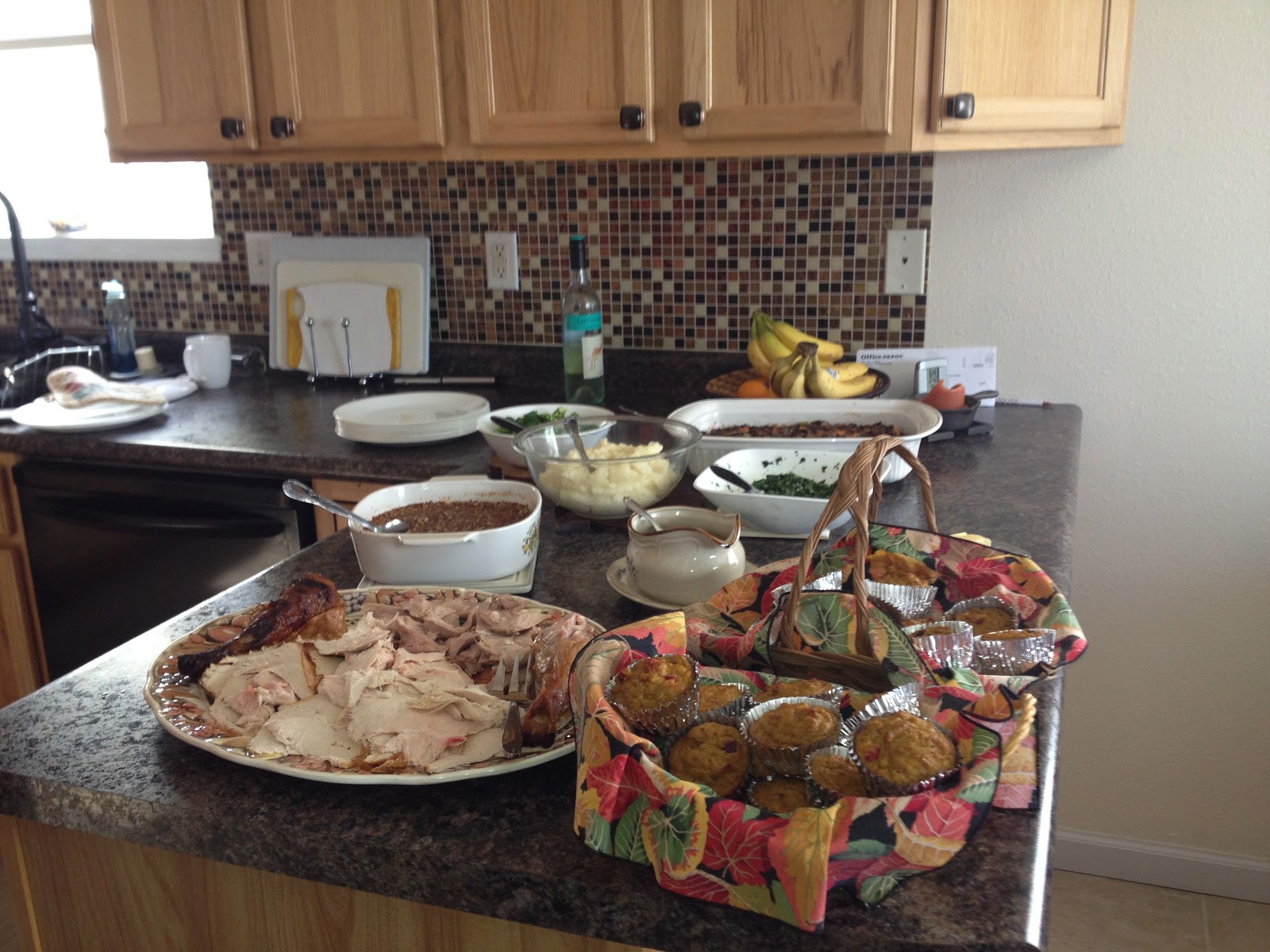


Thoughts for future Thanksgivings or Christmases: we're heading for simpler. Less food (I think I've given up on stuffing or dressing - Cindi and I are about the only ones who eat it; and four pies for 8 people just because each kid has a different "favorite must have"? Um, no. Now we've got pies sitting around the house that no one will eat - think they'll end up next door. Dave has a sweet tooth.). Two tables for cards instead of 8 people playing a single game to speed things along (the Turkey effect was well underway before we came close to finishing).


21 November 2012
Because Jamie asked..
...Thanksgiving menu at the Weedon household this year:
Breakfast: choice of ham/egg/cheese muffins and cheese cake muffins
Matins at Church (have to be there by 8:15 to practice with choir) for the spiritual repast - service at 9
Appetizers after Church:
Smoked salmon, almond thins, brie and sundry other cheeses
Main Meal:
Trader Joe's Turkey, paleo stuffing (sweet taters, apples, celery, onion, bacon, sausage, cranberries, pecans and assorted other goodies), mashed taters, gravy, creamed spinach, broccoli, cranberry almond muffins or pumpkin muffins (she's still debating about that), sweet potato soufflé
Dessert:
None paleo: Pecan pie, cherry pie, chocolate pie; Paleo: pumpkin pie in walnut crust
Of course, coffee, tea, wine served generously throughout!
And the greatest treat of all? Jo will be joining us! She's been in the rehab facility since her surgery back at beginning of October. Looks like she'll only be there for another week and then home for good, but she's even gonna try to make church tomorrow and then here for the feast.
Much for which to thank the Giver of all good!
Breakfast: choice of ham/egg/cheese muffins and cheese cake muffins
Matins at Church (have to be there by 8:15 to practice with choir) for the spiritual repast - service at 9
Appetizers after Church:
Smoked salmon, almond thins, brie and sundry other cheeses
Main Meal:
Trader Joe's Turkey, paleo stuffing (sweet taters, apples, celery, onion, bacon, sausage, cranberries, pecans and assorted other goodies), mashed taters, gravy, creamed spinach, broccoli, cranberry almond muffins or pumpkin muffins (she's still debating about that), sweet potato soufflé
Dessert:
None paleo: Pecan pie, cherry pie, chocolate pie; Paleo: pumpkin pie in walnut crust
Of course, coffee, tea, wine served generously throughout!
And the greatest treat of all? Jo will be joining us! She's been in the rehab facility since her surgery back at beginning of October. Looks like she'll only be there for another week and then home for good, but she's even gonna try to make church tomorrow and then here for the feast.
Much for which to thank the Giver of all good!
20 November 2012
You know
why I like day 20 in the evening? It brings Psalm 104. I think that has to be one of the greatest of the psalms. "May the glory of the Lord endure forever; may the Lord rejoice in His works...I will sing to the Lord as long as I live; I will sing praise to my God while I have being." Psalm 104:31,33
18 November 2012


17 November 2012
This totally cracks me up...

That happens to be the exact way his granddaddy AND his mother sleep. Heredity...
Saturday This-N-That
Last evening Cindi, Bek and I headed over to meet Dave at Jo's rehab facility and enjoyed a game of Liverpool. Slept in a tad this morning, and then got to Facetime with Sawyer and Lauren. We made some pancakes and sausage for breakfast. Cindi cut my hair, and then she and Dave set to work on finishing the shelves in the basement. I think they came out great:
Meanwhile I fixed Bekah's toilet paper holder; swept and mopped in the kitchen; vacuumed; polished brass candlesticks and box (only once a year, and I don't think I did it last year!);
emptied and cleaned curio, then put stuff back in it; Bekah dusted for us and cleaned up her bathroom.
Went to pick up car after oil change, and then worked on computer stuff (finally caved for the convenience of iTune's Match in the Cloud). Cindi threw together a fabulous soup (kale, spinach, asparagus, garlic, onion, turkey stock, and lots of hot pepper) and then set down to work on the afghan for David and Meaghan which she'd been crocheting and finally finished it.
Now she's off for an evening of bowling, Bek is baby-sitting and spending night with a friend, and I'm sitting here with the hound dog and the cat by the fire with a glass of wine. Treasury has brought us to the promises in Jeremiah and to the Passion in Matthew; and Walther was the Writing for today and he was brimming with the joy of atonement. Vesper Psalm tonight was 89: "Blessed are the people who know the festal shout!" Right now am listening to Thrivent's recording of 16th century Lutheran Church music - some really fine pieces on that.
 |
| Cindi recreated the shelves that used to be in the parsonage basement! |
Meanwhile I fixed Bekah's toilet paper holder; swept and mopped in the kitchen; vacuumed; polished brass candlesticks and box (only once a year, and I don't think I did it last year!);
 |
| I remember those candlesticks on the organ in the living room of the Old House; cousin Loretta gave Cindi and me the brass box as a wedding gift—another old family piece. |
emptied and cleaned curio, then put stuff back in it; Bekah dusted for us and cleaned up her bathroom.
Went to pick up car after oil change, and then worked on computer stuff (finally caved for the convenience of iTune's Match in the Cloud). Cindi threw together a fabulous soup (kale, spinach, asparagus, garlic, onion, turkey stock, and lots of hot pepper) and then set down to work on the afghan for David and Meaghan which she'd been crocheting and finally finished it.
 |
| Wonder what the NEXT crocheting project will be? |
Now she's off for an evening of bowling, Bek is baby-sitting and spending night with a friend, and I'm sitting here with the hound dog and the cat by the fire with a glass of wine. Treasury has brought us to the promises in Jeremiah and to the Passion in Matthew; and Walther was the Writing for today and he was brimming with the joy of atonement. Vesper Psalm tonight was 89: "Blessed are the people who know the festal shout!" Right now am listening to Thrivent's recording of 16th century Lutheran Church music - some really fine pieces on that.
16 November 2012
Patristic Quote of the Day
What God promises, He Himself performs. He does not promise and another perform, which would no longer be promising, but prophesying. Hence it is "not because of works but because of Him who calls" (Rom. 9:11), lest the result should be their own, not God's, and the reward should be ascribed not to His grace but to their due.—St. Augustine, On the Spirit and the Letter, 1:41
15 November 2012
The BOC reading for today...
...indicated in Treasury includes the following gems:
Such basic rules as these accuse all the saints, "You shall love the Lord your God with all your heart." Likewise "You shall not covet." (Ap. XXVII:25)
[hence the fiction of surplus merit - the saints all confess themselves to be deficient in merit!]
Because God's kingdom is righteousness and life in hearts, perfection is GROWTH in the fear of God, GROWTH in confidence in the mercy promised in Christ, and GROWTH in devotion to one's calling. (Ap. XXVII:27)
[emphasis mine - but was thinking how it again shows a living growth in three directions simultaneously.]
Such basic rules as these accuse all the saints, "You shall love the Lord your God with all your heart." Likewise "You shall not covet." (Ap. XXVII:25)
[hence the fiction of surplus merit - the saints all confess themselves to be deficient in merit!]
Because God's kingdom is righteousness and life in hearts, perfection is GROWTH in the fear of God, GROWTH in confidence in the mercy promised in Christ, and GROWTH in devotion to one's calling. (Ap. XXVII:27)
[emphasis mine - but was thinking how it again shows a living growth in three directions simultaneously.]
Apocrypha Gem
Put on the robe of righteousness from God; put on your head the crown of the glory of the Everlasting.—Baruch 5:2
New Lutheran Quote of the Day
The truly terrible nature of sin, however, becomes evident only when it is seen as rebellion against the good God.—Dr. Henry Hamann, On Being a Christian, p. 32.
Old Lutheran Quote of the Day
Personal honor is a seed of the serpent; when the devil sows it in one's heart, one does not readily notice how destructive it is. However, once the seed is cultivated, nourished, and bears fruit, it reveals itself. For it gives rise to arrogance, envy, contempt, hatred, strife, yea, finally even to willful disobedience. Here we see why the serpent was so intent on luring our first parents into seeking their own honor.—Blessed Johann Gerhard, Postilla II:233.
Patristic Quote of the Day
Truly He died for us, not that we might not die but that we might not die for ourselves. He was spat upon, beaten, and mutilated for us, so that we, who were worthy of all these things because of our sins, might not only suffer them but also, suffering them for the sake of justice, patiently and gracefully accept them. —Origen, Commentary on Matthew 11,3.
13 November 2012
New Lutheran Quote of the Day
Now it is probably true that the words themselves do cause trouble, and that a sentence like "God justifies me" is an unusual one, a sentence often met by blank faces. But I do not believe that the idea itself is unusual or hard to explain. Public figures are continually defending themselves, their words, their actions, when others stand up in condemnation; and the common word for this defense is justify. So also, people are continually seeking justice in courts, pointing out that their actions are right and proper, and that they should be acquitted of all charges against them and declared "not guilty." This is just what justification describes—the one new idea being that God does the acquitting, the justifying. So the difficulty often seen in this terminology seems to me to be greatly exaggerated.—Henry Hamann, On Being a Christian, pp. 26, 27.
Old Lutheran Quote of the Day

Patristic Quote of the Day
Worldly society has flowered from a selfish love which dared to despise even God, whereas the communion of saints is rooted in a love of God that is ready to trample on self. In a word, this latter relies on the Lord, whereas the other boasts that it can get along by itself.—St. Augustine, City of God, XIV:28
12 November 2012
New Lutheran Quote of the Day
So the Christian is one who holds that God is for him/her in every way, in every circumstance, now and in the hereafter. God is no enemy, no tyrant, no unfeeling or hateful God, playing around with human beings, treating them with indifference or contempt, like boys cruelly playing with flies (Shakespeare in King Lear). —Henry Hamann, On Being a Christian, p. 25.
Old Lutheran Quote of the Day
People today generally raise their voices against the state because they have to pay taxes. This happens because do not believe that God has said or commanded anything as regards Caesar. They think that what they possess is theirs, even though the Lord says here, Give Caesar what is Caesar's. —Blessed Martin Luther, Church Postils III:149.
Patristic Quote of the Day
So long, then, as the heavenly City is wayfaring on earth, she invites citizens from all nations and all tongues, and unites them into a single pilgrim band.—St. Augustine, City of God, XIX, chapter 17.
10 November 2012
I've commented before
on the odd pleasure derived from crossing things off to do lists. While the one at work at the moment is rather formidable, the home list has become rather tame. Little chores attended to today that I could cross off the list include fix the door frame of the master bedroom closet; bring furniture from deck to basement; clean fireplace and caulk a couple spots that needed touch up; bring some wood from wood pile into the garage ready for use; bring the hoses into the garage (hoping that they won't freeze in there). It's a nice warm "Indian summer" day and the perfect sort of day to attend to any last minute outside chores as we prepare for the arrival of old man winter. Now kicking back with a cup of wickedly strong Irish Breakfast Tea and then getting ready to preach up at Zion, Staunton.
07 November 2012
Enjoying a most stimulating
Lutheran Free Conference at the lovely campus of Martin Luther College in New Ulm, Minnesota. Things chasing around my mind at present, provoked directly or indirectly by presentations:
Is canon law best understood as the description of the way that the People of the New Age order their lives in the Old Age toward the reality of the New?
Some speakers have made a distinction between grace perfecting nature and grace liberating nature. I'm not sure I see the difference, for surely nature's perfection is found in her liberation from the bondage of sin/death/decay?
I really appreciated Paulson's presentation - it opened up vistas that I've not yet worked my way through. It will take some time. I did LOVE his take on the rejection of the AC's confession just leaving everyone under the law. More later on that.
Enjoy some pics of the interior of the Chapel of the Christ:


Is canon law best understood as the description of the way that the People of the New Age order their lives in the Old Age toward the reality of the New?
Some speakers have made a distinction between grace perfecting nature and grace liberating nature. I'm not sure I see the difference, for surely nature's perfection is found in her liberation from the bondage of sin/death/decay?
I really appreciated Paulson's presentation - it opened up vistas that I've not yet worked my way through. It will take some time. I did LOVE his take on the rejection of the AC's confession just leaving everyone under the law. More later on that.
Enjoy some pics of the interior of the Chapel of the Christ:


Do you notice how everything about that building confesses? It does. And it gets the confession just right: truly an orthodox space that proclaims the orthodox faith of the Christian community in the Lamb of God who takes away the world's sin! As I said to Pr. Schroeder, I think it leaves behind the silliness of some of the 60's-70's architecture while picking up from it the very best (light, space, gathering) and by a return to truly classic art produces a thoroughly contemporary space that is rooted in the ageless light that streams into this fallen world through the means of grace. VERY well done.
05 November 2012
A Homily for Commemoration of the Faithful Departed
Blessed are those who mourn, for they shall be comforted. - Matthew 5:4
A tale of two sorrows, people loved by God.
Charlie was my friend – we played racquetball together; he sang in the choir and he literally bounced along in the joy of the Lord each day. The call came a few days before Christmas. It was a Saturday night. One of my members was driving the ambulance and said: You better get to the hospital; this one’s not gonna have a good ending. Despite valiant efforts by the ER team, my member was right. Charlie, my bouncing, laughing, singing beer drinking buddy Charlie, was gone. By the time I’d broken the word to his children and his wife, and we’d prayed and cried together, it was wee hours of the morning. I got home and snatched a troubled couple hours of sleep and then headed over for 7:45 service. I walked at out the ringing of the bell and just about lost it. There they were, sitting in Church. His wife, his kids, and all looking sad, but peaceful. I told them afterwards I couldn’t believe they were there. They said: “But it was communion; we wanted to be with dad today.”
Charlie’s funeral kept up the same blend of tears and joy. We sang to defy death. The choir belted out the Hallelujah chorus with not a dry eye in the house. One of Charlie’s rather unsavory business associates from Chicago was there. He literally looked at me as he walked out and said: “I don’t get it. It’s like you guys are happy or something.” With laughter and tears streaming down our faces, we assured him we were.
The death of a Christian can be a celebration of unspeakable comfort and joy even here and now. That was Charlie.
Then there’s Joe. Joe was my brother. We were kindred spirits in so many ways, but he was 11 years older. I think I idolized him more than little bit. Cindi and I were awaken by one of those dreaded early morning phone calls on Palm Sunday when I was serving as a vicar in Garfield NJ. My mom. She told me that my brother had died in a car wreck early that morning. It was Palm Sunday and I was preaching on the OT: “Rejoice, daughter of Zion! Your king is coming to you!” It was a sermon all about joy.
I was so empty inside. You see, the very last conversation I’d had with my brother I had tried to witness to him, but he told me: “Billy, I don’t have time for that…stuff.” (Okay, he didn't really say stuff). I have no assurance whatsoever that my brother ever changed his mind about that.
I remember sitting outside our bedroom in the vicarage and pondering, really pondering for the first time: wouldn’t I rather be with my brother in hell if that's where he ended up than without him in heaven? Maybe the words of Jesus sank in: “Whoever comes to me and does not hate father, mother, sister, brother…” Not hate in the sense of “harbor bitter resentment towards.” Hate in the sense of preferring Him to them. But did I?
The death of someone we love about whom we have little hope of them dying in the faith, it brings to the Christian a kind of mourning and grief that words can’t begin to cover. You know, everything inside of me WANTS to be a universalist. I want to believe that there’s no way that everyone won’t finally be overcome by the great love that we have known in Jesus. But you know the Scriptures as well as I do. You know that’s not the way it will be.
Dreary thoughts for an All Saints Day celebration, Chaplain? No. I’m sure that for most of the folks on our commemoration list, it’s a Charlie-like feast. He always called All Saints “the little easter in the fall.” Loved it. And loved singing that “For all the saints!” It’s a joy indeed. But I want to be honest and realistic. I suspect everyone in this room has those loved one who have died, about whom doubts and fears linger. Did they die in the faith? Did they die trusting in the One who is the Forgiveness of Sin and the Destruction of death? And what if they didn’t? Is there a comfort big enough for that? Because we love them. And death doesn’t diminish the love. Comfort? Really?
I don’t know how, but I do believe that the answer is yes. Jesus, the Blessed One, speaks the promise in today’s Gospel: “Blessed are those who mourn, for they shall be comforted.” He didn’t say: “Blessed are those who mourn for believers”; just “those who mourn.” And like all the beatitudes but the first and the last, He puts that which will bless you out into the future, into the Age that is to come. “WILL BE comforted.”
I don’t know how. But I know He never lies. He will reach out a nail-scarred hand. He will touch you, and He will wipe away the tears, and somehow, someway that ragged hole in your heart will be healed. I can’t even imagine how it will be possible when you think of those who are missing, but you will experience it nonetheless. And I don't believe for one second that it will be by making you forget them or your love for them. For He who bore your sins and theirs on His cross did so because He loved them even as He loves you. And He who rose from the dead, rose for them even as He rose for you. This is the confidence you have in Him: that in Him every last child of Adam and daughter of Eve has been loved with a love immeasurable, vast, divine. Whatever healing awaits us is perfect love in a way that we cannot now begin to conceive; but this All Saints we wait for it in hope.
Blessed are those who mourn, for they shall be comforted. You shall be comforted. For the Charlies of your life, and also for the Joes. With man such comfort is impossible; but not with God. With God all things are possible. For God is love. Amen.
New Lutheran Quote of the Day
Heterodox churches are churches and sects at the same time. They are churches insofar as they still retain such essentials of the Gospel and sacraments as will allow people to be converted and become children of God. But heterodox churches are also sects insofar as they deviate from the evangelical truth and so divide the church and by their errors threaten the faith of Christians.—Prof. Kurt Marquart, The Church, p. 69.
Old Lutheran Quote of the Day
God has so inextricably joined together the love of Him and of one's neighbor that the bond of love for one's neighbor may not be separated without also separating the bond of love for God.—Blessed Johann Gerhard, Postilla II, p. 224.
Patristic Quote of the Day
The Holy Scriptures teach us that there are two feasts of the Lord: one to which the good and evil come, the other to which the evil cannot come. The first feast, of which we have just now heard in the Gospel that was being read has both good and evil guests. Those who excused themselves from this feast are evil, but not all those who came in are good. You, therefore, who are the good guests at this feast I address. You are taking careful notice of the words, "Anyone who eats and drinks without discerning the body eats and drinks judgment on himself." I am addressing all who do this, so that you do not look for good outside the Church and so that you bear with the evil within her.—St. Augustine, Sermons on the New Testament Lessons, 90:1.
Whirlwind Week
Had a great time at the International Conference for Confessional Lutheranism. Truly one of the greatest things was hearing the same confession of faith come tripping out of tongues from literally all ends of the earth. Glory to God!
Attending to worship matters complicated by my own native inability to sit still left me missing some of the presentations, but the ones that I was able to attend to were all quite outstanding.
Moments that stick in the mind: the beautiful singing and music leadership of our music team and the joyous Reformation fest at Faith Lutheran Church with President Harrison's strong Gospel proclamation from Romans 3... how many times the speakers hearkened back to the calling of Abraham as foundational for mission... Our emphasis upon the "Means of grace" as true Lutheran treasure... Although he did not use these words, McGrath seemed to suggest that Luther's theological approach was essentially iconic: where all things are viewed in and out from the image of the Cross of our Lord... The joys of hearing the Our Father and the Apostles Creed prayed and confessed in so many tongues... A lot more, but that gives a bit of flavor for the event. I was truly blessed to be able to attend and serve as Chaplain.
Attending to worship matters complicated by my own native inability to sit still left me missing some of the presentations, but the ones that I was able to attend to were all quite outstanding.
Moments that stick in the mind: the beautiful singing and music leadership of our music team and the joyous Reformation fest at Faith Lutheran Church with President Harrison's strong Gospel proclamation from Romans 3... how many times the speakers hearkened back to the calling of Abraham as foundational for mission... Our emphasis upon the "Means of grace" as true Lutheran treasure... Although he did not use these words, McGrath seemed to suggest that Luther's theological approach was essentially iconic: where all things are viewed in and out from the image of the Cross of our Lord... The joys of hearing the Our Father and the Apostles Creed prayed and confessed in so many tongues... A lot more, but that gives a bit of flavor for the event. I was truly blessed to be able to attend and serve as Chaplain.
02 November 2012
Subscribe to:
Posts (Atom)